July Newsletter: Cinematic Places, Tuscan Light and Idlewild


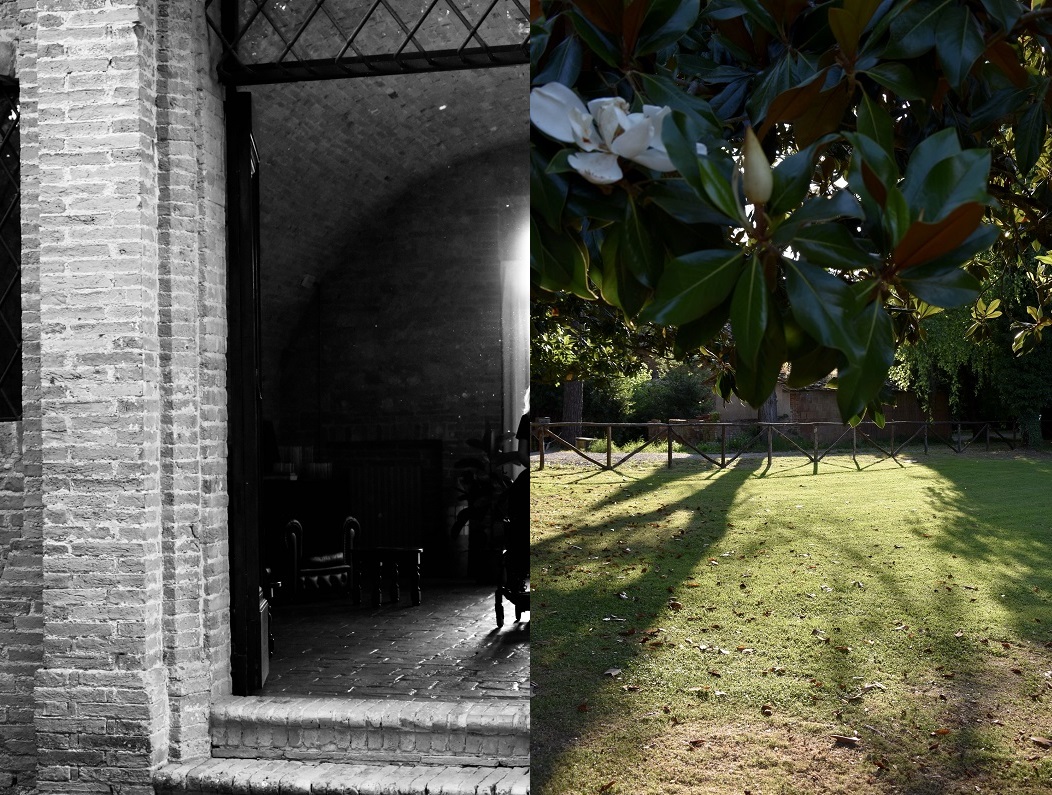
Photos: Classiq Journal


“Siena was so varied and consistent, so small
and inexhaustible, that it seemed during those days to be
endless. It was not only an allegory or a state of mind,
but the self as city, modest and particular yet never totally
knowable, for it was a constantly moving target, changing
with every passing influence and unfolding day.”

Hisham Matar, A Month in Siena


Viewing

The Remains of the Day, 1993
James Ivory

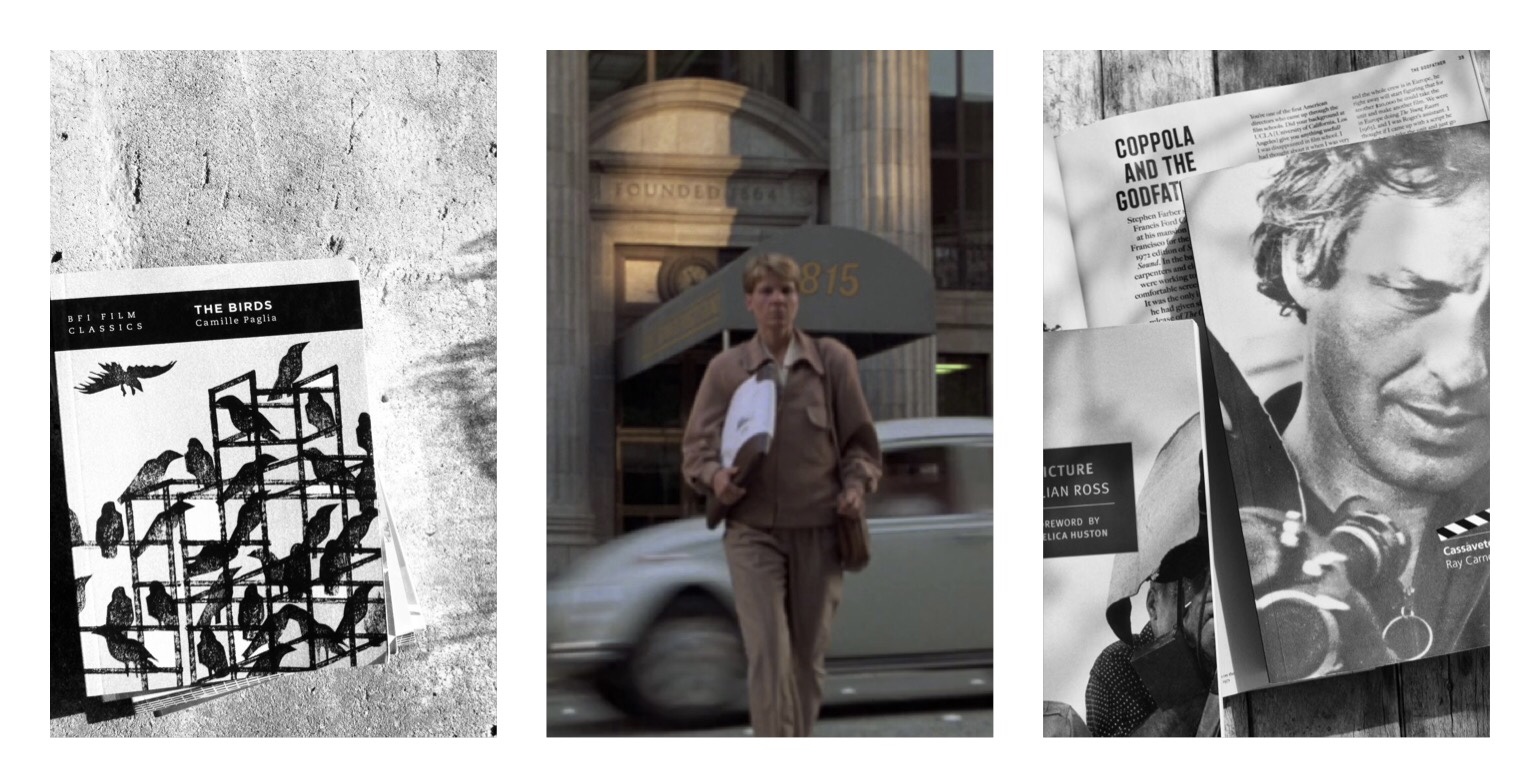
It’s wonderful to watch a film that says so much in so many other ways than words, in quiet, secretive moments that can escape you if you don’t pay full attention. It’s also a window into a world in itself: of decades past, of class, of a society that often valued tradition more than personal feelings. Mr. Stevens (Anthony Hopkins) is the head butler for Lord Darlington, an aristocrat who sponsors controversial international conferences at his estate at Darlington Hall and plays host to world’s leaders while holding a sympathy for Germany before World War II. Miss Kenton (Emma Thompson) is the housekeeper. Mr Stevens has dedicated his life to serving and seems to be oblivious to everything taking place in the house, most of all his own personal feelings. His only aim is to devote himself completely to his job. The most exquisite scene in The Remains of the Day is when Miss Kenton enters Mr. Stevens’ dimly lit room to bring him fresh flowers from the garden and surprises him reading a book. She asks him what he is reading. He hides the cover and refuses to answer. “What’s the book?,” she starts pursuing him. “Why won’t you tell me?,” she keeps asking, cornering him, and finally snatching the book to discover it’s “only” a romantic book. But that holds all the secrets and feelings that Stevens doesn’t express. And that moment is also the moment Miss Kenton reveals her own feelings, but only with the infliction in her voice and the look in her eye. This scene – the way it is filmed, lit, set, every tone in the voice, every body movement – is the key to the whole film. And if you are able to understand what is happening, if you can, for a moment, put yourself in the place of the two characters, it’s a shattering experience.


Bad Day at Black Rock, 1955
John Sturges

I watched this one after I read an interview with Robert Yeoman, Wes Anderson’s long-time cinematographer, who cited John Sturges’ film as inspiration for his camera work on Asteroid City, challenging himself to shoot in the middle of the day as opposed to his usual approach, filming at the beginning or at the end of the day, when the light is a little lower. As an outsider, I myself particularly like the golden hour, both in photography and cinematography, and found his new take on shooting intriguing. From the time John J. Macreedy gets off the train in the small desert town of Black Rock, you are on the edge of your seat. It may be Spencer Tracy’s best performance, and there is a whole wonderful cast in the film as well, but the most mysterious character is the expansive landscape bathed in that bearing sun that Robert Yeoman used as inspiration. “A very easy picture, shot in 23 days,” director John Sturges revealed in an interview with Elwy Yost. “We had a beautiful script, it was all there. We built the town, and the sun, which was one way in the morning, another way in the afternoon, it would take five minutes to light scenes and everything was take one. I think there were no more than twenty scenes overall more than take one. With that cast…”


The Raiders of the Lost Ark, 1981
Steven Spielberg

Before catching the new Indiana Jones in cinema, I wanted to watch Raiders of the Lost Ark again. Forty-two years ago this summer, Indiana Jones took the world on his first and greatest adventure on screen. To this day, the film imagined by Steven Spielberg and George Lucas has remained, for many, the quintessential adventure movie. An exercise in pure cinematic style, Raiders of the Lost Ark has every bit of action held together by an irresistible mixture of boyish spirit and a romance with classic cinema. Drawn from forgotten Saturday matinee serials of the 30s, comics, and Howard Hawks films, Steven Spielberg created the kind of adventure he would have loved as a kid. Throughout his career, Hawks, too, had wanted “to merge his fictional ideals with his real life, a boy’s fantasy being played out every day”, as Todd McCarthy analyses in his book, Howard Hawks: The Grey Fox of Hollywood, something he always sought for in his adventure films. And what Spielberg did with Indiana Jones was hold the visual reins and create a world that the audience did not know or only dreamed of and thrust them into it and into a feeling of adventure and fantasy. The legend still looms large.


Reading

“Relentless gusts off the inky sea, lashing rain, a shore that’s fringed with razor-sharp rocks. But also flower-flecked meadows, pine-backed sand, sunshine and wild strawberries. The island is both. A barren beauty. Harsh yet soft; dark yet light. A place of two faces, impossible to pull apart…
Persona (meaning ‘mask’ in Latin) is writer-director Ingmar Bergman’s minimalist masterpiece, and one of the most striking cinematic probes into the fractured human mind.”
Sarah Baxter’s Cinematic Places takes you behind the scenes, to the real locations of films such as Lawrence of Arabia, Persona, La dolce vita, Lost in Translation, Do the Right Thing, Thelma & Louise, and many more. It’s a fine melding of film and place and it’s truly transporting.


I have re-read A Month in Siena as a travel companion to the region this summer. You get lost reading it. In art, in thoughts, in a sense of place. Following the publication of his Pulitzer-prize winner The Return, his book about his return to post-Gaddafi Libya, to try to find out what happened to his father, who had been kidnapped and taken to prison there twenty-two years before, writer Hisham Matar decided to spend a month in Siena following his life-long interest in and love for the Sienese art. The book is not just about art, it is about humanity, and people, it’s writing about art from a very personal perspective, it’s writing about art with humanity.


In the latest printed issue of Little White Lies, largely dedicated to Wes Anderson and his Asteroid City, cinematographer Robert Yeoman explains how he embraced the power of the midday sun to channel the hot, hot heat of Asteroid City.


On the radar: Jessica Lange: An Adventurer’s Heart and Mon petite Truffe, ma grande Scottie, a collection of Helen Scott – American publicist, translator and François Truffaut’s collaborator on his book on Hitchcock – and Truffaut’s letters edited by Serge Toubiana, published earlier this year.


Listening

The album: The Remote Part, Idlewild


Making

In the Piazza Duomo in San Gimignano, photographer Duccio Nacci has his atelier, La Bottega del Sale, where he sells his black and white and colour photographs printed in his own workshop. It’s not the kind of must-go places listed in the most talked about touristic guides, but the kind of place you stumble upon quite by chance because it has that certain something that meets your eye when you walk by. For me, it was a photograph in black and white in the window that caught my interest, one that was very remote from that Tuscan postcard look we are all too familiar with. It was the image of a shepherd moving his herd down a country road in a cloud of dust, with a lonely cypress tree guarding the path. I stepped inside the shop and before I let myself be drawn in by the photographs carefully laid out, I stood still and observed in awe how the photographer himself was framing a photograph on the spot for a couple. It was both with joy and respect that I finally browsed through his prints. Not without difficulty, I chose the photograph I wanted to take home – a black and white photo of a road lined with cypress trees with the light falling through their branches (image to the right below) – and had it framed and wrapped while we exchanged words. I hoped to return some day, in extra-season, preferably late autumn, when the photographer assured us Toscana is at its best.
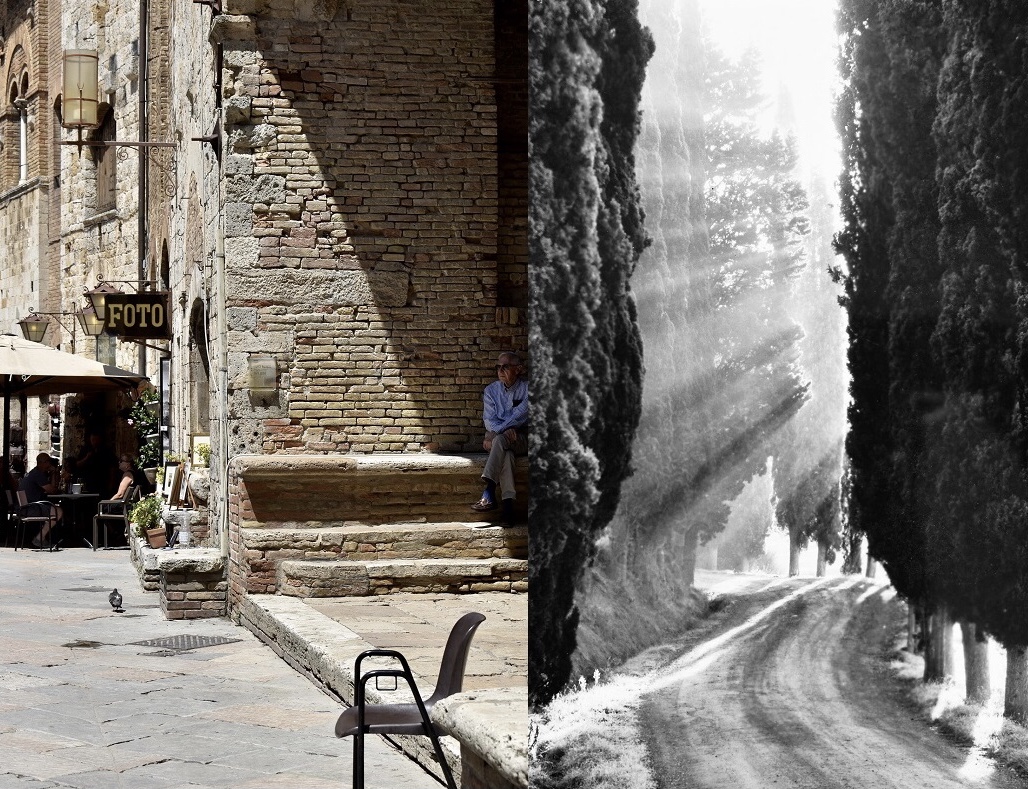
 

Image to the right, photograph by Duccio Nacci


Exploring

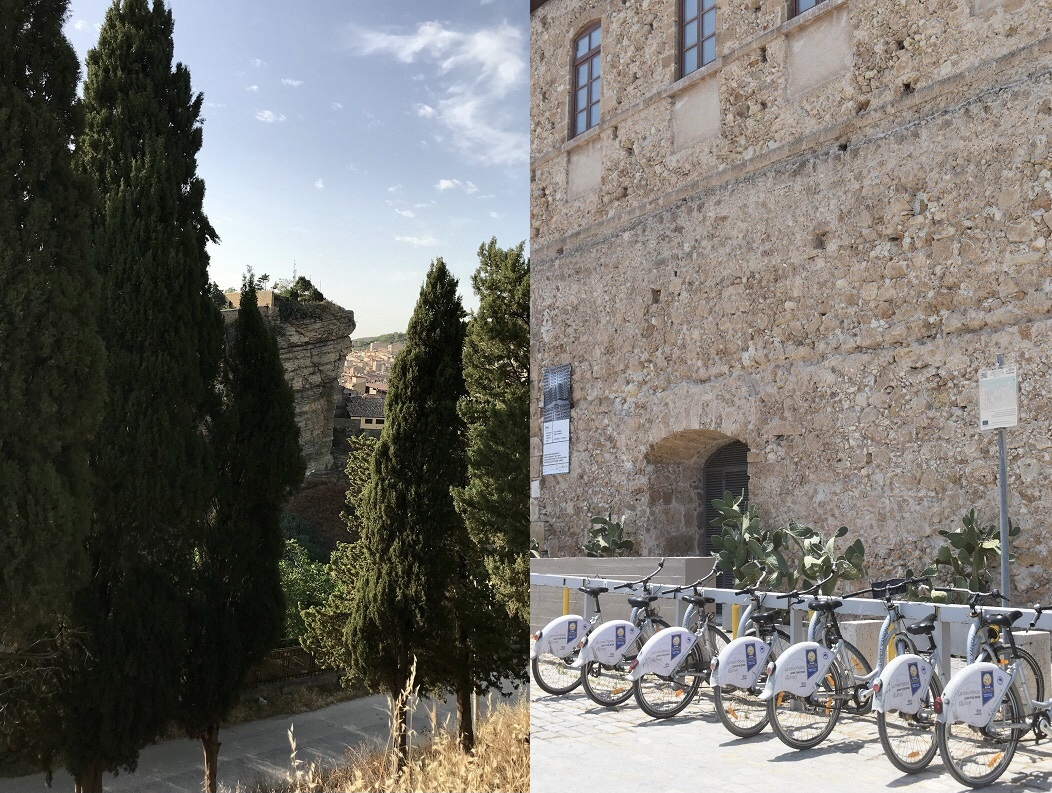
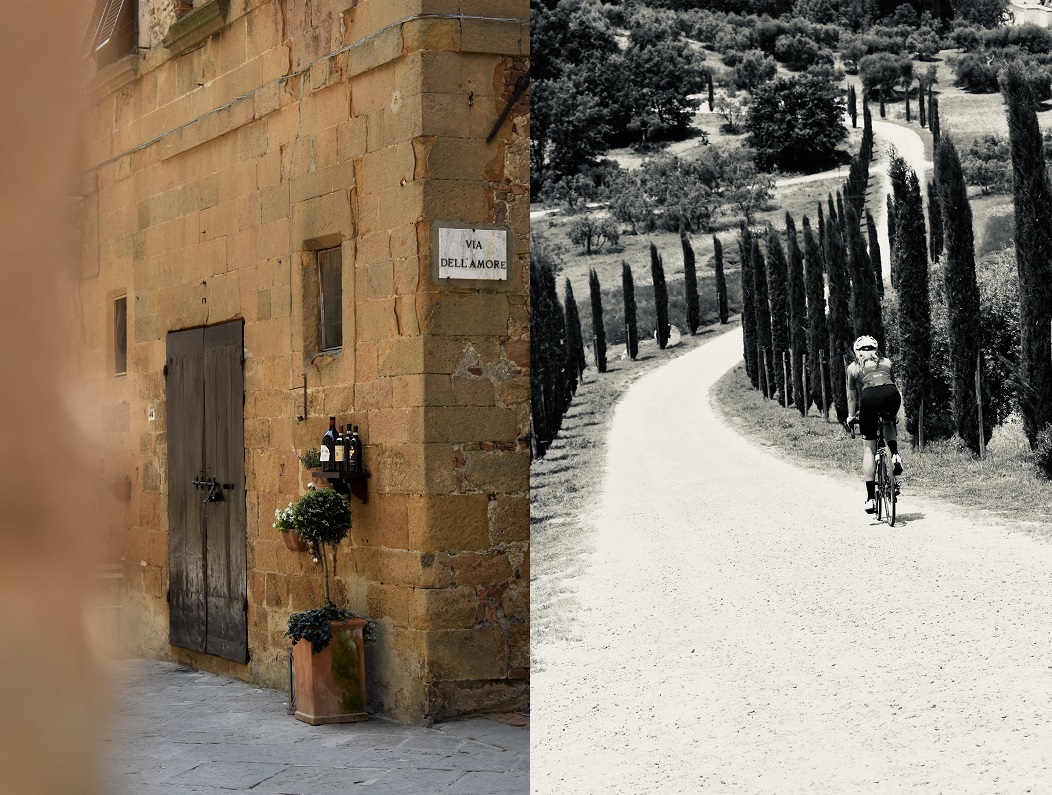
The small towns of Toscana, from the hills of Chianti to Val d’Orcia, with Pienza, San Gimignano and Montereggioni becoming fast favourites. Here is a gathering of spots and experiences that transport me back there: The hour spent in Elizabeth Cochrane’s art gallery in Pienza looking onto the Camminata Panoramica with its breathtaking views of the Tuscan countryside, talking, admiring her works and listening to 80s music. Eating the best ice cream at Gelateria Dondoli in San Gimignano. Strolling the small, charming, beautifully contained Montereggioni at dusk. Spending a few hours in the shade during the scorching afternoon hours at a family-owned winery in Val d’Orcia. Walking around at dawn trying to catch the fog above the rolling hills. The warm welcome and stay ensured by our wonderful hotel host somewhere near Siena – listening to the people on the ground is always the best way to feel and live the reality of a place. Not wanting to leave from a small paper shop in Siena, where the owner only spoke Italian. Siena… although not among the smaller towns, I fully embraced and loved it. We returned to it a few times during our stay, but would love to re-discover it in her more quiet moments.


The regulars: The interviews, newsletters and podcasts I turn to every week and/or every month because they are that good. Craig Mod’s newsletters: Roden and Ridgeline. Soundtracking, with Edith Bowman. Alicia Kennedy’s newsletter. Gone to Timbuktu, Sophy Robert’s podcast on the art of travel. Wachstumsversuche, with Sarah Schill. Sirene, Racquet, and Yolo Journal, all in print.

Posted by classiq in Books, Culture, Film, Newsletter, Photography | | Comments Off on July Newsletter: Cinematic Places, Tuscan Light and Idlewild

This Summer We’re Channelling: Alain Delon in “Plein soleil”

Alain Delon in “Plein soleil”, 1960. Robert et Raymond Hakim, Paris Film, Paritalia


René Clément was the first to adapt Patricia Highsmith’s book The Talented Mr Ripley for the big screen. And he made it his own. Titled Plein soleil, his gripping thriller focusing on the cruel, but cool Tom Ripley (Alain Delon), who ingeniously and skillfully finds ways to further his finances and lifestyle by taking the identity of another man, is much more subtle in portraying the darkness of the character than Anthony Minghella’s The Talented Mr Ripley. And by choosing Alain Delon for the role, who embodies a stylish and handsome anti-hero, he even succeeds in getting the audience to identify with him.

Plein soleil is a visually beautiful film – Highsmith described it as “very beautiful to the eye and interesting for the intellect” – and its style recalls to mind Hitchcok’s works. Clément himself was a technician, who had trained as an architect and made his debut in cinema as a cameraman, and when you watch the film you can observe all these influences on each frame. In fact, he was named the French Alfred Hitchcock after he made this film. Henri Decaë’s exquisite cinematography and the sun-drenched mise-en-scène (the picture was shot entirely on location, in Rome, Naples and the vicinity islands) sharply contrasts the themes of envy, deceit and murder. One other fascinating thing about it is that it is an unusual noir: instead urban settings and somber colours, all is bright and in the open, bathed in Mediterranean colours, inviting the viewer in. And this is also the reason why I prefer the French title: Plein soleil. The English translation, Purple Noon, is misfortunate, because it fails to capture that very inescapable dark feeling despite the sunlit and idyllic settings.


Alain Delon in “Plein soleil”, 1960. Robert et Raymond Hakim, Paris Film, Paritalia


Alain Delon, in his first major part, plays Tom Ripley to perfection – even Patricia Highsmith agreed. The role of Tom Ripley was initially meant for Jacques Charrier, but Delon fought with the producers and the director to get the role. He also had Bella, Clément’s wife and the film’s costume designer, on his side and he eventually got to play Ripley. With his arresting good looks and animal instinct, he bursts on screen and makes a more sinister Ripley than Matt Damon would succeed to in Anthony Minghella’s film. We don’t need dialogue to be made aware of the character’s darting intelligence. This is in itself a great cinematic achievement, something that, yet again, reminds me of Hitchcock. “Movies are made of very simple ideas,” David Mamet, another Hitchcock disciple, wrote in his book, On Directing Film. “The good actor will perform each small piece as completely and as simply as possible.” Delon manages to portray a complex character without many words. And it was a very complex character to interpret, according to Clément himself: “Does criminal innocence exist? Delon must, in the crime, preserve this purity which cannot be judged, because it stems from a psychology which escapes us by escaping the norm of humanity.” Throughout his career, Delon would push “the negation of his own mythology inside a film that respects the rules of the genre,” Jacques Deray, who made nine films with the actor, would reveal.


Alain Delon in “Plein soleil”, 1960. Robert et Raymond Hakim, Paris Film, Paritalia


The young man was entrusted by Herbert Greenleaf, an American ship magnate, to bring his rich and idle playboy home. Philippe (Dickie is Philippe in Clément’s film) is basking in the sun on the Italian shores with his girlfriend, Marge (Marie Laforêt). Tom becomes fascinated by Philippe and his way of life. He succeeds in introducing himself into the intimacy of the couple and eventually the situation turns tragic. Maurice Ronet plays Philippe Greenleaf and, as opposed to The Talented Mr Ripley, where the differences of style, class and appearance were much more obvious between Jude Law’s Dickie and Matt Damon’s Tom Ripley and there was much emphasis on the costumes, in Plein soleil Tom and Philippe are more alike in looks (with Delon’s costumes much more pared down compared to those of Damon so decisively enunciated), both physically and in the way they dress. The devil is in the details though, revealing the differences in class and wealth between the characters. This subtlety makes it more challenging for the viewer. Both characters are clothes-conscious, to the point of being cool in their looks and manners, yet we are able to distinguish between Tom and Philippe by those clothes in an understated yet significant way. We therefore are able to notice Tom’s mutability of identity by the way he dresses and the interest he takes in fixing his identity through appearance. But he does it in a very instinctual way.

Tom wears his clothes more conventionally – for example, light blue shirt with the collar unbuttoned and tucked into his belted trousers. Philippe’s style of dressing is more casual, relaxed and fashionable – a loose, unbuttoned, soft-textured, brown suede jacket revealing his bare chest, fluid trousers rolled up to the calf, hinting at his leisurely, la dolce vita lifestyle as he travels through Europe, having fun being his only purpose. Clothes for him are just a way to express his status, whereas Ripley is trying to alter his identity through them – he is an impersonator who pre-meditates a crime.


Alain Delon in “Plein soleil”, 1960. Robert et Raymond Hakim, Paris Film, Paritalia


Philippe is intentionally portrayed as snobbish and less attractive than Tom. Therefore it is Delon who, from his first outfit of a light blue oxford button-down shirt, off-white jeans and brown suede horsebit loafers, embodies masculine effortless elegance – appreciating the classic codes of dress, but with a relaxed, even rebellious feel. Let’s stay a while on the two grey suits he wears at different moments in the story. He wears a belt with the first, the shirt and trousers are slim-cut, the jacket thrown casually over the shoulder, the loafers are dark coloured. When he takes Philippe’s place, he dresses in his clothes. The grey suit becomes looser in tailoring, the shirt is more relaxed in shape, he loses the belt and he switches to white loafers. The conventional grey suit takes on a different identity, leisurely and much more idle. The masquerade is complete. And we believe it. That’s a good story.


MORE STORIES

The searing style of Jacques Deray’s “La piscine”

The Mosquito Coast: Interview with costume designer Justine Seymour

Revisiting North by Northwest and its costumes

Posted by classiq in Film, Film costume, This summer we’re channelling | | Comments Off on This Summer We’re Channelling: Alain Delon in “Plein soleil”

Read Instead…in Print


“The task of any artist is not to learn many, many techniques
but to learn the most simple technique perfectly.
In doing so, Stanislavsky told us, the difficult
will become easy and the easy habitual,
so that the habitual may become beautiful.”


Read instead…in print #25


House of Games marked David Mamet’s directorial debut, and what a debut that was! He had already earned his reputation as a playwright (winning the Pulitzer Prize in 1984 for Glengary Glenn Ross) and screenwriter (The Verdict, The Untouchables). Mamet has a distinctive, pragmatic style of dialogue, dubbed “Mamet Speak”: poignantly stylised, cynical, abrupt, reminding of film noir dialogue. The film does have that overall neo-noir feel. But it’s not the dialogue that makes the film. It’s the question you keep asking yourself: what’s going to happen next, what is she (Lindsay Crouse as Margaret Ford, a successful psychologist who falls into the traps of a con artist) looking for, how far is she willing to go? You can’t tell that from her acting either. Because her outfits are mannish, her words are enunciated with cold, distant, crisp precision; her presence is uptight and cautious; her sculpted face never crumples. And you keep guessing. That’s just beautiful filmmaking.


“Movies are made of very simple ideas.
The good actor will perform each small piece
as completely and as simple as possible.”


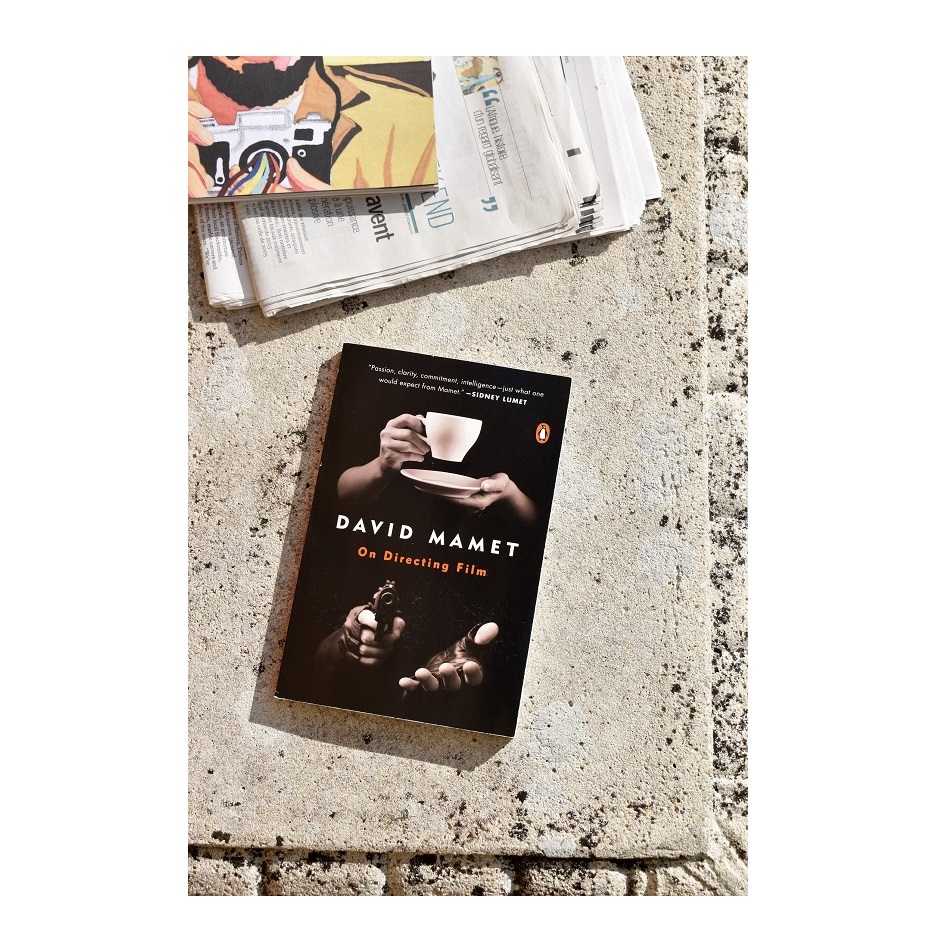
That’s exactly what makes good filmmaking. As David Mamet says in his book, On Directing Film, “you don’t have to narrate with the dialogue any more than you have to narrate with the pictures or the acting. The less you narrate, the more the audience is going to say, ‘wow. What the heck is going on here? What the heck is going to happen next…?” The book is just like his films: precise, direct, it shows you how to tell a story. Keep it simple and master your technique.


“Hitchcock denigrated American films, saying they were all
‘pictures of people talking’ – as, indeed, most of them are.”


Read instead… in print is about a good book about cinema or filmmakers. No discursive, pretentious analyses, no verbose scrutiny. Because the idea is to invite you to read the book, not read about it here. But instead of using social media, I use my journal. Back to basics. Take it as a wish to break free of over-reliance on social media (even if it’s just for posting a photo of a good book) for presenting my work, cultural finds and interests. These are things to be enjoyed as stand-alone pieces in a more substantial and meaningful way than showing them in the black hole of Instagram thronged with an audience with a short attention span. This is also a look through my voluminous collection of books about film that I use as research in my adamant decision to rely less and less on the online and more on more on print materials.


MORE STORIES

Read instead…in print #4: The Birds, by Camille Paglia

Crisp precision: Lindsay Crouse in “House of Games”

Read instead…in print #14: Cassavetes on Cassavetes

Posted by classiq in Books, Film, Read instead...in print | | Comments Off on Read Instead…in Print

June Newsletter: Badlands, Belle and Sebastian, and the Gift to Be Simple


Photos: Classiq Journal


“ ‘tis a gift to be simple
‘tis a gift to be free,
‘tis a gift to come down to
where you ought to be.”

Shaker Dance Song, by Joseph Brackett


Viewing

Badlands, 1973
Terrence Malick

“I’d been a part of making a nearly perfect movie,” Sissy Spacek recounts in her autobiography, “and if I never did another film again, it would be okay, because it was enough to have done Badlands. Terry Malick went on to direct a succession of brilliant, complex films, from Days of Heaven to The Tree of Life, always with Jack by his side as production designer. But nothing has ever really matched the magic of discovery we all felt that summer in the Colorado desert, when we learned how a film could be a living, breathing, collaborative work of art.”

Badlands (1973) was Terrence Malick’s astounding first feature film, a cinematic free verse, a visually lyrical ballad loosely based on the actual case of Charles Starkweather and Caril Ann Fugate, teenage lovers, who went on a killing spree in Nebraska in the late 1950s. Badlands introduced us to the unique talent of Terrence Malick and to many of the distinctive elements in his movies: the poetic approach to narrative and character, the shooting in natural light, the innovative editing, the use of voice-over, the collision of human suffering or violence with natural beauty – it is the director’s particular film-making style that makes a story that has been told many times, of two lovers who are criminals and are pursued across America, an original. A film that is the result of a brilliant mind, of a free mind.

At 50, Badlands is timeless and still timely. I have written about it at large here.


Jurassic Park, 1993
Steven Spielberg

For a couple of years my son had a passion for dinosaurs, he dreamt, drew and breathed dinosaurs, and the whole family became experts in the Latin names of dinosaurs and Jurassic Park became one of our go-to family movies. That age has dawned now, but we wanted to celebrate it along with the film’s 30th anniversary, so we watched it again a few days ago. We still love it, we still marvel at all that inception idea (and at Michael Crichton’s ingenious mind), we still fear the velociraptor more than the t-Rex (“Clever girl!”), we still think it looks very real, we still got carried away by John Williams’ music, we still believe they should have stuck to just this one film, and I thank Steven Spielberg for learning so well from Hitchcock. “The public is avid for everything that touches the imagination…as long as it remains credible.” – Steven Spielberg


Apocalypse Now, 1979
Francis Ford Coppola

There are some films that I intentionally saved watching. Apocalypse Now was one of them. And I am glad. Glad that after so many films watched, it still surprised me, especially visually speaking. And the special effects had nothing to do with it. David Mamet’s words come to mind: “This is good filmmaking, to juxtapose images. Now you’re following the story.”


Reading

Jean M. Twenge’s iGen: Why Today’s Super-Connected Kids Are Growing Up Less Rebellious, More Tolerant, Less Happy – and Completely Unprepared for Adulthood. There is so much truth and worry in this phrase that it was all it took for me to buy the book, without having read anything about it before. We owe it to ourselves and to our children to read it, know the facts, be shocked by the reality and try to find the solution.


Listening


Needle Drops. Rico Gagliano talks with veteran music supervisors behind some of the most culture-defining movie needle drops of the last 40 years.


The album: The Life Pursuit, Belle and Sebastian


Making

The most beautifully designed notebooks. Hand-bound, textile-clothed, in the most luscious colour palette. Ink Tales Letterpress.


Exploring

“The Costa Meno isn’t a real place, although we wish it was. Imagine if there was a vacationland where every place to stay was run by a nonna chef and her clever niece who has collected World of Interiors her whole life and doesn’t want to change the furniture of their little inn at all except for ensuring there are good mattresses and bedding. They keep the 1960s tile and all the art from the great-grandparents. All the meals are homemade, and maybe there is a view, maybe not—it doesn’t matter, because it’s just a short walk to the beach, or into town. These are the places that show up on page 248 of Google search—they aren’t in a collection like Small Luxury Hotels (although we were thinking maybe we should start one!), and have zero marketing budget. We know we highlight a lot of fancy places here, but these are the ones we (and we think you) truly crave—the authentic, the charming, the discovery; properties with both heart and soul. And, not to mention, hotels we can truly afford!”

From the latest Yolo Journal newsletter. Yes, this is the kind of travel I like (and the intel we all appreciate). The latest issue of the magazine is out, too.


“Simplicity is the greatest sophistication.”

Leonardo da Vinci


The regulars: The interviews, newsletters and podcasts I turn to every week and/or every month because they are that good. Craig Mod’s newsletters: Roden and Ridgeline. Soundtracking, with Edith Bowman. Alicia Kennedy’s newsletter. Gone to Timbuktu, Sophy Robert’s podcast on the art of travel. Wachstumsversuche, with Sarah Schill. Sirene and Racquet magazines, in print.
 

Posted by classiq in Books, Culture, Film, Newsletter | | Comments Off on June Newsletter: Badlands, Belle and Sebastian, and the Gift to Be Simple

“Make Room for the Child in Us”: Interview with Illustrator Irina Dobrescu

”What’s the Catch about Reading” anthology, Arthur Publishing House, illustrated by Irina Dobrescu


At a recent book fair I relished in seeing so many children pouring over books. Small children spread on the floor, absorbed by picture books, young children roaming between the aisles searching for favourite authors or on the hunt for new favourites. Picture books and children’s books are flourishing. And with that, I hope our children are, too. In fact, readers of all ages enjoy children’s books and it is important to remember that we must keep storytelling alive and aloud, to keep reading to children even after they can read by themselves. So that the magic of the story does not become overwhelmed by the words, so that they keep on dreaming without being compelled by the reality of the words. They must feel they are invited through a door without being told where they are.

Children’s books illustrators are keepers of the imagination and their well of exploring and building imaginative spaces is endless.

A graduate of arts and graphic design, Irina Dobrescu is also a founding member of the Romanian Illustrators Club. She has illustrated world-renowned stories, both contemporary and classic, such as Grimm Brothers’ König Drosselbart, and has had her own book published. Irina’s illustrations seem to bring out a myriad of emotions that are hiding behind a story. Her pictures seem like something you have imagined or dreamed of and didn’t know what to make of it or how to express it all. There is wonder and magic and always a grain of fable hidden somewhere inside.

In our interview, Irina gives an insight into her creative process, sharing her experiences, challenges and doubts, and talks about why it is important to not know everything and to forget what you have learned from time to time, why acyclic and gouache are the medium she prefers at the moment, and why we should all remain children at heart.


”Look Who’s Talking”, Arthur Publishing House, illustrated by Irina Dobrescu


What is your earliest drawing memory?

I remember drawing with my sister – flowers, rabbits, princesses, landscapes with houses with the sun in the corner and a “going to the seaside’ scene, with us in the car. We had a brand new marker set and I remember the great reverence I had for pink and turqoise. This is a good question, as one of the most important things when I start painting now is to “dash it all” and to have the same enthusiasm I had then.

Your work is both captivating and lyrical, and always filled with a sense of whimsy. How have you honed your style of illustration?

Thank you! Well, I had plenty of time to do it, for better or worse, for I attended art schools from 10 to 24 years old, and, before that, I had my grandfather, a painter, in front of my eyes, painting masterfully.

Then, I liked to read, I had plenty of books to read, and plenty of time to read (and, lately, to listen to audiobooks). I consider that, for an illustrator, reading and being able to enter the world of books, may be just as important as drawing.

I also consider it important to be able to “forget what you have learned” periodically and not to get into a routine with what you are doing, and also to be able to discern what your strengths and weaknesses are. Perhaps I overdo the “forget what you’ve learned” stuff, as I am unarticulated and ignorant in most situations and contexts. But, then again, this inability to communicate only spurs my artistic side to express itself: I feel buried alive otherwise.


“I consider it important to be able to
periodically forget what you have learned.”


From my conversations with illustrators I have discovered, for example, that some don’t like drawing people – some because they feel they lack the ability to draw people as they wished they could, some because they feel the readers, especially children, relate more to animal characters. Is there something you avoid drawing?

I try to avoid the colour violet for some unknown reason, also things that are made of plastic, and shapes that are already “chewed” again and again aesthetically (like a Barbie doll, for instance).


”Stardust”, by Neil Gaiman, illustrated by Irina Dobrescu


Could you give us an insight into your working process? What is the unseen evolution of an idea? Because I always feel it is as interesting as the final result.

Talking about the process of my work, I could say there are two situations:
1. When the idea of a book comes to me.
2. When I receive and accept a book written by somebody else to illustrate.

In the first situation, the process of creating my own stories might seem chaotic – especially as I must mix the roles – that of the writer and that of the illustrator, and especially that I am working at almost all the illustrations in a book at the same time (I don’t take each of them one at a time).

From the inside, the logic is this: I have a vision and the feeling that through this story I can live extraordinary sensations, I can fulfill great dreams and wishes, and most of all, satisfy deep emotional and spiritual needs. So I march with all the army and guns that I own in the direction of the target, as dynamically as I can. Towards the end, I start strategising and refining, but at the beginning it is sort of a Lightning War.

In the second situation, I read the text and let it inspire me as much as it can. To this purpose, I convince myself that the story is MINE, that I can take it into my possession as a child takes a game as a present. So I feel I have the freedom to move in the story and enjoy the different kinds of delights it offers: if it is a magical world, hey, anything might happen there, anything I might invent myself; if it has princesses, the little girl in me jubilates and has a lot to say about this; if there are love-stories, all my favourite books of this kind are waking up to life and start sending their perfume. And so I start putting down ides and sketches, noting these ideas and also provoking some for the parts of the story that might not be so very inspiring yet need an illustration (there is always an illustration bank inside my head).

Then I start painting the final paintings, lately trying to use techniques that permit me to “think things along the way” and not to be forced to establish each detail from the very beginning. For instance, in the technique I use at the moment, acrylics and gouache on modeling clay, I can first create a background – a landscape or an interior – and then add the characters, and then erase them easily if I change my mind. Actually, working started resembling more and more to playing with the dolls and puppets from my childhood, and that is almost a therapeutic thing!


Illustration by Irina Dobrescu


You have illustrated many books by other authors, both classic and contemporary stories, including König Drosselbart by Grimm Brothers, as well as your own. Is there any project you are particularly fond of, and why? And what is the biggest challenge when you have to bring new life to a well-known character?

It is hard to name a favourite project, yet maybe my own stories make me the most excited, at the beginning at least. (I was no doubt levitating a few inches from the ground in the first weeks of working at the Poker Player Wolf.)

I do not feel intimidated when creating generic, classical, drawn over and over again characters, as I suppose these characters become classical as they “hit” an archetype inside us, an archetype which maybe we get born with. So the wolf in Little Red Hood, for instance, is and feels very much my own personal old paw/enemy wolf – no matter how well others are or aren’t acquainted with it.


”Everything could and can inspire me.”


What fuels a children’s book writer’s imagination?

Normally, everything could and can inspire me – as long as I have, if I can say so, my soul awaken.

For that to happen, I usually need to help it be awoken, and what helps me most is prayer, going to church, wise thoughts, positive affirmations. But also journaling, romantic walks in nature, reading literature, passionate studies of psychology, philosophy, eastern cultures, ancient cultures, and sometimes, even math. Also, and maybe I should have mentioned this in the beginning, the dear persons around are the most inspirational things in my life.


”Dwarf King”, by Radu Vancu, illustrated by Irina Dobrescu


What was your favourite book as a child, the book that sparked your imagination or spoke to you more than any other?

It’s hard to choose one, I hope I will not cheat if I will name more: Winetou, Cireșarii, Pride and prejudice, The Mystery of the Yellow Room, and all Agatha Christie’s.


How about illustrated books? Anything you remember from your childhood or something you love even now as an adult?

I liked Lívia Rusz’s illustrations (Peter Pan and Wendy was a favourite of mine!) and also Dana Schobel’s.


“Read to them even when they can read by themselves.”


Peter Pan and Wendy was also one of my favourites. How can we inspire children to read more today?

A method, I think, would be to read to them, even when they can read by themselves. And maybe an idea is to help them, with our parental authority, to resist staying on phones or other devices, and give them books instead – also crayons and sketchbooks or maybe a guitar!


König Drosselbart, by Grimm Brothers, illustrated by Irina Dobrescu


What other artists and illustrators have inspired you in your work?

I will name the illustrators Lisbeth Zwerger, Rébecca Dautremer, Joanna Concejo, Wolf Erlbruch. As for artists, Pieter Brueghel, Johannes Vermeer, Hans Holbein, Constantin Brancusi and Paul Klee.


I have to say that I was almost expecting to find Lisbeth Zwerger on your list. There is something in your style of illustration that reminds me of her work. And I am particularly fond of her because she illustrates so many classics, keeping their work alive. I miss the imagination, fantasy and literary language from those books that could literally open minds and worlds. What are your thoughts on this? Is there something missing from today’s children’s books?

Yes, I find Lisbeth Zwerger an extraordinary illustrator, with the secret aesthetic code of the great old masters in her pencil! Her compositions are very intelligent, the atmosphere is strong yet subtle, and her technique is getting more and more attractive (if possible!).
I think indeed the old classical fairytales are full of wisdom and of meaning and that an illustrator should try to get at the bottom of that, and at the bottom of his/her own psyche, while drawing upon them. This would maybe help the readers to find the hidden meaning and the magic of stories.


”Father Brown”, written and illustrated by Irina Dobrescu,
and inspired by a novel by the English novelist G.K. Chesterton


In this time and age, what do you wish people appreciated more?

I think it would be helpful if people would appreciate more nature and the richness and the magic of reality. That that reality is also very well described by their vision of it from when they were children, and from every time when they were happy, in love maybe. That fairytales, or classical love-stories, try to describe the same reality they have around them. I don’t mean it is best to evacuate the adult inside us, only to help him make room (and support!) for the child as well, or for the wild, inspired, in-love teenager inside us.


Thank you, Irina, for this wonderful incursion into a world of play and wonder.


”Satul Nimica Toata”, illustrated by Irina Dobrescu


Website: irina.dobrescu.net


MORE STORIES

“The creativity and curiosity are already there in most of us”:
Interview with artist and illustrator Øyvind Torseter

Making a fictional world feel real: Interview with graphic designer Erica Dorn

Beyond Ernest et Celestine: The Art Gabrielle Vincent:
In conversation with Fondation Monique Martin

Posted by classiq in Art, Books, Children's books, Children’s illustration, Interviews | | Comments Off on “Make Room for the Child in Us”: Interview with Illustrator Irina Dobrescu