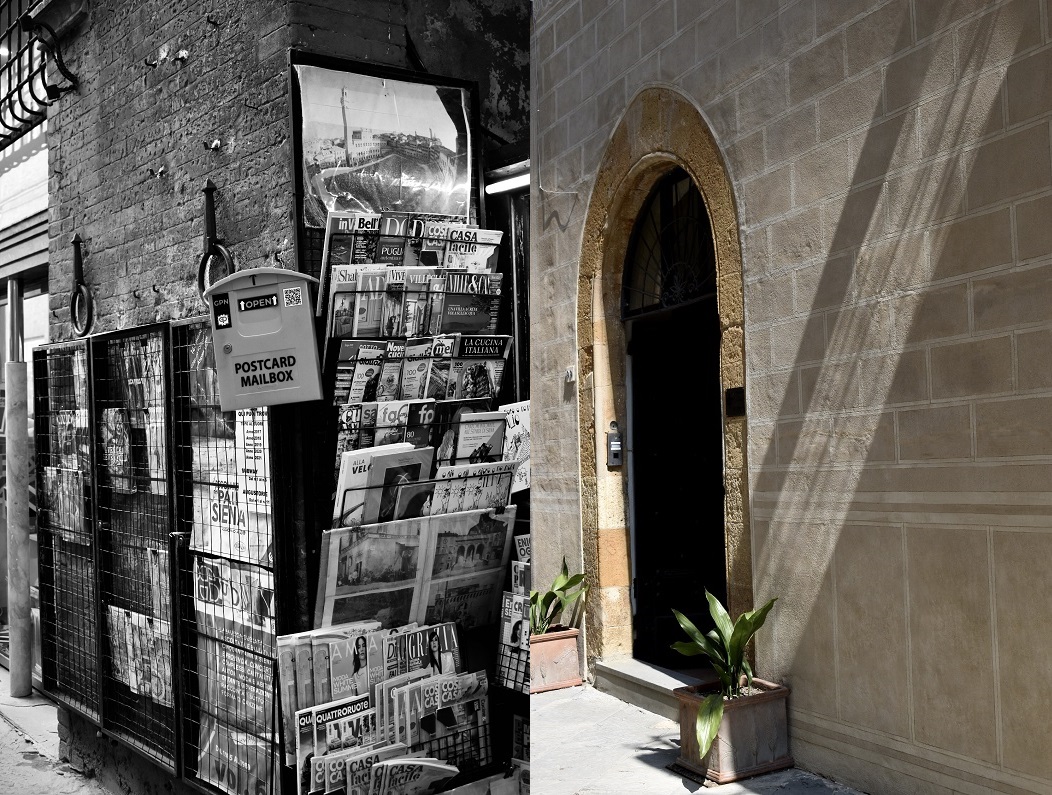
Photos: Classiq Journal
“Siena was so varied and consistent, so small
and inexhaustible, that it seemed during those days to be
endless. It was not only an allegory or a state of mind,
but the self as city, modest and particular yet never totally
knowable, for it was a constantly moving target, changing
with every passing influence and unfolding day.”
Hisham Matar, A Month in Siena
Viewing
The Remains of the Day, 1993
James Ivory
It’s wonderful to watch a film that says so much in so many other ways than words, in quiet, secretive moments that can escape you if you don’t pay full attention. It’s also a window into a world in itself: of decades past, of class, of a society that often valued tradition more than personal feelings. Mr. Stevens (Anthony Hopkins) is the head butler for Lord Darlington, an aristocrat who sponsors controversial international conferences at his estate at Darlington Hall and plays host to world’s leaders while holding a sympathy for Germany before World War II. Miss Kenton (Emma Thompson) is the housekeeper. Mr Stevens has dedicated his life to serving and seems to be oblivious to everything taking place in the house, most of all his own personal feelings. His only aim is to devote himself completely to his job. The most exquisite scene in The Remains of the Day is when Miss Kenton enters Mr. Stevens’ dimly lit room to bring him fresh flowers from the garden and surprises him reading a book. She asks him what he is reading. He hides the cover and refuses to answer. “What’s the book?,” she starts pursuing him. “Why won’t you tell me?,” she keeps asking, cornering him, and finally snatching the book to discover it’s “only” a romantic book. But that holds all the secrets and feelings that Stevens doesn’t express. And that moment is also the moment Miss Kenton reveals her own feelings, but only with the infliction in her voice and the look in her eye. This scene – the way it is filmed, lit, set, every tone in the voice, every body movement – is the key to the whole film. And if you are able to understand what is happening, if you can, for a moment, put yourself in the place of the two characters, it’s a shattering experience.
Bad Day at Black Rock, 1955
John Sturges
I watched this one after I read an interview with Robert Yeoman, Wes Anderson’s long-time cinematographer, who cited John Sturges’ film as inspiration for his camera work on Asteroid City, challenging himself to shoot in the middle of the day as opposed to his usual approach, filming at the beginning or at the end of the day, when the light is a little lower. As an outsider, I myself particularly like the golden hour, both in photography and cinematography, and found his new take on shooting intriguing. From the time John J. Macreedy gets off the train in the small desert town of Black Rock, you are on the edge of your seat. It may be Spencer Tracy’s best performance, and there is a whole wonderful cast in the film as well, but the most mysterious character is the expansive landscape bathed in that bearing sun that Robert Yeoman used as inspiration. “A very easy picture, shot in 23 days,” director John Sturges revealed in an interview with Elwy Yost. “We had a beautiful script, it was all there. We built the town, and the sun, which was one way in the morning, another way in the afternoon, it would take five minutes to light scenes and everything was take one. I think there were no more than twenty scenes overall more than take one. With that cast…”
The Raiders of the Lost Ark, 1981
Steven Spielberg
Before catching the new Indiana Jones in cinema, I wanted to watch Raiders of the Lost Ark again. Forty-two years ago this summer, Indiana Jones took the world on his first and greatest adventure on screen. To this day, the film imagined by Steven Spielberg and George Lucas has remained, for many, the quintessential adventure movie. An exercise in pure cinematic style, Raiders of the Lost Ark has every bit of action held together by an irresistible mixture of boyish spirit and a romance with classic cinema. Drawn from forgotten Saturday matinee serials of the 30s, comics, and Howard Hawks films, Steven Spielberg created the kind of adventure he would have loved as a kid. Throughout his career, Hawks, too, had wanted “to merge his fictional ideals with his real life, a boy’s fantasy being played out every day”, as Todd McCarthy analyses in his book, Howard Hawks: The Grey Fox of Hollywood, something he always sought for in his adventure films. And what Spielberg did with Indiana Jones was hold the visual reins and create a world that the audience did not know or only dreamed of and thrust them into it and into a feeling of adventure and fantasy. The legend still looms large.
Reading
“Relentless gusts off the inky sea, lashing rain, a shore that’s fringed with razor-sharp rocks. But also flower-flecked meadows, pine-backed sand, sunshine and wild strawberries. The island is both. A barren beauty. Harsh yet soft; dark yet light. A place of two faces, impossible to pull apart…
Persona (meaning ‘mask’ in Latin) is writer-director Ingmar Bergman’s minimalist masterpiece, and one of the most striking cinematic probes into the fractured human mind.”
Sarah Baxter’s Cinematic Places takes you behind the scenes, to the real locations of films such as Lawrence of Arabia, Persona, La dolce vita, Lost in Translation, Do the Right Thing, Thelma & Louise, and many more. It’s a fine melding of film and place and it’s truly transporting.
I have re-read A Month in Siena as a travel companion to the region this summer. You get lost reading it. In art, in thoughts, in a sense of place. Following the publication of his Pulitzer-prize winner The Return, his book about his return to post-Gaddafi Libya, to try to find out what happened to his father, who had been kidnapped and taken to prison there twenty-two years before, writer Hisham Matar decided to spend a month in Siena following his life-long interest in and love for the Sienese art. The book is not just about art, it is about humanity, and people, it’s writing about art from a very personal perspective, it’s writing about art with humanity.
In the latest printed issue of Little White Lies, largely dedicated to Wes Anderson and his Asteroid City, cinematographer Robert Yeoman explains how he embraced the power of the midday sun to channel the hot, hot heat of Asteroid City.
On the radar: Jessica Lange: An Adventurer’s Heart and Mon petite Truffe, ma grande Scottie, a collection of Helen Scott – American publicist, translator and François Truffaut’s collaborator on his book on Hitchcock – and Truffaut’s letters edited by Serge Toubiana, published earlier this year.
Listening
The album: The Remote Part, Idlewild
Making
In the Piazza Duomo in San Gimignano, photographer Duccio Nacci has his atelier, La Bottega del Sale, where he sells his black and white and colour photographs printed in his own workshop. It’s not the kind of must-go places listed in the most talked about touristic guides, but the kind of place you stumble upon quite by chance because it has that certain something that meets your eye when you walk by. For me, it was a photograph in black and white in the window that caught my interest, one that was very remote from that Tuscan postcard look we are all too familiar with. It was the image of a shepherd moving his herd down a country road in a cloud of dust, with a lonely cypress tree guarding the path. I stepped inside the shop and before I let myself be drawn in by the photographs carefully laid out, I stood still and observed in awe how the photographer himself was framing a photograph on the spot for a couple. It was both with joy and respect that I finally browsed through his prints. Not without difficulty, I chose the photograph I wanted to take home – a black and white photo of a road lined with cypress trees with the light falling through their branches (image to the right below) – and had it framed and wrapped while we exchanged words. I hoped to return some day, in extra-season, preferably late autumn, when the photographer assured us Toscana is at its best.
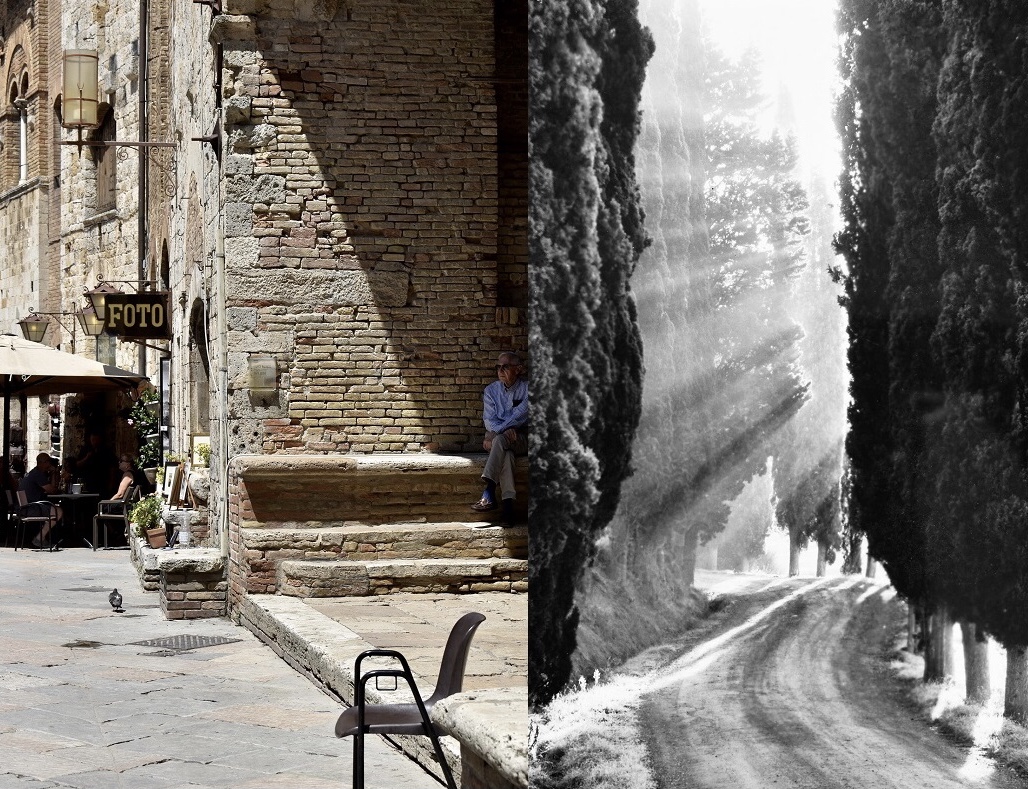
Image to the right, photograph by Duccio Nacci
Exploring
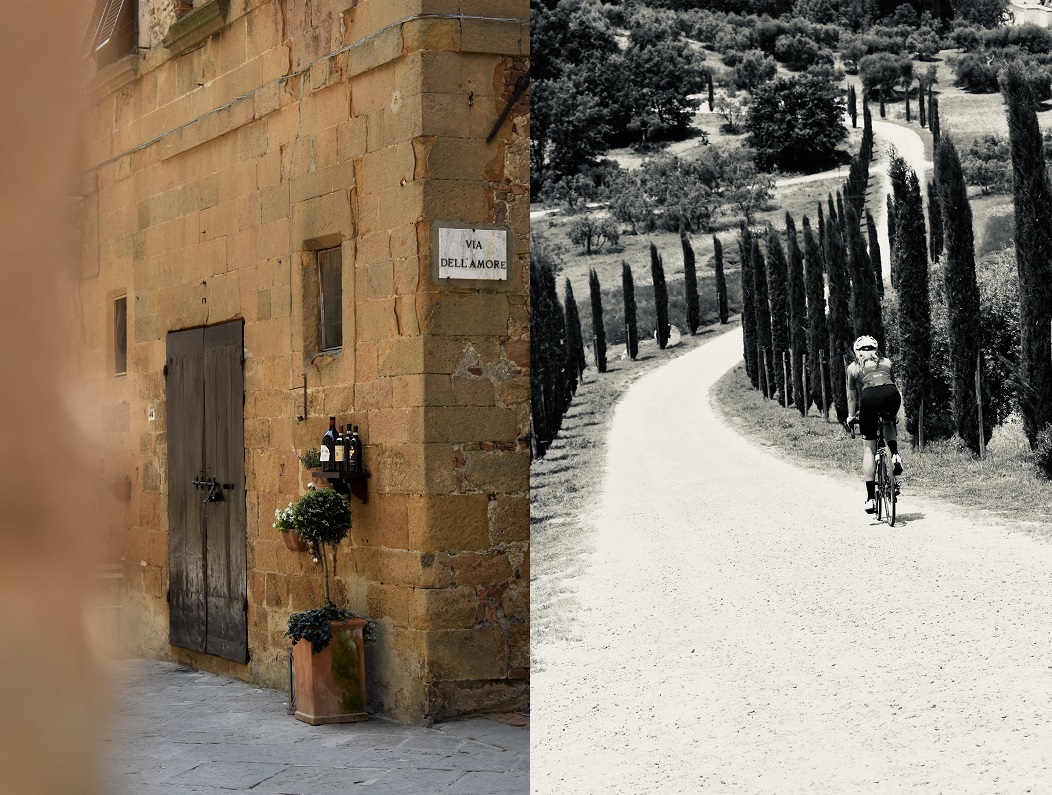
The small towns of Toscana, from the hills of Chianti to Val d’Orcia, with Pienza, San Gimignano and Montereggioni becoming fast favourites. Here is a gathering of spots and experiences that transport me back there: The hour spent in Elizabeth Cochrane’s art gallery in Pienza looking onto the Camminata Panoramica with its breathtaking views of the Tuscan countryside, talking, admiring her works and listening to 80s music. Eating the best ice cream at Gelateria Dondoli in San Gimignano. Strolling the small, charming, beautifully contained Montereggioni at dusk. Spending a few hours in the shade during the scorching afternoon hours at a family-owned winery in Val d’Orcia. Walking around at dawn trying to catch the fog above the rolling hills. The warm welcome and stay ensured by our wonderful hotel host somewhere near Siena – listening to the people on the ground is always the best way to feel and live the reality of a place. Not wanting to leave from a small paper shop in Siena, where the owner only spoke Italian. Siena… although not among the smaller towns, I fully embraced and loved it. We returned to it a few times during our stay, but would love to re-discover it in her more quiet moments.
The regulars: The interviews, newsletters and podcasts I turn to every week and/or every month because they are that good. Craig Mod’s newsletters: Roden and Ridgeline. Soundtracking, with Edith Bowman. Alicia Kennedy’s newsletter. Gone to Timbuktu, Sophy Robert’s podcast on the art of travel. Wachstumsversuche, with Sarah Schill. Sirene, Racquet, and Yolo Journal, all in print.


