Editorial: Just A Girl

Editorial - Just A Girl - Laurence Olivier Marilyn Monroe - Joe Eula 

The Editorial: thoughts, short stories
or essays about the world of cinema


Joe Eula is a bit of an unsung hero of the 20th century fashion illustration. He had a sharp eye in capturing the essence of whatever he was drawing in simple and spare lines, without going into great detail. Considering his remarkable output, he is barely acknowledged in surveys alongside Eric, René Bouché, Tom Keogh, and Antonio Lopez. I tend to pay special attention to this kind of artists, because there are not few times when this demonstrates their devotion to an uncompromising vision, regardless of any kind of pressure or influence they may be subjected to, and we have become a little short of these values these days. He showed the same integrity and no-nonsense approach to all his famous friends and people, from artists, to musicians and actors, he worked with his entire life.

He did not give much importance to his encounter with Marilyn Monroe either. “To the best of my knowledge, no [other] fashion illustrator ever sat and drew Marilyn Monroe. It’s on a really torn piece of paper. It’s her and Olivier,” says David Downton in the book Joe Eula: Master of the Twentieth Century Fashion Illustration, by Cathy Horyn. Eula drew the actress in 1957, during the filming of The Prince and the Showgirl in England. I think Marilyn liked being treated just like the girl next door for a change. Remember her in jeans?

photo: Joe Eula illustration of Marilyn Monroe and Laurence Olivier

Posted by classiq in Art, Editorial | | Comments Off on Editorial: Just A Girl

When Noir Meets Colour

I should start by saying that I will always prefer black and white movies and that black and white cinematography is one of the most beautiful forms of art. This is especially true with noir films – films that are characterised by sharply delineated chiaroscuro photography, but which are not that easily definable as they appear. I do believe that plot, themes, attitude and characterization are the most essential noir features, which is why as soon as you watch Leave Her to Heaven or Chinatown, you automatically define them as noir films. Today I am revisiting four favourite noirs shot in colour. There is much more than what meets the eye behind voluptuous colours or the sparkling blue of the Tyrrhenian Sea.
 
Leave Her to Heaven 
Leave Her to Heaven (1946)

Despite the dark plot, there is much luscious beauty in Leave Her to Heaven, the quintessential noir in colour. Cinematographer Leon Shamroy’s masterful use of colour, brightly lit and edged with somber hues and shadows, makes each image pure pleasure for the eye and has the same impact as the black and white that defines Hollywood film noir. The photography mirrors tempestuous Ellen (Gene Tierney), whose extreme beauty highlights her psychotic streaks and changes. Tierney’s angelic beauty and unblinking cruelty are a daunting combination. Tierney dominates every scene she is in, both physically and emotionally. The boat scene is one of the most perturbing sequences in the history of Hollywood. Gene Tierney’s face is like a perfect composure, reinforced by the beautiful, peaceful setting. At her darkest, she seems at peace, and this makes her character one of the most cold-blooded femmes fatales in the history of cinema, and provokes a disquieting feeling in the viewer, one that is impossible to forget.
 
Dial M for Murder 
Dial M for Murder (1954)

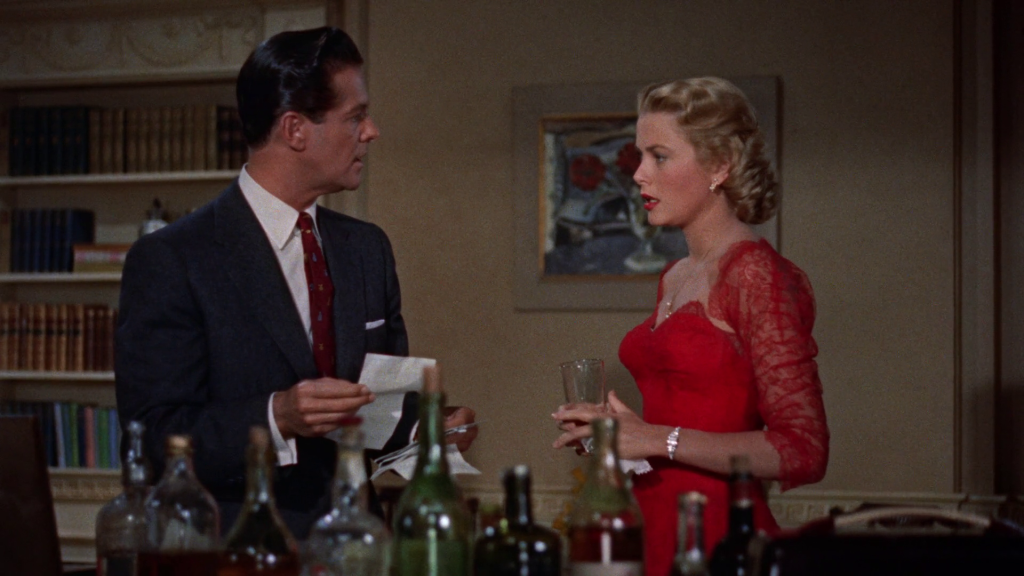
In his first film featuring Grace Kelly, Alfred Hitchcock used all the tricks he had mastered over the years to get the public’s undivided attention, starting with the striking use of colour (this was only his third colour movie). He uses it in an interesting way in terms of costumes: you see Grace in a skirt and cardigan in the palest shade of pink, almost white, in the first scene, having breakfast with her husband, and then in bright red, a few seconds later, with her lover, Mark (Robert Cummings), and the contrast of those two moments, with the two men in her life, is very strong.

The set design is beautiful, every frame is perfect, and the film is altogether beautifully filmed by Robert Burks, Hitchcock’s cinematographer on no less than twelve movies, who masters some of the trickiest shots in Hitchcock’s filmography (the action is mostly confined to one room). But, coloristically speaking, the experiment with Grace Kelly’s costumes is the most striking. Her clothes go from bright to somber as the plot thickens and her innocence starts to be questioned. As opposed to the colour palette of her previous clothes, which brought out the blue in her eyes, the faded colours she wears later on are intelligently used to make her eyes look grey, too, in tune with the grey days coming. Hitch always knew how to guide his audience through the story, and the dialogue played the smallest part in it.
 
Chinatown 1974 
Chinatown (1974)

Roman Polanski said that, in Chinatown, he tried to create that Philip Marlowe atmosphere, which he’d never seen in the movies the way he got it in the books of Dashiell Hammett or Raymond Chandler. Indeed, Chinatown is not only a one of a kind film noir (because this is the feeling you get, that it’s an original noir, not neo-noir, and that’s why it’s included here), but a complete film and one of the best movies of all time. The style of the 1930s, when the story is placed, is conveyed by a “scrupulously reconstruction of decor, costumes, and idiom, not by a deliberate imitation, in 1973, of thirties film techniques”. This is exactly what makes Chinatown fascinating: it evokes the Golden Age of 1930s-1940s Hollywood, without losing itself in nostalgia or turning into another overly stylised version of that era. The look of the film is nothing less than a work of art. I never get tired of those golden tones of the film and that bright, desert light of Los Angeles – John Alonzo’s creative, beautiful cinematography made it look like a classic black and white movie magically transposed to colour. It’s like Los Angeles is a character in itself and is trying to tell the viewer that it will continue to exist, in that punishing light, despite the desert, despite the dark secrets, despite its bleak reality.
 
Plein soleil Alain Delon 
Plein soleil (1960)

Plein soleil is a visually beautiful film – Patricia Highsmith described it as “very beautiful to the eye and interesting for the intellect” – and its style reminds me of Hitchcock’s works. Clément himself was a technician, too, who had trained as an architect and made his debut in cinema as a cameraman, and if you watch the film, you’ll be able to observe all these influences on each frame. In fact, he was named the French Alfred Hitchcock after he made this film. The cinematography, by Henri Decaë, is exquisite and the sun-drenched mise-en-scène (the picture was shot entirely on location, in Rome, Naples and the vicinity islands) sharply contrasts the themes of envy, deceit and murder. What is so fascinating about it is that it is an unusual noir: all is bright and in the open, inviting the viewer in its aesthetic rapture… and into a story of crime and masquerade. In this same regard, I will always prefer the French title: Plein soleil. The English translation, Purple Noon, is misfortunate, because it fails to capture that very inescapable feeling of sun-drenched Mediterranean savoir-vivre, despite the intense dark plot.

Of course, part of the film’s dazzlingly beautiful quality is Alain Delon in the role of Tom Ripley. One memorable sequence is when Delon is strolling through the fish market in Naples. I think he’s at his most charming then, a display of subtlety in portraying the darkness of the character – he embodies a cool, elegant and handsome anti-hero (so different from the other Tom Ripley embodied on screen by Matt Damon, who is driven by complexes and dark instincts), and you almost get to identify with him. Almost. His aimless stroll, linen jacket slung over his shoulder, face basking in the afternoon sun, is extremely revealing of Ripley’s ambiguity. The essence of the entire film and of the character seems to be captured in that seemingly purposeless scene for the plot – that mixture of ravishing beauty and inhumanity.

photos: 1-Leave Her to Heaven (Twentieth Century Fox) / 2-Dial M for Murder (Warner Brothers) / 3-Chinatown (Paramount Pictures) / 4-Plein soleil (Robert et Raymond Hakim, Paris Film, Paritalia)

Posted by classiq in Film | | Comments Off on When Noir Meets Colour

Editorial: The Streets of San Francisco

Editorial-Vertigo-The streets of San Francisco 

The Editorial: thoughts, short stories
or essays about the world of cinema


Sixty years ago this week (on May 9th), Vertigo was released. It is often hailed as the best movie of all time. I may not be of the same opinion, nor is it my favourite Hitchcock film, but I can not deny its grandness and beauty. Vertigo was shot in San Francisco – Northern California is where Alfred Hitchcock found much comfort and an irresistible backdrop for some of his finest films, including Shadow of A Doubt (1943) and The Birds (1963) . With its vertiginous hills, high-reaching buildings and panoramic views, San Francisco is the perfect setting for Vertigo, the city being used to dizzying effect for a story of romantic obsession with the image of a woman.

The film’s use of actual urban locations was still rather rare for that time for a studio movie – as a side note, Vertigo was definitely no studio commercial success. There is no shortage of atmospheric Bay Area locations in Vertigo, but the silent sequences of Scottie’s extended tailing of Madeleine (Kim Novak) in her green car on the streets of San Francisco is where both the beauty of choosing that location and the mastermind of Hitchcock lie. So subtle yet revealing and involving. The camera floats, immersing Scottie (James Stewart), and the viewer along with him, into his chase of wild ghosts and down the road to doomed love. Hitchcock certainly does not rely just on the real geography to make Vertigo‘s San Francisco wholly cinematic. Mr. Hitchcock, after countless viewings, your films hold the same spellbinding effect on me.

photo: movie still | Alfred J Hitchcock Productions

Posted by classiq in Editorial, Film | | Comments Off on Editorial: The Streets of San Francisco

One Day That Summer: Camel Safari, Kenya

This year, I am starting to celebrate my favourite season early – it is my reckoning that some of you will happily join me – and I am bringing back One Day That Summer, the photographer interview series I started last summer. Today’s exclusive story behind the lens is from photographer, screenwriter and director Todd Ritondaro, who is taking us to Africa and a unique experience in Northern Kenya.
 
One Day That Summer - Camel Safari Kenya - Todd Ritondaro 
“This photo is from two summers ago while I was on Camel Safari in Northern Kenya. I had the good fortune of being one of the cameramen on a documentary about elephant poaching in Kenya a few years back and became good friends with the artist and conservationist Alex Beard, who put the whole thing together.

Alex and I went back to do another camel safari, to create art (his painting, my photos) in the bush, which then gets sold to help benefit conservation in Northern Kenya through his organization called The Watering Hole Foundation.

The camel safari is a pretty unique experience. It’s a week camping in a few different spots in the middle of nowhere in Northern Kenya among herds of elephants and all sorts of wildlife. All your senses fire 100 percent and you slip into the natural rhythm of nature. There is nothing else like it.”


@toddritondaro | toddritondaro.com


Related content: Pienza, Tuscany / The Dune, Hossegor / Little Dreamer, Paris

One day that summer - Classiq

Posted by classiq in Journeys, One day that summer, Photography | | Comments Off on One Day That Summer: Camel Safari, Kenya

Life Lessons from Akira Kurosawa

Who can define Akira Kurosawa’s role in the world cinema landscape? His filmography defies categorization. His movies are very complex, both from the point of view of the craftsmanship, visual poetry and passion that went into their making and of the way they managed to preserve the national identity while conveying a universal appeal. He handled with the same ease action themes and humanistic elements, and his Shakespeare adaptations – Ran (1985) after King Lear and Throne of Blood (1957) after Macbeth – are some of the most original in the history of cinema. Starting up as a painter and later becoming a scriptwriter and an assistant director before making his directorial debut with Sanshiro Sugata (1943), Kurosawa was a complete film-maker, one who produced one of the most consistent and impressive bodies of work in the cinematic world.
 
Life Lessons from Akira Kurosawa - Classiq
 
There are many words of wisdom about cinema and life lessons in Akira Kurosawa’s autobiography, Something Like An Autobiography, but the part where he recounts his childhood (he confessed he was a slow child whose intelligence did not bloom until in his third grade of primary school), particularly of the way his father and his art teacher fostered his interest in the arts, sports and school, had a profound effect on me and can serve as guidance for every parent and teacher.


“My father’s attitude toward films reinforced my own inclinations
and encouraged me to become what I am today. He was a
strict man of military background, but at a time when the idea of
watching movies was hardly well received in educators’ circles,
he took his whole family to the movies regularly. Later, in more
reactionary times, he steadfastly maintained his conviction that
going to the movies had an educational value.”


“Another aspect of my father’s thinking that had an important effect on me was his attitude towards sports. After he left the army academy, he took a position at a gymnastics school, where he set up facilities not only for traditional Japanese martial arts such as judo and kendō swordfighting, but for all kinds of athletics. He built Japan’s first swimming pool, and he worked to make baseball popular. He persevered in the promotion of all sports, and his ideas stayed with me.”
 
Akira Kurosawa drawing - Classiq

Drawing by Akira Kurosawa

 
“In the old days – in my day, that is – art education was terribly haphazard. Some tasteless picture would be the model, and it was simply a matter of copying it. The student drawings that most closely resembled the original would get the highest marks.
 

But Mr. Tachikawa did nothing so foolish.
He just said, ‘Draw whatever you like.’


Everyone took out drawing paper and colored pencils and began. I too started to draw – I don’t remember what it was I attempted to draw, but I drew with all my might. I pressed so hard the pencils broke, and then I put saliva on my fingertips and smeared the colors around, eventually ending up with my hands a variety of hues.

When we finished, Mr. Tachikawa took each student’s picture and put it up on the blackboard. He asked the class to express opinions freely on each in turn, and when it came to mine, the only response was raucous laughter. But Mr. Tachikawa turned a stern gaze on the laughing multitude and proceeded to praise my picture to the skies. […] Then he took my picture and put three big concentric circles on it in bright red ink: the highest mark.

From that moment on, even though I still hated school, I somehow found myself hurrying to school in anticipation on the days when we had art classes. That grade of three circles had led me to enjoy drawing pictures. I drew everything. And I became really good at drawing. At the same time my marks in other subjects suddenly began to improve. By the time Mr. Tachikawa left Kuroda, I was the president of my class.”
 
Storyboard for Ran by Akira Kurosawa - Classiq

Storyboard for Ran, drawn by Akira Kurosawa


“In the early Taishō era (1912-1926), when I started school,
the word ‘teacher’ was synonymous with ‘scary person’.
The fact that at such a time I encountered such free and
innovative education with such creative impulse behind it,
I cherish among the rarest blessings.”

 
Akira Kurosawa drawing - Classiq

Drawing by Akira Kurosawa

 
Related content: Life Lessons from John Cassavetes / The Art of Cinema by Jean Cocteau / My Life and My Films by Jean Renoir

Books about film - Classiq

Posted by classiq in Books, Film | | Comments Off on Life Lessons from Akira Kurosawa