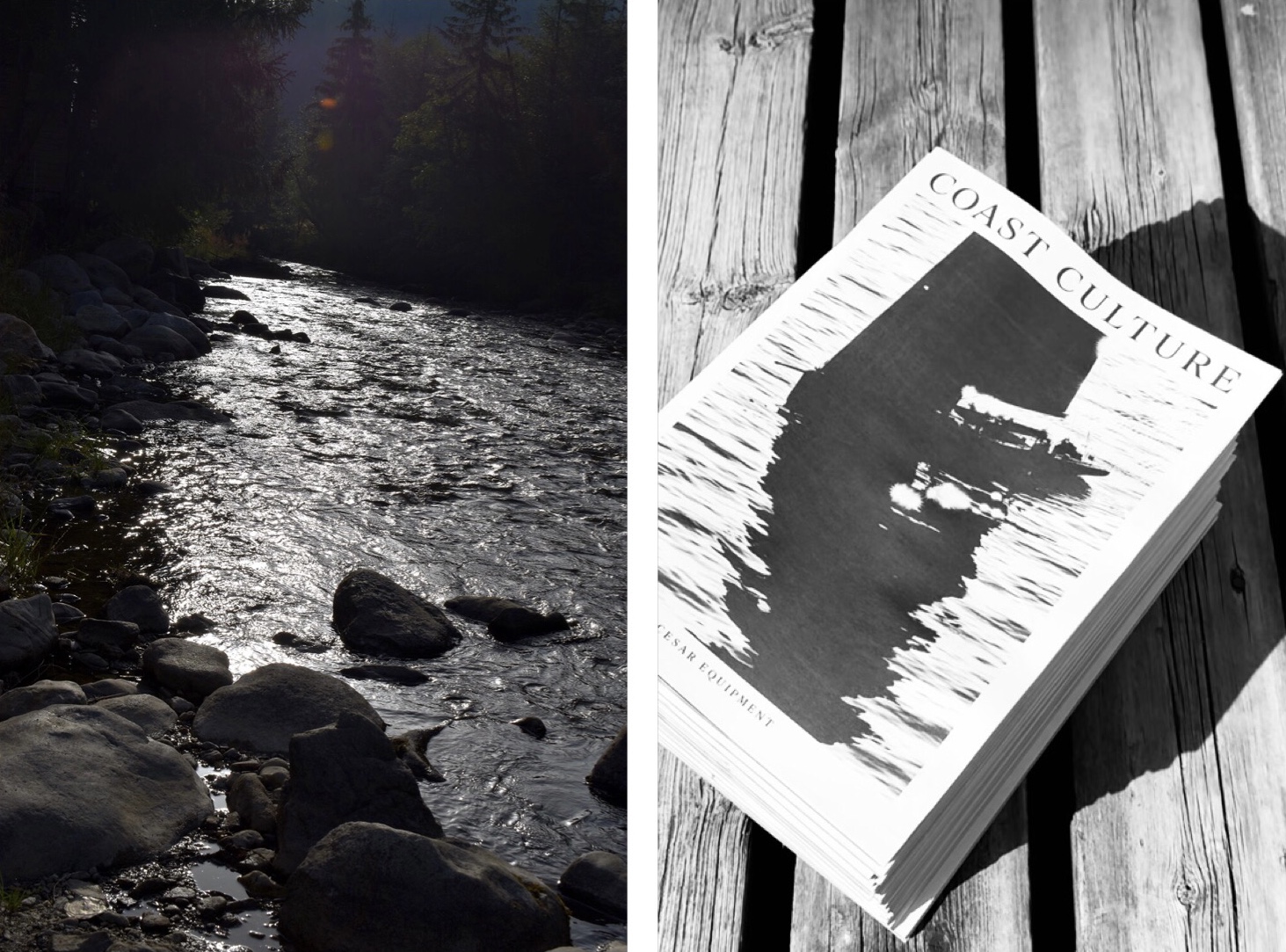
Photos: Classiq Journal (left), Caesar Equipment (right)
“We are shaped by our childhoods, and my childhood
wasn’t about airplane trips. I flew for the first time
when I was 17 years old. I rarely travelled outside Sweden.
My summers were spent in Stockholm and on Koster. The majority
of my childhood memories came from the Koster Island and the sea.”
Artist Petter Alexis Askergren (Coast Culture magazine)
Photos: Classiq Journal
Viewing
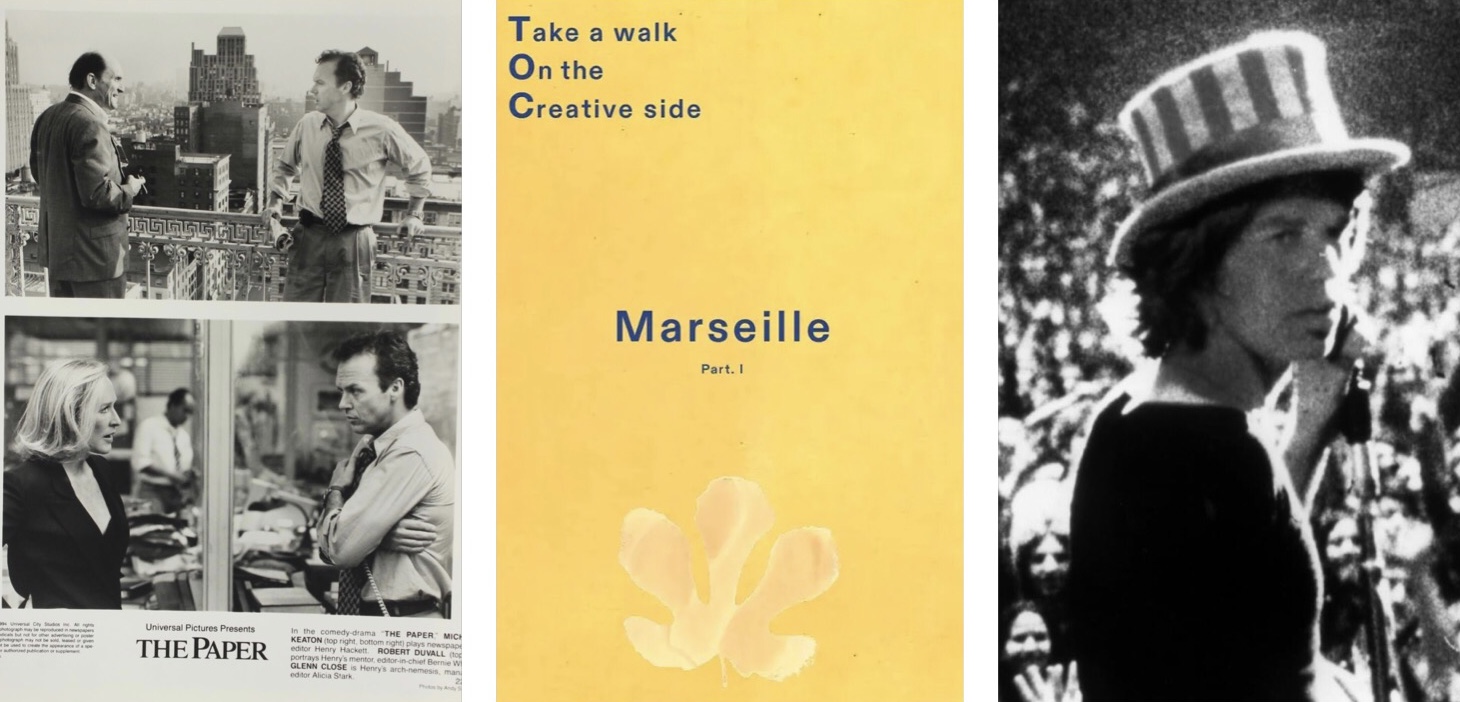
The Paper, 1994
Ron Howard
What’s it like to be a reporter? How is it done? How do they talk, how do they behave, what expressions do they use, how fast do they talk, how fast do they think, how do you get the story right, how do you work against a deadline? What is journalistic integrity? How often does a newspaper follow the unwritten rule to go with a story on hand and the fix it tomorrow? Watching The Paper, you get a lot of these questions answered. It is very authentic. It’s thrilling to see how characters interact, how conversations overlap, how their principles surface, how they compete, and what the job does to their personal lives. Especially Robert Duvall’s. He’s in a supporting role, but by the end of the film you know him better than everyone else. That said, the feeling I had was that all the actors (Michael Keaton, Glenn Close, Marisa Tomei) breathed life into their roles, not through imagination, not through personal experiences, but through real observation, and through their reaction to each other and the circumstances. They’re real.
Tickets, 2005
Ermanno Olmi, Abbas Kiarostami, Ken Loach
It’s Kazuo Ishiguro who inspired me to watch Tickets, with his list of favourite films set aboard trains that he curated for the BFI Southbank earlier this year. Films like Shanghai Express, 1932, The Lady Vanishes, 1936, and Night Train, 1959 (that extraordinary Rear Window-like microcosm of human experiences that I wrote about in this editorial), firm favourites of mine, I was happy to find in his selection, while others were new discoveries, like Tickets. A crowded train that travels through Italy, to Rome, focusing on different characters from episode to episode. Usually, when there are more directors involved in a film, the chapters, individually directed, are explicitly separated from one another (Boccaccio ‘70 comes to mind). Not here. The transition from one chapter to the next is done very smoothly, and although there are elements that define each episode, it’s wonderful to see how this type of film can bind together three different visions in a continuous form.
Gimme Shelter, 1970
Albert Maysles, David Maysles, Charlotte Zwerin
San Francisco, 1969. The Rolling Stones gave a free concert at the Altamont Speedway Park, during their first tour of America. Worried about the security which was practically nonexistent for an overall very poorly planned event, the Stones asked the Hells Angels to keep order for them – there was a crowd of approximately 300 thousand people – but the day ended tragically as drugs broke loose and violence broke out and a fan was killed, something the documentary almost accidentally captured on film. Gimme Shelter begins with the aftermath of what happened and Mick Jagger’s reaction to it in the editing room. It is an extraordinary documentary, certainly one of the best music documentaries ever made, it’s also chilling and terrifying, the way the camera captures the electrifying energy of Mick’s performances, the madness of the crowds and that barbaric event. It’s also an unvarnished portrait of a rock band, a rock band that shook the world and that has always embraced the reputation of bad boys.
Reading
I first came into Sophie Denux’s work through her photography. Her photography is a discreet and elegant guidance into the culture and people of the places she travels to. Not just aesthetically pleasing, but a real representation of them, arising a humanistic feeling. She is after a deeper connection, one that is based on an equal exchange and on the respect for a land’s richness of culture. And the people generally respond by being themselves. Her stories are rooted in traditions of craft and artisanship, past and present, which translate into beautiful, enriching conversations with communities, custom and heritage.
The bi-annual independent magazine created by Sophie Denux, Toc Toc Toc Editions (Travel Observe Create), was born from the desire to share a certain vision of creation, of contemporary craftsmanship and its various players, taking the form of an invitation to discover their world, their living spaces, their workshops, their journeys. A continuum of cultural knowledge and creativity.
With her most recent creative project, she has turned her eyes to the place where she lives, Marseille. The book Take a walk on the creative side: Marseille Part I is like a character map, their stories coming together in the city of Marseille, a character in itself, opening door after door, to artists’ homes and studios, exploring how artists are, how they create, how they live, teaching us life lessons, nurturing our minds and creative sides.
I am very happy that Sophie has trusted me with carrying her book in my shop, where it is currently available.
Listening
The radio: Monocle on Sunday
The soundtrack: Gimme Shelter (1970)
The album: Not Bad for New Jersey, Brian Fallon
Making
In the Mood For…, a different kind of voyage guides, “driven by a love for print, photography and graphic design, as well as a desire to create the kind of books I would have loved to take along on my own travels.” We all document our travels nowadays, as much as some of us, myself included, are trying to resist snapping countless pictures and hoarding them away just because we can (opting for a camera instead of the phone, even if it is digital, will make you think twice before you press the button, will make the action more intentional, will almost feel like a small act of rebellion), but how different would it be if we slowed down, truly observed the place where we are, stroke up a conversation with the local vendor, just walked, not with a digital map in hand but where our wandering eye took us, and record in ink, or at least in typed words, the fleeting thoughts and particular feelings of that moment caught in that very intentional photo you’ve taken, just like an old-school postcard? That’s the kind of thoughtful travel companion In the Mood for… books are.
Exploring
I do love a small film festival with personality. This autumn, Ocean Film Festival Italia is touring Italy, from October 14 to November 12.
On an end note
Booksellers, and antique booksellers in particular, have been raising alarms over rare books being bought and scanned to feed AI models and training programmes, and then destroyed. In August, NPR talked to 404 Media cofounder and reporter Emanuel Maiberg in this interview about a large shipment of rare books that arrived at an Amazon AI training warehouse in the US. Maiberg explained why they target rare books: “The AI models are mostly trained on all the information that they scraped off the entire internet. At the point at which they did that, that content was human-generated. Articles from newspapers, from blogs, scientific articles, just people chatting online. And what AI companies discovered is that – once they scraped all that data and they were looking for more data to make their AI models even better, they tried generating data with AI and then having the AI train on that text.
It turns out that that causes a problem called model collapse, where if an AI trains an AI training data, it gets worse. So now they’re looking for more human-generated text because they already scraped the internet. The next logical step is to scan books that are not easily available online. This is why, at least the books that I’ve seen that end up in these orders, are not popular, common, easy to find books. They’re more rare books.” A rare book means more than a first edition of a classic novel from the 1900s. “A rare book is most likely a book that was never printed in large quantities because it is about a niche subject. It is what is called vanity publishing, where someone self-publishes a book. It’s an instruction manual for a product that’s no longer available. It’s really things like this that people at the moment don’t really care about. They don’t have high emotional value. But we don’t necessarily know what we might find valuable in the future.”
The obvious question to ask, I believe, as an individual, is: How can we fight this? Stay human. Get creative. Live in the real life. And read. Read a lot. Physical books. Read strange writing styles – here is how Craig Mod so eloquently puts it in his brilliant newsletter Roden: “My best response to the ‘horde of agents colonising our brains’ is: Be as weird as possible. Write as strangely as possible. The books I love the most, the ones I come back to again and again, I return to because they’re singular and of a singular voice. That alone makes them odd.”
Read books, magazines, as rare and indie as possible, essays in other languages than English. Learn a new language, if you have to. Read local authors. Buy books and cherish them. Take a detour. Start asking more questions. Stop relying on the Internet. Create a magazine, a paper-only magazine, and make it available to your small community.
Earlier this month, Andreas Åhrman, the co-founder of the brand Caesar Equipment, whom I had the pleasure to interview not long ago, generously sent me a bunch of Coast Culture magazines. It’s a beautiful editorial endeavor exclusively reserved as giveaways to Caesar customers and other selected retailers, hotels and some restaurants. Newspaper paper, large format (the kind that has gauged my interest lately, from various reasons), ad-free and, most importantly, gathering a very select number of stories that seem intentionally crafted to try to reclaim our right to take time over reading a newspaper or magazine and so that the limited collection of thoughtful stories and visual storytelling published can patiently inspire and truly be appreciated. Which is exactly my own philosophy when it comes to this cultural journal that I write, even if it is a digital publication. Maybe this kind of Coast Culture initiative is another answer to fighting the suppression of ideas that is happening and the rise of the AI. The stories written in Coast Culture magazine are about making, keeping and nurturing real connections – between people, between people and nature – about authenticity, about passing on real knowledge and life choices. We must get curious about everything. A simpler life, a broader mind.
Photos: Classiq Journal
The regulars
The interviews, newsletters and podcasts I turn to every week and/or every month because they are that good. Soundtracking, with Edith Bowman. Ruthie’s Table 4 with Ruth Rogers. Fashion Neurosis, with Bella Freud. AccuRadio. Craig Mod’s newsletters: Roden and Ridgeline. Rennae Stubbs tennis podcast. Gone to Timbuktu with Sophy Roberts. Sirene Journal, Racquet, Waves & Woods, Legénde, and Monocle, all in print.