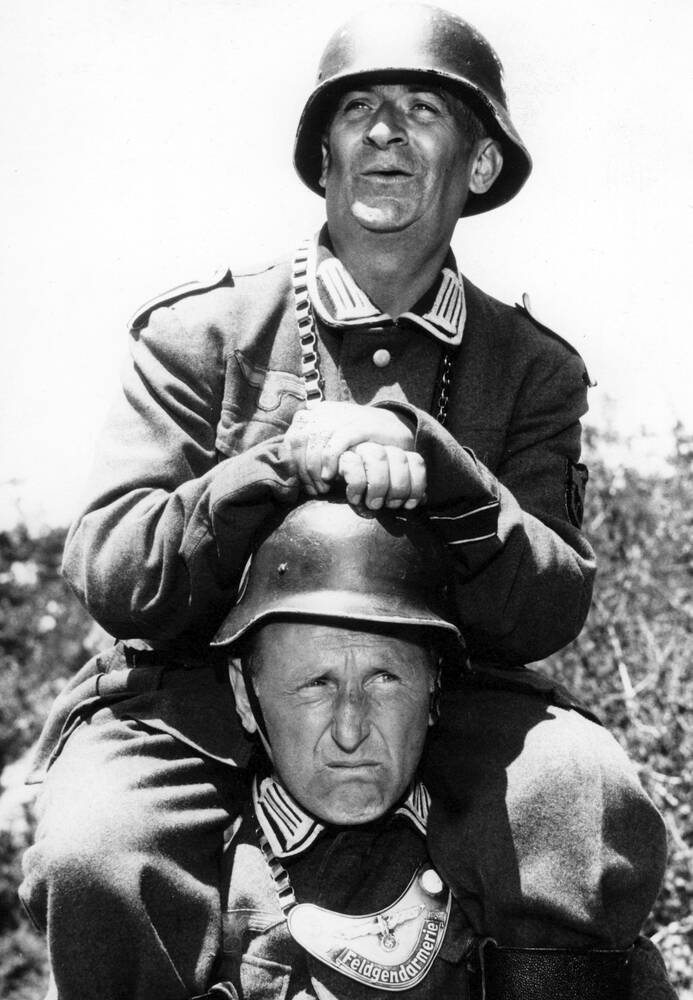
Louis de Funès and Bourvil in “La grande vadrouille”, 1966, directed by Gérard Oury. Les Films Corona, The Rank Organisation
The Editorial: thoughts, short stories
or essays about the world of cinema
It’s 1942. Three Royal Air Force pilots are shot down over Nazi-occupied Paris and land right on the doorsteps of the city’s quirkiest characters, who couldn’t be more different than each other: Bouvet (played by Bourvil), the working class everyday man, and Lefort (Louis de Funès), the eccentric star conductor of the Paris Opera. Against their will, the two Parisians find themselves guiding the three pilots to the Free Zone. A perilous, albeit hilarious, tribulation ensues, and a masterfully crafted one at that.La grande vadrouille (1965), directed by Gérard Oury, was the most successful film of all time in France until it was outtaken by Titanic, in 1997. That says something about the French audience, how seriously they take humour and comedy.
The year before, the same Oury had made La Corniaud, also with Bourvil and Louis de Funès in the lead roles, which was another success for audiences and earned him great reviews from fellow filmmakers, such as François Truffaut and Henri-Georges Clouzot, who both wrote him letters of appreciation, with Clouzot praising the film as the best French film he had seen in ten years. The film revived the French cinema, which hadn’t experienced such success since 1940, not even for films that benefited from successful press campaigns. A classic gangster story, with car chases, plot twists, confrontations and misunderstandings, that takes on a different tone because of Bourvil and de Funès, two of the best comedic actors in the history of cinema.
Gérard Oury was an adventurer of the 20th century, who lived by the motto: “I do what I like in my life.” But he knew that the path to his aim was work. And work he did. “To make a film, it takes me 12-17 months. A film is like a boat you want to use to sail around the world – to embark on a great adventure. You have to design it, build it, launch it and steer it with great care and firmness if you want to reach your destination safely,” the director remarked in an interview for Republique Le Provencal, when the film was released.
In Oury’s opinion, there had never been a crisis in the French cinema, but rather a crisis between certain film producers and the public, a rift that stemmed from years of relying on easy solutions in the realm of cinema. “I have no reason to stop halfway along the new career path that I have set out for myself. My next film, while remaining in the comedy genre, will be different from the first. It will be something like ‘To be or not to be’ that the French faced during the occupation.”
That next film was La grande vadrouille. The filmmaker took comedy seriously, not shying away from expressing mild contempt for “intellectual” directors who were benefitting from huge press coverage. Gérard Oury is as much part of the identity of French cinema as the New Wave. But for Oury, the criterion of success was very simple: “I do not make films for small groups of aesthetes. I think that entertainment as a whole – theatre, cinema, television, radio – needs to address itself to the mainstream. Films that are not made for the public do not interest me.” He made films for the large public, but that doesn’t mean his films were easy entertainment. He showed great admiration for the great Hollywood comedy directors, especially Frank Capra. Regarding them as touchstones for his own film-making, he believed that an important aspect of their appeal lay in their universality. “Humour is not only a defining feature of mankind, but also a mark of international brotherhood much more appealing than tears. Laughter is a collective response that has no frontier, a cultural phenomenon as important as any other.”
La grande vadrouille is fast, and funny. Gérard Oury’s comedies may not have travelled well overseas, to America, not even to Great Britain, but that has nothing to do with how good they are, but with an obtuse way of thinking. Indeed, the humour is more subtle, the beautiful French language more nuanced, the farces realistically funnier. And there are no more different temperaments than Bourvil and Louis de Funès, and maybe that’s exactly why they go so well together. “One practices humour with sensitivity and discretion, the other explodes in gags and ludicrous effects,” the director remarked. And Oury knew exactly how to channel de Funès’s torrent of antics without overplaying him, so nicely balanced at times with Bourvil’s rush of honest feeling. Frankly, there are few things that can lift my spirit as quickly as a Louis de Funès comedy can. Just the sight of his expressive face makes me laugh, without ever falling into stifling amusement. It’s pure relief and joy and childlike abandon to playfulness. It’s fresh and naïve, I laugh without guilt, and I love it for it. The director also took great advantage of the medium, the film camera, relying on action rather than dialogue, seizing the urgency of desperate feats in desperate times. In this urgency I truly see Ernst Lubitsch and his own To Be or Not to Be.
MORE STORIES
Editorial: All the comfort in the world, no compassion
“Continually honing my ability to imagine is an important part of my work”:
Interview with cinematographer Bill Kirstein
Editorial: She’s earned those stripes