Very, Very Natural and Herself: Katharine Hepburn in “Bringing Up Baby”

”Bringing Up Baby”, 1938. RKO Radio Pictures

 
Is Katharine Hepburn playing herself in Bringing Up Baby? And if so, why not? Katharine Hepburn turned Hollywood on its head. She fearlessly and uncompromisingly set out to become a star in an industry that wanted greatness on its own terms, an industry that often tried to destroy the original few. She wanted greatness on her own unconventional terms, and she became the reluctant and the most natural movie star.

In his screenplay of Son, John Cassavetes had a line saying you gotta have “a few more people like Katharine Hepburn. You know? Charlie Chaplins. People that are higher class, you can’t have all low class, so that everybody’s low. Put more high class in there, you know, with graceful people like Garbo, so that people can look up a little instead of looking down all the time.”

So why wouldn’t Katharine Hepburn play some version of herself in at least some of her movies?

The role of Susan in Bringing Up Baby was indeed tailored to her. However, Katharine hadn’t done screwball comedy before and she wasn’t getting the hang of it when the filming started. In his book, Howard Hawks: The Grey Fox of Hollywood, Todd McCarthy recounts: “Hawks had figured she would have no problem as the role was so close to her own background as a clever, imaginative, outspoken New England heiress, but she was trying too hard, desperately trying to ‘act’ funny, and constantly cracking up at her own antics and those of her costar. “I tried to explain to her that the greatest clowns, Keaton, Chaplin, Lloyd, simply weren’t out there making funny faces, they were serious, sad, solemn, and the humour sprang from what happened around them… Cary understood this at once. Katie didn’t.”

Only after Hawks turned to veteran comic Walter Catlett, asking him to play a scene of Katharine’s with Cary, and Catlett played it “with every mannerism of hers, very serious, she was entranced. After that, she played perfectly – not trying to be funny, but being very, very natural and herself.”

Hepburn also credited Cary Grant with guiding her through. “Cary told me that the more depressed I looked when I went into a pratfall, the more the audience would laugh.” Cary knew how to be funny and the only direction he took from Hawks was to keep “the bumbling, bespectacled, always-anxious screen character created by Harold Lloyd”. “Cary was so funny on this picture”, Katharine wrote in her book, Me: Stories of My Life. “He was fatter, and at this point his boiling energy was at its peak. We would laugh from morning to night. Hawks was fun too. He usually got to work late. Cary and I were always early there. Everyone contributed anything and everything they could think of to that script.”

Hepburn and Grant liked to hang out together off the set, too, and brought all that energy and thrill on the set. And it shows on the screen. The laughs in Bringing Up Baby are real, not for one minute letting the gender, sex, and marriage connotations, or the exploration of middle-class repressions and upper-class eccentricities that subtly permeate the film turn it into being too serious. It remains funny and breakneck-paced until the very end. Another scene recalled by Hawks in McCarthy’s book involves Cary asking Katharine at one point in the story “What happened to the bone?”. Hawks continues: “And Katharine said something like “It’s in the box.” They started to laugh – it was ten o’clock in the morning – and at four o’clock in the afternoon we were still trying to make this scene and I didn’t think we were ever going to get it. I tried changing the line. It didn’t do any good. They were just putting dirty connotations on it and then they’d go off on peaks of laughter.”
 

”Bringing Up Baby”, 1938. RKO Radio Pictures

 
Howard Hawks preferred making comedies to dramas, according to Todd McCarthy, but he wasn’t interested in joke-derived humour. “For him, humour had to flow out of the characters and their attitude to what was going on around them.” He also liked spirited, good-humored give-and-take between men and women and he also liked to play up his female characters’ allure, especially in comedies, like in the case of Bringing Up Baby, where Cary Grant’s shy, naïve and awkward paleontologist, David Huxley, becomes entangled with Katharine’s outworldly, outspoken and willful heiress Susan Vance.

Katharine was born in a liberal family and had an extraordinary relationship with her parents. They were her greatest role models. “Mother and Dad were perfect parents. They brought us up with a feeling of freedom. There were NO RULES. There were simply certain things which we did – and certain things which we didn’t because they would hurt others. […] And I think, how I miss you two. I was so used to turning to you. It was heaven. Always to have you two to turn to in despair, in joy. There you were: strong – funny. What you did for me – wow! What luck to be born out of love and to live in an atmosphere of warmth and interest.” Such was the confidence and love that they instilled in her that Hepburn’s liberal point of view, her strong sense of right and wrong, her courage and determination, her bluntness and pragmatism, her bullheadedness, and, yes, her bigger than life persona, often came off on screen. So of course it makes sense that Hawks wanted nobody else in the role of Susan.

“I must say that I didn’t have brains enough to be scared, so I did a lot of scenes with the leopard just roaming around,” Katharine further wrote in her autobiography. “Olga Celeste, the trainer, had a big whip. We were inside a cage – Olga and I and the leopard – no one else. The cage was for us alone. The camera and sound were picked up through holes in the fencing. The first scene I had was in a floor-length negligee, walking around. I was talking madly on the telephone with a long cord. The leopard followed me around pushing at my thigh, which they had covered with perfume. I would pat its head. The scene went very satisfactorily. Then I changed into a knee-length dress with tabs on the bottom of the skirt covering metal pieces to make the skirt swing prettily. But – a large but – one large swirl and that leopard made a spring for my back and Olga brought that whip down right on his head. That was the end of my freedom with the leopard.”
 

”Bringing Up Baby”, 1938. RKO Radio Pictures

 
Katharine also had natural, unaffected looks and a slim figure that were very much in the Hawksian mood. It would be another two years until Hepburn’s favourite costume designer, Adrian (part of whose incredible talent was that he let an actor’s true personality and natural beauty shine through even behind the most extravagant gowns, and I am especially referring to Katharine Hepburn and Greta Garbo), would dress her in The Philadelphia Story, but Howard Greer did a pretty good job in Hawks’ film, too. Greer (who, after he served in France during World War I, remained in Paris and worked for Lucille, Paul Poiret and Molyneux and designed clothes for the theater in Paris and London for three years before returning to America and starting to work in film costume design) dressed Hepburn in a couple of glamorous gowns and several dresses in the film, unlike the masculine style she appropriated in real life, but the way she wears them is singlehanded and evokes such an ease in movements, the kind that had been perfected in years growing up as a trouser-wearing and sports-loving tomboy. But I like her in dresses. She’s a sight to be seen in that kind of dress, statuesque yet natural, transcending the magnetism of her personality, highlighting her beauty and femininity, yet revealing an unexpected side, too.

When David first meets Susan on the golf course, she sports a white under-the-knee skirt and white blouse. But the bias cut of the skirt allows freedom of movement, and the collar of the blouse is appropriately a Peter Pan collar, so the clothes certainly carried some of the independent spirit of the film character, and of Katharine’s too. Even the most extravagant costume in Susan’s wardrobe, the gold lamé evening dress with the veil encircling her head, is more than the Old Hollywood glamour that one would expect. First of all, despite its extravagance, it’s still Katharine you notice, not the dress, and I can’t think of any other I could say the same thing about. Secondly, the dress is meant to be costumey (many Golden Age of Hollywood movie costumes were), but the scene is so particularly funny – David accidentally steps on her dress and tears off its rear revealing her lingeried back, which he then tries to cover up with his top hat – that one can not help interpreting both the scene and the dress as a pratfall. Especially that the sequence was inspired by something similar which had happened to Cary in real life and Hawks had to put it in the film because it was his kind of situation-derived humour.

In another scene, Katharine accidentally broke a heel off her shoe. Cary immediately whispered a line into her ear, “I was born on the side of a hill”, whereupon she reprised the ad-lip on the spot as she continued to limp along. Grant’s dazzling quickness made perfect team with Hepburn’s wit and adventurous side.

Katharine does wear a pair of trousers in one scene, paired with a baggy shirt, and there are many pictures of her dressed in slacks (as she liked to call them) on the set, a clear sign that she was bringing part of her own style on screen – her costar, too, would perfect the art of the man dressing the character throughout his career. But my favourite look in the film is the light-coloured, floor-length gown that Susan wears at night when she and David are looking for the escaped leopard. It has a black bow around the neck, another black bow around the waist and ruffles around the shoulders. But the silhouette is flowy and playful and the way I would describe it is high society meets classic elegance meets tomboy attitude. And Susan certainly defies its purely fashion statement when she throws a black, thick-knitted cardigan over it when she goes to get David out of jail. It’s like she’s saying she’s trying Hollywood out, but definitely setting out to play Katharine Hepburn. She had fun doing it.
 

Katharine Hepburn and Howard Hawks on the set of ”Bringing Up Baby”, 1938. RKO Radio Pictures


MORE STORIES

Howard Hawks’ safari style in “Hatari!”

Bonnie Lee and the leather-jacket flying men in “Only Angels Have Wings”

When the man dresses the character: Cary Grant in “To Catch a Thief”

Posted by classiq in Film, Film costume | | Comments Off on Very, Very Natural and Herself: Katharine Hepburn in “Bringing Up Baby”

April Newsletter: On Personal Space and Actors’ Private Lives

Photos: Classiq Journal


I have watched Nomadland this week. Fern, Frances McDormand, moves around country with the weather and with the work. After the economic collapse of her working-class town, Fern, a former substitute teacher and a widow in her sixties, hits the road with her van, joining a group of older itinerant workers, real-life nomads in fact who play some version of themselves in the film. This is a great American road movie and Fern is a pioneer, this independent spirit breaking with the standard of modern day society. The road becomes her space to pause, to think, to being, to keep going and searching. It is a quiet performance, but one that goes so deep and one that bestows such power on the viewer. I am not sure if the word “performance” is the right word. It’s raw, naked emotion, intensely human and which might change, or at least challenge, the way you think about your own life. It is a very intimate, ineffable portrait that seems to connect you not just with the character, but maybe with Frances McDormand a little, too, who has long been so adamant about keeping much of her private life to herself. And with that, she has also kept that mystery that I personally find very difficult to rediscover in the work of so many actors who are always in the public’s eye. She brings her own search for truth in performance to the screen.

“I made a very conscious effort not to do press and publicity for 10 years in what other people would think would be a very dangerous moment in a female actor’s career, but it paid off for exactly the reasons I wanted it to,” Frances McDormand said in The New York Times about her decision for staying away from the public’s eyes. “It gave me a mystery back to who I was, and then in the roles I performed, I could take an audience to a place where someone who sold watches or perfume and magazines couldn’t.”

Did you know that trees need personal space, too? In an edition of Ernest Journal, they write how “crown shyness is a naturally occurring phenomenon observed in forests where the crowns of trees avoid touching each other, creating a stunning visual effect akin to a network of cracks in the canopy.” The exact explanation is not yet fully known, “but the most popular theory is that it’s a preventative measure against shading; to optimise the tree’s exposure to light and maximise photosynthesis.” In other words, trees need room to breathe and thrive and grow, they need room in order to live.

I believe that is true for every individual and it is true for every actor. An actor must carve out some personal space, as much further from the public as possible in order to breathe new life into each role.

I do like to read about my favourite actors from time to time. I think I mostly enjoy the long-form written interviews in magazines, the kind that take time to research and to prepare and to write and to go back to, because I love a good conversation. But I do not care for knowing about what actors do in their day-to-day lives, and I don’t particularly care for them to stare at me from behind an advertising campaign. Leave something to the imagination, leave room for your audience to think where your vulnerability or strength you display on screen comes from. Where is the mystique? What is fascinating about an actor who makes himself/herself so publicly available?

The actor’s face gives you a perspective into the character’s story. What can you see new in a face that you see seven days a week on social media when it appears before you on the big screen? And now that we have been away from the movie theater for more than a year, the line between that real face and a character face, on a screen that becomes smaller and smaller, becomes even more blurry.

The world of film today is certainly also a product of our modern-day society, a society governed by advertisers, marketers and the media, all of whom use celebrity culture as a weapon of mass distraction. And it’s such a shame that actors are willingly part of it. I keep thinking of François Truffaut’s tribute words to Gloria Grahame: “The beautiful eyes of Gloria Grahame make you die of love, then wait a little longer, until another movie is released.” That kind of screen magnetism is lost today. Not only that, but even before the pandemic, the media machine had made it impossible to look forward to a promising film without already knowing the smallest details about the production. As for films that linger on in your memory for years, performances that impress you in the way a classic actor held the screen, a genuine moment that makes you feel as if something special is created in front of you? That is something much more difficult to attain with new than with old movies.

Listening to the archives of one of my favourite podcasts (there are not many), Desert Island Discs, from the days when Kirsty Young was the host, I came across the episode with Christopher Nolan, where she recalled how he had once said that he didn’t want people to know much about him personally because he wanted people to remain interested in his films, and they wouldn’t show the same interest if he were to put himself out there all the time. I dug up that interview, it was for The Hollywood Reporter, and this is what he said: “No, I don’t want people to know anything about me. I mean, I’m not being facetious. The more you know about somebody who makes the films, the less you can just watch the movies — that’s my feeling — which is why doing these things [interviews] always feels a bit like — (laughs) I mean, you have to do a certain amount of promotion for the film, you have to put yourself out there, but I actually don’t want people to have me in mind at all when they’re watching the films, genuinely.” Well, I am one of those people, and I don’t think I am the only one.

During a festival I attended three or four years ago, I had the chance to meet a few filmmakers and actors and take part in Q&A’s with some of them. Lynne Ramsay and Joaquin Phoenix, who had just released their film You Were Never Really Here, were among them. And I simply rejoice every time I think of that film because these two creative outsiders (Phoenix and Ramsay are both known for their no-bullshit attitudes when it comes to the Hollywood system and its promotional games) united to make this film together. Because not only did they break away from the system, but they broke the form of the crime genre, too. But I also can not forget Joaquin’s unease when someone asked him a stupid personal question. I was embarrassed for having to be present in that moment. We were there because these two people had made a great film, and one of the reasons for this was that their integrity had allowed them to remain creative and have a heavy word to say in the world of cinema today. And for whoever doesn’t get that, for whoever is nourished on celebrity rubbish and Instagram feeds, watching movies, watching that kind of film, is a useless exercise*.
 

Left: Photo by Classiq Journal
Right: “Above the Rooftops at Sunrise in Venice” by David C. Phillips, photographic print available in the shop.


The Classiq Journal newsletter goes out the first Sunday of each month. It’s a culture trip.
 
Reading

“I was an alien there (ed. note: in Hollywood). I loved solitude.” One of the most distinctive actors of the silent era, Louise Brooks, could write, too. Her book Lulu in Hollywood gathers her essays on Gish and Garbo, Bogart, Chaplin, W.C. Fields, G.W. Pabst, the one who cast her in Pandora’s Box and Diary of a Lost Girl, “essays striking in their evenhandedness and insight,” Lotte H. Eisner writes in her afterward to the book. I have read countless books and essays on classic Hollywood, but Louise Brooks’ writing about Hollywood and its stars is such a unique point of view that it’s made me realise how very few writers search for truth, observe and see with their own eyes. Although her writings draw from her own encounters and personal observations on cinema from her life in the movies, this is not a memoir book, because she didn’t care to write her memoirs. “In writing the history of a life I believe absolutely that the reader cannot understand the character and deeds of the subject unless he is given a basic understanding of that person’s sexual lives and hates and conflicts. It is the only way the reader can make sense out of innumerable apparently senseless actions.” And she didn’t want to get that personal. Talk about personal space. And she would stop writing altogether, too, because, as she wrote to Lotte once, “I shall write no more. Writing the truth for readers nourished on publicity rubbish is a useless exercise.” – *It’s Louise Brooks’ words that I adapted in the paragraph above.

Kenneth Grahame’s The Wind in the Willows. For children and adults alike. There are not enough books celebrating magical worlds, for either children or adults. This is an anniversary edition released last year by Egmont books, but I prefer this one (pictured further down) because of the cover. Both editions feature the original illustrations by E.H. Shepard.

Mark Harris’ Pictures at a Revolution, where he tells five stories at a time, about the making of five movies at a pivotal moment for the future of the American cinema, in the 1960s, and the birth of the New Hollywood, is a great account of making movies. I am therefore enthusiastic about his new book, Mike Nichols: A Life.

A long-form written interview is my favourite kind of interview. In this interview with Rui Nogueira, Gloria Swanson reflects on her life spent as one of the greatest stars of Hollywood’s Golden Era, a time before the pictures got small. And the screens even smaller.


Photos: Classiq Journal. Image to the right, from the book Lulu in Hollywood.
“I did not possess the appeal of a child star, but I possessed a more powerful attraction: a pupil’s total attention.” Louise Brooks


Viewing

Micki and Maude (1984), directed by Blake Edwards. Good comedies are hard to come by, especially today. And nobody has the guts to make truly funny comedies nowadays.

Jean-Jacques Beineix’s Diva (released 40 years ago this March) is the kind of film where style overrides content, a striking triumph of an electrifying, dark aesthetic that draws more from pop culture than from the cinema itself. The images guide you rather than the plot. And I like that. Beinoix is interested in telling his story visually, vibrantly and dynamically, independent of any kind of form. It transports you.

La ligne de démarcation (1966). It’s Claude Chabrol, and it’s Jean Seberg and Maurice Ronet in different roles than how I had seen them before, her different from the sensuous tomboy with a pixie-cut and “a glint of boyish malice” (again Truffaut) in her eyes in Bonjour tristesse (1958) or again the girl with a pixie-cut, all light and cool and mischief, in Breathless (1960), him different from his leisurely and good-looking characters rivaling Alain Delon in both Plein soleil (1960) and La piscine (1969).

Hillbilly Ellegy, directed by Ron Howard. If only for Glenn Close alone and this film would be worth watching.

Chasing Childhood. Let the children play and give them freedom and just carry them through.
 
 
Listening

Alec Baldwin’s Here’s The Thing is part of my Regulars (see the end of this newsletter), but I still like to highlight particular episodes, like the one with Sam Wasson, where they talk about Wasson’s book about the making of Chinatown, especially that they talk about the thing that I may appreciate the most about the book, especially in these right or wrong times we are living, in a world that displays so little regard for preserving family and privacy, and fair and measured public scrutiny: and that’s the fact that the book does right by Roman Polanski. And I want to quote the author in the interview about his hoping to have written a “balanced but sympathetic” portrait of Polanski: “We live in such an extreme yes or no culture, there is no grey area and Roman is the definition of grey, the way every great character is. Every great character is.”

The other Here’s The Thing episode I want to point out is the one with Malcolm McDowell.

“I like not doing the obvious.” Mark Strong selects the eight soundtracks of his life for Desert Island Discs. Punk has a special place in there, because punk happened in a particular period in his life when he realised that music can give you your sense of self. Yes, that’s what good music does. And most of all I love that he chose Heroes from David Bowie. And I love it even more that he chose the German version, Helden, sung by Bowie himself, one I wasn’t even aware of. And he chose it because he speaks German and that’s why Helden has a special resonance to him. I love German, too, and I don’t speak it as much as I would like, but from now on I am going to listen to Helden.

The playlist.


Making

Each month I highlight one lifestyle/design brand that I believe in 100%. I love SAYA Designs for their products and their values, and because its founder, Victoria Jones, is an inspiration. About her own inspirations, Victoria told me: “I am inspired by many, many people, but especially artists like Georgia O’Keeffe and Barbara Hepworth, whose organic forms I love. Activists like Dian Fossey, who was an American Conservationist in 1966 who went out to live alone in the jungle to protect mountain gorillas. She was so brave and courageous, especially at a time that when hardly any people, let alone women, were doing what she way doing.”
 
 
Exploring

In a recent edition of Monocle, the magazine covers a beautiful story very dear to my heart. Kodomo Hon no Mori (Nakanoshima Children’s Book Forest) is a children’s library housing 18,000 books that has been gifted to Osaka by architect Tadao Ando, who calls the city home. “I wanted to execute the idea of creating a facility in which children can read as much as possible. Reading is an essential part of nurturing our abilities to judge, express and raise creativity,” says Ando. The library carries books that adults can also read, because “you cannot just tell children to read. But they’ll get into it if they see that their parents are into it.” That’s the kind of personal space that I understand.

 
The regulars: The interviews, newsletters and podcasts I turn to every week and/or every month because they are that good. Craig Mod’s newsletters, Roden, and Ridgeline, and Huh (yes, all three of them). Wes Del Val’s book-ish interviews. Soundtracking, with Edith Bowman. Here’s the Thing, with Alec Baldwin. Alicia Kennedy’s newsletter. Monocle magazine, in print.


“Spring was moving in the air above and in the earth below
and around him, penetrating even his dark and lowly little
house with its spirit of divine discontent and longing.”

The Wind in the Willows


Posted by classiq in Books, Culture, Film, Newsletter | Comments Off on April Newsletter: On Personal Space and Actors’ Private Lives

Anny Romand in “Diva”: An Agnès B. Kind of Sensibility

Anny Romand and Jean-Jacques Moreau in “Diva”, 1981. Les Films Galaxie, Greenwich Film Productions, France 2

 
We go to different films for different reasons, Roger Ebert once said. And, of course, we love each film for different reasons. Jean-Jacques Beineix’s Diva (released 40 years ago this March) is the kind of film where style overrides content, a striking triumph of an electrifying, dark aesthetic that draws more from pop culture than from the cinema itself. The images guide you rather than the plot. And I like that. It’s a realistic, graphic and underground vision that creates a spectacular universe where detached characters move around industrial wastelands or indoor locations and the Paris Métro to symbolise an alternative, underground society, characters who have trouble in entering the real world and who take pleasure in the illusion of their own story. Beineix, who was at his filmmaking debut with Diva and who in an interview for Télérama in 2013 said that his raw material is more about sound than anything else, is interested in telling his story visually, vibrantly and dynamically, independent of any kind of form. It transports you.

Jules (Frédéric Andrés) is a young postman who has a passion for an opera singer, Cynthia Hawkins (Wilhelmenia Wiggins-Fernandez) who categorically refuses to make records. During a concert in Paris, he manages to make a bootleg tape of her performance, but only with the intention of keeping it to himself. But then it gets mistaken for a tape containing vital evidence about a human trafficking investigation and it prompts Jules’ being chased all around Paris by those who will do anything to retrieve it, but also by two Taiwanese gangsters from the pirate music mafia who obviously want the tape for what it is. But the most eccentric character is Gorodish (Richard Bohringer), someone who has retreated from the public and lives isolated (his only companion being a Vietnamese, Alba, played by Thuy An Lulu), thus reflecting the essential attitude of 1980s France and the social misfits who had turned their back on ideological struggle and accepted the fact that the world struggles in a grey zone rather than exists in black or white.
 

Anny Romand and Patrick Floersheim in “Diva”, 1981. Les Films Galaxie, Greenwich Film Productions, France 2

 
This universe is intersecting only tangentially with the real city of Paris, and when that happens, it’s like a window into reality and, with the risk of sounding counterintuitive to the film’s aesthetic and vision, I love those parts. It’s that street-wise quality that brings me to a particular clothing in the film. And if it is supposed to be ironic (the cynical view on the police is a recurring element in the cinéma du look movement), then I appreciate it even more. It’s the look of Paula, a detective played by Anny Romand. Paula appears in about three scenes and she is wearing the same outfit: a roller neck and a down-the-knee straight skirt, both in a shade of grey-light blue and a sort of an oversized windbreaker, in light green (such beautiful colour blocking, too, grey-light blue and green). In her first scene, Paula is sitting at a street-side café with her detective partner and, dressed like that, with her grey cross-body bag tossed on the table next to her coffee, she just seems so of the Paris street scene. Real. And that whole look and setting of Anny reminded me of Agnès B. (not only that, but even Jules’ living arrangement in that abandoned industrial place reminded me of the Agnès B. 1984 summer collection campaign shot in the André-Citroën Park in Paris).

“In the 1980s, Agnès’s personal style subtly evolved into that of women on the street who did not want to look like the women in Blade Runner or Mad Max (popular movies of the time) or in magazines or on runways,” writes in the book Agnès B.: styliste. It’s this realistic contrast of Anny’s look to the whole fantasy-like aesthetic of the film, and of other costumes in the film as a matter of fact (Alba’s neon clothes, for example), that I find very interesting. In fact, it looks modern. Because it also happens to be in contrast (and so are her young partner’s blue jeans, plain t-shirt and leather jacket) with the shabby and outdated suits of her boss, the chief of the police (here may be the irony in fact).

Agnès has always made friends on the street. And she loves movies. Movie posters always hung alongside urban styles in her boutiques. A designer who loves movies is not interested in the fleeting fashion, she is interested in making clothes that go beyond trends and the ephemerality. She is interested in people, people for whom clothes are part of their personality. Agnès has never followed the norm, going against the stream, never radical but always seeing forward, relaxing the men’s rigidness and breathing androgyny into the women’s line. Real work uniforms were one of her inspirations. But she made them interesting, she took them out of the context and moved them into a new playground. And I think that relates here. Anny’s look is kind of a uniform, too, but it’s cool, because it is like it still has a primary function, but a new way of wearing it. It’s freeing and practical, and most of all, modern and very individual. I will take Agnès B.’s guidance and not apply too many words “to what is essentially a subtle, almost indefinable quality”.


MORE STORIES

The future is shaped by the past: The costumes of Blade Runner

Le Redoutable: In conversation with costume designer Sabrina Riccardi

To Live and Die in L.A.: Renaissance Woman and Dance Hall Days in the Alienated City

Posted by classiq in Film, Film costume | | Comments Off on Anny Romand in “Diva”: An Agnès B. Kind of Sensibility

Étude in Black: Romy Schneider in Yves Saint Laurent in “Innocents with Dirty Hands”

Romy Schneider in “Innocents with Dirty Hands”, 1975. Jupiter Generale Cinematografica, Les Films de la Boétie, Terra-Filmkunst

 
Romy Schneider is glorious in Les innocents aux mains sales. And although this article will mainly cover the role her Yves Saint Laurent clothes play in the film, that characterisation refers first and foremost to her performance. The extreme emotions she’s capable of is transfixing. When Romy smiles, the entire screen lights up. She possessed a childish innocence that was liberating and all-encompassing. You dissolve in a radiant smile and lightness, too, when you watch her. And when turmoil takes over, everything shows up in her eyes. Her sadness is devastating, it’s like you are at once aware of the most troubled soul that goes down so deep that it can never be cured.

Innocents with Dirty Hands starts out in familiar Claude Chabrol territory: bourgeois mores (on the backdrop of a superb Saint Tropez villa), a wealthy husband, a young wife, the temptation of a young lover, the exercise of power, Hitchcockian impulses. Romy is Julie, the young wife of a retired business man, Louis Wormser (Rod Steiger). He has a heart condition, which fuels his frustrations and drinking. Julie is quick to take a lover, their neighbour, a young and broke writer, Jeff (Paulo Giusti), and after scheming murder, everything takes a turn towards the unexpected, more than once, and she goes through a whole lot of transformations.

If Chabrol seems to prepare us for a Hitchcockian kind of suspense, he quickly deviates from form, as the film is essentially a portrait of a woman. “Certainly I’m happy right now making these films about murder. My interest isn’t in solving puzzles, but in studying human behavior,” the filmmaker remarked in an interview in the 1970s, during a period of his revived career, when his films took on a new direction. Focusing on the lives and fates of women is another element that’s part of the familiar Chabrol territory, but this time he takes it further. He chooses to show us a woman completely isolated in a world of men, trying to navigate a series of relationships and confrontations with a number of different males roaming around (she has no interaction with any other woman throughout the duration of the entire film), never fitting into the same mold as them; they are practically the watchmen of her life: policemen, lawyer, magistrate, banker, financial advisor, and of course, her husband and her lover. They all have ready-made ideas about Julie. And Julie is certainly no pure-hearted heroine, as none of Chabrol’s female characters is. She is independent but domineering, intrepid but selfish, rapacious but vulnerable. But she is also more than what meets the eye and more than any of these men make of her. She is unpredictable and complicated and this makes for an intriguing study of the psychology of a woman. That’s what the real suspense is about, trying to figure her out.

And who else than Romy could give us a more complicated mystery to solve? I am reminded of artist Andreas Reimann’s portrait of Romy, the ‘Romy Classic’, and his words: “This face, what I call the ‘Romy Classic’ never let go of me. Is it sad? Filled with pride or arrogance? Does she have a slight smile on her lips…? Her mysterious face has often been compared with the look of Mona Lisa.” Romy’s Julie is a character capable of love, murder, hate, passion, redemption, forgiveness, who lives her life according to her own morality and to her own timing. She is right or wrong by different canons of society and according to the different men she crosses paths with, but her right and wrong are of a different kind and come at a different time and it’s transformative, revealing and perturbing. She moves in her own ocean of freedom and in her own kind of independence.
 

Romy Schneider in “Innocents with Dirty Hands”, 1975. Jupiter Generale Cinematografica, Les Films de la Boétie, Terra-Filmkunst

 
When I wrote about Romy wearing Yves Saint Laurent in Claude Sautet’s César et Rosalie, I said that it was the character of Rosalie that came very close to Romy’s personality, and, dressed in Yves Saint Laurent, Romy was the personification of the modern woman. I still believe that. Dressed in an Yves Saint Laurent capsule collection, from trench coat to pea coat, welcoming change and not settling for what others expect of her and not afraid to break free from the dependence on men, she navigates the challenges and freedoms of the modern woman.

When it comes to Yves Saint Laurent’s collaboration with cinema, it’s always his long-term relationship with Catherine Deneuve, his muse, model and close friend for decades, that is brought to attention, but I believe that Romy Schneider – Yves Saint Laurent is the true testament to modernity in fashion, and her character in Innocents with Dirty Hands may be different than the one in César et Rosalie, but her clothes once again attest to a type of female modernity and independence. Taking for example Saint Laurent’s clothes for Deneuve in Belle de jour, they are instrumental in disengaging the character of Severine from the discourse of femininity and beauty created around the male subject, while Romy’s clothes in Innocents, on the contrary, don’t deny femininity and signify desire and sensuality in relation to the female body first and foremost, not just to class and exclusivity. And that’s where their (the clothes’) power (and the character’s power) resides. Catherine Deneuve was more of an icon in Belle de jour, Romy Schneider was more of a woman in Innocents with Dirty Hands. Schneider’s Julie does not repress her sensuality, on the contrary, she is trying to make everything work for her while embracing her femininity as a powerful tool. Her husband is trying to hold on to her with his money and she owes her entry into the world of the rich to him, but she remains independent of mind. She has made this world her own, she is an integral part of it. She is neither an object woman nor a submissive wife.

Her clothes here are truly styles created for women. Even when he drew inspiration from the menswear in his fashion collections (the pin-stripe suit, the knickerbocker suit, the safari jacket, the blazer come to mind), Saint Laurent wasn’t after downplaying femininity, just the opposite, he wanted to emphasise it, going so far as to suggest that “a woman who dresses like a man – in tuxedo, blazer or sailor suit – has to be infinitely feminine in order to wear clothes which were not meant for her.” He liked to accentuate the femininity of these masculine looks by adding details that were quintessentially feminine, like the see-through blouse under a tuxedo, or the pussycat bow on a buttoned-up blouse. He celebrated the woman, not from the perspectives of the appropriation of men’s styles for women, but of femininity in all its distinction and beauty.
 

Romy Schneider in “Innocents with Dirty Hands”, 1975. Jupiter Generale Cinematografica, Les Films de la Boétie, Terra-Filmkunst

 
The opening of the film is quite inédite. A naked Romy is sunbathing in the garden of her Saint Tropez villa and a kite is landing on her posterior. The owner of the kite, a young and handsome man, comes to reclaim it and so the two are introduced. The evening of their meeting, the man is invited to dinner where he meets the husband. Drunk, Louis retreats to his room, and so Julie and Jeff commence their affair. The first black dress of the film – the black dress, the symbol of feminine and seduction, but also the symbol of imminent tragedy – that she is wearing is truly her first attire we’ve seen her in so far although this is the second sequence she appears in. It establishes her position and feelings, but Chabrol skillfully and quickly reflected her availability with Julie’s nudity from the very first shots, presenting Julie without the costumes that define her socially and as an image. The evening gown is a very revealing, sexy dress, with jewelled straps across the back and following the line of the body. A distant elegance and both an unattainable lust and boiling passion are evoked. We see her in a caftan afterwards, in day-light, an YSL signature nonetheless, when her husband surprises her with a new car, a beautiful Datsun 260, offering us a glimpse into her pleasurable life as a woman showered with gifts from her husband.

This personality changes radically when we see her again, one more time the triangle at dinner time. It’s the fatidic night and the black dress she is wearing is the one I initially considered writing solely about. It is a long dress with long sleeves, a collar and a plunging neckline. It has a straight cut, with a slit down the leg. It looks statuesque, further elongated by the killer heels (pun intended) and Julie’s hair tied in a chignon. It’s edgy, it speaks of hidden thoughts and an unperturbed sexuality, a woman used to exercising power over men. The way she looks in that scene by Louis’ bed, I don’t think I have ever seen anything similar, she is like the weapon of the crime herself.
 

Romy Schneider in “Innocents with Dirty Hands”, 1975. Jupiter Generale Cinematografica, Les Films de la Boétie, Terra-Filmkunst

 
The day after, she is again in a caftan, a luxurious piece that suits her, seamlessly integrated in Chabrol’s impeccable mise-en-scène, when she meets the policemen. From now on, with the exception of the puritanical white dress she puts on in a key moment in the film (her position is still one of strength, even if the transformation from unfaithful wife and attempting murderess into a devoted wife gives way to her inner contradictions about the two men in her life, contradictions that will ultimately decide her fate – “I will forgive you as you will forgive me,” Louis tells her), black, or variations there, of becomes her uniform. The navy blue skirt and blouse she wears when she mails the letter to her lover borders black. The tweed skirt and jacket in tones of grey reveal a black turtleneck underneath when she takes off her jacket.

But finally, it’s a black calf-length dress, with a full skirt and long sleeves when she finds out the truth about her husband. She’s in the same dress when, a little later on, she finds out the truth about her lover, culminating in an ordeal of an incident. I’ve always loved a long-sleeved dress with an A-shaped full skirt that falls mid-calf. When worn with high heels, it emphasises such a beautiful movement of the female body. It is not the Diane von Furstenberg wrap dress, nor the masterfully simplistic Halston dress that I find the most liberating and atemporele, but this dress. It would only feel fair for Yves Saint Laurent to reclaim it. “I can not work without the movement of the human body,” Saint Laurent would comment his need to design on real models. “A dress is not static, it has rhythm.” And Chabrol makes sure we see Romy move around in her dress, all turbulence and conflicted feelings underneath in motion.
 

Romy Schneider in “Innocents with Dirty Hands”, 1975. Jupiter Generale Cinematografica, Les Films de la Boétie, Terra-Filmkunst

 
The sequence before the closing shot (and before the final black dress) finds her composed and resigned in a sober black roller neck. She is wearing a chignon again. She is being accused of something she is not guilty of and pleads with her lawyer, Jean Rochefort’s Maître Légal (there’s also humour in Chabrol, but he only makes fun of the justice departments), about the inconsistency of the judicial system.

The lawyer – Oh! The inconsistency of women!
Julie – When I wanted to kill my husband, nothing was done to me, and when I did everything to save him, they will punish me!
Lawyer – These are the twists and turns of justice. (…) The truth is what people want to believe, and remember that it is righteousness done by men, for men.

It’s the second time in the film when Jean Rochefort steals the scene (his in Innocents is one of the finest supporting roles in cinema), but we mustn’t easily forget the act Julie has conducted, having led all the way the dance between her and her husband and her lover. She was ultimately torn and trapped between the two. Physically free but mentally locked in her own duality.
 

Romy Schneider in “Innocents with Dirty Hands”, 1975. Jupiter Generale Cinematografica, Les Films de la Boétie, Terra-Filmkunst


MORE STORIES

Jacques Demy in black & white and his quiet heroines

Jean Seberg’s look on screen: a marker of modernity

Dressed to fit the monochromatic look and distresssed reality of a 1955 noir:
Mickey Rourke in Angel Heart

Posted by classiq in Film, Film costume | | Comments Off on Étude in Black: Romy Schneider in Yves Saint Laurent in “Innocents with Dirty Hands”

A Life Outside the Lines


You either have it or you don’t. Not talent. Integrity. To hold your own and be able to say: “I’m doing one for myself now, and next I’m going to do one for myself, then after that I’ll do another one for myself, too.” That’s the kind of actor Nick Nolte has always been. The words above are about his choices of the movies he has taken on making in an industry that “emphasized things that simply weren’t that important”: artistically satisfying, small, meaty, gritty films. I’m not forgetting the talent either. That he is a great actor, that’s the main reason I wanted to read his book after all.

His is a career to be respected and admired. His (Rebel: My Life Outside the Lines) is a book to be read. Because it truly feels like an antidote to today’s celebrity culture. It speaks to the rebel in you, especially if this rebellion “comes from a simple fear of being forced into a box that doesn’t fit” you, especially in a time when people are discouraged to be different and encouraged to seek out the easy way to success, whatever that means.

He was a football player before he was an actor and the way he felt about football (American football) clearly came from the same passion and drive that has motivated him in his acting once life led him in that direction. “I never looked back with regret at not finishing a football career, because I had found something that provided adrenaline as well as the exploration of my creative and sensitive being.” And I liked that part about football, because it attests the fact that from very early on he found it vital to put passion in whatever he would choose to do in life. Sports does that, acting does that, anything artistic does that. It makes you think how important it is to find something to do where you can grow out your fears and triumphs. But how hard is it to do that in the age of uniformity? I’m happy when I read this kind of memoir. It grounds me, because it reinforces my conviction in what I truly believe in, while it also teaches you that in order to pursue an artistic endeavor you have to have “the ability to forget what you think you know”.

I wouldn’t tire of reading the lengths of depth he goes in order to prepare for each role, how he learned to inhabit his characters, how he learned that “an actor had to know more, imagine more, than simply the words the playwright had given him to speak.” But it’s the man behind the actor who tells about the ups and downs of Hollywood, and of life, and about living his life regardless of what is popular or expected, and about finding a way – acting – to cope with life. That’s not about a profession, but about one way to look at life, a life lived outside the lines, but which found its meaning in the lives and lines of every character he’s played. “Imagination is reality.” I get that.


“My parents were likely scared to death, yet they never showed it,
offering me comfort and privacy throughout my ordeal as they held
their counsel and simply hoped for the best. I took it for granted, not
realizing at the time that I had won the parental lottery. I might have
had a very different kind of experience with different parents.”


“Acting it was: a vocation, a survival tool,
and a destiny all rolled into one.”


“That’s how I combated fear. Pull a prank.
Tell a lie. Or retreat to nature.”


“Almost a lifetime later, I recognize that often the best remedy
for my own problems is to offer someone else a helping hand.”


MORE STORIES

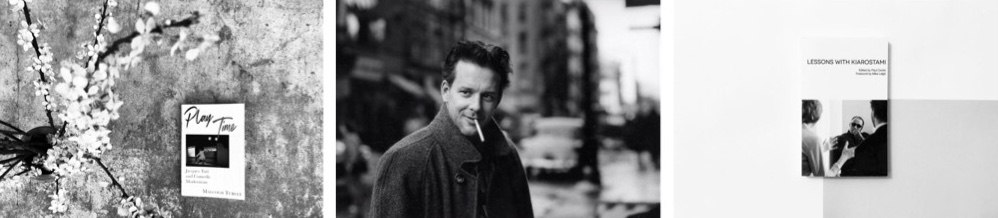
Play Time: “My Job Is to Bring a Little Smile”

Dressed to fit the monochromatic look and distresssed reality of a 1955 noir:
Mickey Rourke in Angel Heart

Life Lessons from Abbas Kiarostami

Posted by classiq in Books | | Comments Off on A Life Outside the Lines