Stéphane Audran, Vermeer and Lagerfeld: The Visual Richness of “Babette’s Feast”

Stéphane Audran in “Babette’s Feast”, 1987. Panorama Film International, Nordisk Film, Det Danske Filminstitut


One of the most acclaimed films in Cannes this year, Trang Anh Hung’s La passion de Dodin Bouffant, which also won the award for best director, is not just a story about “The Napoleon of the culinary arts”, Dodin Bouffant (Benoît Magimel), and his beloved cook Eugénie (Juliette Binoche), but one that distinguishes itself visually through a mise-en-scéne evocative of Impressionist paintings. It is this latter quality that made me return to a classic and a visual piece of art in the world’s cinema: Babette’s Feast.

Based on Karen Blixen’s short story by the same name, this is another one of the Danish author’s writings which was beautifully served by the moving picture (Sydney Pollack’s Out of Africa had come out two years before, in 1985, to worldwide acclaim). It is the tale of Babette, a Parisienne (Stéphane Audran) with a mysterious past, displaced by the 1830s Communard uprising who comes to live in an ascetic Lutheran community on Denmark’s Jütland coast. She works as a housekeeper and cook to two elderly sisters, Martine and Philippa, and she also cooks for the elderly folk in the village. It’s through her cooking (not only the feast of the title, but especially the slight but significant changes she makes in the food she serves daily – when she has to leave for a few days and Philippa and Martine bring their soup to an old man in the village, he is sour for the lack of taste of the food and leaves his spoon down) that Babette is going to make this austere community discover not just the pleasure of food, but the triumph of art, and how art can free minds and hearts and can cause them to rearrange personal feelings. When she wins the lottery, Babette, so wonderfully, luminously inhabited by Stéphane Audran, who hovers a subtle sensuality over this remote and spartan village and over the entire movie, instead of returning to France, and after she has bent on these people’s monastic way of life for years, takes the opportunity to treat them to a culinary feast.

Director Gabriel Axel described the film in the most beautiful way in a conversation with Jill Forbes, for Sight & Sound magazine, in 1988: “All I can say is that in Babette’s Feast there’s a minister, but it’s not a film about religion. There’s a general, but it’s not a film about the army. There’s a cook, but it’s not a film about cooking. It’s a fairy tale, and if you try to over-explain it, you destroy it. If you wish, it’s a film about the vagaries of fate and a film about art because Babette is an artist. She creates the greatest masterpiece of her life and gives it to the two old maids. The moment you start to dissect the film it becomes symbolic, and I resist that. It’s the love of her work and her knowledge of it which affects people.” I love his refusal to too much “narrative”, to explaining too much. It is Babette’s story and the way it is visually told that affects us, as viewers. It was her story and her profession, that seems so typically French, in the director’s own words, that attracted him to the story in the first place, and he found a way to telling us the story, through the retention of the image, the moving image. “An artist is never poor,” she answers Philippa when they find out she has spent all the money she had won in lottery for the French dinner she prepared for them.


Stéphane Audran in “Babette’s Feast”, 1987. Panorama Film International, Nordisk Film, Det Danske Filminstitut


This past summer I finally got around to read Karen Blixen’ short story. I had first seen the film years before that. And I was actually glad I had watched the film first, because I loved reading the book with the image of Stéphane Audran as Babette. Audran is so much part of the film that she seems part of the mise-en-scéne. This is a film that best conjures up Stéphane’s talent and presence. One unforgettable moment is how respectful and composed she remains when she – who, unbeknownst to everyone else, us viewers included, used to be a head chef at Café Anglais, one of the best restaurants in Paris, long ago – has to listen to Martine explaining to her how to prepare ale-and-bread soup. “It has to soak.” “You slice it.” “Bread.” “A little ale.” “Ale-and—bread soup.” Stéphane is sublime, and so is the entire scene.

Director Gabriel Axel – who was Danish but brought up in Paris and who confessed that, in a film studio, he felt more at home in France than in Copenhagen – said in an interview with Raoul Mille that he didn’t think of the French actress right away, but she was the perfect choice. “She was feminine, and she had that Parisian feel that Babette needed to have in this film. Also, in Karl Lagerfeld’s cloak, she was… She had to differentiate herself from the others, which she did perfectly with lots of grace and generosity. She is a wonderful actress, in addition to being a great artist.” Babette is an artist, too, and Stéphane Audran has all the right gestures in the kitchen. Not only did she learn to deliver her lines phonetically in Danish, but, according to the director, she learned the métier from Chef Peterson from the La Cocotte restaurant, who taught them the recipes and all the mannerisms. And when you watch Audran, you don’t just watch an actor on screen, you watch a chef, Babette, in her kitchen. The grace was there for the director to capture it, and in relationship to her expressivity, complements each image.

For her film wardrobe, Stéphane Audran worked with Karl Lagerfeld. The cape and cloak that Gabriel Axel refers to, which are now in the collection of La Cinémathèque Française, are considered one of the most iconic pieces of film costume. On the sketch of Babette’s first costume, which Stéphane Audran kept, Lagerfeld wrote: “Babette costume de voyage”, and a few other details: 10 boutons, culeur in ton degradé, gros plis religeuse. Babette is wrapped in the cape when we see her for the first time, the moment she arrives on the stormy Danish coast through the incessant wind. It gives the actress the appearance of a blaze in the dark, announcing a change in the air and in the very nature of the place. “I accepted the role by reading, at the end of the script, such a beautiful sentence which said, ‘From the heart of the artist rises a long cry for the whole world. Give me the opportunity to give my best. He who puts love into what he does is an artist.’” Her costumes are simple yet perfectly cut and tailored. In the austere Danish village, they stand out not because they are out of place but because they are impeccably made.


Stéphane Audran in the cape cloak that Karl Lagerfeld designed for her for “Babette’s Feast”, 1987.
Panorama Film International, Nordisk Film, Det Danske Filminstitut


Karl Lagerfeld and Stéphane Audran had an exceptional artistic relationship, one that stretched over many years and many films, starting from the 1970s. She even appeared in Vogue editorials wearing his designs for Chloé. In one of them, shot by Deborah Turbeville for the American Vogue, February 1975, Stéphane Audran is photographed in Karl’s apartment in Paris (which was often used for magazine shootings) next to Karl himself and his right hand, Marie-France Acquaviva. Stéphane is wearing one of the designer’s ravishing two-piece crepe de chines for Chloé – “the palest bois de rose blouse, two-tone sash, pleated skirt” – and Marie-France is dressed “in the thinnest of thin suedes – without hems, without double stitching, swede that becomes skin again”.

It was another designer however, who was also a friend, Maurice Albray, who had taught Stéphane Audran, in the 1960s, about the importance that a piece of clothing could have in embodying a character. “As long as I don’t have the clothing, I don’t know where I’m going. The moment I have founded it, I feel calm,“ Audran confessed. Everything started with the clothes. When Albray left for the United States, Audran read an article in Elle about four up-coming fashion designers, Karl Lagerfeld being one of them. She contacted him and the rest, as they say, is history, movie history. Juste avant la nuit (Just Before Nightfall), from 1971, directed by Claude Chabrol, was their first film together. “This work was different from his activity in fashion and that’s certainly what amused him,” Stéphane said about Lagerfeld, a designer who was always appreciated not just for his artistic eye and talent, but also for his culture and intelligence. “The excesses of his imagination took me back to the disguises of my childhood. It was light, happy, different. In Les noces rouges (The Red Wedding), in 1973, I played a bourgeois woman who has a lover. They become murderers by killing their respective spouses. For one of the costumes, Chabrol asked Karl for a dash of red which would symbolise sex and death. He designed a classic dress, buttoned in the front. When I sat down, we saw a red jumpsuit. Anybody else would have thought of a scarf or gloves. For example, like the ones worn by Isabelle Huppert in L’ivresse du pouvoir (Comedy of Power).”


Stéphane Audran in “Babette’s Feast”, 1987. Panorama Film International, Nordisk Film, Det Danske Filminstitut


The actress kept all the designer’s sketches from the very beginning, first from during his Chloé years (“It was Karl who crystalised an identity for Chloé for the first time. Evanescence, fleeting, fluid, light as air, his clothes were a medium for the freedoms and fantasies of a generation,” writes in the book Chloé-Attitudes) and then at Chanel (under his tutelage and with his drive to always express something fresh, exuberance and elegance were wed like never before or after). “Karl arrived at Chanel in 1983, I frequently found him at the “studio” for fittings…,” Audran remembered. A small company was established around Stéphane Audran. Lagerfeld transmitted his instructions to the studio’s director of haute couture coordination, Martine Cartegini. Her role, she wrote in her autobiography, was to make sure that all the designer’s decisions were faithfully reproduced. She was the one who met with the artisans, embroiderers, jewellers. In general, Karl Lagerfeld only came back for the last fittings. His sketches were always very precise. On another sketch that Stéphane kept, of a boot he designed for her for Folies bourgeoises, also directed by Chabrol, he wrote: “heels: 7 centimeters.” And then further on, another note: “like Gloria Swanson.” Audran remarked how “Karl had an overall vision. He designed jewellery, hats, shoes, hairstyles, makeup, underwear… everything from head to toe.”


Stéphane Audran in “Babette’s Feast”, 1987. Panorama Film International, Nordisk Film, Det Danske Filminstitut


The climactic dinner is grandiose. But not just because of the fancy food, but because of the setting, in stark contrast to the modest homes and way of life of the villagers, and because of Babette’s preparation. It’s all in the details. The way she inspects all the food when it arrives from Paris, the way she cuts the dough, the way she serves the wine. A work of art. And the people at the table don’t even know what they are eating, nor do they allow themselves the pleasure of enjoying the food. Only the General, a man of the world who, as a young man, had taken a liking to Martine before dedicating himself to a military career, is a true connoisseur. Years before, he had dined at Café Anglais, where he tells everyone that the head chef was a woman and where he and his colleagues were served “cailles en sarcophage, a dish of her own creation.” And this woman, this head chef, he explains, “had the ability to transform a dinner into a kind of love affair, alive affair that made no distinction between bodily appetite and spiritual appetite.” He knows he is experiencing something unique. But I would say that the one who feels the most genuine pleasure is the carriage driver, a simple man who sits with Babette in the kitchen during the dinner as she prepares everything, his face lighting up in a smile every time he tastes something. And the most beautiful cinematic moment comes when the film cuts to a frame of the empty dining room, the table still uncleared after the feast – the guests are in the other room having coffee – and the piano music stops exactly before Babette’s helper, a young boy, sneaks in and empties the General’s glass of wine from one sip. That is just a beautiful moment. It’s one of those moments that belongs to cinema, from the times when cinema did everything in the camera or in the editing room, without digital special effects. It’s also the realisation, so simply and subtly done, that what Babette does reaches everyone. And it’s also a funny little moment that I love only for the sake of being funny.

Far from being just a great food-centered movie, Babette’s Feast is a visual feast because of the way it is filmed. From Stéphane Audran’s Babette, who truly is the center piece of the film, to the simplicity yet richness of each single frame textured in muted colours, Gabriel Axel’s film fascinates with the visual power of a fairy tale. “My real master is Louis Jouvet,” the director confessed in the Sight & Sound interview, “whom I admire as a man of the theatre, for his simplicity and total refinement. I worked for four years as a spear-carrier in Jouvet’s company in Paris. I find a similar quality in certain painters, such as Braque or Vermeer. Nothing extraneous, only the essential. In a film, what I look for is the actor’s face. Nothing should detract from the actor’s eyes, in which everything can be read, whether in long-shot or in close-up. In Babette, there’s hardly a story. It’s just a series of portraits. And that’s my ultimate aim.”


MORE STORIES

Closer: Marie Trintignant in Claude Chabrol’s “Betty”

Isabelle Huppert’s red gloves in “L’ivresse du pouvoir”

Étude in black: Romy Schneider in Yves Saint Laurent in “Innocents with Dirty Hands”

Posted by classiq in Film, Film costume | | Comments Off on Stéphane Audran, Vermeer and Lagerfeld: The Visual Richness of “Babette’s Feast”

October Newsletter: Raoul Taburin, Wild Strawberries and The Ballad of Mr Jones


Photos: Classiq Journal


“Suddenly his face opened, his features softening,
and he became quiet and gentle, a moment of grace.
And the camera was there. And it was running.”

Ingmar Bergman, The Magic Lantern


Wild Strawberries, 1957
Ingmar Bergman

Dr. Isak Borg (Victor Sjöström), an aging professor, takes a car trip to receive an honorary award. He is accompanied by his daughter-in-law and, as they drive though the Swedish countryside, he also takes a trip down the memory lane, visiting childhood places and his mother. The black and white in Ingmar’s films is the most beautiful in the whole of cinema. And in Wild Strawberries, where we are taken on a journey into the youth of this elderly character, the black and white is incredibly poetic. “When a film is not a document, it is a dream… At the editing table, when I run the strip of film through, frame by frame, I still feel that dizzy sense of magic of my childhood.”

This film evokes childhood, too, the magic of childhood, and the way people get closer again to their childhood as they get older. Unsurprisingly, the most beautiful moment of the film comes towards the end, when Isak is lying in bed in his son’s home, after the long day’s journey, and you can see him starting to drift off as he lies looking at the camera, and as the camera moves into his eyes, we cut to him back in his childhood. He is worried that he can’t find his parents and he tells a lady friend. She assures him that she will take him to them. They go hand in hand into a meadow and then she points into the distance. Isak sees a little boy – it’s him – running across the field and up to an embankment, where there is a canal. The little boy looks across it and sees, sitting on the other side, a young woman with a parasol and a man standing next to her – obviously his parents – and they look across and wave at him. “It’s incredibly moving when the boy looks across and smiles at the young couple,” Nicolas Roeg writes in his book, The World Is Ever Changing, “and knows he’s safe and turns and runs away. And then we cut to the old man in bed, smiling as he shuts his eyes. A beautiful moment in the most superb film. That is movie storytelling. How can you possibly do that on the page?”

About this very moment, Ingmar Bergman recounted in his book, The Magic Lantern, something that encompasses the unique language of cinema. And everything happened almost accidentally. Bergman remembers how Sjöström was grumpy and nervous throughout the shooting of the film, despite the attention and appreciation the actor/director received from everyone in the crew and cast. Bergman confessed that “it struck me much later that the fuss Victor created around my promise of whisky at half-past four and his senile anger were nothing but an ungovernable fear of finding himself inadequate, of being too tired or indisposed or simply not good enough. […] Perhaps that was what he was thinking, the histrionic old fellow. I did not understand the content of his rage until now, when I find myself in almost exactly the same predicament. All light-hearted games are irretrievably at an end and boredom stares me in the face. Fear of inability attacks and sabotages ability. In the past, I flew unhindered and lifted others. Now I need others’ credence and appetite, others will have to lift me for me to wish to fly.”

That was the Victor Sjöström Bergman had to film and this is how he arrived at that defining moment in the film: “As he walked through the sunlit grass with Bibi in a long shot, he was grumbling and rejecting all friendly approaches. The close-up was rigged up and he went to one side and sat with his head sunk between his shoulders, dismissing scornfully the offer of a whisky on the spot. When everything was ready, he came staggering over, supported by a production assistant, exhausted by his bad temper. The camera ran and the clapper clacked. Suddenly his face opened, the features softening, and he became quiet and gentle, a moment of grace. And the camera was there. And it was running. And the laboratory didn’t muck it up.” In the film, you see his face lighting up in that moment just as described by Bergman and is incredibly moving and beautiful. If you’ve had moments when you have blissfully recounted childhood memories, seeing Victor Sjöström’s face in that moment you feel how everything you yourself felt in those moments as a child rushes back to you. You feel the same as he does, that joy and assurance that you are safe and that everything is alright. Indeed, how can you possibly do that on the page?


Le clan des Sicilian, 1969
Henri Verneuil

Roger Sartet (Alain Delon), a jewellery thief, escapes from a police van with the help of the Manalese mafia family, lead by the patriarch Vittorio (Jean Gabin). Sartet then proposes to them a spectacular diamond heist. Originally planned for Delon and Gabin, the script (by Henri Verneuil, P. Pelegri and José Giovanni after Auguste Le Breton’s novel by the same name), evolved sufficiently enough to include the role of a police commissioner, Le Goff, played by Lino Ventura. With a musical score composed by none other than Ennio Morricone and a clever and suspenseful plot, Le clan des Siciliens is a classic among the classic French polars.

I will be honest and admit that the idea of Delon, Gabin and Ventura on screen together would have garnered the necessary interest for me to watch the film (and I can only imagine how it must have been back in the day, how the public must have felt when they were waiting to see a film with these names on the official poster), and Verneuil certainly knew how to play with the well-honed personae of his three stars – before we see their faces, we see Delon’s hand, Gabin’s feet and Ventura’s back. But any film lover is even happier when they see a film that remains faithful to the medium it is part of. And Verneuil does show true technical prowess in some beautifully crafted scenes, such as the one when Delon escapes from the police van, reminding me of that brilliant and unmatched twenty-nine-minute dialogue-free set piece for the heist in Jules Dassin’s Rififi – incidentally, it was made after a novel by the same Auguste Le Breton. The fun of the escape sequence, aligned with our wanting Delon to be successful, is seeing the ingenuity of his technique. Maybe that’s why we, the viewers, so often root for the bad guys or anti-heroes – their stories always imply some sort of skill and ingenuity, which means we get to see those physical or mental abilities technically being transposed on screen. It’s the visual story, the moving picture we are attracted to. And so it should be.


Reading

One of my favourite books I have read over the last year, or I should very well say one of my favourite books, is Raoul Taburin, by the great writer, illustrator and cartoonist Jean-Jacques Sempé. I don’t know exactly how to describe this book, or its illustrations, nor do I want to too much. It’s gentle and profound, simple and profoundly humane. Its subtle humour, the minimalistic yet incredibly detailed drawings, there’s always something to discover, completely natural yet poignant, witty yet funny and unforced, always capable of stirring something inside of you, something that’s always been there and yet… It’s genius.

Note: Unfortunately, the English version is no longer available online at the publisher (I don’t link to big retail bookshops), but you can find the French version here or you can check out your own local bookshop or book store of choice.


Listening

The album: Jake Bugg, Jake Bugg.


Making

I would like to stay for a while on Jean-Jacques Sempé and his multi-talent and craft, especially that it was a nice surprise to discover his covers for Marcel Pagnol’s plays and books. I’ve only watched Pagnol’s films, I haven’t read any of his works, but the pairing of Sempé and Pagnol seems so natural.

A generally comic vein ran through many of Pagnol’s films adapted from his own writing, such as the Marseille trilogy (Marius (1931), Fanny (1932) and César (1936)), Topaze (1936), and Heartbeat (1938). “Cinema and I were born in the same day, in the same place,” Pagnol said. And André Bazin rightly remarked: “Pagnol is not a playwright converted to cinema but… one of the greatest directors of talking cinema.” Pagnol’s warmth and wit run through all his films and his portraits of daily community life are piercing and magnificent.

Humour was at the forefront of Sempé’s illustrations in the beginning, but over the years his work evolved. Regardless of theme, humour was no longer the only objective of the drawing. He started to offer a deeper look at society, but always from a place of contented humour, not criticism. That was the human comedy, the daily scenes of ordinary life he liked to observe. Each drawing is a short story, that’s his power and sensitivity.


Exploring

The photography of Fran Mart and the Scottish landscapes and seascapes as seen through his lens.


The regulars: The interviews, newsletters and podcasts I turn to every week and/or every month because they are that good. Craig Mod’s newsletters: Roden and Ridgeline. Soundtracking, with Edith Bowman. Alicia Kennedy’s newsletter. Gone to Timbuktu, Sophy Robert’s podcast on the art of travel. Wachstumsversuche, with Sarah Schill. Sirene, Racquet, and Yolo Journal, all in print.


“I wouldn’t have gotten here if I hadn’t heard
Duke Ellington one day on the radio.
He was a guy that I loved, that I still love.
Thanks to him, I made sense of a lot of music.
Thanks to him, I was mesmerised by the talent of others.
He brought me the joy I needed.”

Jean-Jacques Sempé, Le Monde


”How to catch a cold in Paris”, November, 1961 | Jean-Jacques Sempé


Posted by classiq in Books, Culture, Film, Newsletter | | Comments Off on October Newsletter: Raoul Taburin, Wild Strawberries and The Ballad of Mr Jones

Just a Tomboy: Marilyn Monroe Seen Beyond Stardom by Eve Arnold on the set of The Misfits

Marilyn Monroe photographed by Eve Arnold on the set of “The Misfits”, 1961


Lost in thought, rehearsing her lines, with the Nevada Desert as background, Marilyn Monroe is caught by photographer Eve Arnold unguarded, like a foreigner in an otherworldly landscape, displaying a frailty that is hard to imagine someone, at least of all Marilyn Monroe, could reveal in such less than private a place, a movie set. She is on the set of The Misfits, from 1961, her last completed film. In less than a year, she would be dead. Her co-star, Clark Gable, died within days after the film wrapped. More than photographing a film being made or actors behind the scenes, Eve Arnold caught on film nothing less than the fragility and futility of human kind. They say that sometimes you can see the soul of a film in a photograph taken on the set. But that only very rarely happens. Eve Arnold managed to capture not only the soul of the film, but the souls of its actors, and not just in one photograph, but in many of the photographs taken on the set of John Huston’s film. She recognised the soul of the actor and transformed it into photographs. And that is the rarest gift a photographer can possess. It is her photographs, more than the film itself, that have become memorable for carrying the visual resolution of the film and of its actors into the public consciousness for decades.


Photographs by Eve Arnold from the set of “The Misfits”, 1961


“I knew I belonged to the public and to the world not because I was talented or even beautiful, but because I never had belonged to anything or anyone else.” Marilyn Monroe remains the biggest movie star of all time. And yet it is this Marilyn Monroe in blue jeans – which is closer to the real Marilyn than the Marilyn that the star-image makers who put her in fur, sequins, pink and silver, cared for her to envision and that was gazed at on billboards, posters and magazines – that is deeper engraved in the public consciousness. Once again, Eve Arnold’s photographs from the set of The Misfits had an important role to play. The photographer saw beyond stardom and made a whole world see too.

By the very nature of photography, you have to get in close in order to get a good picture. But on a movie set, that can become a very challenging job and to do it well can be extremely difficult. That’s the job of the film set photographer. Because a good unit still photographer must get close while remaining unseen, is ever-present yet invisible, incredibly quiet and gentle, yet forceful and determined. They may be obliged to keep the distance, but they must know how to be in the right place at the right time, which is everywhere and at any given time. And so not only do they require technical skill, but they must know and respect film and possess a keen understanding of human behavior and patience. They record not only the situation that is presented to them and document the film as it’s being made, but also capture the moment. That moment of intensity, of an actor immersed into a role, or that moment of earnestness or contemplation between takes that makes the viewer forget that a film is being made and seems depicted from life itself, not a staged set or still-frame of what’s seen on screen but something much more real and authentic. It’s not just about the image, but about the feeling… a stolen moment.


Marilyn Monroe photographed by Eve Arnold on the set of “The Misfits”, 1961


I like this Marilyn in blue jeans. A tomboyish, typically American girl, with a very natural and understated way of dressing. Simple, confident, modern, in pared-down colours, it was this remarkably cool, ahead of her time style that she would many times emulate off-screen. Marilyn played a great role in making jeans the mainstay garment of the twentieth century, part of America’s heritage, but, most importantly, part of modernity. She was one of the very first women in Hollywood stars to demonstrate the appeal of jeans. On screen, she wore them for the first time in Fritz Lang’s noir drama Clash by Night (1952). Marilyn plays Peggy, a small-town girl working at a fish can factory and the girlfriend of Joe Doyle. She has a mind of her own and she is looking for more than marriage and being a dutiful wife. And when Joe’s sister, Mae (Barbara Stanwyck), returns home after having failed to fulfill her big ideas in the big city, Peggy instantly feels a connection with her – her right to being independent, to having her own dreams, to laying down your own rules and abiding by them rather than society.

Jeans are probably the mainstay garment of the twentieth century, part of America’s heritage. James Dean and Marlon Brando made denim defiant and sexy in the 1950s – the first decade in which young people’s style was distinguished from their parents’. Soon Marilyn became the female version of the look, equally sexy and rebellious. I think her look in jeans rather than her image in sequins and diamonds that has always played a big part in Monroe’s statute as one of America’s biggest symbols of youth culture, her pervasive image having held an influence over generations ever since. One of the most unconventionally beautiful images of Marilyn, taken by Philippe Halsman, show Marilyn in full hair and make up, wearing men’s jeans and lifting barbells. Marilyn’s beauty was matched by her boldness and bravery.


Marilyn Monroe on the set of The Misfits by Eve Arnold

Marilyn Monroe photographed by Eve Arnold on the set of “The Misfits”, 1961


Marilyn would wear again jeans in The Misfits, her last film, like a preordained message of how she should be remembered. Even Jean Louis’ dresses created for her for the film pale in comparison to the denim on denim look, the legendary pair of Levi’s jeans and the Lee denim jacket, punctuated with the perfect break-up item, the white shirt. The jacket was a Storm Rider model, launched in 1933, with blanket lining and corduroy-lined collar, which the likes of Paul Newman and Kirk Douglas used to sport. But worn by her, it became the most influential denim jacket, even for men.

John Huston, her director on this film, as well as on her first significant acting role, The Asphalt Jungle, observed in an interview with Peter S. Greenberg for Rolling Stone magazine, from 1981, and republished in the book John Huston Interviews (The University Press of Mississippi), that she had “the ability to go down within herself and pull up an emotion and put it on the screen.” In an earlier conversation, from 1974, with Rosemary Lord, he said he would “put Katey Hepburn at the top of my list of actresses – and Marilyn Monroe of course. What they say about her now… It’s tragic exploiting a tragic memory. Good hearted girl – a great heart she had. I think the Bogarts and the Monroes were new in their own generation – they weren’t like anybody else, and people are never replaced.” But “thanks to this medium,” he continued, “they’ll be there for a long time.”

In the same interview mentioned above, Huston remembered how even in The Misfits, when everyone knew there was definitely something wrong with Marilyn, a premonition of doom closing in, there was still a freshness about her that had endured from the first time he met her, when they did the screen test for The Asphalt Jungle. And that was the uniqueness of Marilyn. That appeal is still there, in the public’s collective memory, in all her films. It is argued that her public image lives on because she brought in people a feeling that she was headed for disaster, that she showed a vulnerability that made people feel very protective towards her. Her appeal has to do with more than that, just as it has to do with more than her sex appeal. Because she moved men just as much as she moved women. Just like James Dean. She brought along not just a new look, but a new voice. And in none of her films seems that image more penetrating than in these two films, Clash by Night and The Misfits, where she dressed so casual and free, the voice of every generation since.


Marilyn Monroe and Clark Gable photographed by Eve Arnold on the set of “The Misfits”, 1961


“She was a sort of a valiant, funny, witty woman when I first met her,” Eve Arnold remembered as stated in the Magnum book Eve Arnold: Lives Behind Photographs. By 1960, when Eve was on set for The Misfits, she was “still all of that, but there was a string of sadness underlying it.” One day after seeing the rushes, Monroe asked Eve, “How do I look?”. Eve replied that she looked wonderful. Monroe said, “I’m tired. I’ve been on the last film for six months, I’ve been dancing for six months, I’m thirty-four years old, you know, what’s going to happen to me?”

Eve Arnold was given exclusive access to shoot the production of the film in the Nevada Desert – Magnum had negotiated exclusive rights to film the shooting and Arnold was one of the few photographers Marilyn trusted. Eve’s portraits of Marilyn are among her most famous works and the most intimate portraits of Marilyn. They had met in 1954 at a John Huston party and they developed a relationship based on mutual respect and appreciation that lasted until Marilyn’s death in 1962. “If you’re careful with people and if you respect their privacy, they will offer part of themselves that you can use,” Eve Arnold told a BBC interviewer. “At photo sessions, she was in total control,” the photographer recalled. “She manipulated everything – me, the camera. She knew a lot about cameras and I had never met anyone who could make them respond the way she did.” […] “I never knew anyone who even came close to Marilyn in natural ability to use both photographer and still camera. She was special in this, and for me there was no one like her before or after. She has remained the measuring rod by which I have – unconsciously – judged other subjects… She had learned the trick of moving infinitesimally to stay in range, so that the photographer need not refocus but could easily follow move,ents that were endlessly changing. At first I thought it was surface technique, but it went beyond technique. It didn’t always work, and sometimes she would tire and it was as though her radar had failed; but when it did work, it was magic. With her it was never a formula, it was her will, her improvisation.”

It may be that Marilyn Monroe had an astounding feel for the camera, that she was the one who guided it. And yet that doesn’t take anything away from Eve Arnold’s ability to aim the camera, with acuteness, respect and humility, an inconspicuous glance at her muse. She is sexy and innocent, adulated and lonely, contemplative and lost. She’s her entire lifetime in a few shots. She is forever.

 
Marilyn Monroe on the set of The Misfits by Eve Arnold

Marilyn Monroe by Eve Arnold- The Misfits

Photographs by Eve Arnold from the set of “The Misfits”, 1961


MORE STORIES

“She’s the beast in the jungle”: Anne Bancroft’s Mrs. Robinson in The Graduate

”Art will set you free”: Interview with photographer Bill Phelps

Colour and costume: From The Umbrellas of Cherbourg to La La Land

Posted by classiq in Film, Film costume, Photography | | Comments Off on Just a Tomboy: Marilyn Monroe Seen Beyond Stardom by Eve Arnold on the set of The Misfits

Simplicity: The Brevity of Film Costume in “Les Aventuriers”

”Les Aventuriers”, 1967. Société Nouvelle de Cinématographie, Compagnia Generale Finanziaria Cinematografica


Two guys and a girl try to make a life out of what they love doing. It’s this free willing that unites them in the first place. Manu (Alain Delon) is a pilot who does flying stunts. Roland (Lino Ventura) is an engineer who is building an experimental race car engine. Laetitia (Joanna Shimkus) is a sculptor interested in kinetic art. But when everything they have been working for on goes up in flame – Manu’s license is revoked because of a practical joke, Laetitia’s exhibition of metal sculptures is a critical flop and Roland’s engine literally goes up in flame – they leave for Congo, in search of a sunken treasure. They settle into an idyllic exotic life which then turns for the worse so suddenly that the entire atmosphere and rhythm of the film change, only to take an even darker turn towards the end. It could be a cautionary tale, with the difference that the characters are the most reluctant and involuntary fortune seekers. It’s the spirit of adventure that drives them more than anything else. And more than a romance between two guys and a girl, it’s the story of three friends and their true and beautiful friendship.

Les Aventuriers (1967) was directed by Robert Enrico after a script by José Giovanni, who was a novelist and scriptwriter before becoming a film-maker too. He contributed to the screenplays of some extraordinary films, such as Le Trou, Jacques Becker’s critical benchmark for the French policier, Jean-Pierre Meville’s Le deuxième souffle and Claude Sautet’s debut film Classe tous risque, each film having had much to bring to the genre, all adapted after his books. Giovanni knew the world he was portraying well. A former convict himself, who had been sent to the death penalty in 1948 before having his sentences commuted to life imprisonment and then further shortened to 20 years, Giovanni was finally pardoned after 11 years in prison, by ordin of the French president, René Coty. He owed the saving of his life to his father, who never ceased in his efforts to obtain the grace for his son. But Giovanni never forgot his past and he put it in writing and on film.

Alain Delon and Lino Ventura often appeared in the films directed or written by José Giovanni, either together (Le clan des Siciliens, with a remarkable Ennio Morricone musical score), or separately (Le deuxième souffle, Classe tous risque, Deux hommes dans la ville). “I don’t direct Lino,” remarked Jacques Deray in his book, J’ai connu une belle époque, another director who worked repeatedly with Ventura and Delon. “It is enough to make a space available to him: he will fill it in, he will invade it, like all great actors. Lino, who was an actor and who always remained a man.” Both Lino Ventura and Delon, who is such a physical and instinctive actor, inhabit the scenes, even more so when they are on screen together, and their presence weighs more and more as the film progresses so surprisingly towards its Greek tragedy ending. They understand each other so well on screen. “I have unforgettable memories of Les Aventuriers,” Alain Delon remembers in the book Lino Ventura, by Luciano Melis and Laurent Ventura, “filming lasting more than three months, sublime landscapes: Djerba, Fort Boyard, Italy… I remember our long conversations in the evening, once the scenes were shot, as if it were yesterday.” As for Joanna Shimkus, I can’t think of anyone who could be more believable as someone both men are attracted to but remain just friends with right up till the end.


”Les Aventuriers”, 1967. Société Nouvelle de Cinématographie, Compagnia Generale Finanziaria Cinematografica


Les Aventuriers is also one of those films where I find myself taking great interest in observing the details, the way colours play out on screen, for example, and how entire scenes in the beginning are made of a red shirt, red truck, red poles, red plane, navy pea-coat and a brown suede jacket – red makes a strong visual impact in the way it is inserted piece by piece, be it in costume or decor, in every plan – or the navy and blue colour schemes that fill in the screen when the characters are at sea or near the sea. But this aesthetic sensibility that resonates throughout the film is not something that seems forced on you, it comes very naturally, as if the camera’s merit was merely that it was able to capture it all.


The Paco Rabanne dress worn by Laetitia (Joanna Shimkus) is the only credited film costume in ”Les Aventuriers”, 1967.
Société Nouvelle de Cinématographie, Compagnia Generale Finanziaria Cinematografica


Another thing about French films is that costumes are such an integral part of the characters and story that I am often reluctant to talk about them separately for fear of sounding too studied. Furthermore, there is no costume credit in the film here (the actors were most probably given freedom of choice), except for the Paco Rabanne dress made of aluminum discs and panels linked together by wire using pliers worn by Laetitia for her exhibition. And even so, the dress is worn in a moment in film when, avant-garde as it is, blends in so well in the scene that it makes it an object in the exhibition rather than a piece of wardrobe worn by the character.

Designing skill ran in the Rabanne family. His mother was the chef seamstress at Balenciaga’s Spanish branch. He had an industrial design background, having studied at the École des Beaux-Arts in Paris, which he put to good use when he started out in fashion as jewellery designer, selling his plastic jewellery and buttons to Balenciaga, Dior and Givenchy. He became a fashion revolutionary, by eschewing traditional couture techniques and experimenting with alternative and unconventional materials and new methods of garment construction, inspired by his architectural training and the impact of space and space travel in the 1960s. Undoubtedly, the dress retains an element of outer space here, but it’s again something that relates so well with the characters – Manu and Roland arrive at the exhibition and when they finally get a glimpse of Laetitia from afar they realise she is unreachable, because there are so many strangers there who steal her attention and she isn’t even able to see that her friends have made it to the event.


”Les Aventuriers”, 1967. Société Nouvelle de Cinématographie, Compagnia Generale Finanziaria Cinematografica


But the brevity of film costume here is the signature for simplicity. This sort of seems like a given when we have Alain Delon in the cast. His cool and resolute demeanor demands neither too many words nor too many details. Aviator sunglasses, simple t-shirts, khaki trousers, jeans, navy sweater and leather bomber jackets are as much part of Manu’s repertoire as white shirts, slim-cut suits and the trench coat. And yet, it is not primarily the clothing, but the way he wears them. All three main characters’ costumes focus on key pieces that are as modern, actual and practical today as they were back in 1967. That’s because the French sense of style is so innate and ageless and the antidote to fashion. Maybe the pea-coat was made iconic by other movies, such as Steve McQueen in The Sand Pebbles or Robert Redford in Three Days of the Condor, but I don’t believe there has ever been another film that had its main three characters, boys and girl, wear a pea-coat and wear it so well. And there has been no other film that has made such a strong plea for the plain navy oversized sweater and shawl-collar cardigan – and for its best teammate, the blue jeans – either. Actors who inhabit their characters, characters who wear their clothes, it’s just as simple as that.


”Les Aventuriers”, 1967. Société Nouvelle de Cinématographie, Compagnia Generale Finanziaria Cinematografica


Out at sea, the characters need garments that stand up to the task. The sweater does that. It’s an item so much part of a sailor’s life or of someone who lives by the sea that we also get to see it on the little boy, Laetitia’s cousin, on his shore expeditions. It’s weighty and tight enough to shield the brisk air and sea water, intuiting at a harsh life by the sea, but also keeping him comfortable and free to play and dream of adventures. And maybe these youthful practicality will cast the most light on his own style when he grows up.


”Les Aventuriers”, 1967. Société Nouvelle de Cinématographie, Compagnia Generale Finanziaria Cinematografica


MORE STORIES

Delon, Belmondo, Borsalino and the myth of the gangster dandy

“The Nest”: In conversation with costume designer Matthew Price

Timeless Yves Saint Laurent: Romy Schneider in “César et Rosalie”

Posted by classiq in Film, Film costume | | Comments Off on Simplicity: The Brevity of Film Costume in “Les Aventuriers”

Read Instead…in Print


”There’s not a right way of doing something and a wrong way.
There’s a right way and another way
– and that way is freedom.”


Read instead…in print #28


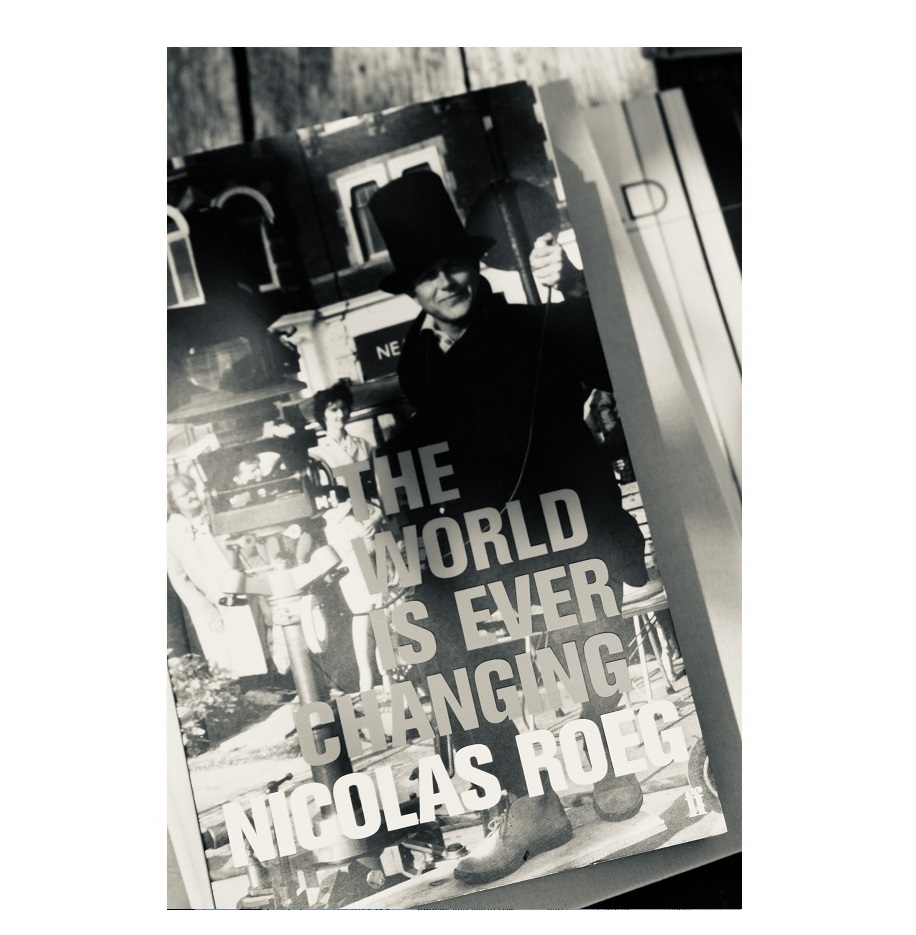
In his book, The World Is Ever Changing, Nicolas Roeg writes one page about his personal life and upbringing, and the rest of the 236 pages about film and filmmaking. I love that. But, of course, in writing about film he brings into discussion books, paintings, poetry, he employs his feelings, thoughts and opinions on life. He writes about films the way he made them, from a very personal perspective and from a deep love and understanding of cinema. He didn’t just have a love for movies, but for the medium of cinema, for experimenting with elements that are only specific to film, like time or camera movements, for the way images and not words can and must drive the action and the plot, for making films that only belong to cinema. He tells the story of a true visual storyteller, one whose faith in the imagination nullifies all reasoning, one who was always “willing to leap into the unknown – that way you’re investing in the future”.

If there were just one paragraph that you could read from the book, it would have to be one that encompasses what filmmaking is about and the magic of it all, when Nicolae Roeg describes a scene from Ingmar Bergman’s Wild Strawberries that he ends with: “A beautiful moment in the most superb film. This is movie storytelling. How can you possibly do that on the page?”


”If only we could put the clock back
– isn’t that what’s often said? Well, in film we can.”


”I realised that there was another way of telling stories,
of passing on information – not on the page, but through
the retention of the image, the moving image.
This is such an extraordinary thing. We’re used to it now,
but it still excites me because this whole idea of
connecting film with our minds is still unexplored.”


Read instead… in print is about a good book about cinema or filmmakers. No discursive, pretentious analyses, no verbose scrutiny. Because the idea is to invite you to read the book, not read about it here. But instead of using social media, I use my journal. Back to basics. Take it as a wish to break free of over-reliance on social media (even if it’s just for posting a photo of a good book) for presenting my work, cultural finds and interests. These are things to be enjoyed as stand-alone pieces in a more substantial and meaningful way than showing them in the black hole of Instagram thronged with an audience with a short attention span. This is also a look through my voluminous collection of books about film that I use as research in my adamant decision to rely less and less on the online and more on more on print materials.


MORE STORIES

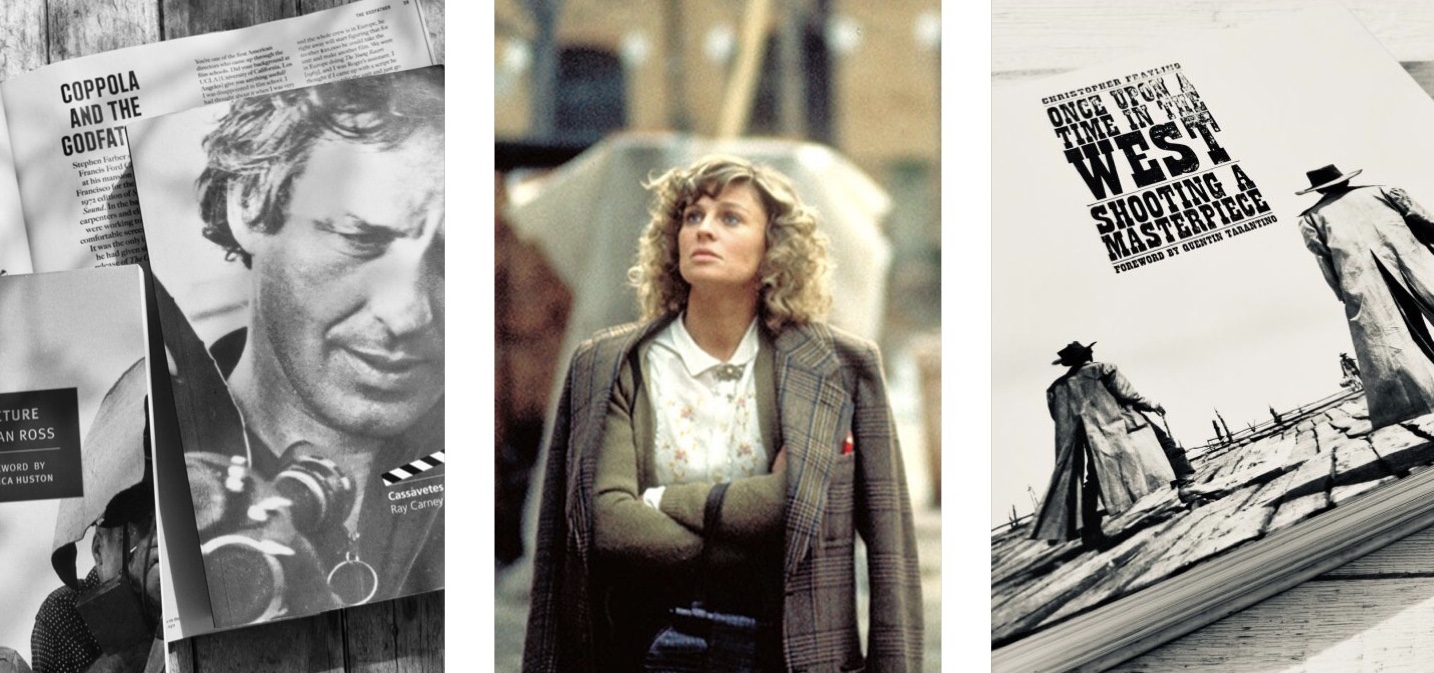
Read instead…in print #14: Cassavetes on Cassavetes

Talking film costume: Julie Christie in “Don’t Look Now”

Read instead…in print #8: Once Upon a Time in the West: Shooting a Masterpiece

Posted by classiq in Books, Film, Read instead...in print | | Comments Off on Read Instead…in Print