An Artist Who Sails: In Conversation with Stella Marina

On board of Eda Frandsen. Photo courtesy of Stella Marina


Stella Marina’s subtle wash drawings and aquatints evoke a meditative beauty, energised by the solitude of the shifting seascapes. The sea is where she finds inspiration, even the place that she can call home. The sea is where she has found herself, naturally gravitating around adventure, yet being in harmony with nature and with herself. An attitude, a belief that is as much outlandish and visionary as it is respectful of time, history and being. The sea seems to impart an understanding of the meaning of life that most cultures have long forgotten in people’s constant quest for comfort and the ease of life. Maybe life should not be easy. Maybe life should not be about comfort. It is in seafarers that we, as humans, have always found the greatest stories of discovery and self-discovery, for surviving and heading forth in hard times, trying to find new roots.

Creativity comes from living. And being at sea opens up new worlds, not just in the obvious, literal way, but in a true and creative way. Stella Marina’s photographs, of a restorative beauty and brimming with the most freeing simplicity of expression, are a moving homage to the sea and to the profound and boundless relationship formed between artist and the sea. Stella’s own journey carries the salted scent of water, her dreams floating according to the rhythm of nature, heart and eye placed together along the ever shifting, infinite backdrop of the sea.

In our interview, Stella and I talk about braving a decade of pure freedom, artistic inspirations, about building something solid and lasting her own way, and life at sea on board Eda Frandsen, a beautiful traditional 1938 gaff cutter, converted to a strong and capable sailing ship, perfectly suited to a life of adventure under sail.


From the top: Portrait of Stella by Tor Harrison | On board of Eda Frandsen. Photos courtesy of Stella Marina


When I first wrote to you, you were on passage in the Irish Sea. Where were you heading?

When we first spoke in October, I was sailing South from Scotland, down the Irish Sea. It was a beautiful passage as we invited 7 of our friends to join us. Being at sea with people you love is one of the best feelings in the world.

My partner Mungo and I split our time between Scotland in the summer and the South West of England, Cornwall, in the winter.


You are an artist and a mariner. Which came first, art or the sea?

I studied Illustration, Printmaking and Film at Camberwell School of Art in London, graduating in 2012 amidst a sea of student protests against the increase in tuition fees. I was terrible at living in a city and decided that I desperately needed to go out and rediscover the things that fuel me. Going to work on a sailing boat seemed to be a great way of doing so. I strongly believe that if you are an artist you will always be one, whether you like it or not. Sailing and the sea are my work and my office. My time at sea has taught me so much about myself, the world, and people in general. I feel incredibly lucky to get to do this for a living, but I think of myself as an artist who sails at the moment.


When did you learn to sail?

I have a memory of being pushed out in a little red wooden sailing dinghy when I was around 6.


Stella Marina drawing


I think so many of us have felt at one moment or another the urge for a big change in our lives, or the need for more freedom. What was the driving force that made you make that step? Determination, courage, idealism?

A little idealism, a little realism, a pinch of desperation perhaps. In 2012, I was 22 years old, I was reading a lot about climate, global emissions, food and water shortages, trying to figure out what I could do with my life that would at best not have a negative impact on the planet. It was necessary to be very honest with myself about the life I hoped to be living in 20 or 30 years and I worked backwards from there. Of course, it is not possible to plan everything, but I had certain parameters to work with. I wanted to be outdoors, not at a desk, I wanted to travel, I wanted to have adventures and meet new people, and I didn’t want to sell people things they didn’t need. It meant essentially turning my back on being perceived as creative, and the friends I had made at University and starting from scratch. I wouldn’t describe it as an easy or ideal route to take. But now I am beginning to find more time to make work for myself, paintings, drawings etc, and I have a lot of material to work from. Ultimately there came a time in my mid 20’s when I had to say to myself, “You made the decisions at the time because they felt like the right ones, you can’t question that or change it now so you just have to ride it out and be thankful”.


Your photos express a visible form of happiness and freedom. What does the sea mean to you?

Thank you, I appreciate that. One of the reasons I embarked on this career and, in particular, taking people on sailing voyages, was because I wanted to share the joy of sailing and being at sea. So often seafaring is depicted as a very masculine, tough and dangerous thing to do, but it really doesn’t have to be that way. With the right mindset and knowledge, being at sea can be the most beautiful experience. It teaches you the power of friendship, community and communication, it teaches you how to be both resilient and soft. You will be shown the power and strength of nature and learn how to navigate through all that life throws at you. It will show you the edges of your strength and how to push past them and make you appreciate the simplest of pleasures.

At sea, I am the best version of myself, but, ultimately, being at sea has taught me how to live better on the land.


The eXXpedition voyage. Dinner on deck. Photo courtesy of Stella Marina


Did you ever feel a certain voyage or time at sea as a rite of passage for you?

In 2014 I crossed the Pacific Ocean from Mexico to the Marquesas in French Polynesia with a cruising family. It was formative to say the least! Then, in 2015, I joined an all-women’s sailing research voyage from Brazil to Guyana with a group called eXXpedition. We were researching plastic pollution and the impact of Persistent Organic Pollutants on women’s health. We were 14 women on a 72 ft sailing boat for 22 days. I had joined as an artist and sailor, but that voyage encouraged me to commit further to sailing as a career. I took my Yachtmaster exam and dove into the world of full-time travelling & sailing as a way of life.


Have things changed since your 2015 eXXpedition journey, or in the last decade since you set out for a life at sea? How have you personally experienced the impact of humans and human activity on the sea? Are you feeling hopeful or less optimistic?

The first thing that springs to mind is that the number of people who are aware of the impact of plastic pollution on the planet and of the effects of persistent organic pollutants on our health has risen dramatically. When I began my journey with eXXpedition this was certainly not the case, and, for that, I am very grateful and proud of the work they have done. I am also buoyed by examples of ecosystems around the world which have restored themselves when allowed to do so, and the rate at which they manage to recover. My optimism lies in the knowledge that nature has incredible healing solutions and in itself is very resilient. I believe that should the planet be granted the chance, it would heal.

On the other hand, we continue to see the impact and destruction caused by Humans across the globe. We are living in an Anthropocene age, where, particularly in the United Kingdom, it is hard to imagine how the landscape would have looked without Human intervention. There are a distinct lack of sea mammals, sea birds and fish compared to historical records, a rapidly growing number of fish farms, and the seawater quality, particularly in the South of England is truly appalling. We are also seeing an increase in very extreme weather, extreme wind strengths and storm conditions.

When it comes to climate, I am not an optimist or a pessimist, I am simply realistic. I have little faith that the majority of the governing bodies of the world have the foresight or strength of character to implement significant change at the rate at which it is required. I believe that local communities will need to work together more to help and support each other, to reinstate a level of self-sufficiency.


Mid-Atlantic. Photo courtesy of Stella Marina


Tell us a little about Eda Frandsen, the boat and the voyages.

Eda Frandsen is a traditional Danish Hajkutter; she was built in 1938 to fish for Cod in the North Sea. In the 1990’s, she was saved from demolition by a family who brought her to the West Coast of Scotland to start a sailing charter business, and she has been doing so ever since. My partner and I bought the boat and business 3 years ago and have continued in much the same way that she always has. We offer 6 & 9-night voyages exploring the islands on the West Coast of Scotland from April to October, it’s a remote area of incredible natural beauty with abundant wildlife and fascinating history. I have sailed to some beautiful places in the world, but I can honestly say that there is nowhere yet that I have found to beat the completely raw elegance of Scotland.


Can one ever feel at home at sea?

Yes, I believe so, I believe I do.

It’s not for everyone, but those who fall for it fall hard and fast for the rest of their lives. Being out on the water, in balance with your circadian rhythm, away from all that the modern world demands of you is very addictive. It is a different kind of living, of feeling at home and I do think it is important to spend time living on the land as well. Ultimately, we are land creatures, and I feel that being afloat tests your nervous system in a way that should probably not be a permanent state. I suppose one could question it in terms of how well you sleep, I sleep very well onboard Eda Frandsen, and many people also tell me they do too. But it is a different kind of sleep to sleeping on the land, that deeply restorative sleep of a comfy bed in a thick-walled cottage while a storm rages in the distance should not be overlooked!


The eXXpedition voyage. Essequibo River Guyanan. Photo courtesy of Stella Marina


How much time do you spend on land throughout a year? And what is the thing you look forward to the most every time you return to the land, besides a good night’s, deeply restorative sleep?

Nowadays I spend 6 months at sea and 6 months on land. The thing I look forward to the most is having time to reflect on the summer that has passed and laying good foundations for the one that is to come. My winters are like a hibernation, it is all about restoring myself, my relationships, my body and working on the boat so that we can be the best versions of ourselves when the time comes. The sailing season is very intense, we more or less work for 6 months without any days off, the only way it is possible to do this is by really leaning into resting in the dark winter. I like it, for me at the moment it’s a good way to live.


It truly sounds like a good way to live. It feels so incredibly liberating and good for one’s soul and being. To be exactly where you want to be. That’s what it’s all about after all. As an artist who sails, are you inspired by any seafarer writers and adventurers in particular?

The first wave of inspiration for me came from artists I came across in galleries, people like Simon Starling, Tacita Dean, Ben Rivers and Bas Jan Ader. Artists who have looked to adventurers or alternative ways of living for inspiration. It was through them that I discovered Donald Crowhurst, Joshua Slocum and Thor Heyerdahl. The story that struck the deepest chord was that of Bernard Moitessier and his wife Françoise Moitessier de Cazalet. I used to dream of turning their books into a film. Their stories can teach the world so much not just about how to navigate at sea but about how to navigate life, fear, relationships and the future.


South Pacific palms. Photo courtesy of Stella Marina


I am glad you brought up filmmaking, because I was feeling I had to ask you a question about making a film at this point in our conversation. Are you still considering the idea of a film or documentary about life at sea?

Well, that is a good question, I have quite a lot on my plate at the moment… That said, it was through the transformative nature of cinema that I came to this life. There are very few good films about sailing or life at sea, and I considered that in order to make one, it would be very important to be fully knowledgeable about sailing and the sea. There is nothing worse than a director who makes a movie about something that they do not have sufficient knowledge of. I feel that now, after 10 years at sea, I am finally clutching at the skirts of having enough of that knowledge. So, in short, yes, one day I would love to make a great film about sailing, life at sea, kinship, solitude and navigating all that the world throws at you. I still feel that it would be a good film for the world to see.


Which are those influential films you are referring to?

There is a short film by Maya Deren called At Land that I absolutely love. I am interested in the ways that cinematic mediation alters and shapes our perception of what is real or possible. Then there is also Ben River’s Two Years at See (2011) which is an incredibly beautiful and poignant study of solitude and rural living.


Small Isles. Photo courtesy of Stella Marina


What are your plans for the winter?

I have a few projects I am working on. I take a small studio space in the winter and spend as much time there as possible. We have quite a short jobs list on the boat, but that varies year on year. Owning a wooden sailing boat is a fairly full-time job, there are always projects to be getting on with, painting, varnishing etc. It is just my partner and I that run the business, so I also do a lot of the office work in the winter so that in the summer when I am at sea the process is as smooth as possible. When I am with our guests in the summertime, sailing and cooking, I want to be as present as possible rather than needing to spend time on the computer.


Is there anything your guests are surprised to find on the boat, regarding the cooking experience or any other aspect of life at sea?

I think they are probably surprised by how quickly they get used to it, by how little stuff you actually need and how well they sleep in the relatively small bunks. It’s true that the food does play a big part in the whole experience, some people have said they do just come back for the food.


In this time and age, what do you wish people appreciated more?

It is going to sound terribly cliche, but I wish more people appreciated the moment they are in, rather than always pushing for the next thing. Of course planning, hope and excitement are all great things. But appreciating what you have, in this moment, and that once it has passed you cannot go back to it, anything else will be a repetition. Maybe I am wrong, but, in general, I feel that maybe not many people truly appreciate that. Oh, and rain, I really appreciate fresh, clean rainwater.


Thank you, Stella, for this wonderful talk and for your life lessons.
 

stella-marina.co.uk | eda-frandsen.co.uk


MORE STORIES

The Sea Library: In conversation with Anna Iltnere

The Mosquito Coast: Interview with costume designer Justine Seymour

Looking at the world from a place of respect,
with photographer Frederique Peckelsen

Posted by classiq in Art, Interviews, Photography | | Comments Off on An Artist Who Sails: In Conversation with Stella Marina

Jean Cocteau’s Fantastic Worlds

In Jean-Denis Malclès’ design, the Beast emerges from the darkness with only his head and mane visible. Likewise, Belle is bereft of a body, her expression can be read as either pleading or desirous.” (Selling the Movie: The Art of the Film Poster)


Come December, I will find myself drawn to the fantastic worlds of Jean Cocteau, who found the supernatural quite natural, who found light in darkness and darkness in light. For winter is a time for introspection and reflection. Cocteau tells stories that can carry you away and bring you back to your own self.


“There is little talking in La Belle et la Bête. It is a fairy tale.
Since I was a child myself I have been fascinated by La Belle et
la Bête. When I was writing La Belle et la Bête, I tried to make the film
that I used to imagine – at a time when I was still too young
to go to the cinema or the theater – from my parents’ mysterious
outings and the programmes that they left in my room.”


Cocteau was one of the most individualistic of the French directors and promoted the idea of cinema as art – distinct from what is usually known as ‘art cinema’. He disliked the elitism of art cinema. His cinema as art is about motion pictures which are full of a myriad of artistic possibilities, something that is rarely explored in contemporary cinema today. To be honest, I have always been of the opinion that art movies are made for critics. Cocteau disregarded critics and placed his faith in the audience, in the collective experience of movie going, something I can not stress enough in this day and age. “Critics have no hold over it [beauty]. […] Critics can not hear it because the roar of current events clogs the ears of their souls. A mass audience is without preconceptions. It never forms a judgment based on the author or the actors. It believes in them. This is the childhood audience – and the best.”

A brilliant mind and visionary artist, Jean Cocteau thought the heart presided over the intellect. How very true… He often referred to his work – an unequalled variety of artistic expressions, from filmmaking, to theater, sculpting, drawing, painting and literature (he even designed sets and ballets) – as poetry, “but not that which relates to verse, but rather a lyrical sensibility rooted in intellectual integrity and hard work”. That kind of poetry, I understand. His films had an ethereal beauty and elegance and he wanted them to appeal through images rather than words because that’s the real style of a film. He was not inspired by facile anti-Americanism and his writings show his eclectic taste in movies. Cocteau believed in his art and in his films and in his feelings and in the artist and in the medium of cinema.

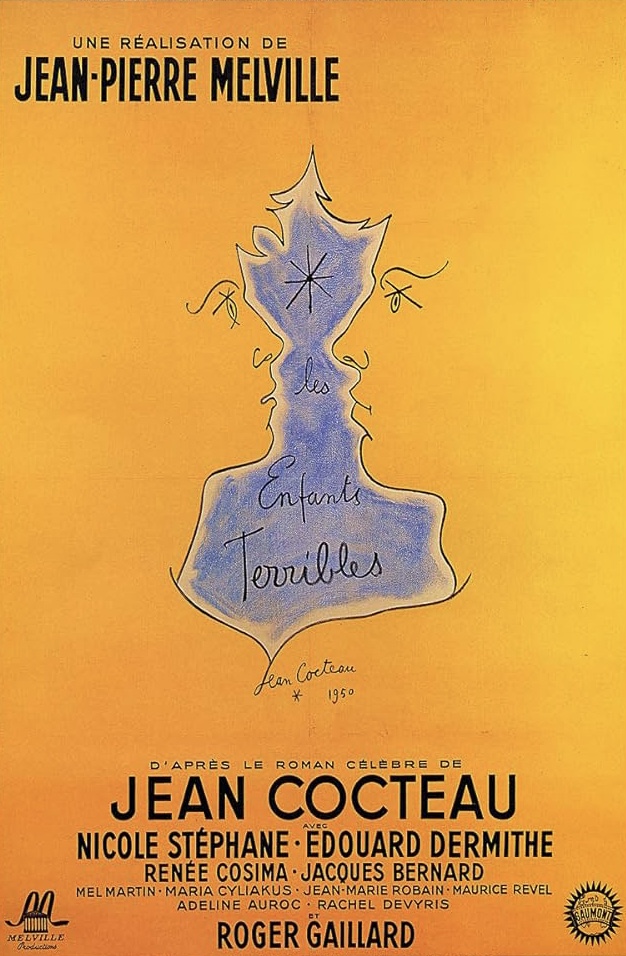
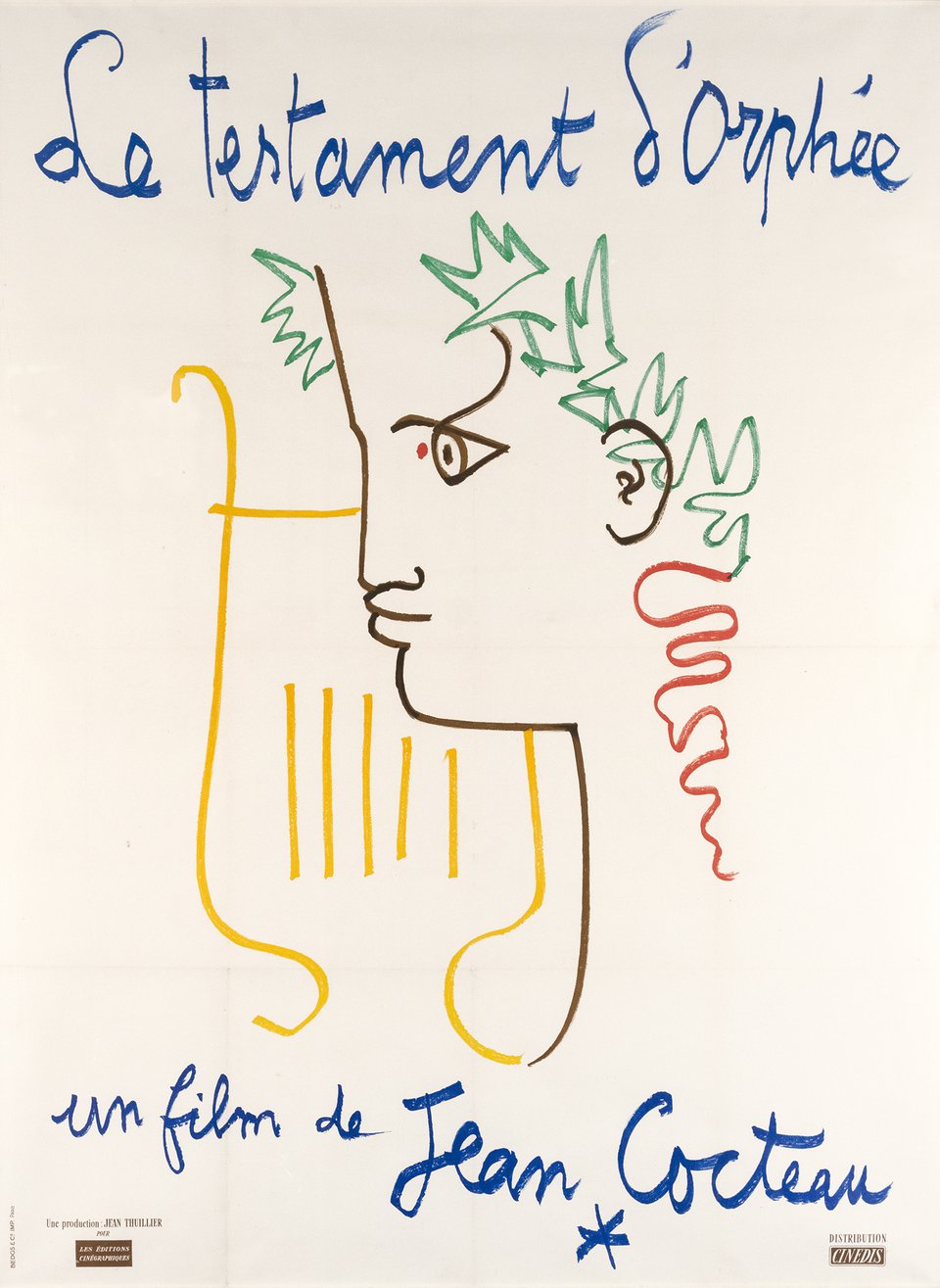
And because I am fascinated by film posters as a medium of art that further advances the language of cinema, here is Cocteau’s film universe in four amazing film posters.
 

”Cocteau’s simple line drawing transforms into a Roschach test in this poster for Jean-Pierre Melville’s film. It is the perfect metaphor for the eponymous siblings and their tormented desires, which end up destroying them.”
(Selling a Movie: The Art of the Film Poster)


“Remain free in a world where freedom is hounded down,
alone in a world where individuals abandon their individuality
to the group, alert in an inattentive world,
fearless in a world driven by fear.”


“There is a formal beauty in the pyramid form of J. Harold’s photomontage, featuring three central characters from Cocteau’s dream of a film. Death is ever present, while the statues hint at a tale that transcends time.”
(Selling the Movie: The Art of the Film Poster)


“There is nothing more vulgar than works that set out
to prove something. Orphée, naturally, avoids even the
appearance of trying to prove anything.
‘What were you trying to say?’
This is a fashionable question. I was trying to say what I said.”


”Like those of Pablo Picasso, Cocteau’s line drawings were exquisite, their delicacy conveying emotion in the subtlest of ways. This can be seen in the simple design for his Testament of Orpheus (1960). The film title and director’s credit are written, unfussily, in blue ink. Between them, a figure is seen in profile, drawn using one single brown line, with a few additional details making an eye and ear. Two haphazard green lines denote a Laurel, a little orange some hair, and in the background is the gold of a lyre.”
(Selling the Movie: The Art of Film Poster)


”Why is it that the real audience and the most simple hearts
can read all these secrets as in an open book and write
about them in numerous letters to us that would
make a critic’s reputation? This is the audience that
I address, to express my gratitude to it.”


Jean Cocteau quotes from the book The Art of Cinema, by Jean Cocteau


MORE STORIES

The art of film posters: Interview with illustrator Tony Stella

Orphée’s Death is wearing Elsa Schiaparelli: María Casares in Orpheus

Art directing film posters: In conversation with artist Akiko Stehrenberger

Posted by classiq in Film, Film poster design | | Comments Off on Jean Cocteau’s Fantastic Worlds

The Birds, the Ultimate Hitchcock Heroine and the Grandfather Figure

Tippi Hedren in “The Birds”, 1963. Universal Pictures


It was sixty years ago, 1963. It was very rare that women enjoyed the prerogative of a sports car in movies. Grace Kelly had a nice moment in To Catch a Thief, driving her Sunbeam Alpine fast on the coast of Monaco and keeping Cary Grant on the edge, but it was more for the benefit of her passenger. My favourite to this day remains Tippi Hedren in The Birds, driving her Aston Martin convertible on the meandering curves of Bodega Bay, free, liberated, a natural extension of her rapacious, bold nature. It’s a joy watching Tippi control that car, especially that we are served the scene with a grain of Hitchcock humour, who filmed the lovebirds in the cage on the floor leaning with every curve. If there has ever been a car that I have ever really wanted to drive, then that’s the car, and it’s all because of Tippi Hedren.

It says so much about her character. Just as her green suit does. Because that suit alone and what happens to it can guide us through her character’s trajectory. It is a trajectory similar to that of Tallulah Bankhead in Lifeboat, probably the most self-sufficient, independent and complex character developments of Hitchcock’s heroines, and one of my favourites alongside Tippi Hedren. François Truffaut described Tallulah Bankhead in Lifeboat as “starting out as a jaded sophisticate and, in the course of the physical ordeal, gradually becoming more natural and humane.” The same happens with Melanie Daniels, who starts out as a snobbish, perfectly coiffed socialite who gradually becomes vulnerable, breakable, more natural and humane.


Tippi Hedren in “The Birds”, 1963. Universal Pictures


But more than talking about the costume, which has been done so many times, I would like to talk about a particular scene, my favourite of the whole film, which offers a window into the character, the times, the place. But first, let’s start from the beginning: San Francisco, one of Hitchcock’s favourite locations. A bustling city, a busy street. We get a glimpse of an elegant woman waiting at the lights at the curb. We see her crossing the street and the immediate impression we get is that she’s very much a woman of her surroundings. She is dressed in an elegant and sharp charcoal grey suit of wool blend, composed of a pencil skirt and a jacket with stand collar, three-quarter length sleeves and angled front welt pockets, and a white collarless blouse underneath. She wears long black leather gloves and an oversised black fold-over clutch and classic pointed-toe pumps. Her light blonde hair is in an impeccable chignon. She sits and walks tall and natural within the cityscape in Union Square, flanked by skyscrapers, palm trees and the towering Dewey Monument. She crosses the street and suddenly stops when she hears a wolf whistle. With a scornful look, she half turns, ready to confront the impertinent man, but her face lightens up in a smile when she realises it’s just a school boy. Her brass yet elegant manner, her self-confident, runaway walk and moves, her bold, assured demeanor speak volumes about her, without a line of dialogue.

Melanie Daniels is in a league of her own, very much unlike the very conventional-looking women around, not very much unlike the sharp suited men in black. The men’s world is clearly a world Melanie Daniels enters as she pleases. And nowhere is this thought more visual than in the shot of Melanie and Mitch (second image below) in the bird shop – her blouse sleeve cuffs are peeking out from underneath her jacket sleeves, a key sartorial element in men’s wardrobes.


Tippi Hedren's style-The Birds 1

Tippi Hedren and Rod Taylor in “The Birds”, 1963. Universal Pictures


She enters a bird shop, where she is about to meet Mitch Brenner (Rod Taylor), a young lawyer. He is sharp-suited and ruggedly masculine, and, in my opinion, one of the most underrated Hitchcock male characters. Rod Taylor lets the character lead the way – he makes him real – and his style is just as subtle yet strong as his performance. I believe he is the most modern of all Hitchcock’s main male characters. Melanie Daniels decides to play shop girl with this sharp-suited, ruggedly masculine customer, showing him around the shop and foolishly taking a canary out of its cage to gauge his interest. An occasion to put into practice her natural ability to allure. She doesn’t realise that he’s already been playing a prank on her. He’s recognised her from the very beginning, as he had seen her in court, defending herself at a hearing for one of her practical jokes. “Back in your gilded cage, Melanie Daniels!”, he says putting the canary that has escaped back in the cage – her cosmopolitan image he had of her had already been working against Melanie Daniels. Her look when she realises she’s been had, is priceless. She snaps and she tells him exactly what she thinks of him, without a moment’s thought to watch her manners. So many of Tippi Hedren’s looks and gestures and moments in The Birds are impossible to associate with any other performance. There could be only one Melanie Daniels and Tippi Hedren absolutely is the ultimate Hitchcock heroine.

Hitchcock discovered Tippi in a tv commercial, asked her to do a screen test and fought for her with the reluctant suits at Universal who considered her casting too risky a choice. She was not the usual female star Hitchcock’s films were centered around. She was a novice, at her first film role. “I was a movie star, not because I’d proven myself yet but because none other than Alfred Hitchcock said I was”, Tippi wrote in her book, Tippi: A Memoir. “And he hadn’t just given me this opportunity, he’d personally seen to it that I could take it and run with it, he’d literally taught me everything I knew about acting.”


Tippi Hedren's costumes The Birds 4

Tippi Hedren in “The Birds”, 1963. Universal Pictures


The action quickly moves to a small, sleepy coastal town called Bodega Bay, at about 60 miles North of San Francisco, and the sense of location is so sharp and assured that it has always felt very familiar to me, like I had been there before. In no other Hitchcock film is this feeling more pervasive, not for me. It’s a feeling that stays with me and that makes the film all the more impactful. The Brenners’ house and farm Hitchcock and his team built themselves, making an exact copy of the existing houses.

Melanie arrives in Bodega Bay – she has vicariously driven us there in her car – in her green suit, mink coat, perfectly matched taupe heels, gloves and bag, and ton-sur-ton scarf. She hadn’t planned to come all the way here. She had meant to leave the birds, a present for Cathy – she is not used to not having the last word, so she has concocted a birthday present for Mitch’s sister, partly for fun, partly because it’s in her nature and commandeering personality – outside the door of his apartment in San Francisco, but a neighbour had told her Mitch spent the weekends in Bodega Bay with his family. That’s where we get a first good look at her green suit.

Hitchcock was planning on using a lot of green in the movie, and limited Edith Head, his long-time collaborator, to using green in Hedren’s wardrobe as well. “Green to Hitchcock evoked a chaste, cool quality, setting Melanie apart from the Bodega Bay residents”. Edith Head used another one of her designs, the eau de nil suit worn by Grace Kelly in Rear Window, as inspiration for Tippi’s green suit, only this time with a structure more akin to a Chanel suit. The costume designer kept the lines simple – she usually did, especially in the ’50s and ’60s, because it had always been her fear that if she didn’t, her designs wouldn’t stand the test of time. Six copies of the suit were made, since Tippi would wear it for a large part of the film, and most of them would need to be distressed during the repeated attacks of the birds.

The suit is in fact not actually a suit, but a sleeveless sheath wool dress with side darts, bias finish on the jewel neckline, nipped in at the waist and matching big buckle belt, paired on top with a matching jacket with three-quarter raglan sleeves with turnback cuffs and patch pockets. The colour coordination in this suit is an attention grabber, but not in a distracting way. Reportedly, Hitchcock personally selected Hedren’s jewellery for the film: a multi-strand, two-toned pearl necklace and bracelet and a pair of gold hook stud earrings for the charcoal grey suit, and the same earrings, a gold necklace, a chunky gold ring and a delicate gold bracelet watch for the green suit. It was important that Melanie be elegant to suggest her privileged social position and materialistic nature, so her wardrobe had to send out a certain message. “There are wonderful designers who make you look good, very elegant,” Tippi said. “But Edith taught me that you not only design to make a person look according to their character, you have to make sure the person can do the action.”


Tippi Hedren and John McGovern in “The Birds”, 1963. Universal Pictures


Melanie Daniels arrives in Bodega Bay in her crisp suit and make-up. Her hair is still intact, as she used her scarf to keep it in place while driving her convertible. She stops in front of a general merchandise store which also serves as a postal office – nothing could look more American than that, with a Levi’s advertisement in the window and two Coca-Cola signs hung on the store front – and that’s where one of my favourite scenes takes shape. She enters to ask for directions about the Brenners’ house. There is a very warm and candid looking elderly man, John McGovern, behind the counter – he is both postal clerk and shopkeeper. He is visibly surprised and pleased at the same time seeing this charming and elegant stranger in his shop. She is obviously someone he is not used to seeing around his little town. He is intrigued and fascinated by her, in the most kind and friendly manner, even if at first he seems just slightly reluctant. I’ve always resembled him with a grandfather figure, a grandfather who greatly loves his granddaughter (give or take a few years here in the case of both characters) and although he hasn’t fully understood her and he is still getting used to her having her own mind (she is from a different generation, she lives in the big town, the changing times), he has secretly given her his greatest support and has always admired her independent nature. He’ll always live in his world, but she always makes his day when she visits. The shopkeeper is probably the most open-minded of all the town folk, too. She has that effect on him. If you have had this kind of grandfather figure in your lives, consider yourselves lucky. And visit him often.


– Good morning!

– Good morning!

– I wonder if you could help me.

– I’ll try my best.

– I’m looking for a man named Mitch Brenner.

– Yeah…

– Do you know him?

– Yeah…

– Where does he live?

– Right here, Bodega Bay.

– Yes, I know, but where?

– Right across the bay there…

– Where?


And the dialogue continues with Melanie finally figuring out where the Brenners live, with her confessing that she wants to surprise them, and the shopkeeper joking that she should hire herself a boat and go by the back door. The look on his face when she goes on and asks where she can get a boat is something I cherish deeply and every time I watch the film I am thankful for all the great supporting roles in cinema. His surprise is genuine when he finds out that she can handle a boat and that’s the moment when she finally wins him over, and the man, all smiles, offers to order her a boat. The charming “Thank you!” she offers in return after asking further directions ends the most natural, casual and elegant conversation between strangers I have ever seen on screen. They could easily be grandfather and granddaughter, two generations apart.

Now you should grab yourself the film, put it in your player and start watching. The small, sleepy coastal town becomes the place where birds are attacking people for no apparent reason. Nobody has any idea what draws the birds and turns them bad, and Hitchcock makes sure that the mystery stays intact. “If you like, you can make it the theme of too much complacency in the world: that people are unaware that catastrophe surrounds us all.” I’m sure you hadn’t thought about that one.


“The Birds”, 1963. Universal Pictures


sources: Hitchcock Truffaut, by François Truffaut; Edith Head: The Fifty-Year Career of Hollywood’s Greatest Costume Designer, by Jay Jorgensen Alfred; Hitchcock: The Complete Films, by Paul Duncan; an Alfred Hitchcock interview with Ian & Perkins Cameron


MORE STORIES

Jacques Demy in black and white and his quiet yet lyrical heroines

Read instead…in print: Cary Grant’s Suit

Stéphane Audran, Vermeer and Lagerfeld: the visual richness of Babette’s Feast

Posted by classiq in Film, Film costume | | 10 Comments

November Newsletter: Autumn Sea, The Maltese Falcon, and Budding Imagination


Photos: Classiq Journal


“Real isn’t how you are made. It’s a thing that happens to you.
When a child loves you for a long, long time, not just to play with,
but REALLY loves you, then you become Real.”

The Velveteen Rabbit by Margery Williams


Viewing

The Maltese Falcon
John Huston

We know we are in San Francisco from the very beginning. Setting the mood can very often make or break a film. John Huston sets the mood as soon as The Maltese Falcon opens: dark, night, the most claustrophobic and cinematic of settings, San Francisco. It was his directorial debut. The film that ushered in and set the standard for film noir. The film that would give us the most American of actors, or, as Truffaut said, the “modern hero”. American noir and American film wouldn’t be what they are without Bogart. When you watch Bogart on screen, you see Bogart in action, not a character in play. That’s how immersive his role is, and his roles will continue to be. The soft cigarette, the soft-brimmed fedora and the belted trench coat became his trademark. Perhaps only Alain Delon has made the trench his own the way Bogart did. And I can say for sure that I wear a trench as much as I do because of Bogart and Delon.

The most important part Bogart had played until then was in Raoul Walsh’s High Sierra, alongside Ida Lupino, after a script by John Huston. Then Huston, hitherto known only as a writer, cast him in his first film after George Raft turned down the role (Raft had also turned down the part in High Sierra). It was a larger-than-life performance and the beginning of a wonderful character, that of Humphrey Bogart. Humphrey Bogart is Sam Spade. The role seems to have been written for him, but we know it wasn’t, which only means that Humphrey Bogart is the one who made Sam Spade. The rapid fire dialogue would easily be enough to keep your interest up, but there is so much we’d miss out on if we did that. Because so much more happens behind that dialogue. The way he clutches his jaw, how he tilts his fedora, what he does with his hands or the way he raises his eyebrow, it all means something. It’s the language of cinema. John Huston had Dashiell Hammett’s pulp fiction novel typed word for word in screenplay form. And then he translated it into images. There’s something that writer Paul Theroux said that comes to my mind, which I recently read in Nicolas Roeg’s book, The World Is Ever Changing, something Theroux said to Roeg: “You have a genuine love for reading and a liking for writers. John Huston also had it; not many others.” John Huston had that, and a genuinely distinctive love and talent for both writing and filmmaking. A first time director and an unproven actor deliver one of the finest lessons in the art of cinema.

“Walk and talk, talk and walk; that was his job,” François Truffaut wrote in his beautiful essay A Portrait of Humphrey Bogart, from 1958. “As he went along the street, he put his hand on anything it could reach. A fire hydrant, a railing, a kid’s head became so many markers along his route. Bogart adapted to life remarkably well, and grabbed hold of it. He constructed his own character; he learned to punch his ear to express astonishment. You think he’s just polishing his nails on the back of his jacket? Yes, but watch him stretch his arm out and land that sock right on the jaw: ‘Tell that to your boss.’ With Bogart, you had to know to keep your distance. […] Humphrey Bogart was a modern hero. The period film – the historical romance or pirate story – didn’t suit him. He was the starter at the race, the man who had a revolver with only one bullet, the guy in the felt hat that he could flick with a finger to express anger or gaiety, the man at the microphone: Hello! Hello! Calling all cars… If Bogart’s appearance was modern, his morality was classic. He knew that causes are worth less than beautiful deeds, and that every act is pure as long as it goes by the rules.”

Sam Spade upholds his hidden but strong principals, too: “When a man’s partner is killed, he’s supposed to do something about it. It doesn’t make any difference what you thought of him. He was your partner and you’re supposed to do something about it.” The way he delivers those lines, towards the very end of the film, and his look when she explains to Brigit O’Shaughnessy why he won’t let the killer of his partner get away (a partner who he may not have thought too much of, a partner whose wife had been carrying an affair with Spade), are such a great departure from the cynical detachment and jokes that he’s accustomed us with that it will take us by surprise. He’s been all along a close observer of the human kind.

The plot in The Maltese Falcon is so intricate that you end up following the characters more than understanding what’s going on. But it doesn’t even matter. It’s the tension, the lighting, the attitude that matter in a noir. The mood. And John Huston got it right from his very first shot. Everything is so bizarre (I wouldn’t have used this word before to describe it, but at the last viewing of the film, from a couple of nights ago, I found it very appropriate, much in the vein of The Big Sleep – but, of course, The Maltese Falcon came first), the characters are so self-centered, the dark streets so many, the offices and hotel rooms so cramped, that you are fully absorbed in this shadowy world where everyone’s interest, and your own, is to see if anyone gets away alive.

This plot of deceit and double-crossings begins when Miss Wonderly (Mary Astor) shows up at private eye’s Sam Spade’s office and hires him to rescue her sister from a man named Floyd Thursby. She pays up front, and Spade and his partner, Miles Archer (Jerome Cowan), know something is off, but nothing prepares them for the femme fatale that lurks underneath. Mary Astor (who quickly offers three names and settles on Brigit O’Shaughnessy) is one of most unpredictable and most unlikely femmes fatales in film noir, which is why she is the perfect bait for Sam Spade and his falling into the web of international thieves – Joel Cairo (Peter Lorre, in a role that fit him like a glove) and Casper Guttman (Sidney Greenstreet, at his wonderful debut in film at 61) are the other two – who will kill to get their hands on a little black jewel-encrusted bird statuette, the Maltese falcon, that they had been chasing for years. The futile pursuit of wealth. “You’re good, you’re very good!”, is Spade’s favourite description of O’Shaughnessy several times. “You’re not exactly the kind of girl you pretend to be.” And yet, she hides her character so well under a docile and restrained guise that Spade is smitten when he finally unmasks her. But nothing will prevent him from letting her take the fall. “When a man’s partner is killed, he’s supposed to do something about it.”


Seven Samurai, 1954
Akira Kurosawa

Music and sound were elements Akira Kurosawa considered from the moment he began directing a film. In Seven Samurai, he used different theme music for each main character – the director acknowledged that he had changed his thinking about music in film when he began working with composer Hayasaka Fumio. The characters Kurosawa gives us are unlike any other. Seven samurai who are capable of finding the purest humanity in their violent-prone natures. Kurosawa’s is a revisionist portrayal of the traditional Japanese warrior. His samurai do not suffer from one-sidedness, they are shown in their human strength and weakness. You witness the chaos of battle, but there is no trace of violence for the sake of violence here. And there is no trace of the traditional samurai who has always been depicted as nothing more than an artful swordsman. And yet, the action scenes are so overwhelming and perfectly executed that you wish you could wipe out from the face of cinema all films that have ever used the slightest input of CGI in their making.

In his book, Something Like an Autobiography, Kurosawa explained how he used more than one camera to shoot the climactic battle scene, because “it was impossible to predict exactly what would happen in the scene where the bandits attack the peasants’ village in a heavy rainstorm. If I had filmed it in the traditional shot-by-shot method, there was no guarantee that any action could be repeated in exactly the same way twice. So I used three cameras rolling simultaneously.” It was ground-breaking. Kurosawa was obsessed with movement. His camera would follow the actor as he moved, it would stop when he stopped. Kurosawa got closer than ever before to the samurai, physically and emotionally. “There is something that might be called cinematic beauty. It can only be expressed in a film, and it must be present in a film for that film to be a moving work. When it it is very well expressed, one experiences a particularly deep emotion while watching that film. I believe it is this quality that draws people to come and see a film, and that it is the hope of attaining this quality that inspires the filmmaker to make his film in the first place. In other words, I believe that the essence of cinema lies in cinematic beauty.”

Quiet moments have never been more compassionate, battle scenes have never been more dynamic. Seven Samurai is a masterpiece of filmmaking, one that reached a level of meditative depth and cinematic beauty like no other.


Way Out West, 1937
James W. Home

I wonder, is there anyone in the world who wouldn’t laugh at seeing Oliver Hardy wrapped in a blanket right up to his belly (he’s naked underneath), being towed by a donkey, with his laundry hanging above him? The road is bumpy and he is grumpy. Stan Laurel is walking by the donkey and he is of course the one responsible for Oliver’s condition. The previous scene from Way Out West, with a slumbering Ollie (this time dressed) being towed by the mule, is one of the funniest entrances of the duo. For the next ten minutes after that first close-up, I laughed so hard that my belly hurt. Then I gave up – some moments were so funny that you didn’t even feel like laughing anymore, if that makes sense. Sometimes I think people have forgotten what is funny. Todd McEwen, a Laurel & Hardy devotee, who got up at 4.30 in the morning as a kid to watch their films, says it best in his book Cary Grant’s Suit: “Disney cartoons aren’t funny. At Disney they wasted all their time and money on capitalism winsomeness.”

A coach ride later, after Stan hitches a ride on a passing coach by doing an impression of Claudette Colbert in It Happened One Night, showing off his leg (more belly-aching laughs), we witness one of the most joyous moments in any film. The two encounter a singing quartet in front of a saloon and they get caught up in the rhythm of a song. Not only is their dance a perfect comic moment, it simply makes you happy. A good comedy should never be underrated again.

And who else but Oliver Hardy could get away with pulling the audience back from the illusion of watching a film by casting a glance in our direction whenever Stan Laurel does something foolish? It’s a paradox, but it just works. Wouldn’t any other character, in any film, just drive you crazy?


Babette’s Feast, 1987
Gabriel Axel

“In Babette’s Feast there’s a minister, but it’s not a film about religion. There’s a general, but it’s not a film about the army. There’s a cook, but it’s not a film about cooking. It’s a fairy tale, and if you try to over-explain it, you destroy it. If you wish, it’s a film about the vagaries of fate and a film about art because Babette is an artist. She creates the greatest masterpiece of her life and gives it to the two old maids. The moment you start to dissect the film it becomes symbolic, and I resist that. It’s the love of her work and her knowledge of it which affects people.” I have written at length about Gabriel Axel’s film in Stéphane Audran, Vermeer and Lagerfeld: The visual richness of Babette’s Feast.


Reading

For the last few months we have read The Chronicles of Narnia. It was the first time (never too late!) for both me and my son. To say that I am at least as fascinated as my eight year old (I would barely finish one book from the series that he’d be off to read it to his grandparents every chance he got) would be a huge understatement. First, I would like to say that I don’t share the contemporary taste for “proper” stories for children, those so-called practical stories about real life that are abounding nowadays, a type of story that has arisen from the digital age parents’ overprotective nature, out of a wrongly channeled desire to make the world of childhood as comfortable, bright, and cheery a place as it can possibly be. In his book, Tending the Heart of Virtue: How Classic Stories Awaken a Child’s Moral Imagination, Vigen Guroian writes in the most eloquent and pleasant way about the harm of not reading to children classic fairy tales and stories. Why? Because traditional tales have the ability and gift to make children know and face their own fears and ask questions and try to discover the answers to their questions, about the world, about human kind, about everything. But the gift of these stories is bigger than that. They are filled with a richness and complexity that is often missing from the modern-day children’s books. But, most importantly, they ignite the imagination, they fascinate, they broaden children’s minds. And they reveal, in the most subtle, kind and natural way, so many layers that help children understand human kind and themselves. A child can see both the mystery and truth in such stories. As Johann Christoph Friedrich von Schiller explained, “Deeper meaning resides in the fairy tales told to me in my childhood than in any truth that is taught in life.” The Chronicles of Narnia are that kind of books.

I have already mentioned above the book Tending the Heart of Virtue: How Classic Stories Awaken a Child’s Moral Imagination. I vividly remember a visit of my son’s and mine to a bookshop from a couple of years back, when a mother of a toddler desperately started a conversation with me, asking for advice about children’s books, saying that she found the majority of the books there (the books referred to in my previous paragraph as practical stories about real life) “disastrous”. I agreed. Because her child was still very small, I recommended Peter Rabbit, Ernest e Célestine, Pettson and Findus, and Eric Carle’s books (firm favourites of my son’s when he was that small). But I wish I had Vigen Guroian’s book back then to refer to for books for children who were a little older. I was facing the same dilemma she was, but regarding a six year old. How Classic Stories Awaken a Child’s Moral Imagination is a valuable book. First of all because it guides us not what to read to our children, but simply to read to our children. Many parents stop reading to their children when children start reading by themselves, which in many cases, means when a child is only at the tender age of six. That, in my opinion, is disastrous. With the talent of a true storyteller, the author opens up the fascinating and powerful world of children’s books (from Narnia, to Pinocchio and The Velveteen Rabbit and many others), which are so important in children’s upbringing and in shaping up their characters.


Listening

The podcast: The MUBI Podcast, my favourite film podcast alongside Edith Bowman’s Soundtracking. Hosted by Rico Gagliano, the podcast has run for three seasons so far and it has dived into particular aspects of filmmaking. That and the fact that it is beautifully written and edited (by the same Rico Gagliano) makes it intoxicating to listen to and makes you “go watch some movies”, as Rico ends every episodes. The first season is titled “Lost in Translation” and spotlights movies that were massive cultural phenomena in their home countries, but nowhere else. The second season, “Only in Theaters”, tells surprising stories of individual cinemas that had huge impact on film history and, in some cases, on history in general. And, finally, the third season, named “Needle on the Record”, tells the stories behind some of cinema’s most renowned needle drops – moments when filmmakers deployed pre-existing music instead of an original score.


The soundtrack: The Killer, by David Fincher. Needle drops almost exclusively from The Smiths.


The album: Everybody Else Is Doing It, So Why Can’t We?, The Cranberries


Making

The Wild English Garden Collection by India Hicks and Phenelope Chilvers. At their third collaboration together, India Hicks and Penelope Chilvers have created a capsule collection that features boots inspired by the beautiful winter garden at India’s family home in Oxfordshire. “Designed by her late father, designer David Hicks, it is a calming, wild space where she enjoys taking time to reflect, and these products pay homage to the garden’s rich colours and autumnal essence.” The collection encapsulate the rich palette of an English landscape in autumn, reimagined with India’s unique sense of eye. I love the way India continues to weave her stories – India is not only a born storyteller, but she carries out her own story, as well as her storied heritage, so beautifully – into Penelope’s free vision of making slow fashion, defined by the reputation of the best quality crafted in Spain with great consideration and a design that is beautiful and enduringly elegant.


Exploring

Artist and film poster designer Akiko Stehrenberger’s solo show, “Doyrivative”, at The Lodge art gallery, Los Angeles.

With each new film poster, Akiko Stehrenberger seems to be opening the door to imagination even wider, not just for herself as an artist, but for the viewer, too – even movies you know, you come to think of them differently. Each of her poster designs extracts that special quality of the film it represents, is conceived to suit not just the story, but the feel and the mood of the film, creating visual symbols that merge completely with the experience of the film. Because you don’t just watch a film, you experience it. That’s the work of a visionary, who, with an aesthetic that is often strikingly minimalistic, enigmatic yet very precise in encapsulating a powerful frame of mind, has paved the way to less conventional movie poster design, driven by the desire and strengthened by the skill to create poster art that has its own visual identity.

“For me, the style of illustration communicates almost as much as the idea does. This is extremely important in my work and why my work is as versatile as it is. The piece has to feel appropriate for the film rather than just be illustrating for the sake of illustrating. A good movie poster has a simple and clever idea. It also intrigues the viewer enough that they want to see the film in hopes it will answer the questions the poster imposes,” Akiko revealed in our interview.

Yet, Doyrivative dives deeper into Akiko Stehrenberger’s brilliant mind. Her first non movie solo show exhibits mixed media pieces (paintings, sculptures, installations) where the concept determines the materials used. She juggles so many aspects of design and art that I can only think of Akiko Stehrenberger as a 21st century design maverick, or some new kind of Renaissance designer. Doyrivative, The Lodge, Los Angeles, November 2nd – November 25th.


The regulars: The interviews, newsletters and podcasts I turn to every week and/or every month because they are that good. Craig Mod’s newsletters: Roden and Ridgeline. Soundtracking, with Edith Bowman. Alicia Kennedy’s newsletter. Gone to Timbuktu, Sophy Robert’s podcast on the art of travel. Wachstumsversuche, with Sarah Schill. Sirene, Racquet, and Yolo Journal, all in print.


Posted by classiq in Books, Culture, Film, Newsletter | | Comments Off on November Newsletter: Autumn Sea, The Maltese Falcon, and Budding Imagination

Read Instead…in Print


Read instead…in print No. 29

There are many good books about film that I have read, but Cary Grant’s Suit: Nine Movies That Made Me the Wreck I Am Today is by far one of my favourites. It has humour in it. Just like a good film (that is not a comedy) has humour in it (like Hitchcock’s). Just like life (amidst hardships, tragedy, rises and falls) has humour in it. Todd McEwen writes from a very personal point of view. Movies are truly woven into his life and it’s absolutely thrilling to read how he meanders through some of the movies that have marked him in one way or another. He makes you live the movies, make them part of life. A film lover just knows. And the way he writes about, yes, Cary Grant’s suit in North by Northwest, well, it’s the best writing about the most written about suit in the history of film.

Cary Grant’s Suit is also a beautiful book to look at (how could it not be, bearing the title it does?), and beautifully made – a classy Nothing Hill Editions, textile cover and all, released this year. And it so happens that I found it quite by chance in my favourite bookshop in the world (see the quite literal seal of approval on the first page in the image below?). The kind of thing that happens only when you visit bookshops. Or maybe it wasn’t exactly by chance. Vlad knows what his readers want even before they know it themselves.


Read instead… in print is about a good book about cinema or filmmakers. No discursive, pretentious analyses, no verbose scrutiny. Because the idea is to invite you to read the book, not read about it here. But instead of using social media, I use my journal. Back to basics. Take it as a wish to break free of over-reliance on social media (even if it’s just for posting a photo of a good book) for presenting my work, cultural finds and interests. These are things to be enjoyed as stand-alone pieces in a more substantial and meaningful way than showing them in the black hole of Instagram thronged with an audience with a short attention span. This is also a look through my voluminous collection of books about film that I use as research in my adamant decision to rely less and less on the online and more on more on print materials.


MORE STORIES

Read instead…in print: The Birds, by Camille Paglia

Ruggedly masculine: Rod Taylor in “The Birds”

Read instead…in print: The World Is Ever Changing, by Nicolas Roeg

Posted by classiq in Books, Film, Read instead...in print | | Comments Off on Read Instead…in Print