Back to School: The On-Screen Preppy Look of Robert Redford

The preppy look of Rovert Redford All the President's Men 
Robert Redford has made it clear from the very beginning that he came into films because of the craft of acting, and then, by founding the Sundance Film Festival, that he stuck in the business because of the films themselves, which is why he wanted to open the path for independent film makers. I do think his movies and his wider contribution to the film world loom larger than his undeniable good looks. He’s never been interested in appearances, but it has taken some a while to look beyond that. So now that he is 80 (and still “a rugged harmony of clean-cut American manhood”), I guess it is okay to talk about his style, too. But, even now, I am not sure Mr. Redford would agree with my talking about his style. Even if I leave his younger self’s looks (that face, blond hair, unforced physical perfection et al.) out. But I am focusing on the film costumes. They are part of the character. Anything that would help an actor get into character, I am sure he would agree with that.

Here are a few looks from Robert Redford’s cinematic past men can still take their sartorial cues from. And because it’s that time of year again when a tad of nostalgia for that back-to-school feeling is in the air, these are all looks that are grasping into Ivy League style. They are also about that American look that is more about dressing down (in the true preppy spirit), and less about glamorous Hollywood style – another thing that I am sure Mr. Redford agrees with in real life. “There was nothing at the end of the rainbow for me here. Hollywood was not a place I dreamed of getting to. I never could take seriously the obsession people have about being a celebrity or getting to Hollywood — I was born next door.”
 
The preppy look of Robert Redford all the president's men 
Robert Redford was promoting his politically-charged film The Candidate in 1972 when Bob Woodward and Carl Bernstein, the two investigative reporters from The Washington Post, broke out the Watergate story and president Nixon resigned. But Redford didn’t want All the President’s Men,which turned 40 this year, to be about Watergate or Nixon. “I wanted to focus on something I thought not many people knew about: How do journalists get the story?” This is one of the best political thrillers ever made, even if we know the outcome in advance. And that is because what is indeed fascinating about the story is the journalistic part. “We took all the elements of their work — the typewriters, telephones, pens on paper, and kicked up the sound on all of them. Every scene where the typewriter is used, the noise is kicked into high gear so there’s a real bang. What does it sound like? It sounds like weapon.”

Just as accuracy is of the utmost importance in relating a journalistic story, so it is in getting the character right on screen, especially if the plot is contemporary, set in a familiar surroundings, using familiar attire. And when it is the story that you are after, your clothes should really go unnoticed. But clothes also serve to add to the authenticity and individuality of the character. Redford is sporting a beige corduroy suit (it may not be a go-to option today, but the corduroy jacket remains a classic element in the men’s wardrobe) throughout the film; it’s kind of his thing. He wears his suit with plaid or button-down oxford or blue striped shirts and preppy knitted ties, which are a great way to fit into a more formal work environment while displaying a certain amount of casualness – choices that should never distract his and others’ attention from the story. Because a journalist wants to speak louder than his clothes.
 
The preppy style of Robert Redford Three Days of the Condor

Robert Redford preppy look Three Days of the Condor 
In one of Sydney Pollack’s best political thrillers, Three Days of the Condor (1975), Robert Redford plays CIA analyst Joseph Turner who goes rogue after his entire office is assassinated. It’s one of the films that never go out of style. Not just because of Redford’s wardrobe that exemplifies New England campus attire, but because of the topic that echoes present day political issues.

But we are here to talk clothes, and Redford’s look is comprised of pieces men can wear year in and year out, without giving the slightest importance to what is the latest this or that. They’re utilitarian, pared-down, conservative, and are almost exclusively items that have long been identified with prep style. There is a quietness about this style, which is as fresh and relevant as ever. The chambray shirt and tie (the width of the tie may be the only outdated thing about the film) topped with a crew neck navy sweater and a grey herringbone jacket (with flap pockets to increase its casual tone) will always be one of the finest examples of fall layering and Ivy style. The look is completed by jeans and hiking boots – a very individual statement, one that is the perfect example of men’s approach to dressing, not shying away from embracing comfort in the cold and not giving up their natural sense of style for the sake of fashion. The ease of this look has an appeal that has spun decades. The second look is no less enduring, as it loses the herringbone jacket in favour of the pea coat, another true and tried classic.
 
The preppy look of Robert Redford The Way We Were 
In 1973’s The Way We Were Redford played WASP college student Hubbell Gardiner, a young preppy gentleman with a talent for writing, but who was a privileged golden boy for whom everything came too easy and who had a rather light approach to life. The character may have had serious character flaws, but that’s the way Redford wanted him. The actor originally turned down the role because Gardiner “was a bit of a Ken doll with no dimension and I wasn’t interested in that,” Redford said, “I’ll be interested if we can find some flaws in him.” And so they did. His clothes were not among them. School sweaters (a standard amongst men on game days on and off campus), tennis sweaters, knitted sweaters in geometric patterns, fisherman’s sweaters, they are all symbols of preppy style (and, come the very first day of autumn cold, ready to be broken out) and Redford wears them all with the ease and unalloyed appeal that he’s capable of.
 

Discover our movie stories shop – inspired by the fascinating world of cinema
and by the never-fading beauty of the tangible

 
quotes sources: The Telegraph, May 2016 / Entertainment Weekly, August 2015 / Esquire

photos: 1,2-All the President’s Men, 1976 (Warner Bros) / 3,4-Three Days of the Condor, 1975 (Wildwood Enterprises) / 5,6-The Way We Were, 1973 (Columbia Pictures)

Posted by classiq in Film costume | | Comments Off on Back to School: The On-Screen Preppy Look of Robert Redford

Venice Film Festival 2016

Paul Newman Venice Film Festival 1963 
The Venice Film Festival is the oldest film festival in the world, dating back from 1932, and, may I add, the most glamorous one – what better location than Venice, the city that has grasped our imaginations for so long? “Venice has been painted and described many thousands of times,” Henry James wrote, “and of all the cities of the world is the easiest to visit without going there.” The 73rd edition of this premier festival that is part of the “Big Three”, alongside the Cannes Film Festival and the Berlin International Film Festival, kicks off today, but out of respect for the Umbrian earthquake victims, it has cancelled its opening ceremony.

I don’t want to say that cinema is not what it used to be anymore, because there are still good movies being made today which give me hope. But the truth is they really don’t make movies like they used to. As for the notion of movie star, it has completely altered its meaning. This can be easily reflected in the photos taken of the actors and actresses attending the festivals. The glamour, class and mystery are gone. And, no, glamour, class and mystery will never be old-fashioned. Furthermore, I would just like to say that I really don’t like the idea of an actor or actress being on Instagram, much less following them (except for Naomi Watts – I just love her), unless it reflects exclusively their work, like in the case of Leonardo diCaprio – that is an act of class. Maybe it’s just me, but if there is no trace of privacy, I tend to lose interest in watching them onscreen and immerse in their characters.

“It brought the cream of the A list,” Russell Blackmore, the founder of Sonic Editions, the repository that produces prints of iconic 20th-century photography, was telling Mr. Porter a couple of years ago about the yesteryear of the festival. “Today you have scrums of paparazzi all taking the same pictures against the same promotional backdrops. But back then you had a few local photographers with inside knowledge, working their beat. They got their tip-offs from the gondoliers or the hotel concierges so that they were in the right place at the right time to get some candid shots.”
 
Venice film festival Elizabeth Taylor Gene Tierney

Monica Vitti Venice Film Festival 
Photographers were looking to capture iconic faces in situations you wouldn’t normally expect them, unstudied, with an element of surprise. Like Elizabeth Taylor looking completely at ease and content in trousers on the pier, or Gene Tierney and Monica Vitti in simple t-shirts. And Paul Newman wearing a tuxedo and still being impossibly cool in that famous shot in a water taxi in Venice in 1963, with Piazza San Marco in the background.
 
Venice Film Festival 2016 poster 
The poster for the 73rd Venice International Film Festival, whose jury will be presided by Sam Mendes, unveils an image described as the “moment of expectation” of cinema. An anonymous spectator adorns the poster, inviting the viewer to feel the imminent moment right before the screening of a film at the festival. I think this feeling applies to any film lover right before watching a movie at the cinema.

This year, Damien Chezelle’s musical, La La Land, will open the festival, following up his 2014 much acclaimed Whiplash. “I was so honored to get the invitation to open Venice,” said Chazelle. “It’s the kind of place that seems to belong in a dream. That’s the feeling I wanted to capture with this movie: the way things look and sound in a dream, the magic and the romance of it all.”

The line-up includes 20 movies competing for the Golden Lion, of which here are some others that have caught my interest: Tom Ford’s Nocturnal Animals (his 2009 debut feature The Single Man also premiered at Venice), starring Jake Gyllenhaal and Amy Adams, Derek Cianfrance’s The Light Between Oceans (the director’s The Place Beyond the Pines remains one of the best movies of recent years), Andrei Konchalovsky’s Paradise, Terrence Malick’s decades-in-the-making documentary Voyage of Time: Life’s Journey, narrated by Cate Blanchett, Denis Villeneuve’s Arrival, with Amy Adams – the filmmaker’s Sicario is probably my favourite movie of last year. Notably, Birdman and Spotlight, which won the Oscar for best picture in the last two years, respectively (but, most importantly, which are remarkable films), both premiered in Venice. So it seems that the Venice fest has become Hollywood’s awards-season launchpad.

Akira Kurosawa’s Rashōmon, René Clément’s Jeux interdits, Alain Resnais’ Last Year in Marienbad, Andrei Tarkovsky’s Ivan’s Childhood, Luis Buñuel’s Belle de jour, Louis Malle’s’ Au revoir les enfants, John Cassavetes’ Gloria, Krzysztof Kieślowski’s Three Colours: Blue all won the Golden Lion. These are all films that have stuck with me ever since I watched the very first time.
 
Films set in Venice 
To get in the mood while the festival is underway, here are a few great movies set in Venice, from Summertime (1955) and Casino Royale (2006), to The Talented Mr. Ripley (1999), Don’t Look Now (1973) and Everyone Says I Love You (1996).
 
 
photos: 1-4: Archivio Cameraphoto / 5-official poster for the 73rd edition of the Venice Film Festival, designed by Simone Massi / 6-collage by me, clockwise from top left movie stills from Summertime (1955, United Artists), The Talented Mr. Ripley (1999, Miramax/Paramount Pictures), Casino Royale (2006, Columbia Pictures), Don’t Look Now (1973, Casey Productions/Eldorado Films)

Posted by classiq in Film | | 1 Comment

My All-Time Favourite Summer Films (Part II)

My favourite summer movies Point Break 1991 
There is just one kind of summer movie for me, and blockbuster is not part of the definition. The exception may be Jaws, but it’s a classic and a blockbuster in the 1970s meant an entirely different thing than it does today. But my summer picks are usually not just for sheer entertainment, they evoke something more. They bottle some of the summer magic I long for the rest of the year. It is this hallucinatory combination of emptiness and endless possibility, this transitional time between past and future, a time when you let things go and prepare for new challenges, a ripe time for misbehaviour, but for pushing your limits too, a time for childlike fun and dreams, a time when the only thing on your mind can be the heat, a time of discovery, a time when you let yourself just be. For a more comprehensive view of my summer movies, you should first have a look at these other ten favourites.
 
Favourite summer movies Poin Break 1991 
Point Break (1991)
This is a film that takes my mind to rebellious summers and endless beach days as a way of life. It’s just the perfect blend of fearlessness, atmospheric scenery and entertaining action (mainly thanks to the two leading men, Keanu Reeves, as rookie FBI agent Johnny Utah, and Patrick Swayze, as the leader of a gang of surfers who moonlight as bank robbers) to pull you in and linger with you long after the ending credits, like the sand in your toes after you put your shoes on. You can’t really explain a cult movie, and that’s why you have a new appreciation for it every time you see it. You are allowed to be part of it and make your own version of it. And I just have to mention the style part and the classic beach staples. I talked about them here.
 
My favourite summer movies Stand By Me 
Stand By Me (1986)
Why I came around to watching this movie only a couple of years ago, I can’t really say. But there is no doubt that if I had seen it when it was released it would have become one of my childhood movies, a movie I would watch every summer and think of the rest of the year. But the thing is I related to it even now, in my thirties. Because it is not aimed only at children, but at adults, too, bringing back the exuberance of those years, but also stating some truths that you might find hard to believe so early in your life that would hold firm long after you’ve passed teenagehood. “I never had any friends later on like the ones I had when I was twelve. Jesus, does anyone?” The most bittersweet truth of them all. This is a film I can not wait to watch with my son. There are not many of the kind anymore.
 
My favourite summer movies Il sorpasso 
Il sorpasso (1962)
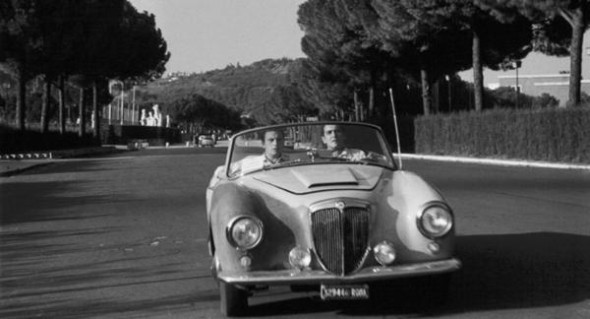
A one-day joyride that takes you through the entire range of human emotions, from slapstick to tragedy. This is the ultimate Italian road trip. A sunny, lazy day in 1960s Rome evolves into a madcap trip taking us through the most beautiful landscape, from Rome to Tuscany, giving way to wonderful surprises and hidden depths. Isn’t this what a road trip is all about? A journey of discovery and self-discovery.
 
Favourite summer movies American Graffiti 
American Graffiti (1973)
It captures the spirit of late 1960s teenage world of small-town America the way I imagined and read about it. The energy, the rock ‘n’ roll, the car-based culture (everything seems to be happening around one), the confused teenager in that crucial point of their life (which everyone can relate to) – the transition from high school to college/faculty and/or life – that summer of big decisions, big plans and transformations, and the last night of insane fun before life arrives.
 
My Favourite Summer Movies 12 Angry Men 
12 Angry Men (1957)
This is a very realistic thriller, despite the confined place where it takes place, inside a little room where a jury in a murder case must reach a verdict on the hottest day of the year. The heat literally gets to them, it puts pressure on the jurors and drives them to cast their vote. It is the thirteenth character in the film. The heat makes them sweaty, it makes them thirsty, it makes them fatigued, it makes them nervous. They don’t want to stay crammed in there for too long. To watch on a hot summer night, without the air conditioning on.
 
Favorite Summer Movies-Little White Lies 
Little White Lies (2010)
Every August a close group of friends go on holiday together, gathering at the beach house of one of them, Max (François Cluzet), at Cap Ferrat. Only they bring along their relationship problems as well. We get the illusion of a leisurely summer holiday, but what soon surfaces is an interlock of loves, jealousies, infidelities, frustrations and compromises. It’s like when you want to live an idyllic summer, breaking away from the realities of life and blocking out the problems you deal with the rest of the year (and even the thought that nothing bad can happen in summer), but realise you can’t.
 
My favourite summer movies Jaws 
Jaws (1975)
Brilliant and terrifying, Hitchcock-style. Jaws is plain and simple a great adventure movie, the kind that keeps you on the edge of your seat, getting you to identify with the characters and asking yourself what you would do if you were them. It is a story that scares the hell out of the audience from the very beginning (skillfully using the power of the unseen – it is what you don’t see that scares you the most), which is why, I think, it is perfect to watch on the idle days of summer.
 
photo: film stills from, except for the first one, a Point Break poster by Chungkong Art / 2-Point Break (Largo Entertainment/20th Century Fox) / 3-Stand By Me (Columbia Pictures) / 4-American Graffiti (Lucasfilm/Universal Pictures) / 5-Il sorpasso (Incei Film/Sancro Film/Fair Film) / 6-12 Angry Men (MGM) / 7-Little White Lies (Les Productions du Trèsor)/EuropaCorp/Caneo Films) / 8-Jaws (Zanuck/Brown Productions/Universal Pictures)

Posted by classiq in Film | | Comments Off on My All-Time Favourite Summer Films (Part II)

The Femme Fatale Is Wearing White

The femme fatale is wearing white-Jane Greer in Out of the Past 
Summer is optimistic by nature. So am I. Maybe that’s why noir is my favourite film genre. Harking back in the past. The sensual, fatalistic bleakness. The subtle tone and mood. The quotable lines that float up into your consciousness and stick. The morally ambiguous hero alienated from society, charismatic yet flawed, charting a course through a disillusioned life and towards a doomed fate often brought to him by the woman he falls for. The wrong kind of woman, who entices him in an illicit passion. She lives by night. She is not afraid to walk alone down the empty streets under dim lit lamps, nor to meet him in the darkest alleys, in pursuit of security, luxury and furs. White is not her colour of choice. But blood-red lipstick is.

Far from finding film noir heavy and gloomy, I rather regard it as a prime contributor to restoring the balance disrupted by the traditional notion of Hollywoodian happy endings. It is also the genre that offers the perfect contrast to my favourite season, to the bright and euphoric summer days. Watching noir films during summertime keeps me grounded: “Don’t kid yourself that this will last forever.” Because you almost do, don’t you, believe in an endless summer?

“I never saw her in the daytime”, says Jeff Bailey about his nemesis, Kathie Moffat, in Out of the Past. “We seemed to live by night. What was left of the day went away like a pack of cigarettes you smoked. I didn’t know where she lived. I never followed her. All I ever had to go on was a place and time to see her again. I don’t know what we were waiting for. Maybe we thought the world would end.” These lines epitomise the essence of the film noir love story. Here are four femmes fatales who commanded the screen with ferocity… while wearing white, either almost entirely or in pivotal moments of these films.
 
The femme fatale is wearing white-Lana Turner in The Postman Aways Rings Twice 
Lana Turner as Cora Smith in The Postman Always Rings Twice (1946)

Unlike any other femme fatale, Lana Turner wears white almost exclusively in The Postman Always Rings Twice. One major reason was to get the film past the censors. “At that time there was a great problem of getting a story with that much sex past the censors. We figured that dressing Lana in white somehow made everything she did seem less sensuous. It was also attractive as hell. And it somehow took a little of the stigma off of everything that she did,” said the director, Tay Garnett, in the book “Lana: The Public and Private Lives of Miss Turner”, by Joe Morella and Edward Z. Epstein.

Be that as it may, it doesn’t lessen the great impact that Lana’s white wardrobe had on the character and on the plot. Dressed in immaculate white (costumes by Irene), Cora is making you doubt her dark, murderous impulses. She doesn’t seem to be evil, at least not by her own flawed character, but rather by fate, and she showcases such a wide range of emotions throughout the film, that she almost manages to get us on her side. I think the element of white (I was stricken by it the very first time I watched the movie) and Lana’s interpretation, with her icy looks, whitering glances and undeterred determination (“I want to be somebody.”), are two of the movie’s strongest points. She is the focal point of every scene.
 
The femme fatale is wearing white-Jane Greer in Out of the Past 
Jane Greer as Kathie Moffat in Out of the Past (1947)

When Kathie Moffat walks out of the sun and into a Mexican café, dressed in white, in a feminine, square-necked dress (costumes by Edward Stevenson), she looks like Jeff Bailey’s dream come to life, not the messenger of his downfall that she really is. “And then I saw her coming out of the sun, and I knew why Whit didn’t care about that 40 grand.” She has the appeal and darkness, the beauty and brutality of the authentic femme fatale. Few others, if any, have achieved this. No foolish flirtations, no sentimentality, a chilling composure. She just goes after what she wants. It’s in her blood.

Such is her on-screen persona that even when Robert Mitchum knows she has double crossed him and seems to genuinely make future plans with his present girlfriend, we can not be confident that, eventually, he will not end up with Kathie. And we remember that early scene after they meet in the Mexican cafe, when she describes the night spot where he might feel more at home, and as she turns to walk away she tells him, “I sometimes go there”. No matter what he does from that moment on, we sense his fate has been determined.
 
The femme fatale is wearing white-Rita Hayworth in The Lady from Shanghai 
Rita Hayworth as Elsa Bannister in The Lady from Shanghai (1947)

The hall of mirrors climax in Orson Welles’ The Lady from Shanghai is one of the greatest scenes in cinematic history, but Rita Hayworth’s short-cut and dyed champagne blonde hair sparked a fair amount of interest, too, not to mention controversy and shock. Elsa Bannister quickly takes control of the elaborate seduction game with Michael O’Hara (Orson Welles). The tropical landscapes and Elsa’s look, dressed accordingly in shorts and bathing suits, play their part. But it is that moment when she is wearing the shimmering, full-skirted white gown with a transparent capelet (costumes by Jean Louis), cloaking her in a seductive elegance under the moonlight, that seals O’Hara’s unreasonably stupid love for her.

Elsa Bannister is the enduring attraction of bad. We know we could all succumb to it at one point or another. As she explains, “One who follows one’s original nature keeps one’s original nature… in the end.” Elsa has no conscience anymore, but she is not necessarily unhuman by nature, but the result of what others have made her (she was psychologically abused by her husband). Her duplicity and actions are not driven by a lust for power and money, like in the case of so many femmes fatales, but out of a need to square things out, even if that means becoming evil. “Maybe I’ll live so long that I’ll forget her. Maybe I’ll die trying.”
 
The femmes fatale wears white-Kathleen Turner in Body Heat 
Kathleen Turner as Matty Walker in Body Heat (1981)

In neo-noir Body Heat, the center of interest and power is the woman. Kathleen Turner’s entrance in her debut film informs us of that. Florida, during a heatwave. Ned Racine, played by William Hurt, a small-town shady lawyer, is strolling on a pier at night and finds himself behind the seated audience to an outdoor concert. Suddenly, a woman in white stands up, turns around and walks straight toward him, seductive, desirable, her clothes clinging in the sea breeze (costumes by Renie Conley). This is Matty Walker. To see her is to not be able to escape her. She knows it. It’s a 50’s film noir atmosphere, but Body Heat does not seem to be aware of the classics that influenced it. It isn’t contrieved or unnatural, quite the opposite. It can stand on its own. And much credit goes to Turner’s femme fatale: cool, devious, greedy, entertaining, the real protagonist. “You aren’t too smart, are you? I like that in a man.”
 
 
photos: movie stills captured by me: 1,3-Out of the Past(RKO) / 2-The Postman Always Rings Twice (MGM) / 4-The Lady from Shanghai (Columbia Pictures) / 5-Body Heat (Ladd Company)

Posted by classiq in Film costume | Comments Off on The Femme Fatale Is Wearing White

Classic American Style: Mary Jo Matsumoto

Classic American Style Mary Jo Matsumoto

left: Mary Jo Matsumoto, my favourite California girl / right: “Laguna Shimmer”
(Laguna Beach, Southern California, is Mary Jo’s native place and where she is currently living and creating)

 
I like to approach each one of my interviews as the starting point of an ongoing, constantly evolving conversation that, in turn, will continue to influence me and what I do. I don’t want the dialogue to stop at the end of each interview. That is why I value so much when a previous guest accepts a new invitation. I literally get to keep the conversation going and this whole process leaves me positively charged. It motivates me. It makes me present. You become more aware of the changes in your own life, because you yourself and your work are somehow the result of everything that has happened to you and of all the people you’ve met, listened to, talked to, admired, been challenged and inspired by.

Formerly a lauded bag designer, Mary Jo Matsumoto has lately been pursuing her passion for drawing, painting and sculpture. As much as I miss her beautiful designs and distinctive perspective on fashion, I must admit I am happy to see her artistic soul evolve in a new direction and her creativity come to life through her art work. I find it interesting to delve into the subject of personal style in this particular stage in Mary Jo’s professional life, something I didn’t feel the need to approach when she was in the fashion field. Maybe because, right now, she seems to me more like herself than ever before since I’ve known her. Without further ado, here is my latest conversation with my friend and favourite California girl, Mary Jo Matsumoto.
 
 
You live in California. How has that informed your personal style?

I never really thought of myself as being tied to California style, but spending the last year in New York City made me aware that there is a style difference between the two coasts – even the kind of art that people respond to is different. My theory is that having a lot of bright light and space can’t help but influence the way one sees and approaches the world. For me, growing up in Southern California created an imprint and nostalgia for a certain open and bright lifestyle. My home is filled with light and I spent a lot of time these past few months making sure that my studio has diffused sunlight pouring in so that my work would reflect this.

Would you say personal style should be something very well established, carried out by certain rules, or should it be more about discovery, exploration and transit? What is your style line in your wardrobe?

I think personal style is a lot like a fingerprint, it’s different for every person. As we become more accepting of who we are, we know what works for our bodies and lifestyle and what doesn’t. Looking back on to the things I wore when I was in my 20s makes me laugh because I was so adventurous in my fashion choices – a nice way of saying a red hot mess, but at least I wasn’t afraid to make mistakes.

These days I like a silhouette with a soft drape, nothing skin tight, but not baggy either. I wear less black and more navy, white is still my favorite color and wearing more bright color is on my to-do list, but I don’t always get around to it. I have a weakness for British designers because of their humour, aesthetic and point of view, but most days I’m in the studio just wearing a tee and jean shorts in the summer or a tee and jeans in the winter. My friends have made it clear that I should really stop wearing my Canadian puffy vest, but I can’t seem to part ways with it. Despite my best efforts, I’m still a closet hoarder of designer sunglasses and shoes.

Do you have any unexpected sources of style inspiration?

I like to follow the beach style of Australia and Hawaii on Instagram, it’s an endless source of pleasure for me. I’ve always loved looking at old photos of stylish people, especially writers, musicians and artists. Indigenous cultures, ancient sculpture, recurring symbols throughout time and the concept of ancestral lineage are also my inspiration. And nature. Nobody does color better than Mother Nature.

Do you think California, and especially Los Angeles, has contributed to the casualisation of fashion?

I’m not sure if it’s California, or the constant glamorizing and branding of a free flowing boho lifestyle, which seems to be more of a lifestyle movement than a fashion trend. At the root of it, maybe it’s a collective yearning for a less complicated life. I also think the internet changed the lifestyle of a lot of people, who now work from home, so the need to dress up is less necessary.
 
Classic American style Mary Jo Matsumoto

Your wardrobe piece with the most beautiful story.

When I was in college my parents came to visit and we went shopping in Union Square. My dad bought me a couture Calvin Klein suit (left image). The cut was almost Japanese, the jacket had no buttons but hung beautifully. I remember trying it on in the dressing room – the jacket and trousers were fully lined and I still remember the euphoria of how it made me feel; it was a magical fashion moment.


What is the one item any Californian girl should embrace? And the one that every woman should embrace?

I’m such a believer in being true to one’s own style that I’m not sure I can answer this, but if I had a daughter, I’d advise her to be healthy so she’ll always look good in whatever she wears. (I’d also tell her to invest in a great pair of shoes).

How do you wear the white t-shirt?

I don’t wear much white these days because of the paint situation – it gets on everything. But I did get one last month from Aloha Suprette that I love.

The jeans style (and brand) you swear by.

I’m tall (with hips), so flare bottom jeans are the easiest for my body type. This past winter I wore Stella McCartney, Paige and 7 for All Mankind flared bottom jeans. During the summer it’s pretty much whatever jeans shorts I don’t mind getting paint on.
 
Classic American style Mary Jo Matsumoto

Mary Jo in her studio, in an Aloha Suprette t-shirt, holding one of her prints, “Big Wave”


What do you collect?

I collect beautiful art books wherever I go. Last year I sold all my furniture, put everything else in storage and lived out of a suitcase for 14 months. It really brought home the fact that I don’t need a lot of things to be happy. I’m always bringing home furniture, but try not to get too attached to it.

Do you wear makeup? What is your beauty philosophy?

I don’t wear much makeup, so you’d never know I was a beauty editor for over 15 years. Luckily, before that I was a yoga fanatic and took classes from Gurmukh, the founder of Golden Bridge Yoga, for many years. Back then she taught a weekly women’s class out of her house and I was lucky to learn a lot about healthy food and beauty over two decades ago. Many of the routines she taught are still things I follow to this day: dry brushing, natural oils for moisturizing, staying away from chemical products, eating fresh organic foods, and daily prayer and meditation. I think good skin is the most important part of a beauty routine and that comes from diet as well as skin care. It’s been easier to stick with my organic vegan ways since I returned from New York.

You used to be a fashion and bag designer and now you are following your passion for drawing, painting and sculpture. How does your work define your style?

Painting and sculpting are physical and messy so my clothes are not fancy. I also stand a lot when I’m working which can get cold, so I wear a lot of layers.
 
 
Artwork by Mary jo Matsumoto

left: “Under A Wave” / right: “I Have This Thing with Pink”


Do you have a favorite American designer? And what American designer is the most American in terms of his designs or of dressing America?

I’ve loved Diane Von Furstenberg for decades because she designs for real women; the way her clothes fit, drape and her bold colors – she’s an icon to me. But there are so many great American designers. I’d also have to include Ralph Lauren for capturing the American dream and turning it into fashion, Calvin Klein for his clean lines and Donna Karan for her vision of the modern working woman when there was nothing like this out there for women. I also love the funky originals like Anna Sui, Norma Kamali and Holly Harp, the creator of the ‘rich hippy’ look. Claire McCardell, who influenced everything that’s happening today and innovated the sportswear-as-fashion concept is another great, and Charles James was unbelievable… I think all of them still have a lasting impact on younger designers and the way women dress.

Who, in your opinion, man and woman, best personifies American style?

Olivia Pope in all her white Prada and cape-wearing glamour! Even her pajamas are amazing. She has the ultimate fantasy wardrobe and apartment – it’s the updated American working woman’s dream wardrobe. Even though none of it would be practical for me, I like that a character like her exists.

What do you think the Americans have in terms of style that the rest of the world doesn’t?

The elements of American style that I’ve always loved include a quality of openness, an almost iconic carefree optimistic innocence that leans toward natural beauty.

Would you say you have a laid back approach to life? Or how would you describe your lifestyle?

I would say my lifestyle is about being true to myself. There’s nothing laid back about my work schedule, but I’ve tried to make my environment as comfortable as possible to compensate for the amount of time I’m in the studio. The challenge is about trying to achieve a balance so that life still feels sweet at the end of the day.
 
Classic American Style Mary Jo Matsumoto

left: Mary Jo in her studio. “I only can wear a nice blouse if I’m drawing, but never painting.”


photos: courtesy of Mary Jo Matsumoto. The prints featured here are available for purchase on the Mary Jo Matsumoto online shop .

Posted by classiq in Classic American Style, Interviews | | 1 Comment