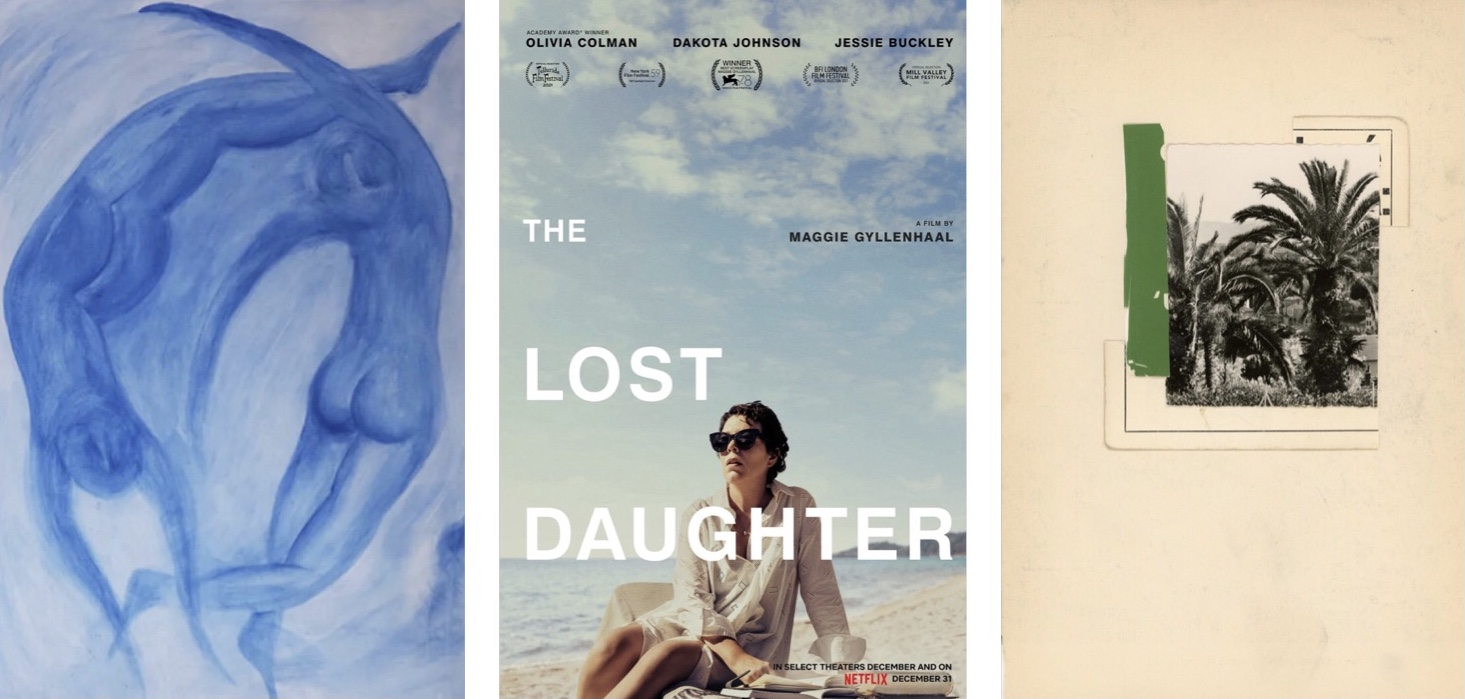
“Bird in Hand. Veronyka Jelinek
Veronyka Jelinek’s minutious editorial compositions capture with skill, wit and tenderness our world, by using observation as a base for imagination, and blending abstract and simplicity with profound humanity. Her animated illustrations become experiences that create emotional attachment, demonstrating how the power of artwork can persist in an age when phone photography is ubiquitous. With individuality, innovation and feeling, she defies the boundaries of the grid, questioning modes of consumption and communication, and making each project a solution and a statement at the same time.
People talk about something because it surprises them, or because it moves them. Veronyka’s work does both. She not only experiments with drive and enthusiasm with different ideas for images, freely leaping from one concept to another, but seeks a sense of adventure, seeks out unfamiliar territory and cultivates it in drawing by hand, too. She allows the accident to occur, catapulting her further creatively. Either way, what we get is not just great design, but art that equates novelty with value, a tool for reinvention, for questioning, for free expression, for social awareness, a visual record of an artist’s experience and her knowledge of the world. Because it is the human connections and relationships that give birth to the best ideas.
Veronyka Jelinek is able to enter any world that she is creating and live within it and express what it’s like.
In our interview, Veronyka and I talk about her fairly early beginnings in art, about the ups and downs of the creative process and why understanding feedback is important, about an artist’s challenging her/his own assumptions and the viewer’s, why she’s such a big fan of Jacques Tati’s “Playtime”, about Pirosmani’s paintings and why she will always prefer human over perfection.
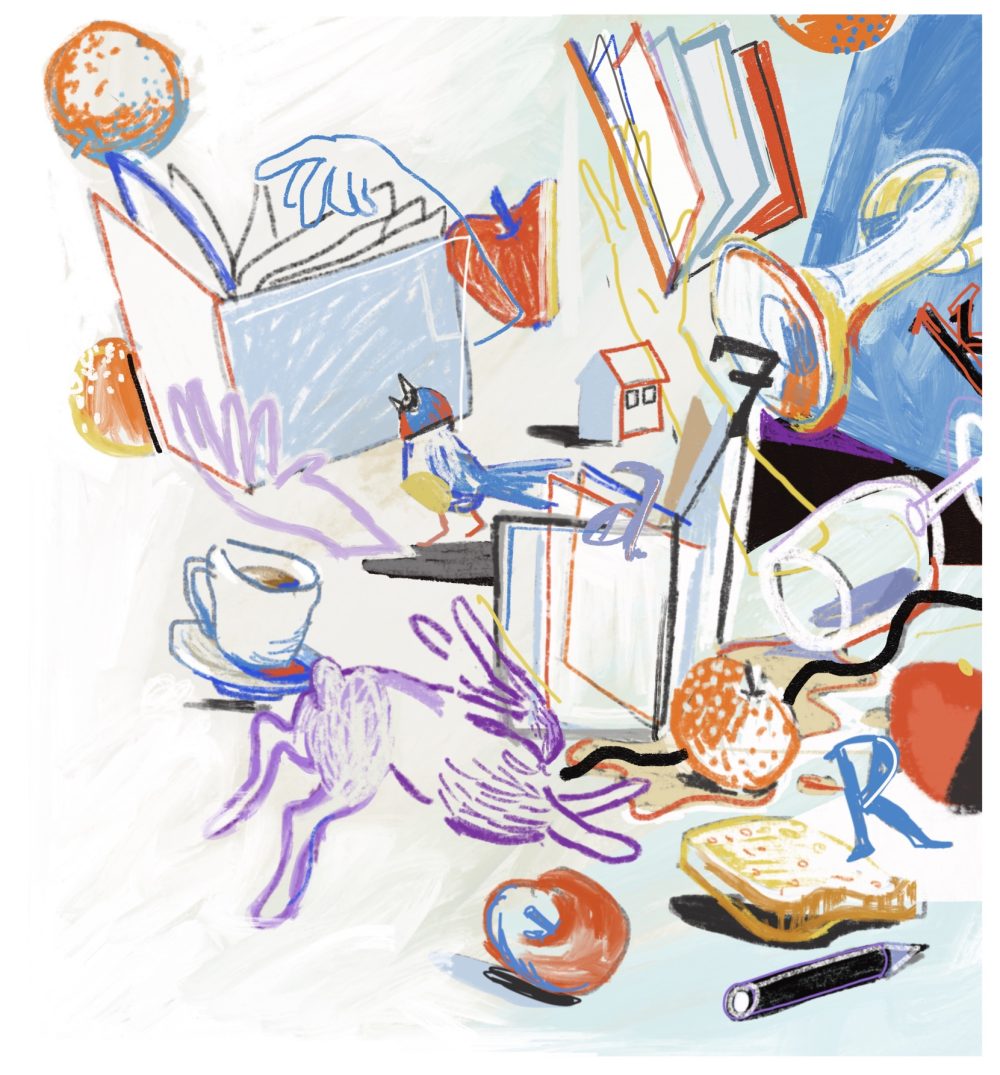
“New York Times Book Review: Any Person Is the Only Self. Veronyka Jelinek
Veronyka, what’s your earliest drawing memory?
Hi, and thank you for having me.
Well, I always liked colour pencils, blue was usually out pretty quickly. I drew mostly animals, figuring out how to make them recognisable and have the correct number of legs — or drawing vast amounts of legs to amuse myself, as one does. I played with gradients, and knew how colours mixed quite early on, mixing them directly on paper. I might have learned certain tricks and conventions way too early. Being quite careful later on to question many of those in a search for a more truthful way of drawing.
Looking back, it always seemed simple to connect the dots, but I wonder if things could have easily unfolded in a very different way, if different things came along. At a young age, we’re easily influenced while being unaware of it. Perhaps I might still wind up doing drawing, maybe I’d just take a different path to it.
Growing up, I had two art teachers — one at school, another at my afternoon class. I didn’t enjoy the school class at all, the teacher felt boring and uptight to me, with too much pressure on realism, subjects I didn’t like to draw.
The other teacher was what you might call a typical painter, wrinkles on his face, simple shirt, a patterned scarf peeking under his neck, knitted vest, a cotton coat paint splashed here and there, and a kind heart. I’m glad I got to know him a little.
I’d be filling out large sheets of paper with broad strokes, drawing owls and water buffaloes at the local zoo or sitting on a curb with pencils and charcoals, trying to capture an essence of a chestnut tree. The way of seeing things shifted, I could see more, maybe understand more. Our atelier was next door to a music class, so while painting a still life of some sorts we often overheard piano, cello, or French horn seeping through the walls (and had painted those too).
Preparing for my exam to enter an art school, he was helping out a few of us with extra hours. We would get together, at times just two students, sitting for each other’s portrait drawings, he would be sitting and drawing with us – I’m happy to have a charcoal portrait of the young me drawn by my teacher (he passed away not that long after). It’s still somewhere in the stack of old drawings, though it is especially the memory that I’m happy to have. He insisted when we grow up, go out to the big world and maybe get a bit more serious, we should always bring with us the roots, the simple things, the haystacks, the mud, sun, rain and raw materials with which we make art.
I had a great math teacher too, and was always inclined to solving all kinds of puzzles. One can imagine I might have gone on to becoming a scientist of some sort. They’re both paths of curiosity, questioning and intuition.
I think every child likes to draw in some way, as part of exploring the world. Depends if we keep at it. It is one more language, a tool that helps us in seeing the world. We nurture it with experience and, more importantly, experiment.
“I think every child likes to draw in some way, as part of
exploring the world. Depends if we keep at it.”
Can you tell us a few words about what your creative path has been like?
Freshly out of school, with no idea how the industry works, I applied for jobs in 3D animation, got accepted in two and took both of them. That was a bit crazy, but gave me a lot of experience in a short time. The little financial cushion I built was welcomed too. I also quickly learned about the ups, and more importantly, how to handle the downs, of freelancing. Peeking into various branches of animation, as they can be quite separated industries, commercials, games, feature films, short independent films, working with non-profit organizations, I was very flexible in using all kinds of software. Leaving 3D in the process and finding my way back to drawing.
Taking a few months break from commissions, I met a lot of great people with similar struggles and dreams, at the La Poudrière in France (quite interesting school where many fantastic animation directors come through). It also opened up the world of editorial illustration for me, and I’ve been running with these two horses since, animation and illustration.
I’ve been fortunate to collaborate on some very nice projects over the years and met a lot of nice people. It’s been sad to see some art directors I have worked with slowly disappear, changing their focus or even leaving art direction altogether. Making images is about relationships too, and finding the right ones for you.
“Making images is about relationships too,
and finding the right ones for you.”
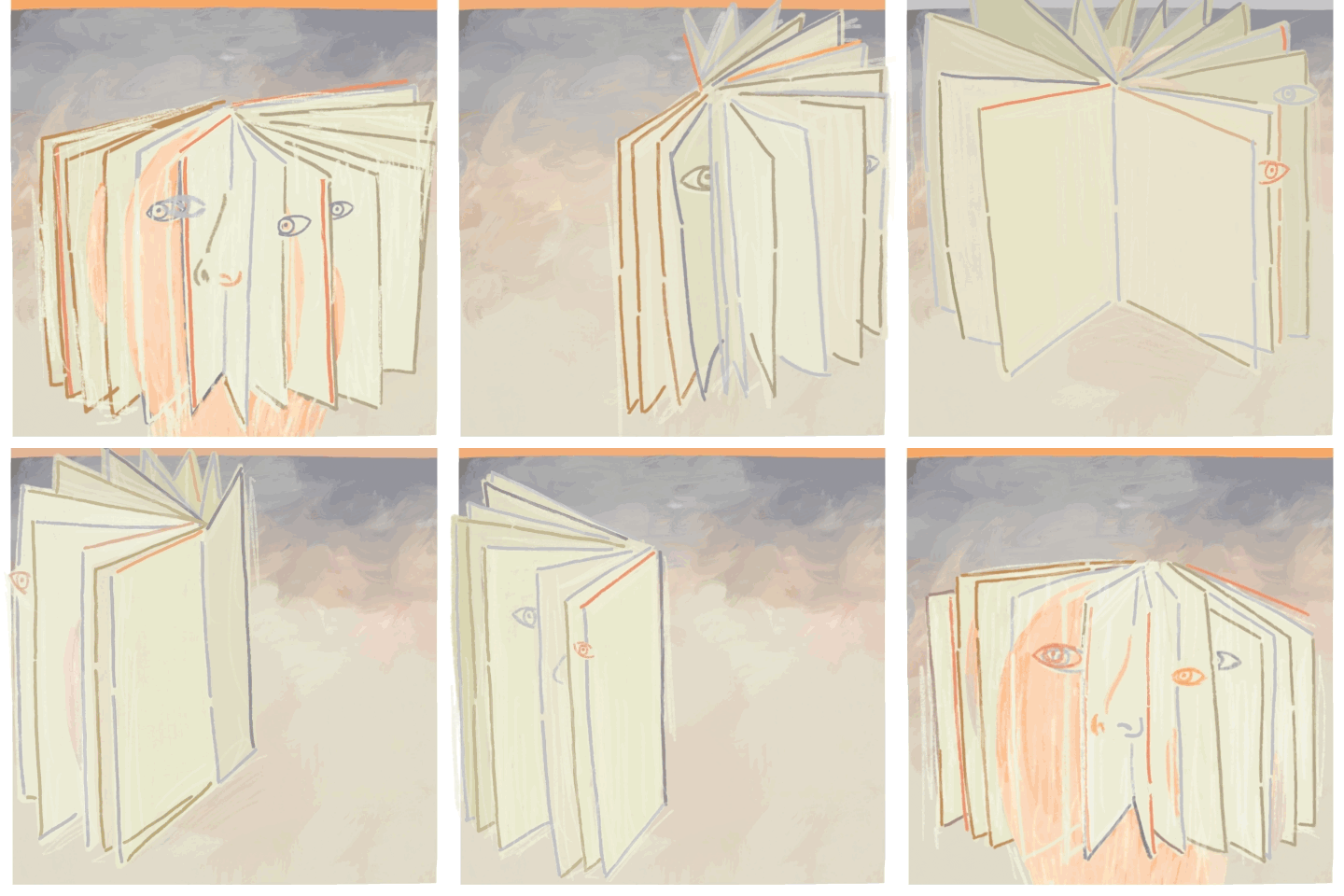
“New York Times: Reading a book from start to finish. Veronyka Jelinek
You mention leaving 3D animation and finding your way back to drawing. Was that something you had wished for? And this is something I always come back to whenever I am thinking of how differently illustration and drawing, especially by hand, as opposed to other ways of image making, communicate: You – you, as an artist, but also the viewer – remember differently with drawing, don’t you?
I agree, drawing, seeing the hand of a person behind it, has a certain power to it. The slight imperfection of the line is in fact perfect in its expression, it speaks, reaches you. Also painting or handmade ceramics.. there is something tactile about it, it has a feeling, it exists.
The brief 3D journey was a practical choice for me. You could focus purely on the motion, as the roles in a 3D production are, most of the time, separated. In commercial art, there could be a tension between your ideal project, the one that comes along, and choosing the compromise you are willing to make – with experience, and growing as an artist, hopefully that gap closes as much as possible, finding the right projects for you. I think, at that time, I wasn’t yet ready to work in animated drawing in its complexity, so 3D was a first step into the working environment for me.
In animation especially, I think it’s great to experience different techniques, drawing, puppet, 3D, flat paper, objects, clay, sand.. Puppet animation is very tactile, you feel the texture in their movement and presence. Especially the felt made puppets have a charm to them. Each of the techniques opens up a different understanding of the motion, the volume, timing, spacing, silhouette, light.. So going through all of those enriches the drawing in return. I like drawing for its plasticity, it lends itself for morphing images, and the control over each frame is instant. I like to take in all the aspects at once when thinking of an animated image — the character and texture of the movement, the composition evolving in time, the visual look, all coming together in an organic way.
Though I’m also intrigued by the collage approach, which I think connects to the montage in animated film editing. Putting two or more images together to create context, a new meaning that sparks between them. I like to explore this correlation, in editing, in collage and sometimes treating a drawing as if it were a collage.
“Drawing, seeing the hand of a person behind it,
has a certain power to it. […] There is something tactile
about it, it has feeling, it exists.”
What is the most valuable lesson that you learned at art school and what is the most important skill that you have honed as you’ve evolved as an artist?
Well, at the end, you have to teach yourself, you just have to do the work yourself, find yourself. To have someone who really supports you is rare — I think usually other people have less ambition for us than we do for ourselves, so it’s on you to kind of prove yourself and find out what is important for you. People tend to judge mostly based on accomplishment, not so much intentions. So building a solid portfolio of personal work is a good step forward. I think experimentation is really key. Not stopping yourself from going through the process, not judging oneself too early, there are low points in any creative process —pushing through those is where interesting solutions come from. So, staying true to yourself and trying not to lose that special spark along the way.
It’s useful to understand feedback. Especially when working with clients. In my opinion, when there is (negative) feedback, you should notice the issues, but not necessarily listen to the suggested solutions, the solutions should come from you, formed by your own vocabulary. Often when people feel something doesn’t quite fit, might mean you need to actually push more not retrieve, to make your choice more intentional and confident.
“There are low points in any creative process —
pushing through those is where interesting solutions come from.”
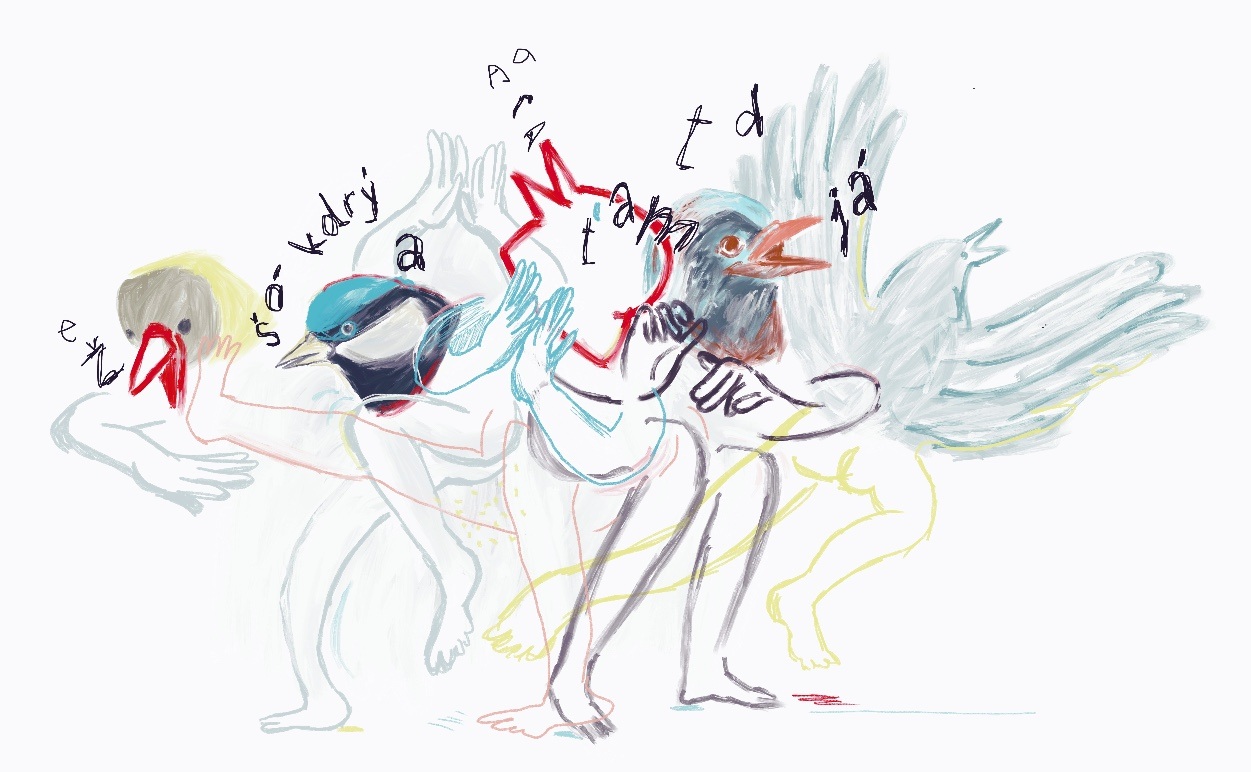
“Freedom of expression. Veronyka Jelinek
You do editorial illustration and you have collaborated with some great print publications. One thing that fascinates about illustration is that it can create a whole new reality of its own. What do you seek to bring new to the editorial? How much of the story does the image, in illustration, have to carry?
Editorial illustration, books and animated films are usually constructed with some sort of text or narrative in mind. Finding the very core ideas, bringing those into images, together with the right feeling. Not only the ‘what’, but the ‘how’. I’m often careful to ditch the most predictable or obvious options too early, as something quite good could arise there if turned around in an interesting way. I like to dive into diverse subjects, from science to book reviews or opinion essays — always seeking a certain honesty, slight poetic twist, the right mood.. I hope to bring images that in some way see beyond the surface of things. Play with concepts, pushing the visual narration, say more perhaps in a less usual way.. I think it’s important to be thoughtful, and also try to pitch solutions that might be unexpected. Often those would be the ones picked, and if not, at least we should try. Images communicate in a way that will always be interesting to me, that I’d like to explore again and again. I think that a great image is not necessarily the one that says it all, but one that inspires something in you.
“In the end, you have to teach yourself,
You just have to do the work yourself, find yourself.
To have someone who really supports you is rare.”
I loved your illustration for The New York Times essay “Let students finish the whole book. It can change their lives”. You have collaborated as illustrator on the children’s book Jirka in a Cube. Books not only foster children’s minds and imagination, but they are probably the easiest and most effective way to make important and sensitive issues understandable to children. Have you thought about writing (and illustrating) your own book?
Thank you. And yes, I agree, children’s books will always have a special place for me. Many books from my childhood formed me in some way in visual sensitivity and taste. I would spend hours flipping through pages, studying the images in great detail, an easy child to leave alone without worry. Similarly, I could watch patterns on curtains or a wallpaper and untangling the repetition in them, the lights of a passing car running over a ceiling at night, distorted reflections in spoons, my kaleidoscope, looking for the right little stone to carry in my pocket, observing bubbles of air suspended in layers of ice on a frozen lake..
My mum had a very good taste for children’s books, and of course there is a very rich tradition of book illustration in Czechia altogether. Some of my favourites were Adolf Zabransky, Jiri Trnka, Alois Mikulka, Mirko Hanak, Karel Benes, Jindrich Kovarik, Daisy Mrazkova, Kveta Pacovska or Jiri Salamoun. And nowadays we have a strong young generation too. I have always had a soft spot for rhymes, especially ones with clever playfulness or poetry of life in them (many of those I still remember today), discovering that images and poetry are able to say things that would otherwise sound odd in ‘normal words’. I had one particular book that became quite special to me, called An Island where Violins Grow (Ostrov, kde rostou housle) — an anthology of poems but, more importantly, the graphic design was unexpectedly bold and the illustrations were reproductions of fine art paintings, drawings and collage from a wide range of authors, like Paul Klee, Henri Rousseau, Picasso, Chagall, Magritte, Frantisek Kupka or more serious drawings from authors I had previously known only from children’s illustration. It was an eye opening book for me at that time.
I considered taking a book illustrator path when starting my art studies — feeling very distant and unlikely to me, I then chose design instead. Which was interesting, though a bit restrictive, and I switched to animation at the university. Taking a circle back to books, I’d love to get more into illustrating for children collaborating with other authors, and draw for book covers. I have a few book ideas of my own in a drawer, so, yes, I hope it will happen in some form.
Children’s books especially come with a feeling of responsibility — getting close to the very young minds, that are open to everything, these books are often read again and again. Luckily, there’s some support available for children’s books in Czechia, and a lot of great books are coming out. Though it is baffling to see something as important not receiving little more care, as the industry is known for tight budgets across many countries.
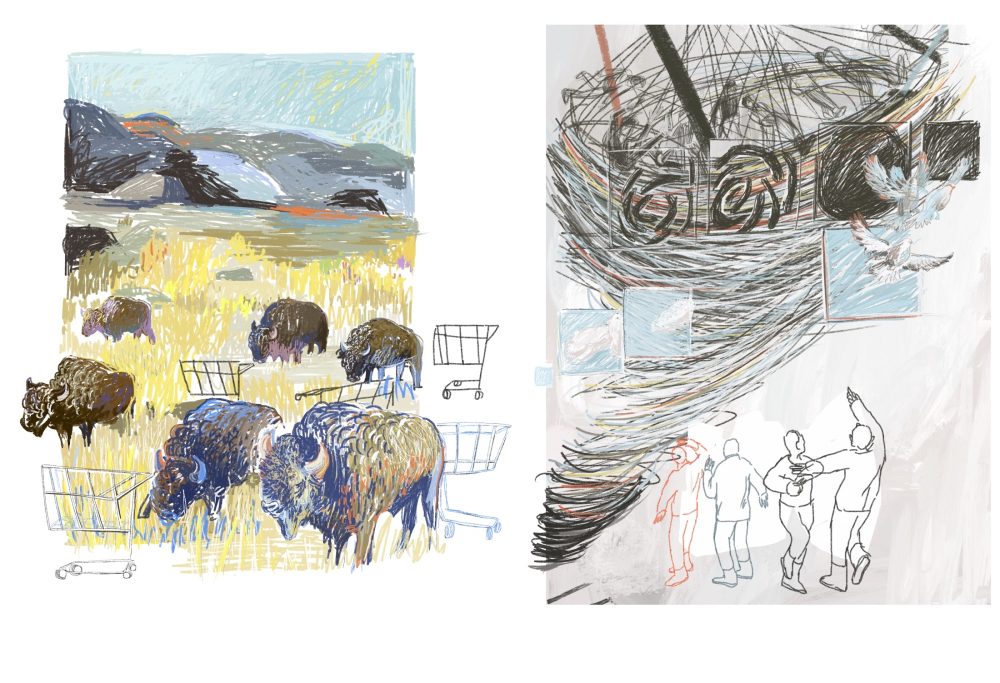
“Host: Essay on politics in the US. Veronyka Jelinek
“I think that a great image is not necessarily the one that says it all,
but one that inspires something in you.”
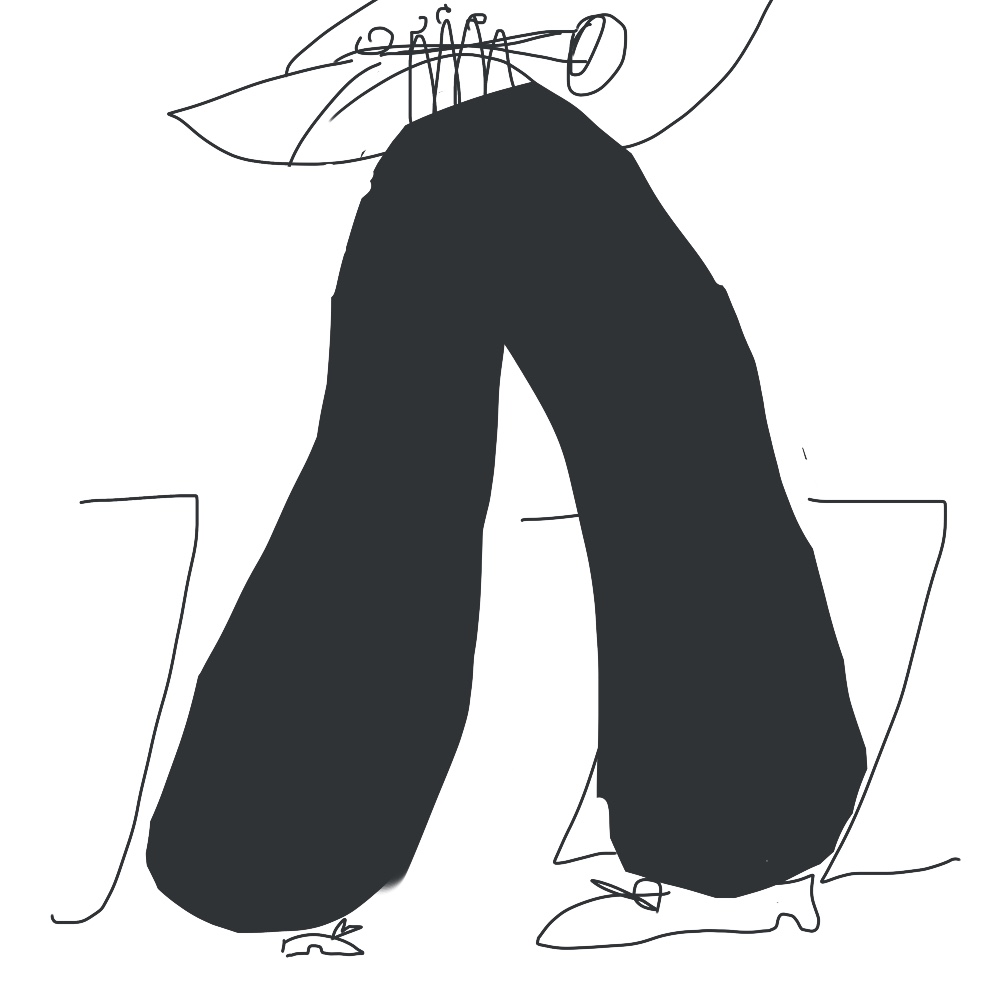
You are right, children’s books come with a feeling of responsibility. They need humour, fantasy and illustrations that feed their imagination, they also need some realism in them and it matters how that realism is handled – and a successful pairing of the writer’s storytelling voice and the illustrator’s visual language plays a huge part in that. And as long as we are on this subject, what would be your favourite author-illustrators collaborations for children’s books?
I often like author books the best, a one person vision, so the voice can be really unique in both ways. If to name just one, it would probably be Jockum Nordström.
But what I enjoy about children’s books, and I think it’s quite important, to have a variety of different styles, some more realistic, others more dreamy or funny, painted, drawn or in collage or whatever style it might be, delicate or bold. I think it’s comforting to know there is not just one way to make a book.
Absolutely. A variety of styles and voices give children confidence to find their own. Speaking of which, who are the artists you look up to? And who and what else inspires you daily?
There are so many great animation and illustration artists nowadays that it would be very hard to mention just a few. Some images that I often come back to include painted animations by Georges Schwizgebel, Rybczynski’s short film Tango or the motion captured by Muybridge – there’s some basic fascination in movement, time and mechanics in all of those. An unspoken narrative that we project ourselves, contemplating on life or what does it mean to be human. They sort of heighten the reality, turning focus on simple yet important things. Similarly, I can lose myself in old photographs — people of the past, erupting volcanoes, nature, as they can feel almost otherworldly at times.
I think that’s what draws me to animation, too, short animated films have a certain quality of observation and transformation in them, a texture. I love to watch a world reimagined through an animated lens, where movement is broken down to less frames, where ink, paint, lines or cloth form another world that reveals something about the real one.
I enjoy raw drawing, like the unspoiled hand that shines through Pirosmani’s paintings, in his feasts, his majestic animals full of soul. His images somewhere between a painting and an illustration, there’s something very basic about them, coming from folk art or a connection all the way back to cave paintings, in the way he is capturing the life.
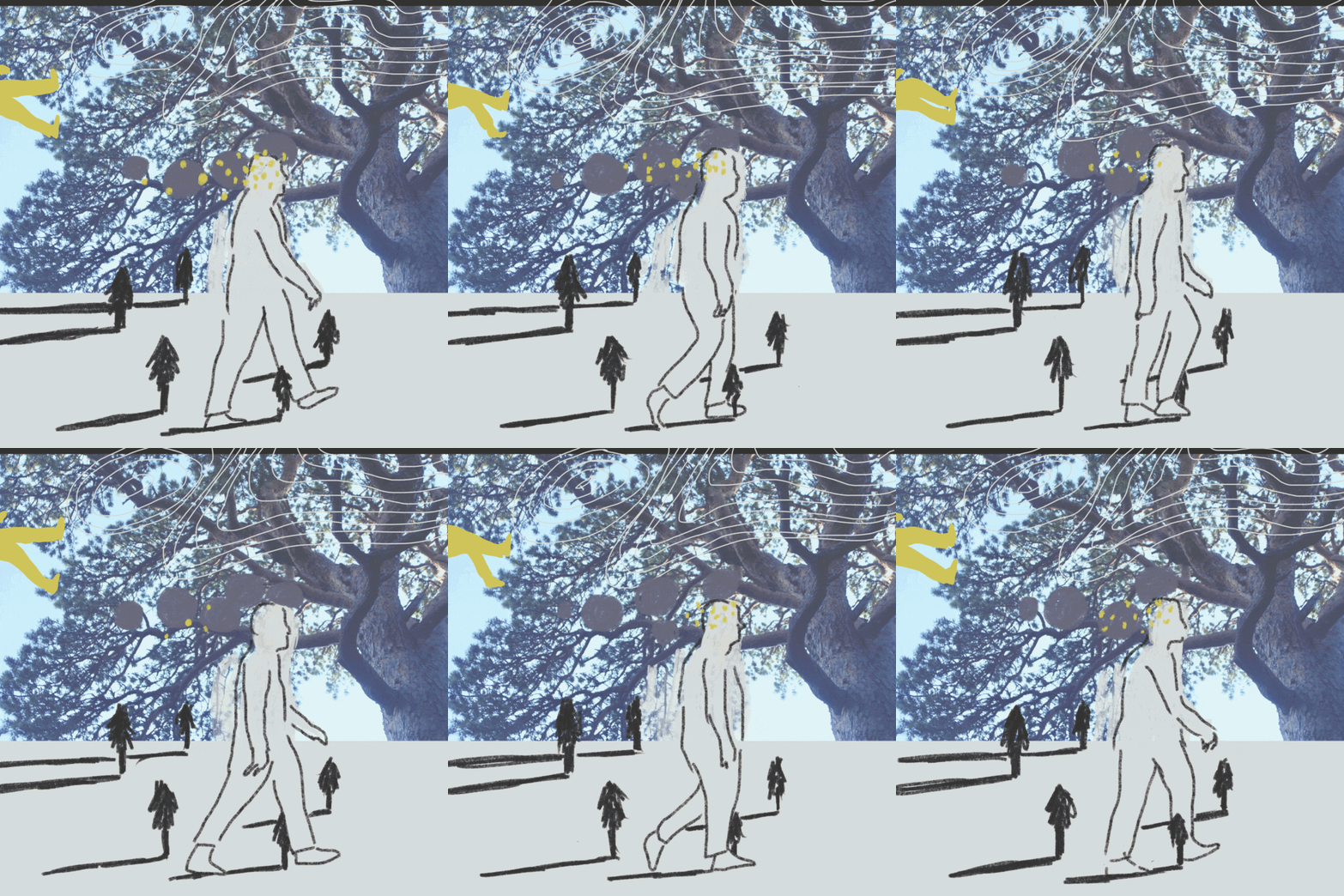
Forest memory. Veronyka Jelinek
“Short animated films have a certain quality of observation
and transformation in them, a texture.”
I’m rewatching a series, On painters with Tom Keating, a painter with heaps of knowledge and a soothing voice. You rarely come across a teacher who would be able to share and articulate as much as Tom Keating.
Someone speaking about their work, process, life and thoughts is an interesting one — Bill Cunningham is a marvelous and humble figure. Or Martin Scorsese, how he sees the cinema, his journey through it.
Cinema plays a big role — I would go alone to the local cinema film club at quite a young age, and I probably saw some films too early. We’d be often only a few people in the theater, but there was always a spoken introduction about the film and director, which I thoroughly enjoyed, slowly realising how films are made. I think I got a solid overview of all kinds of cinema, also animated from many different countries and times. In Central Europe, which in fact is or was Eastern essentially, as a former Eastern block — Central is kind of an euphemism for being stuck between the West and East.. the Western culture was coming with a delay in many ways, we would be watching TV in an interesting mix of contemporary and one or two decades-old shows that were new to us at that time.
Later, when studying and working abroad, in Scandinavia, France or The Netherlands, I became more aware of the cultural differences, and hope that images can connect across. However there are differences in how people see images, or what is expected of an image (for example, see this article on editorial illustration in Japan).
To pick some of my favourites now would be Chinatown, A Serious Man, Fox Catcher, Manhattan, Roma, Phantom Thread, Shoot The Piano Player, Le Samuraï, The Long Goodbye, Big Sleep, Aviator.. there are too many. Recently I enjoyed Nouvelle Vague about the shooting of Breathless.
When growing up, my absolute favourite was Man on The Moon, later I was a big fan of Tati’s Playtime. So, I think I have a taste for the peculiar. And, of course, the terrific sequence — in perhaps a lesser known, Le Magnifique (The Man from Acapulco). If you’ve seen it, you’d surely remember the cleaning lady coming in the midst of the shootout on a beach, casually walking with her vacuum cleaner over the sand paying no attention to the gunshots, entering a door completely out of place, cut to entering a room where the writer lives, disturbing his narration of the book he’s writing.
I also watch a lot of old films for the quality of their image and sound, there’s something special in them, like Breakfast at Tiffany’s or Vertigo. I’m coming back to the series Northern Exposure, especially the early episodes, there’s a lot of cinema playfulness in them, great characters, mood, the music. It’s a rare one and, in a way, it exists against all odds. Of course I need to mention the graphic novels by Chris Ware, the mood of his narratives that span decades, watching his characters cope, his point of view — sort of distant yet in the same time so piercingly personal.
Time is an interesting one — timing in animation or cinema, choosing the pace of things. Still image is so silent, waiting, you can watch it for whatever time you want to spend, for a second or hours. Film flows, and committing to a pace is a choice — I hope there still be slower paced films made in the future. I think we need them.
“Film flows, and committing to a pace is a choice —
I hope there still be slower paced films made in the future.
I think we need them.”
Observation is enjoyable to me – another example could be the intro sequence to John Mulaney’s Everybody’s in LA. Speaking of which, great comedy. Any form of art, when done well, is inspiring, when things come together in that special way. And I find inspiration in many things — though usually they have something in common. It might be art, paintings, sculpture, drawings, sketches.. something about it touches me, some form of truthfulness, makes you feel alive.
In daily moments — especially in nature, encounters with wild animals, hearing bird’s wings, experiencing nature’s rough beauties, the moments where I forget myself. I’m looking for honesty in expression. I’m fascinated by children’s drawing, old cave paintings or stone carvings, their quality of line strokes and forms, their special way of viewing things. I think it’s important not to forget those connections to our past. I will always prefer human over perfection. There’s some form of timelessness in it, where I feel I understand the human behind the image.
“I will always prefer human over perfection.
There’s some form of timelessness in it,
where I feel I understand the human behind the image.”
When working, I’m looking for a quiet place, not listening to music. I need space to connect with myself, with that feeling of focus and inspiration, connect to the topic at hand — that is especially true when animating, but drawing as well. I want to feel the sense of movement and character — I almost need to become a rabbit to draw a rabbit, or a cloud or a hand or a running person, and then aim to capture that feeling.
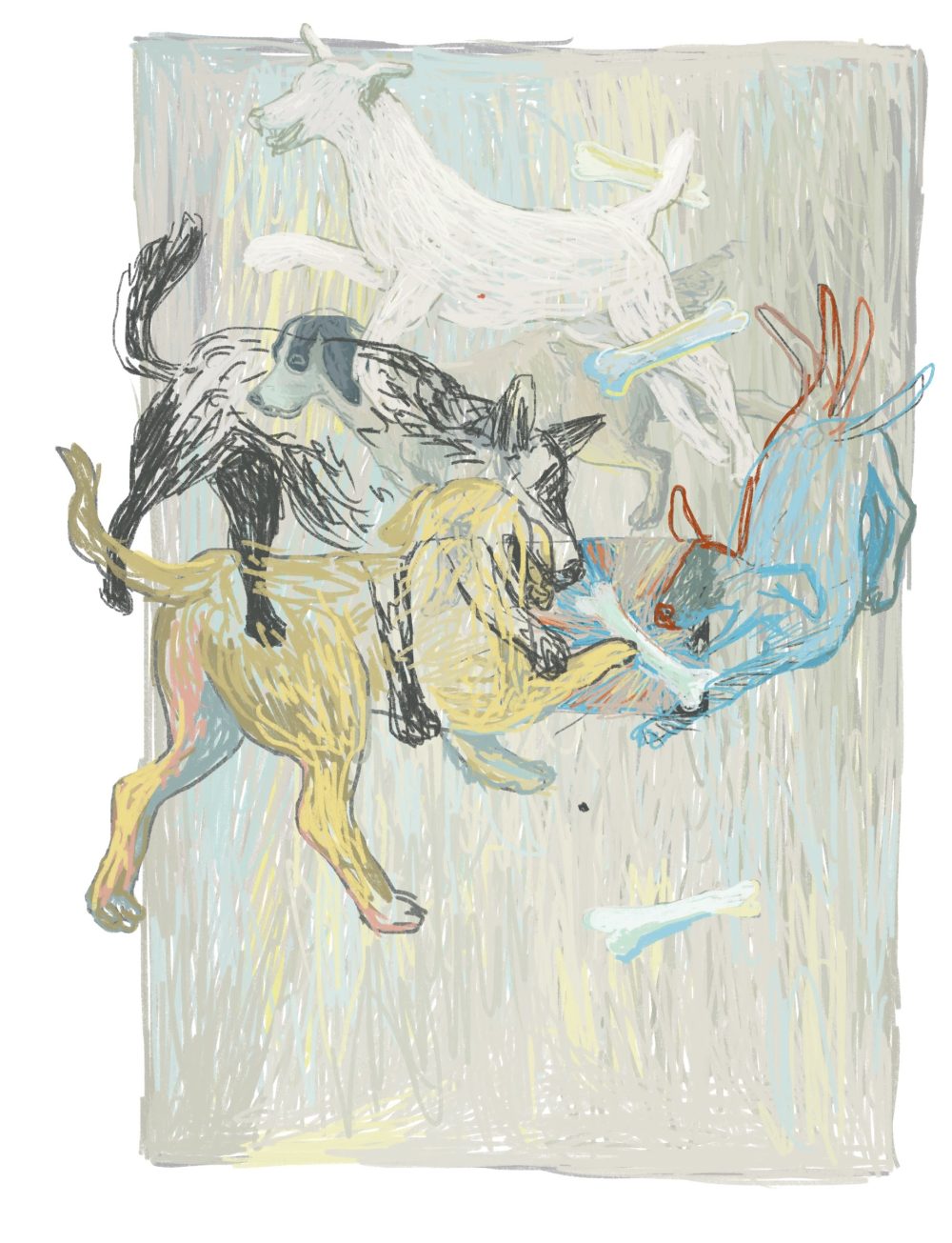
“Host: Essay on politics in the US (3). Veronyka Jelinek
“I want to feel the sense of movement and character —
I almost need to become a rabbit to draw a rabbit, or a cloud
or a hand or a running person, and then aim to capture that feeling.”
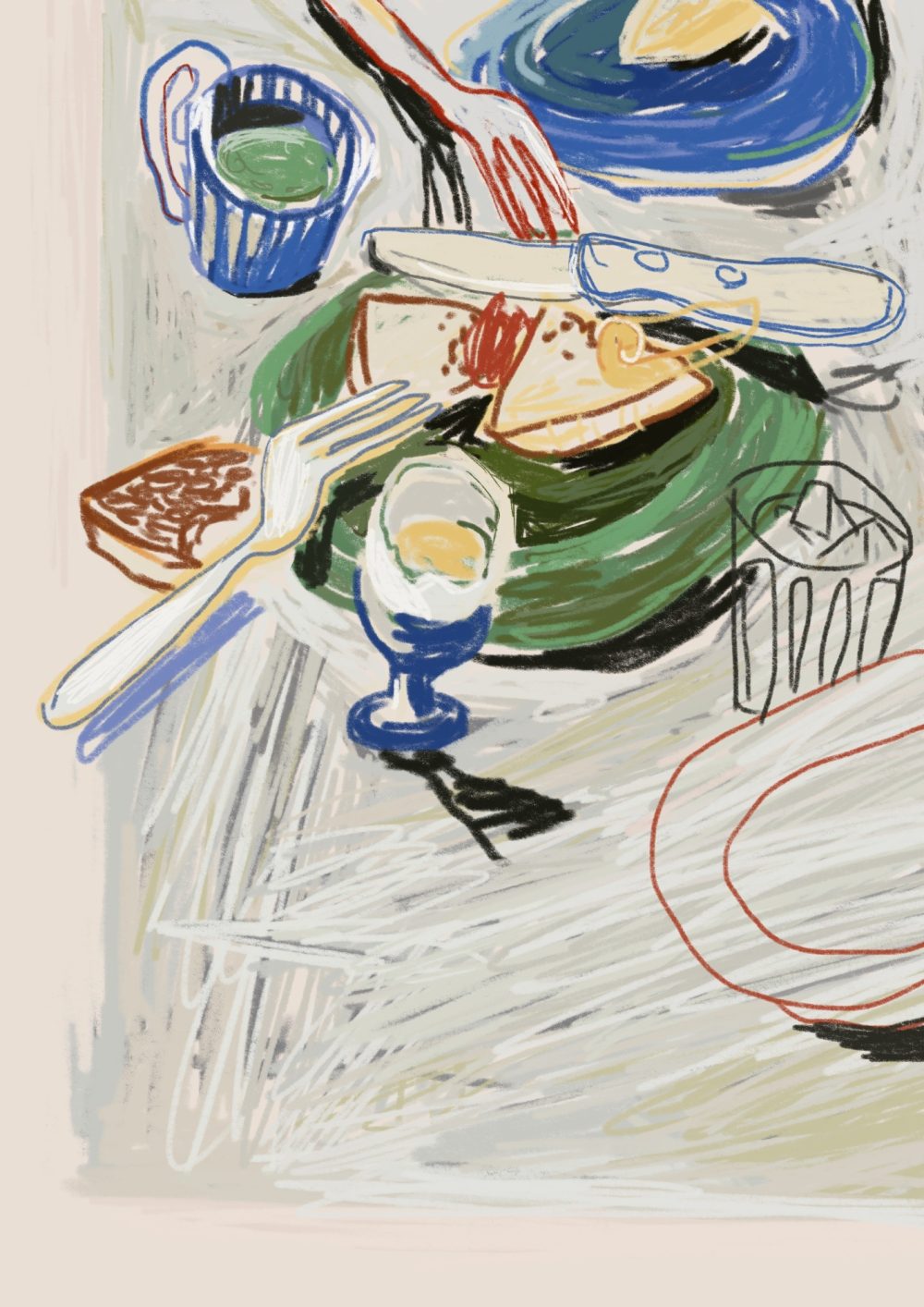
From the table. Veronyka Jelinek
I don’t know why, but I already knew I wanted to ask you whether you prefer to work in silence. Do you have a favourite quiet place when you work?
I have a small studio at home, quiet and calm. I like to work alone or alongside my partner present nearby.
I could never work in a cafe, as I often hear others might enjoy. Not only the audible noise, but the moving people are not white noise, but a distraction to me. Unless, of course, you’re drawing from life. When your mind is tuned on sensitive, openness, observation, noticing things and connections, it’s not that easy to switch back and forth. I used to work in a shared office before, where it is almost a norm that everyone listens to their own music on the headphones, to create their own mental area. I notice how the work was much more on the surface compared to now, when I take effort to create a ‘safe space’ for it.
I feel similarly of other forms of noise, like, for example, I try to be as close to the drawing as possible, avoiding too much technology or software in between the hand and the drawing. If drawing digitally, I often restrain from using the undo button, and prefer drawing over and over to find the right shape of things. I like to shape the process itself to feel immediate, a natural flow. At times, you can feel the image take shape almost like if chiseled away, sculpted one line, one decision at a time in a process of directed intuition.
I think that process takes an imprint on the outcome. And even sitting at a computer or a desk could change that relation. I prefer to keep my process more relaxed whenever possible.
Eventually, I hope to be also able to bring some of my more free style drawings or abstracted animations towards getting commissioned, that’d be really rewarding.
“If drawing digitally, I often restrain from
using the undo button, and prefer drawing over and over
to find the right shape of things.”
And yet, what is your relationship to music? I am asking because, first, I caught a glimpse of a few jazz LP covers among your works, and second, because illustration, and graphic design, lands itself differently on an album cover, it can capture an entire album in the choice of colour, line and pattern used.
When I listen to music, I like to listen to it intentionally, not as a background. However, lot of music comes to me through the cinema. The Jazz album covers were a side project of mine, to get drawing going on a common topic, of course there is an energy in music that sometimes almost leads the hand, asking to be conveyed through an image. I might get back to this series, as I don’t think I’ve succeeded yet in catching it on paper. To draw music, since it has a rhythm, texture, mood, layers, evolves in time — it’s a bit like movement, like animation that is condensed into just one frame, which I’m also intrigued to play with. To play with layers.
To mention some artists I come back to, would probably be Django Reinhardt, Esbjörn Svensson Trio and Nino Rota. And ‘Stormy Weather’ by Ben Webster recording from Copenhagen 1965.
It’d be a pleasure to collaborate with music artists more often, either on album covers or music videos (I have worked on one, though haven’t directed myself). There’s space for abstraction, play and unexpected choices. Sometimes when listening to a song, my animation director’s mind takes over. So, I have a few imagined music videos stored in my head that trigger every time I hear that track.
“There is an energy in music that sometimes almost
leads the hand, asking to be conveyed through an image.”
Can you share a few favourite album covers? And who would you like to direct a music video for?
No particular favourite one comes to mind right now, and, to be honest, it is quite rare for me to come by a physical music album.
For a music video, I’d say if someone likes my images, there’s a big chance I’d like their music, so if anybody is interested just drop me a line, I guess! I can see myself making both more abstracted and loose animations, experimenting with various techniques, and also narration based ones. Altogether a music video is an opportunity to get loose and find possibilities of moving image that wouldn’t cut it in most other formats, I think it can be a great place for growth.
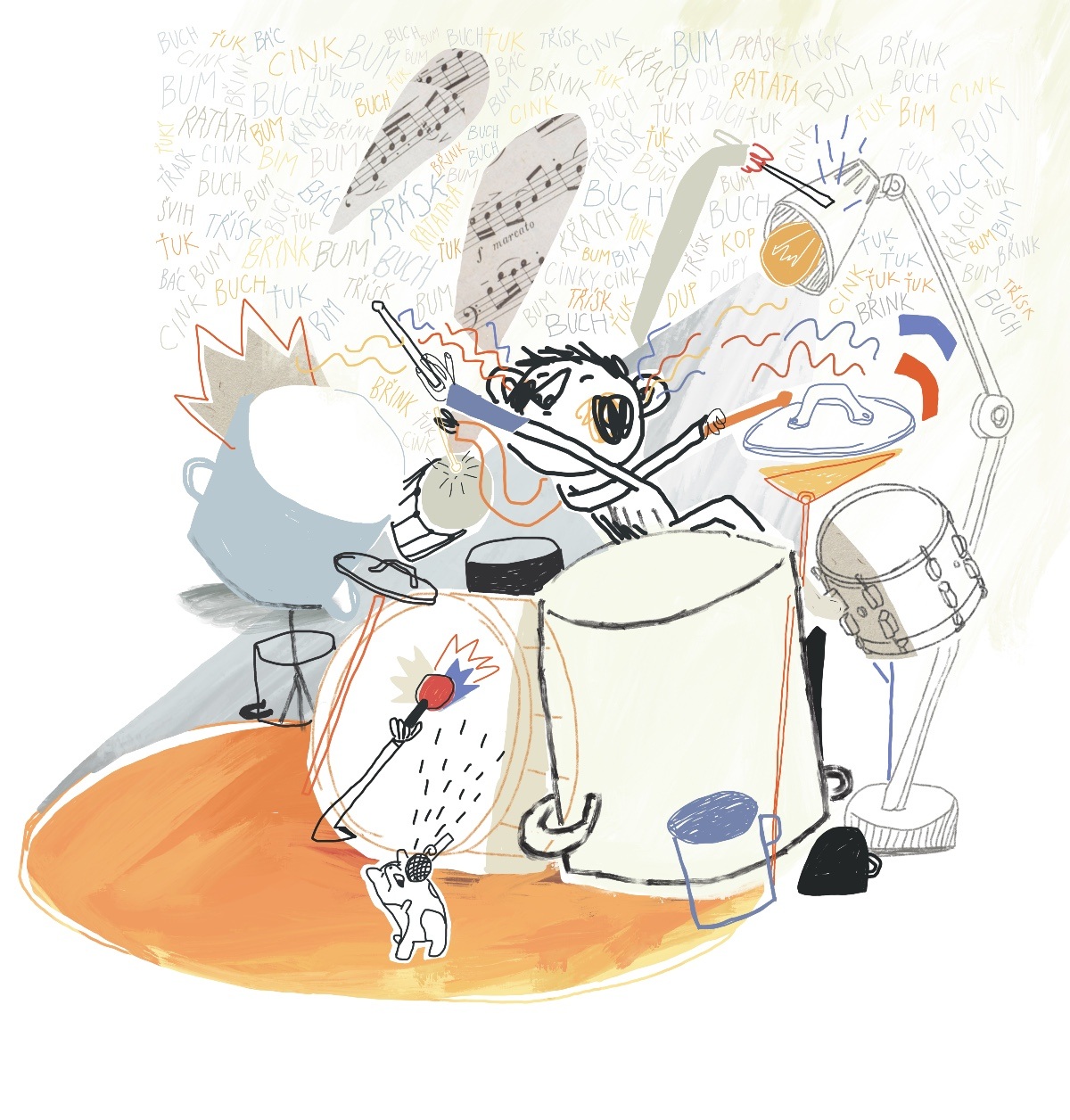
Thank you for this great list of artists, films and filmmakers, art in so many forms that has informed and inspired you along your creative and personal journey.
I love that you mention slower paced films. Yes, I believe we need them, too.
And I also think it is time we revisited Jacques Tati’s films. Not only because he was a filmmaker of great visual sensibility, but he still can, decades on, just through images, make us question our modern ways and values. And the most extraordinary part is that he does that through humour, humour that is almost entirely visual.
And speaking of visual creativity, I have always believed that the animated short film – you’ve mentioned it, too – is a space of infinite freedom. It is a medium that allows each film to invent new universes, new ways of making.”
I notice I’ve mentioned many examples of film noir.
I love noir.
Maybe Playtime could be almost also included as one, since it has a main character sort of silently lost in the world, trying to make sense of it all — aren’t we all? There might be something in Tati’s films that feels similar to what Sempé does, his illustrations are gentle while putting a person in relation to the environment, with a hint of humour, but also a sense of loneliness. I was happy to see an exhibition of his works in Prague, and went through all of his New Yorker covers when he left.
I love Sempé, too.
To get back to short animated films, it is a perfect format to do exactly that — invent your own way of telling, your rules or non-rules, your images, how you edit them or how they relate to sound. There are so many aspects to a film, it can be overwhelming to attempt creating one. I guess your only limitation in creating your own universe within a short film, would be how much of your lifetime are you ready to devote to making it happen, since although wonderful, it could also be quite a demanding medium.
The latest one I saw was a personal story without words, inspired by a distant relative who disappeared in a forest: Whose Woods Are These by Kate Nartker. I enjoyed how the film didn’t explain anything, as nobody knew what really happened to her. The film being a set of impressions of a forest, the night setting in, a figure entering it, all done in weaved textile with an intense texture to it. Refreshing.
”[Jacques Tati’s] Playtime could be almost also included as one
[film noir] since it has a main character sort of silently lost
in the world, trying to make sense of it all — aren’t we all.”
I am going to look this film up and watch it. What you are saying, about the fact that you enjoyed how the film didn’t explain anything, is something I often think about. I wish more movies which are made today would let the images more to carry the story. Do you think we, as society, will overcome this tendency to overexplaining things today, and place more trust in the audience to discover things for themselves?
Yes, certainly, watch it if you have a chance, I think you’d enjoy it too, the technique used is really interesting.
This is debated quite a bit I’d say. Show, don’t tell, and sometimes perhaps not even show really. My answer would be it depends on the material first, that would decide a bit in which direction you might want to take it. More than a shift, I would expect polarisation, some images will be explanatory and some go the other direction. Smaller films or certain subjects. Also, it depends on how visible you want your choices to be – if you use the cinema language to make a certain feeling come across through colour, edit, blocking or choice of light and lenses etc., you oftentimes want them to be felt, not necessarily noticed consciously.
The other problem is usually the financial backing, as long as you prefer your film to be for ‘everybody’ to get your money back, then you will probably make certain choices to get there.. and lose some part of the audience because of that anyway. Film is different from a book, each medium can do certain things, but there are also not so great books as there are not so great films, and not all seek to be great in the first place.
I believe it was Hitchcock who said that there was no need for cinema to abandon the language of the silent film era the way it did when sound came to be. The pure visual narrative constructed through moving images (and occasional written cards). In some sense, a lot of animated short films and some features (I liked The Red Turtle by Dudok de Wit) keep closer to this way of communicating, or going even further with morphing, dream sequences, camera moves (Mind Game does really exceptionally in mixing an action filled drama with sequences of contemplations on life and death).
When film was in its infancy, you could already see some potential developments, film as a documentary, film as a narrative where edit started slowly to take place, and film as a fantastic theatre in the Georges Méliès (also narrative) way. Seeing some of the very old documentary sequences, they almost felt like an abstract cinema to me, since they were at times non-narrative really, just a long shot of fish swimming in an aquarium captured on film, observation. Images magnified through the medium.
If I look around, especially in editorial, there is a visible shift recently towards the less obvious — however, having text alongside, you are invited to be not so specific and you’ll still get the point across. After all, not all images are supposed to be narrative and that’s a good thing – we need both.
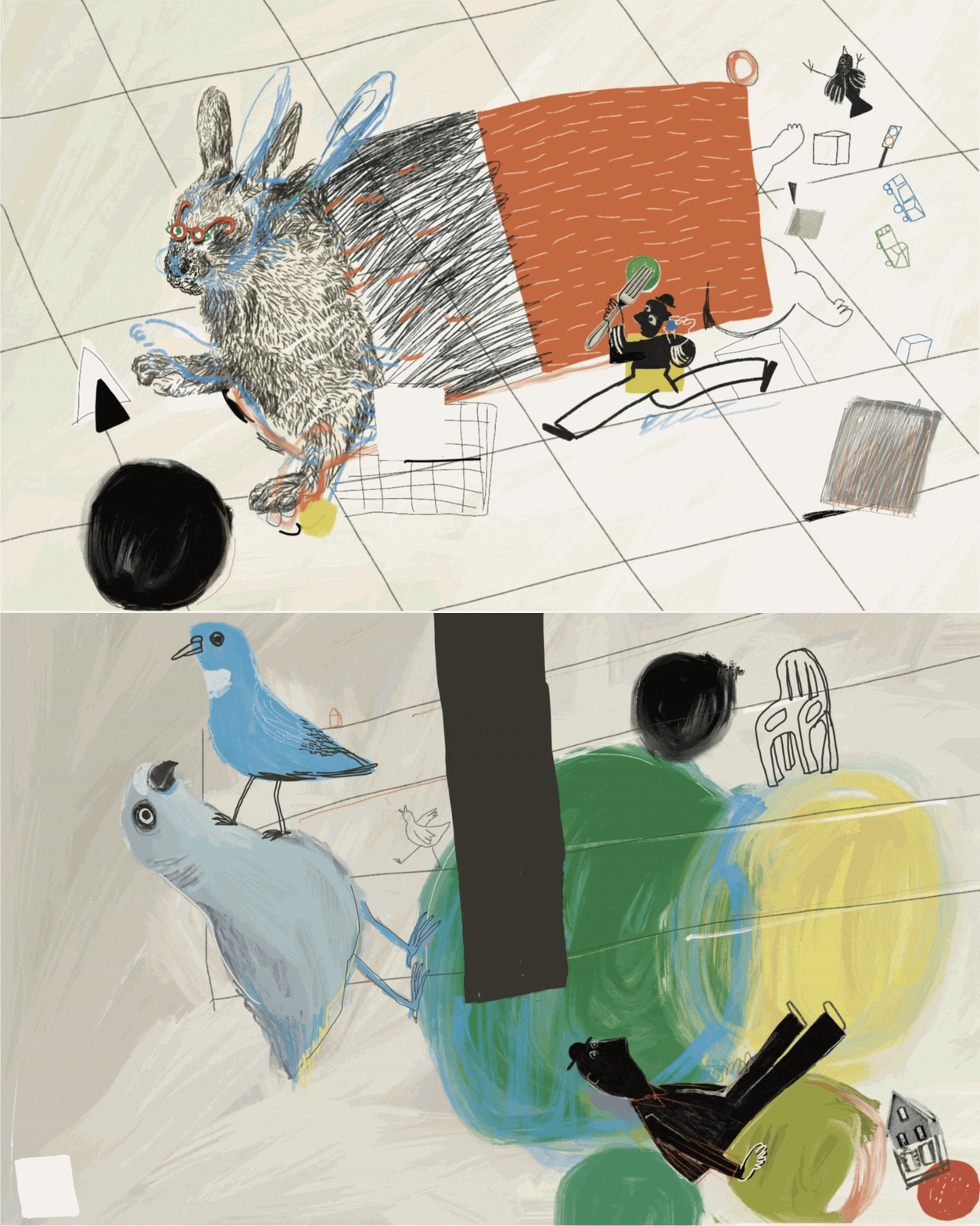
Book illustration: “Marcovaldo”. Veronyka Jelinek
Have you considered film title design or poster design?
Yes, that’d be a great area to explore. One has to bump into the right people to make it happen, I guess. I’ll put it on my list.
And lastly, Veronyka, in this time and age, what do you wish people appreciated more?
I guess, being happy to be alive.
As people, we have created quite complicated systems for ourselves to live in, so I think it’s worth remembering perhaps you don’t need to follow all of it.
Other than that, spending time in nature is worth a while.
Website: veronykajelinek.com | Instagram: @veronyka.jelinek
MORE STORIES
“We are the postmen of the past who leave letters to those of the future”:
In conversation with Ana Gurduza
The Lost Daughter: In conversation with costume designer Edward K. Gibbon
“You only need to assemble, or even easier, distract”:
In conversation with collage artist Vesna Vrdoljak