Sean Connery on the set of “Goldfinger”, 1964. Eon Productions
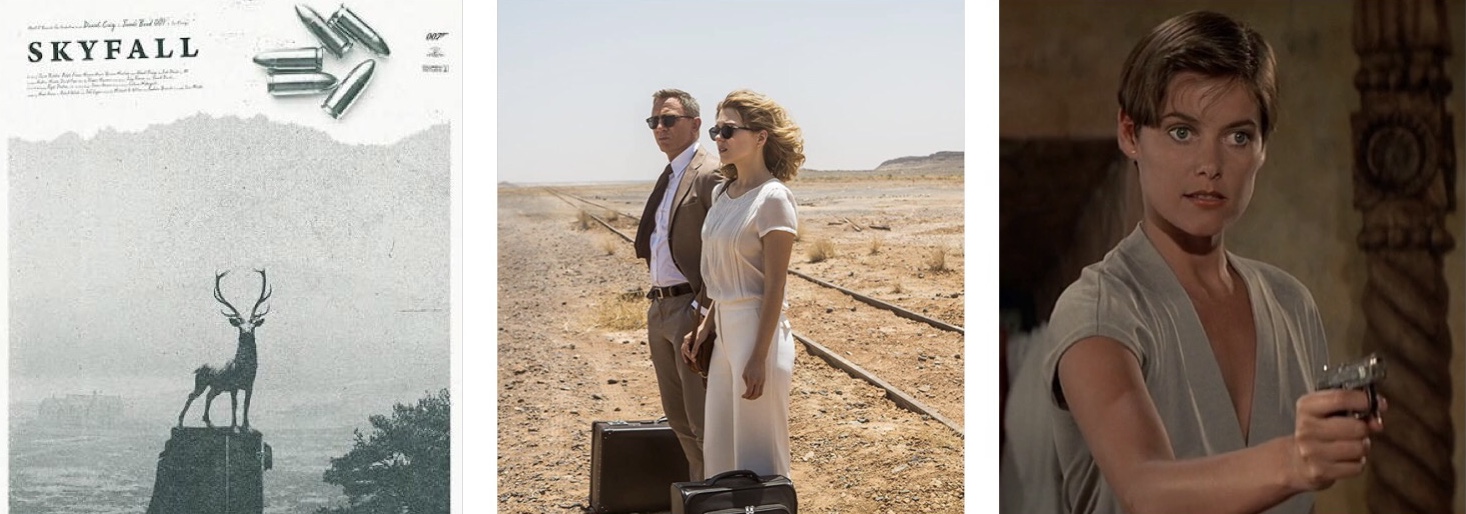
When the rusty fallen leaves ruffle under your feet and the fog moves in, I instantly think of a few films: Les choix des armes, with its distinctive cinematic language, fashioned as a sublime study of human behaviour in a modern social environment, and a medley of timelessness and aristocratic country elegance naturally carried out by Catherine Deneuve (a Chloé fall fashion campaign could take inspiration from her look here) and Yves Montand’s great screen presence, La cercle rouge, a Jean Pierr Melville technical and stylistic mastermind creation, and Skyfall, my favourite and indeed the darkest Bond film). It’s again a personal story, just like Casino Royale, another firm favourite of mine, which goes back deep into the character’s past to confront his demons, and I love how Matt Needle’s poster design taps rights into that. I love everything about this film, really, from its title – “I think Skyfall is a great title for the movie,” said screenwriter John Logan. “It’s arresting, mysterious, sounds wonderful aloud, and would be a lovely reveal for the audience when you pan up and see the word carved into the gates at the end of the Scotland sequence.” – to the gritty London – “London is a character in the story,” said Ben Whishaw who plays Q. “It is rarely represented on film in a way that captures the glamour, the mystery, the danger, and the madness of it.” – and the majestic Scottish Highlands so beautifully rendered through the richness of Roger Deakins’ photography who made this the most visually beautiful Bond film, and this incredibly dark, haunted by memories, James Bond who nonetheless shows his weakness in the end through his complex relationship with Judi Dench’s M.
With each of the aforementioned films, it’s the story, the atmosphere, the cars, and, quite frankly, the sartorial choices of the characters, so appropriate for the season, that keep me invested every single time. And I have just added another Bond film to the mix, because, to my delight, I have rediscovered it recently. More precisely, it’s a certain scene from the film Goldfinger, directed by Guy Hamilton. On a winding road to Geneva, in the Swiss Alps, behind the wheel of his battleship grey Aston Martin DB5, Sean Connery’s James Bond is tailing a black and gold Phantom III 1937 Rolls-Royce, which was so evocatively rendered in yet another Matt Needle film poster and which is driving Auric Goldfinger, the wealthiest man in the world and a scoundrel with a fixation and an unmatched greed for a certain precious metal that is engraved in his name and who eventually comes very close to monopolising the world’s gold reserves.
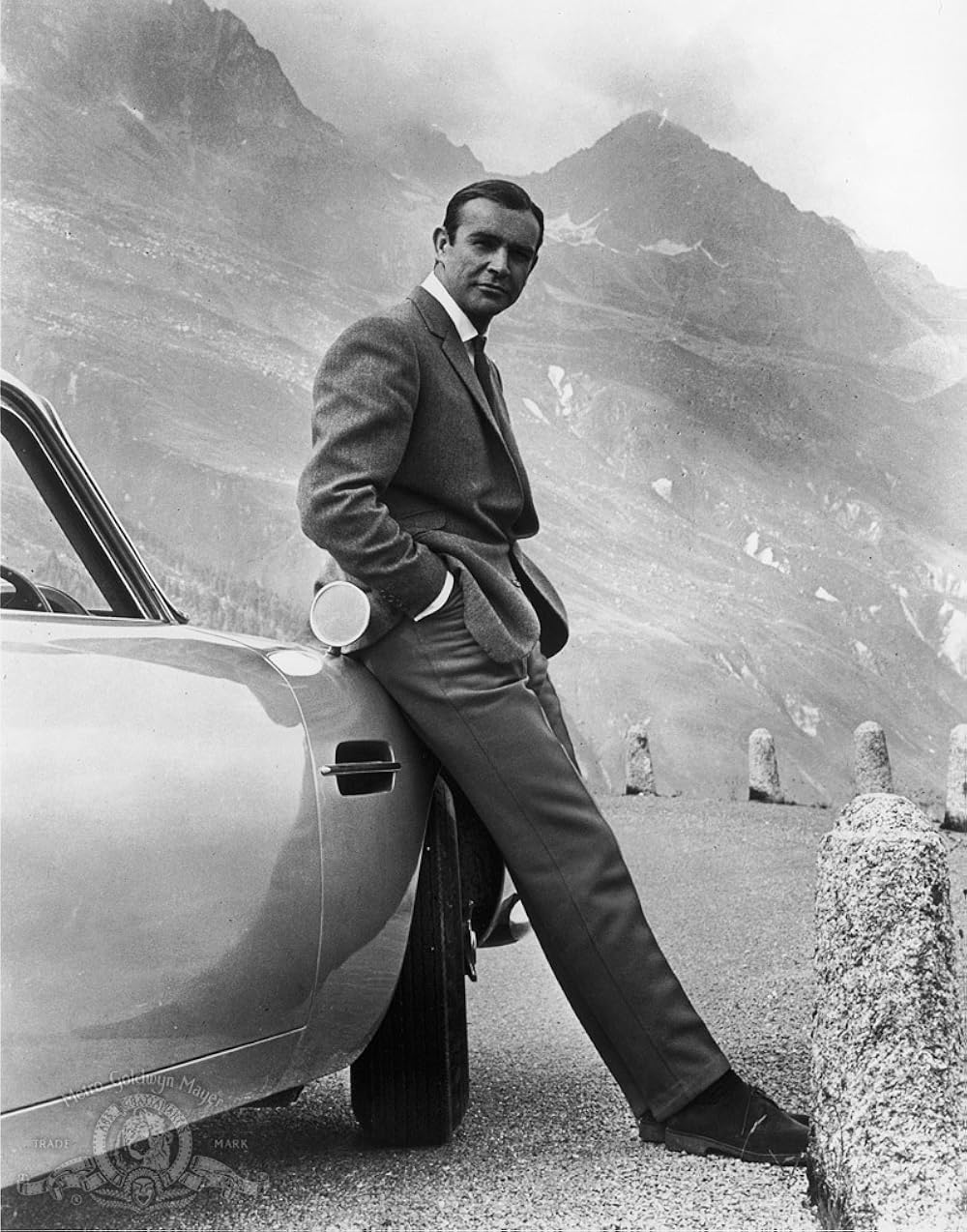
But another chase soon takes central stage: a Mustang and a girl and Bond and his Aston Martin. It’s a beautiful car chase sequence, the girl is Tilly Masterson (Tania Mallet), a Bond girl with an agenda, and Bond is simply in the way. She is seeking revenge for the death of her sister, Jill, Goldfinger’s secretary, who was killed by the villain by suffocation when he coated her with gold paint. Tilly Masterson, unlike her sister who let herself be seduced by Bond, is one of the first Bond girls who breaks the common perception of a Bond girl look (the first had been Tatiana Romanova in From Russia with Love, Pussy Galore comes next in the same Goldfinger, and the latest being Madeleine Swann in Spectre and No Time to Die), being defined more by her costume that reflects her professional role than her sex appeal. Tilly is conservative in her dress and wears a cream blouse with a spread collar and a thickly-knitted woolen cardigan, also cream, a grey knee-length pencil skirt fastened with a square brown and gold leather belt and square-toed brown leather shoes. Her hair is tied with a brown chiffon scarf in a loose chignon. This costume works in direct contrast to her sister’s attire in the film’s opening scenes, and thus positions her as being on a mission.
Sean Connery in “Goldfinger”, 1964. Eon Productions
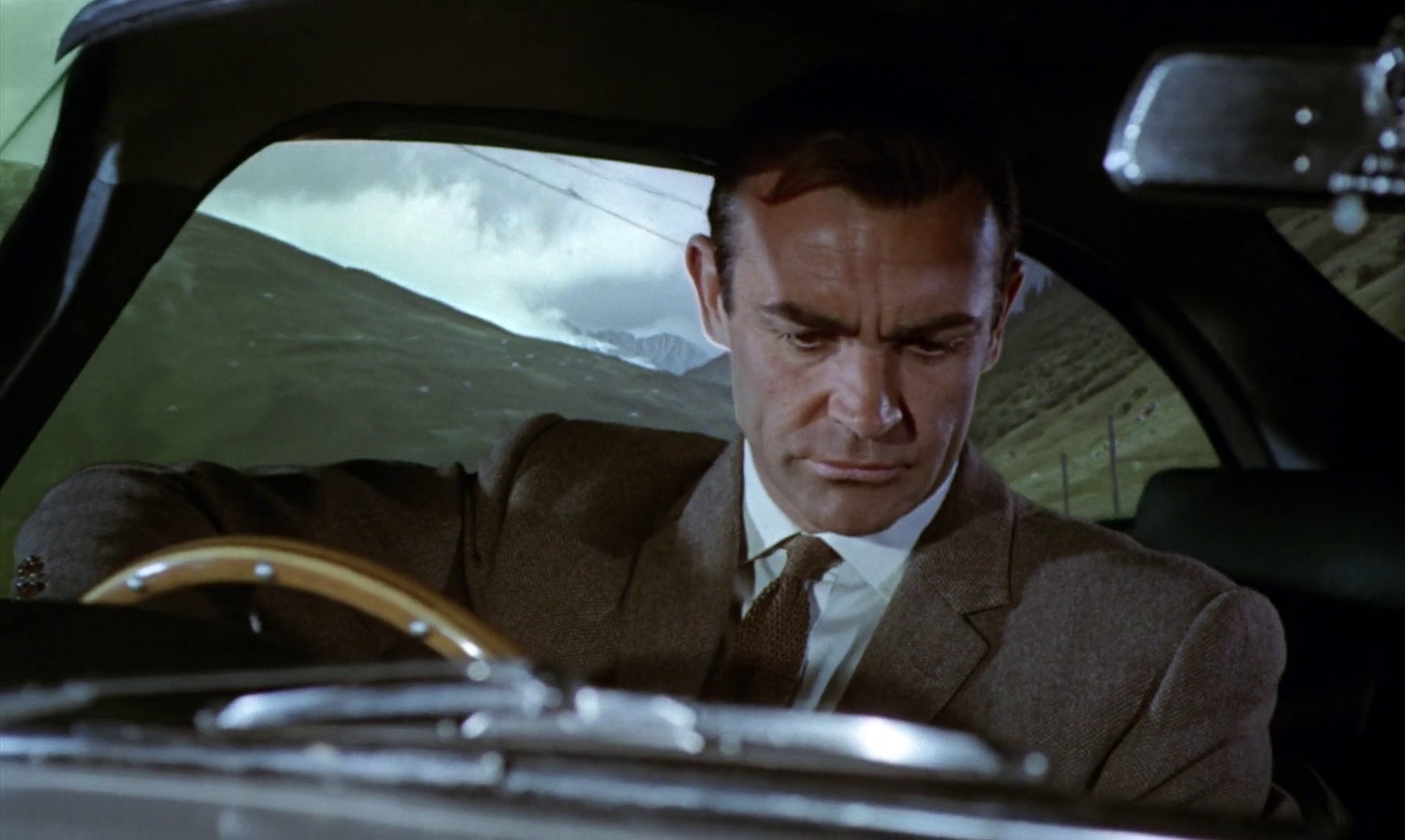
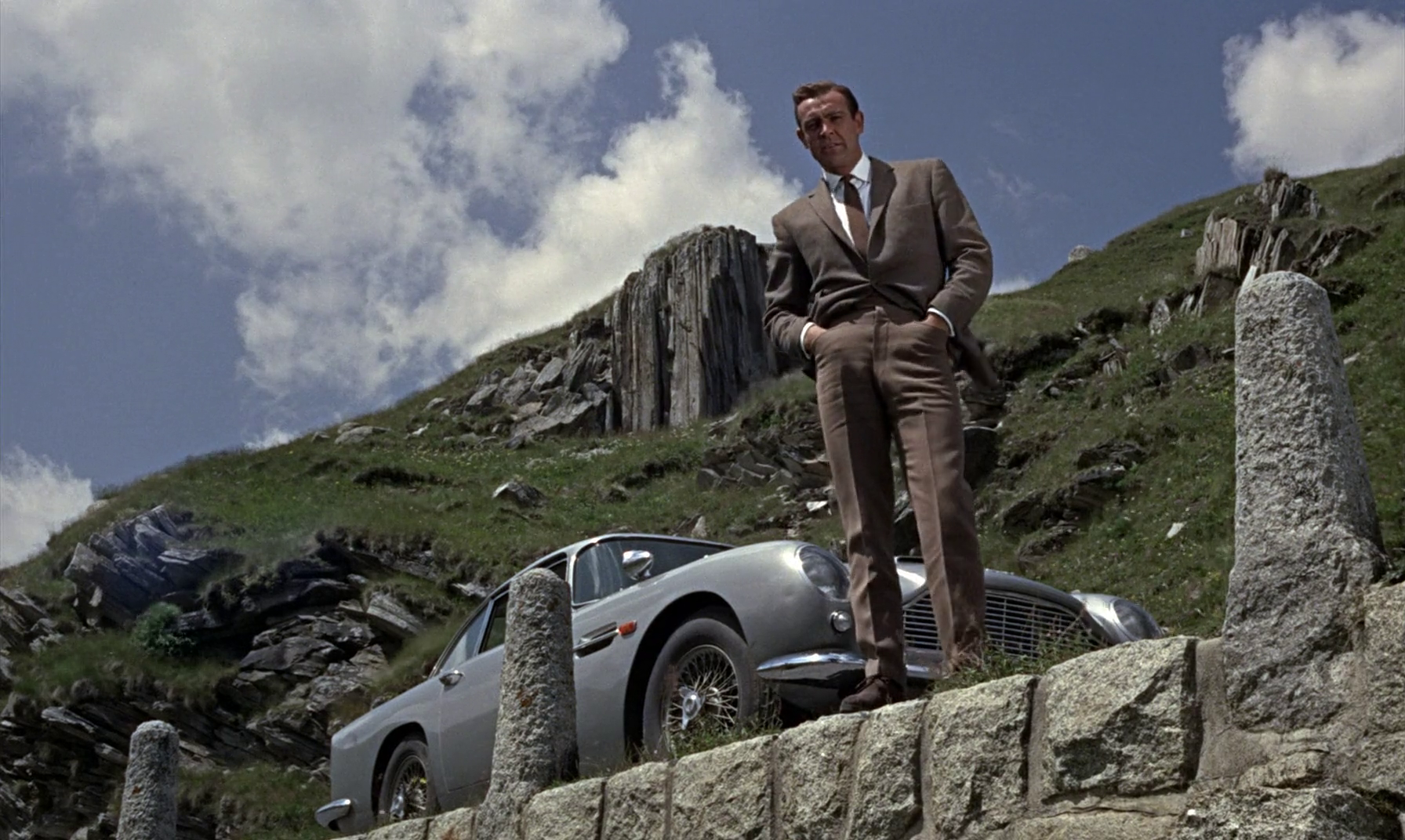
As for James Bond, he appears wearing an Anthony Sinclair tweed hacking jacket with a brown weave. Underneath the jacket, he wears an off-white shirt with double cuffs and a dark brown grenadine tie. These are worn with cavalry twill trousers in light brown and narrow-cut. The mismatch of the jacket and trousers has lent the tweed sport coat the name of “odd” jacket. It was Bond’s “out of office” look, and also the look in which he is seen driving his Aston Martin DB5 for the very first time. The occasion simply called for a proper, elegant sports jacket.
Connery wears eight Sinclair-tailored suits in the film, but it was remarked that 6 of them were made for Connery in Woman of Straw, which had been shot before Goldfinger. A costume supervisor was hired for the first time on a Bond film, Elsa Fennell, with Eileen Sullivan and John Hilling as wardrobe assistants. No costume designer is credited in the film, but Beatrice Dawson created some of the design concepts, with Anthony Sinclair providing Bond’s suits, and the shirts were from Thurnbull & Asser.
The tweed jacket look is one of the most elegant and best Bond suits, and the thing that makes it even more appealing is that it is rooted in practicality and British tradition. In the Dictionary of fashion and fashion designers, the hacking jacket is described as a “fitted, single-breasted jacket which is flared from the waist and has a single back vent. It has been worn since the 19th century for riding and was adapted as a fashion garment during the latter half of the 20th century”. I wouldn’t be surprised if Goldfinger was one of the main reasons for its fame. The hacking jacket, always made of tweed, has a history and style of its own, with an equestrian origin and a name deriving from the word hack or hackney, the saddle horse chosen for the everyday by the British upperclass, unlike the horse used for jumping or hunting. The jacket needed to allow freedom of movement and easy access to the pockets, protection from the elements and still look good after the ride. As with all good items of style, the jacket was a natural and comfortable part of who the wearer was and it eventually made the transition from aristocracy to the ordinary man and to the everyday life. That’s how it happens with clothes that are authentic and have a one-of-a-kind sensibility and character and come from an appreciation of what has come before. The trousers that Bond wears with the jacket are also of equestrian descent, and, as the name suggests, are woven from a fabric, cavalry twill, used for formal horseback attire. Sean Connery is a natural in the way he sports that look evocative of old-world heritage and elegance but filled with a modern energy and his own signature.
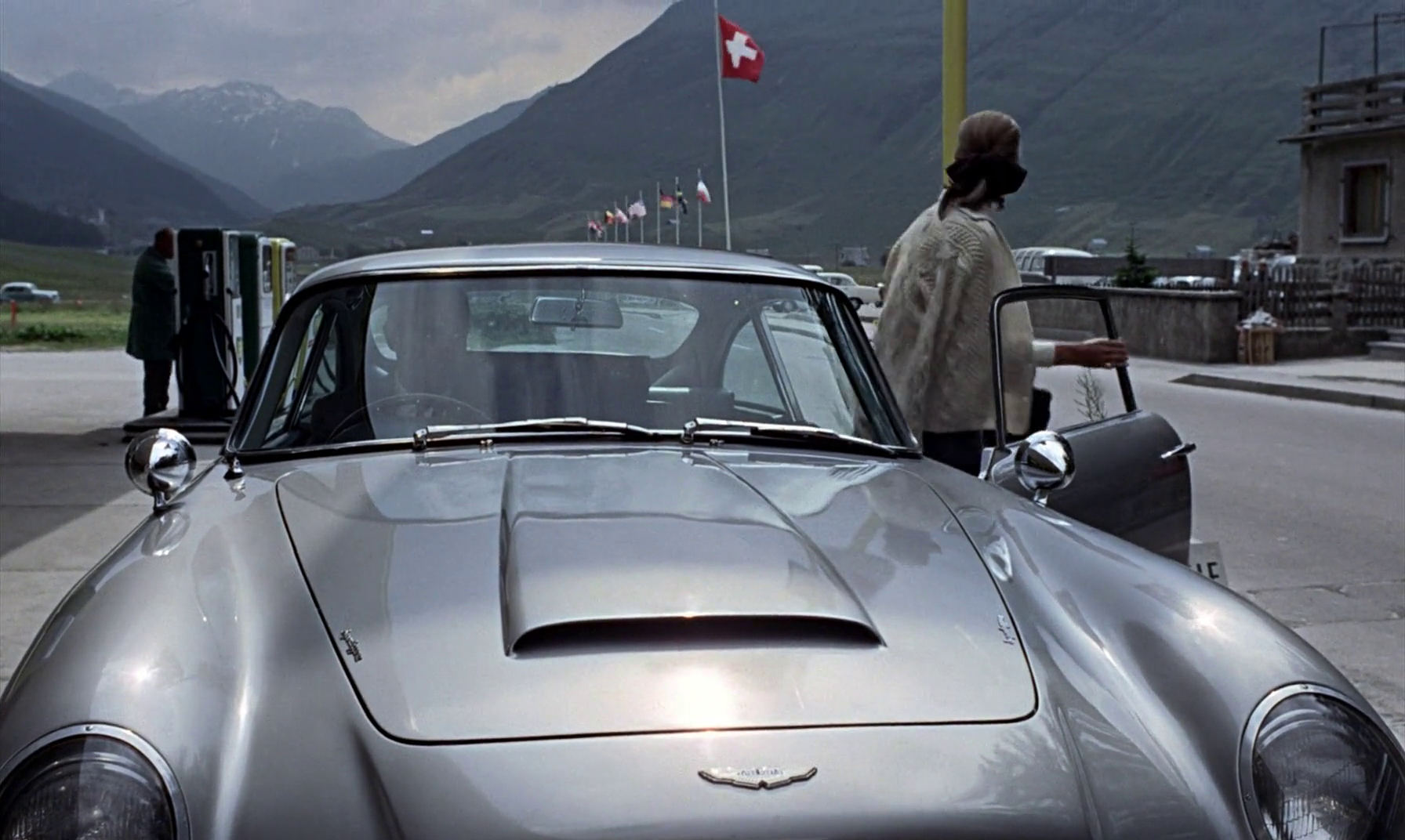
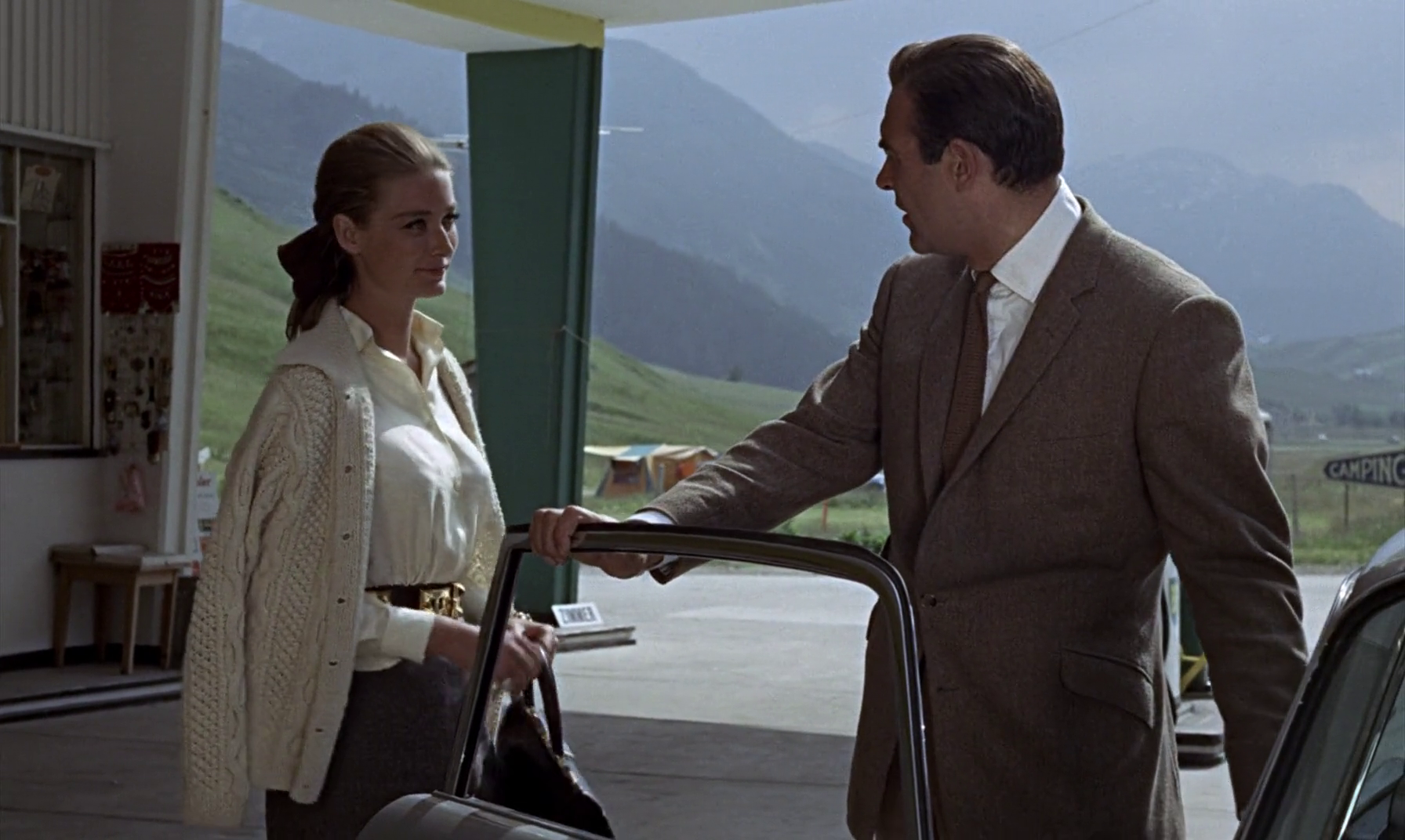
Sean Connery and Tania Mallet in “Goldfinger”, 1964. Eon Productions
The Goldfinger car chase sequence thus introduces us not only to one of the best and distinctive sartorial lessons from Bond, but it is in itself one of the elements that will become a template (never a cliché!) for what makes a Bond film a Bond film. According to film historian Paul Duncan, as noted in the book The James Bond Archives, there are quite a few other such elements in the film: a storied pre-title sequence, a visually arresting title sequence that sets the tone and theme of the movie and features characters from the film, a supervillain, Goldfinger (Gert Fröbe), who is not only outrageous and eccentric but also intellectual, a gambling scene that introduces Bond to his adversary (the golf game), the indestructible, taciturn aide of the supervillain, Oddjob, a background briefing by M, an innocent flirting with Miss Moneypenny, not one, but two good girls who die making Bond’s assignment more personal for the first time, extravagant sets designed by the one and only Ken Adam, a bad girl whom Bond seduces, a visit at Q’s quarters and an arsenal of gadgets supplied by Q that will save Bond’s life on an occasion or two. Furthermore, it was the first blockbuster of the series and it launched James Bond into the public consciousness. The producers were quick to capitalise on this by signing agreements to promote and license Bond products. And why not? After all, the hacking jacket combination has been, according to the Anthony Sinclair website, one of their most popular tailoring requests. And immediately following the success of Goldfinger, the sales of Aston Martin went up by 60 percent. After that, “we never had any more problems getting cars from manufacturers”, the producers enthused.
And yet again, beyond revenues and brand image, sometimes it takes just one small thing to excite a whole sensibility about a world, at least as far as I’m concerned: an impossibly charming character wearing a tweed jacket better than anyone else.
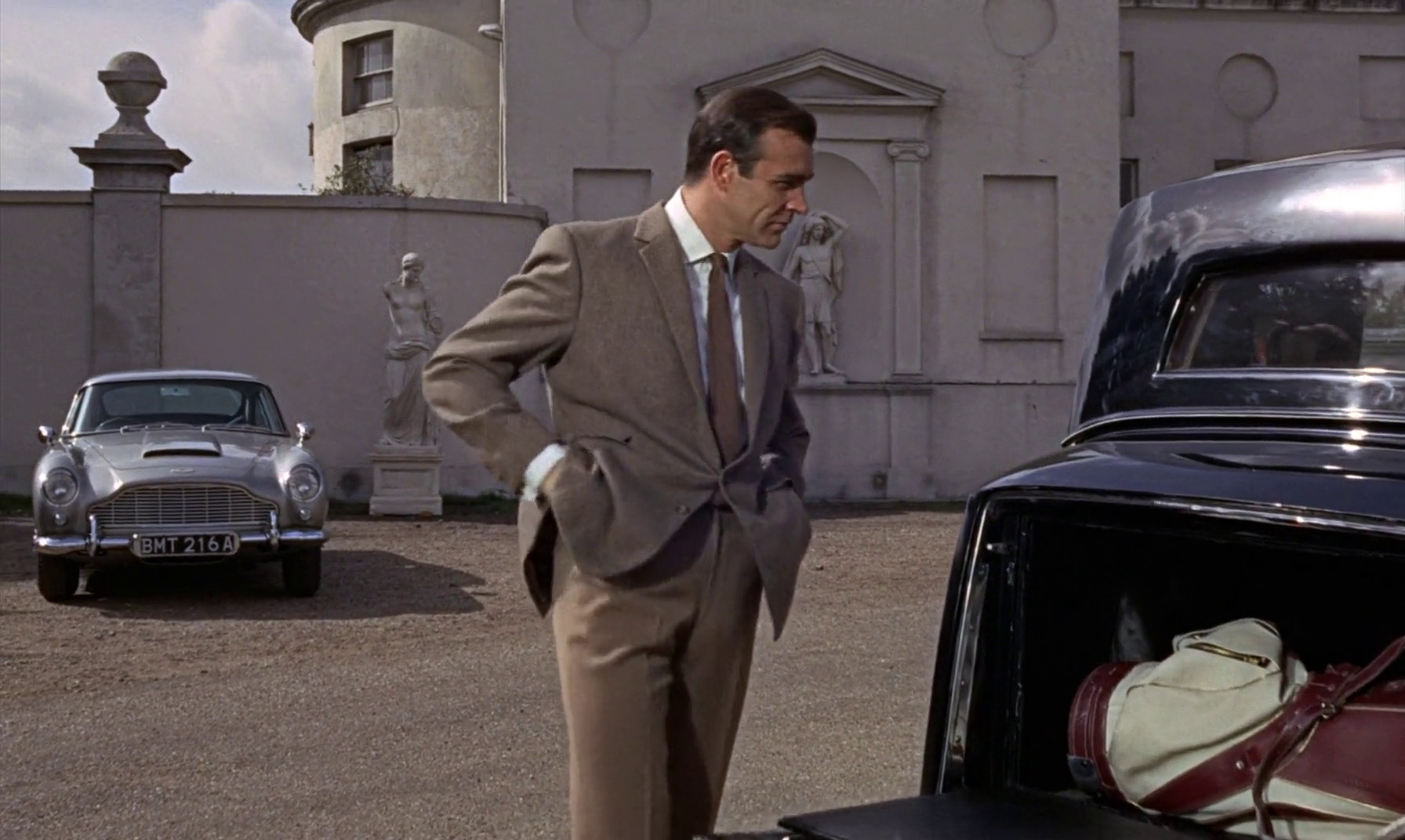
Sean Connery in “Goldfinger”, 1964. Eon Productions
MORE STORIES
Real emotion and visual power: In conversation with Matt Needle
A return to form yet firmly planted in the 21st century:
Léa Seydoux and Daniel Craig in “Spectre”
A different Bond girl: Carey Lowell in “Licence to Kill”