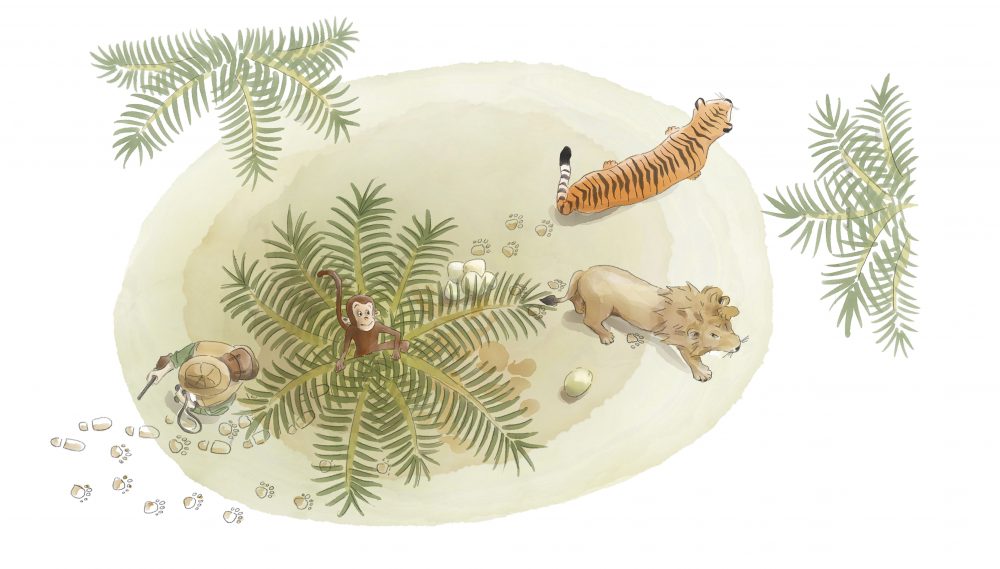
Monkey Crush, by Ian Worboys, with illustrations by Silke Diehl
Ian Worboys didn’t grow up with the idea of becoming a writer of children’s books. But he discovered early on that rhyming poetry helped him overcome dislexya. And as a young father of four, he found himself looking for books in rhymes that were fun, to help him engage more with his children and fully and directly capture their attention and inspire their imagination. Unable to find such books in bookshops, Ian started his hobby of writing poetry, which found great success with his children – we should always trust our children’s judgement. And this is where The Crush Series started to take shape. The first book would be published decades later, followed by others that will find success worldwide.
The Crush stories have a particular sensitivity. They are brought to life through Silke Diehl’s wonderful, soft yet expressive illustrations that give shape to Ian’s humorous words. It’s this beautiful synergy that makes the stories special. But beyond the fun and entertainment, there is a hidden depth in these books. The characters eventually find balance through reconnection with their natural state, but they teach children to relate to the world and to realise something about life. Children need to know about life and not shy away from it, and so many times, especially with young children, books say best what needs to be said. They help children look at things with their own eyes, reflect and have their own ideas. The Crush books simply show us that play and education go hand in hand.
In my recent interview with Ian Worboys, he shares why we all need to grow our minds as we and our children grow older, the one space where he can enter his creative world and why children’s books need some realism in them.

Monkey Crush book spread
What does reading do better than anything else?
Reading helps to open up the reader’s imagination. When you read, you literally open up a world of possibilities where words turn into colour, actions, emotions and characters jump out from the pages. When you watch videos or TV channels, you are are seeing someone else’s imagination.
If my words work as I intend to work, then when children read my books and see the illustrations from Silke, so they can see the animals moving around in their heads, they can feel the tension as one animal stalks another in order to eat, and then they experience the relief and humour when the characters live to see another day.
How did you start writing children’s books? Did you know early on you wanted to be a writer?
I never envisaged becoming a writer, least of all in having five books published with two more still to come. The reason I say that is that I am dyslexic and so I found school very difficult and of all the subjects English was the most difficult. But dyslexia also makes you a problem solver and you have to use your imagination to get around words that you cannot spell.
I started writing rhyming poetry for my four children when I was on holiday in Spain one year. I had been to the bookshop to try and find humorous poetry for them and I only found bland books or whole stories. So, I joked with them and during that holiday my passion grew, and I found that I was able to rhyme and make them laugh. The kids used to come up with a subject and then ask me to write a poem. Those early poems were as diverse as eating ice-cream on a donkey to peeling open prawns at a restaurant.
The catalyst to me publishing the books came after the death of one of my children at the age of 27 from Sudden Arrythmia Death Syndrome. He had always told me that I should publish the poems from the Crush series and so, having put together a bucket list of things that I should have done when he was alive, but never did, so I started looking for an illustrator. The rest, as they say, is history!
I am very sorry about your loss. We have a lot to learn from our children, including how to be more creative, and keep our imagination alive. I often wonder if parents do the same with their children. Have you encouraged your children to be creative?
I have always encouraged creativity in my children by getting them to open up their minds. I encouraged them not only to ask questions, but to ask them what they would do in a certain situation. Reading books allows the base for many questions. Sometimes I would be outrageous and create unusual situations, mixing things up, to show that in your mind almost anything is possible. We designed our Crush quiz cards with this in mind. You can both teach kids to learn and grow their creativeness at the same time.
Frog Crush, by Ian Worboys, with illustrations by Silke Diehl
Are you a full-time writer now? Do you have a writing routine or do you let the stories come naturally to you?
If I look back at my life, I would love to have been a full time writer, but brining up 4 kids required a full time job.
Over the past 20 years I have been lucky enough to have a job where I fly several times a week. I find that I can enter my own creative world while on a plane and my ideas flow onto my laptop.
I always carry my “ideas” book with me and I write down all sorts of ideas. I have ideas for books, board games, TV shows, plays and many other things. Maybe I will do at least one of them when I retire one day.
“We all need to grow our minds as we and our children grow older.”
Do you remember which was the book or children’s illustration book that sparked your imagination as a child more than anything else?
I loved the humour and illustrations of Dr Seuss The Cat in The Hat, as the books made me laugh. I also enjoyed Wind in the Willows, again for the imagination of animals being alive in my mind and then, when my children were young, I fell in love with Beatrix Potter. Her illustrations, her love of animals and the use of pastel colours seemed to me to be a perfect mix. In Silke’s illustrations, there is a similar use of softer colours.
In today’s world, most books are screaming at children with primary colours bursting from their pages, but we wanted Crush to show the world in a softer way through quality illustrations even though our subject matter is all about the Circle of Life. Successful books need some realism in them and it is how that realism is handled, when writing for children, that makes a book a success like the Crush Series.
I agree. The Crush Series books have humour, but they also talk gently, through the rhyming poetry as your storytelling voice and the use of pastel colours in the illustrations, about the circle of life. Are books the best way to teach children, especially young children, about the realities of life?
The start of 2020 was a year like no other for all of us. I believe that children need to know about good and bad so that they are prepared for the world. To me, this is what teaching a child is all about.
I respect those who seek to protect children from the real world, but in the longer term, teaching them early on through a light touch, like my books, allows questions that can be answered sensitively.
An example of this is that some schools will not read my books because two of them have guns in them! I prefer to think that I have gently introduced the concept that some hunting is bad and some is a necessity in order to survive. But readers will make their own minds up.
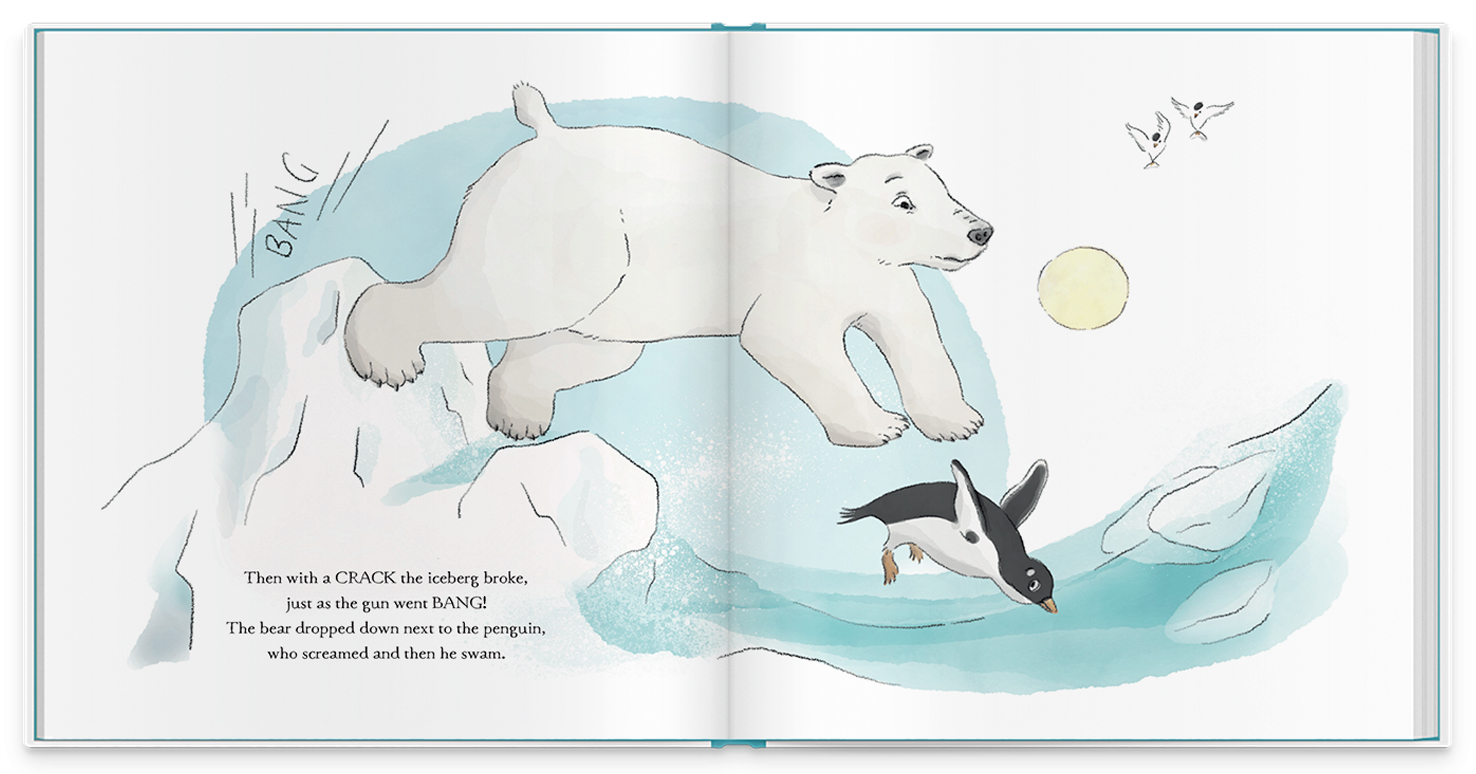
Penguin Crush book spread
I do believe that more children’s books should embrace contradiction. And I think you chose the right word when you said that so many books today are “screaming” with primary colours. Unknowingly, I have always had a problem with that, and you’ve just so clearly pointed it out. Why do you think they use those colours?
I think that too much of education has been dumbed down to a basic level. That includes many of the illustrations that are used. Children love to copy drawings and even though their efforts may not look correct to us adults, to them and their eyes, they are obvious copies. This should be encouraged and so we designed the Crush colouring books. We show fun, simple illustrations that they can copy. We try to open up that creativity streak that children have.
Bright colours seems to be a very modern trend and so when Silke proposed softer pastel colours, our whole team agreed that they were more realistic and gentler on the eyes. We feel that we achieved a great balance in our illustrations.
Part of the beauty of The Crush series is that the drawings tell the story, too, step by step. How does your collaboration with Silke Diehl works? Was it difficult to find an illustrator whose drawings are such a perfect companion for the text?
Having made the decision to get the books published, I then turned my attention to finding an illustrator. I had conversations and some early illustrations done, but they weren’t what I wanted. A chance conversation with one of my German work colleagues led me to his wife Silke Diehl. She was working as an interior architect and had a successful business, but her dream was always to become a children’s book illustrator. She read the first book, Monkey Crush, and fell in love with the animals in the story. To her, the rhyming poetry jumped form the pages into her mind and quite quickly she drew some sketches which, to me, were just what I was looking for.
We chatted and Silke agreed to illustrate the first five books. Her mind is incredible, and she sees situations from many different angles before coming up with beautiful imaginative illustrations. As an example, in Frog Crush there is a frog sitting on a large lily pad. Now most people would draw just that but Silke drew it as if you were a fish looking up through the water to see the frog sitting there waiting to catch a fly. Genius!!
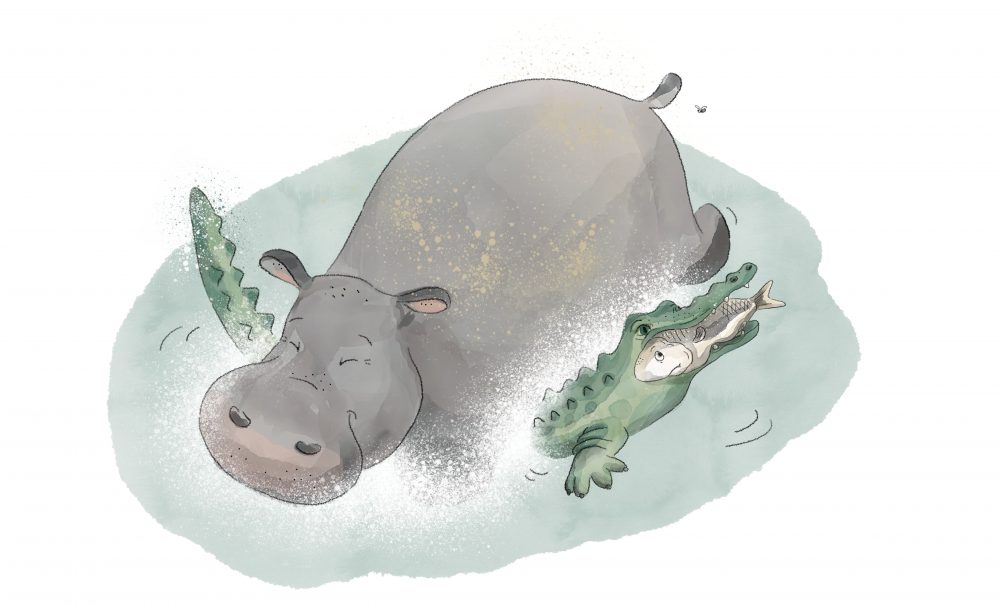
She can draw a hippo and just a small change to his face in his eyes or mouth and the reader can see what he is thinking. The end of each book is where each animal escapes to live another day through a situation that we call the Crush, this page is the climax of the story and in each book this illustration stands out as the best in the book. The illustrations have surprise, movement and humour.
When working with Silke, she creates a story board of small sketches to show how the story will unfold. She then shares those with our marketing team, led by Nora Hategan and me. We then have a discussion about what has been proposed and make suggestions that Silke thinks about and then shows in a new story board. To be honest, there are rarely any major changes as Silke is ahead of us in what she wants, which she knows, that we will love.

Penguin Crush, by Ian Worboys, with illustrations by Silke Diehl
I love that your stories deal with the natural world. And I also find that children usually respond better to animal characters than human characters. Do you agree? And if so, why do you think is that?
From when children start speaking, adults use animals to get them to make noises, to learn to speak and to recognise them. We take them to farms and zoos and so children relate to them. Animals have faces and so we can explain much with just small changes to their faces. Silke is incredibly skilled at this particular part of her drawings. One look at the hippo as he jumps on the evil crocodile and you can feel the satisfaction. Children can see and feel that excitement too.
In this time and age, what do you wish people appreciated more?
I think that with our ever growing faster access to technology, that often does the thinking for us, that people should appreciate that books are a great way to escape from the pressure of modern day life. Within a book you can be who you want to be, where you want to be! You can take yourself back to the Knights Templar in the 1100s or onto Mars in the year 2050. You can be a super hero or a super spy, a mariner or a pilot, the choice is almost limitless.
I personally feel that people are losing their creative identity, that Twitter, Tik Tok, Facebook and other social platforms have replaced reading books. The problem with these media, which I also use, is that they are far too often shallow in their content. We all need to grow our minds as we and our children grow older.
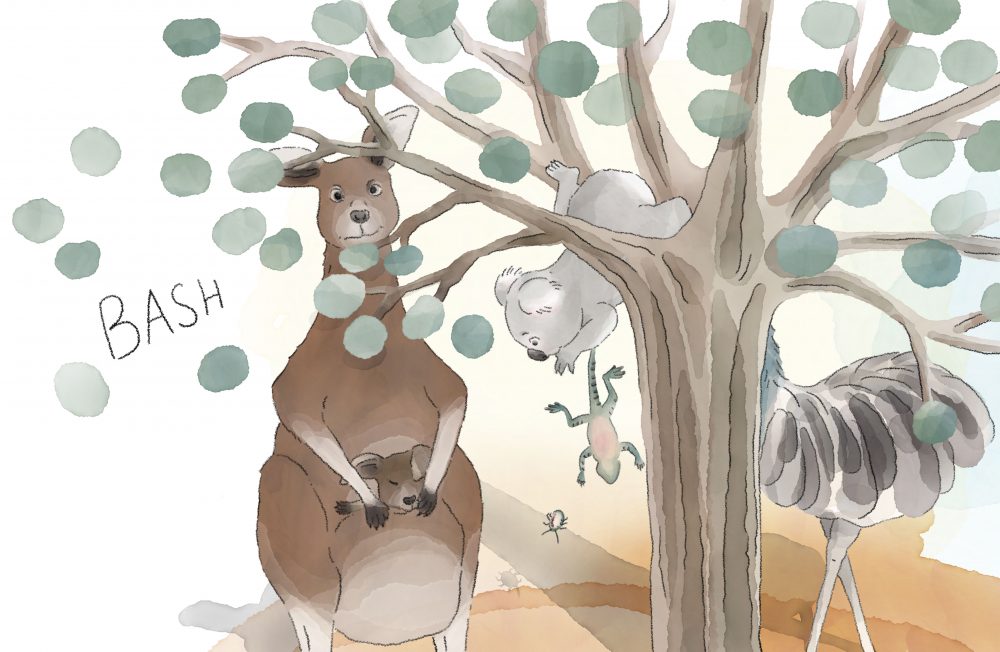
Kangaroo Crush, by Ian Worboys, with illustrations by Silke Diehl
That should be a guideline for every grown-up and parent. On an end note, what’s next in The Crush Series?
Crab Crush is about to be released early June along with a puzzle and painting book, and then we start work on Elephant Crush. Further into the future we also have Bird Crush. I am also working on some new poems where I take some of the characters in the Crush Series and create stories just for them. Mr Hippo or Mrs Kangaroo spring to mind.
We also look at partnering with other brands that share our values with which we can identify together new creative ways to reach the customers and parents who want to bring up their children in different but fun ways.
We at Crush are always trying to build in the educational facts in the stories alongside the fun part of each book, so that children can learn as they read and have fun.

Kangaroo Crush book spread
You can find The Crush Series books on thecrushseries.com or you can check with your favourite independent local bookshop.
MORE STORIES
Beyond Ernest et Celéstine: The art of Gabrielle Vincent:
In conversation with Fondation Monique Martin
Making art and creating awareness: Interview with artist Alex Beard
Leaving space for the reader’s imagination:Interview with Marianne Dubuc