
It starts to look like autumn and I love soaking up each ray of sunlight left, enjoy the leaves’ changing colour, take one last chance to appreciate nature properly until the cold settles in, and finally be able to catch a good film at the cinema since the beginning of spring. But my perfect kind of autumn day usually ends with a good book. These are the books I’ve been reading or plan to read this fall.

The Lonely City, by Olivia Laing. This is the book that has been recommended to me most often in the last year (and that’s the reason I’ve included it here) and I was looking forward to reading it. It explores the author’s loneliness in New York City, but mainly through the works and lives of artists of the 20th century who lived there. It is a very interesting approach, but it lacks personal depth, as the writer does not go much into her own loneliness. And the even bigger “but” comes from the fact that I could not relate to it simply because I’ve never felt lonely (not to confuse lonely with alone), so I don’t know if it would have made any difference had the author delved deeper into her own life (although I believe it would have). The bottom line is: this just isn’t a book for me. I appreciated the many art references though, and I think Olivia Laing’s work would have benefited more from that if it had been illustrated with photos of the artworks mentioned. But if I were to choose an artistic investigation into loneliness and the modern city, I would choose Wong Kar Wai’s Chungking Express, the quintessential film (yes, it is a different medium) about loneliness in the postmodern metropolis, in contemporary Hong Kong.

Georgia O’Keeffe at Home, by Alicia Inez Guzmán. “When I got to New Mexico, that was mine. As soon as I saw it, that was my country.” I have been fascinated with Georgia O’Keeffe’s Ghost Ranch home in New Mexico (its architecture and styling, but also the place where the artist’s daily routine was marked by her respect for simple rituals and the freedom to be fully present in each moment) for a long time and this is just one of those art books I needed in my home. And what I love the most about this sumptuous life history is that explores the influence of the various landscapes and cities inhabited by Georgia O’Keeffe on her life and artwork (yes, this one is generously illustrated, as it should be).

The Bookshop, by Penelope Fitzgerald. England, 1959. Florence Green decides to open a bookshop in a small town that does not want a bookshop. I have a keen interest in stories about bookshops, just as I have in coming-of-age movies. These are two crucial aspects in the development of a child and of an individual. I hope the book lives up to my expectations. On a side note though, I dislike whenever a book gets the cover showing the poster of the film adapted from it, like in the case of the latest edition of this book (not the one pictured above because of this exact reason). Keep them separately! They are two different worlds!

A Tokyo Romance, by Ian Buruma. A film student from Europe. The fascinating and bustling city of Tokyo in the 1970s which shaped the young artist. Moments on-set with Akira Kurosawa. I have to admit that the latter detail was what made me buy the book. That, and the fact that Ian Buruma is a former editor of The New York Review of Books (he left the position this September).

Woolgathering, by Patti Smith, and Devotion, by Patti Smith. Because I want to read everything written by Patti Smith.

A Brief History of Time, by Stephen Hawking. I wasn’t good at physics in school (I wonder what difference it would have made if I had had more open-minded teachers in some disciplines), but I think you are never too old to learn anything. My brother loved physics in school and understands physics (incidentally, unlike me, he had a great teacher) and he recommended this book. “It’s accessible, you should give it a go,” he said. A Brief History of Time remains a staple of the scientific canon, and its succinct and clear language (this gives me hope) continues to introduce people of all ages to the universe and its wonders.

Open, by Andre Agassi. I am well into this one and, all I want to say for now (I will write more in detail about it in the near future) is that not only is it a great memoir, one of the best I’ve read, but it is simply a great book. In fact, I liked it so much from the very first pages that I ordered a copy for my parents as well (oh yeah, the tennis love runs in the family). It’s also the first sportsman autobiography I’ve read and it’s new territory. I don’t think you can get a rougher and more raw view into the inside world of tennis. It’s haunting, the way Agassi recounts with extreme precision the highs and lows of his career, a career in a sport that he never chose, but which it was chosen for him by his father.

The Long, Long Life of Trees, by Fiona Stafford. I read a couple of chapters from this book last evening and I could have read it all in one-go, but I think it’s best to take one chapter at a time in. Because it is a wonderful book to have and to hold and Fiona Stanfford writes beautifully (it’s also beautifully illustrated). The synopsis reads: “Throughout history, trees have served humankind in countless practical ways, but they are also sources of great symbolism and creativity. In this lyrical tribute to the rich diversity of trees, Fiona Stafford explores seventeen species that have inspired stories, songs, poems, paintings, religious and patriotic devotion, and much more.”

The Devil Finds Work, by James Baldwin. Published in 1976, it is both a memoir of Baldwin’s experiences watching movies and a frank critique of the fraught intersection between Hollywood’s industrial practices and its limiting representation of black characters, with emphasis on films such as In the Heat of the Night (1967), Guess Who’s Coming to Dinner (1967), The Defiant Ones (1958). I expect it to be razor sharp, witty and poignant. This book is not Baldwin’s only foray into film comment. In the 1955 collection “Notes on a Native Son”, he wrote about Otto Preminger’s all-black musical Carmen Jones (1954), and his essay “The Northern Protestant” (1960) is about Ingmar Bergman’s Sawdust and Tinsel (1953).
Note: I have added links to every book, in case you want to read more about it beforehand, but I hope you will first visit your favourite bookstore in town to search for any book that has captured your interest. My own favourite bookshop, where I regularly get my refill, is this one.

Autumn Reading List
in Books
Comments Off on Autumn Reading List
A One Woman’s Homage to the Flyer’s Jacket

Hers is the glamour of an adventurer who stirs your imagination with her game-changing style, while learning to love Africa. In Anthony Minghella’s The English Patient (1996), Kristin Scott Thomas plays Katharine Clifton, a British who goes to Northern Africa with her husband (Colin Firth) on a desert expedition. I will not say much about the film, just that it is overly sentimental, too long and with an unfulfilling ending for my own taste, and that I totally understood Elaine’s ordeal in Seinfeld when she had to watch it again unwillingly. However, I did watch it again a little while ago, at my own free will, but I did it just for Kristin Scott Thomas’ flyer’s jacket look (hazards of the job I guess).

In her suede aviator jacket, pleat-fronted trousers, white shirt and earth-toned scarves, Katharine may be channeling aviator Amelia Earhart. It is one of the film looks that will endure over time and there is a lot we can take from it any given day. The colour scheme – beautiful browns, raging from chocolate and caramel, to camel, tan and milky beige (in the image above, Katharine and Almásy (Ralph Fiennes), dressed in sand-hued clothes, seem to blend with the desert). The fabrics – natural fibres, very practical and necessary in the African heat (it’s in utilitarianism that resides the endurance of any clothing item), like linen, cotton and wool. But, most of all, it’s that timeless, androgynous, modern silhouette: the aviator jacket over white shirt, and oversized trousers. Masculine-inspired and bold and supremely self-confident, very Katharine Hepburn. It looks casual and simple and easy and natural. But it’s enigmatic and seductive, too. “A woman wearing a man’s overcoat as she walks along the street is much more sensual than one wearing an evening dress,” said Giorgio Armani. I second that.

I often write about men’s style in film. Because an innate sense of style seems to run amok among our male counterparts, because men’s style stands the test of time much better than women’s and because I myself have a fondness for menswear basics. Whether it’s Robert Redford in Three Days of the Condor, James Dean in Rebel without a Cause or Steve McQueen in Bullitt, men’s style simply ages better. But I have to admit that whenever a woman is channeling a men’s style well, hardly anything beats that. It happened with Kelly McGillis in Top Gun (can you seriously think of a better look than a bomber jacket with a pencil skirt?) and Lauren Hutton in American Gigolo, and, in this case, Kristin Scott Thomas in The English Patient. She is not merely channeling masculine style, her flyer’s jacket is worn like a public declaration of her femininity, one that it is well aware of her innate power.

There is a red patterned shawl that Katharine wraps herself in now and then. I like that splash of colour, maybe hinting at the fact that, underneath those neutral colours that can hide her emotions, she is in fact in search of a certain kind of freedom and of romance, and she came to Africa to find it. “Up in this air you breathed easily, drawing in a vital assurance and lightness of heart. In the highlands you woke up in the morning and thought: Here I am, where I ought to be.” (Karen Blixen, Out of Africa)

photos: film stills from The English Patient | Miramar, Tiger Moth Productions
in Film costume
Comments Off on A One Woman’s Homage to the Flyer’s Jacket
Editorial: American Comedy

The Editorial: thoughts, short stories
or essays about the world of cinema
The extraordinary thing about classic American comedies, and, by that, of course, I refer to the likes of Lubitsch, Capra, Cukor and Sturges, or Howard Hawks’ His Girl Friday and Bringing Up Baby, Billy Wilder’s Some Like It Hot and Gregory La Cava’s My Man Godfrey (I will write about Chaplin and Buster Keaton another time), is that you can predict from the very beginning how it will end, and yet, their style is captivating – unexpected ideas, the wildest fast-talking farces and the most comical details in the story are possible. Ironically, Preston Sturges’ own yearning to make a ‘significant’ picture later proved part of his professional downturn. I myself often disregard what otherwise could qualify as a very good movie if it weren’t for the happy ending. Maybe that’s why Billy Wilder’s The Apartment is one of my all-time favourite films. It is one of the finest satirical comedies, different from the formal plot of romantic comedies, old and new. It has subtlety and an adult sensibility, which is what makes the story so good and poignant and real. The beauty and strength of the movie come from the fact that it shows that life comes with good and bad, you can’t have one without the other.
But, still, what is it about the majority of classic comedies that still attracts me despite the predictable ending? I guess I like the exercise of style and sophistication a classic comedy exerts. Often, the first hour of a comedy, even the whole movie right up until the end, is such an unhindered display of creativity and craft, as if the director and writer gave complete reign to their imaginations, to being silly without forgoing wit and a lightness of touch. Not to mention the shrewdness and effervescence of screwball comedies, and the fact that romance always comes second to comedy in a screwball, which is why I always prefer it to romantic comedies.
But what I want to point out is that I think comedies are often underrated. There is that famous line in Sullivan’s Travels (1941) when Joel McCrea’s character, after he has been mistaken for a tramp, arrested and put to work on a chain gang and he finds himself watching a comedy with the other convicts, every one of them laughing harder than the other, as if they have no worries in the world: “There’s a lot to be said for making people laugh. Did you know that that’s all some people have? It isn’t much, but it’s better than nothing in this cockeyed caravan.” Sometimes laughter is the best medicine. We should never underestimate a comedy’s merit and power. Few comedies are as smart as Sullivan’s Travels, which was made in the time when Preston Sturges was praised as Hollywood’s premier satirist and crafter of social comedies. He “sent affectation and friendliness to the devil and replaced them with satire and cynicism,” wrote François Truffaut. Sullivan’s Travels is unpretentious but remarkably complex, as Sturges proves his skill and ease to steer between moods and genres, always delivering a good punchline just at the right time. Sometimes a good punchline is all we need to make a bad day better.
photo: Joel McCrea and Veronica Lake in Sullivan’s a Travels, 1941 | Paramount Pictures
The Podcasts I Am Listening to This Fall
On a recent flight I started to catch up with two of my favourite podcasts and discovered another one, too, in the process, so here are the three podcasts (I believe in quality, not quantity) I am planning to keep listening to this fall.
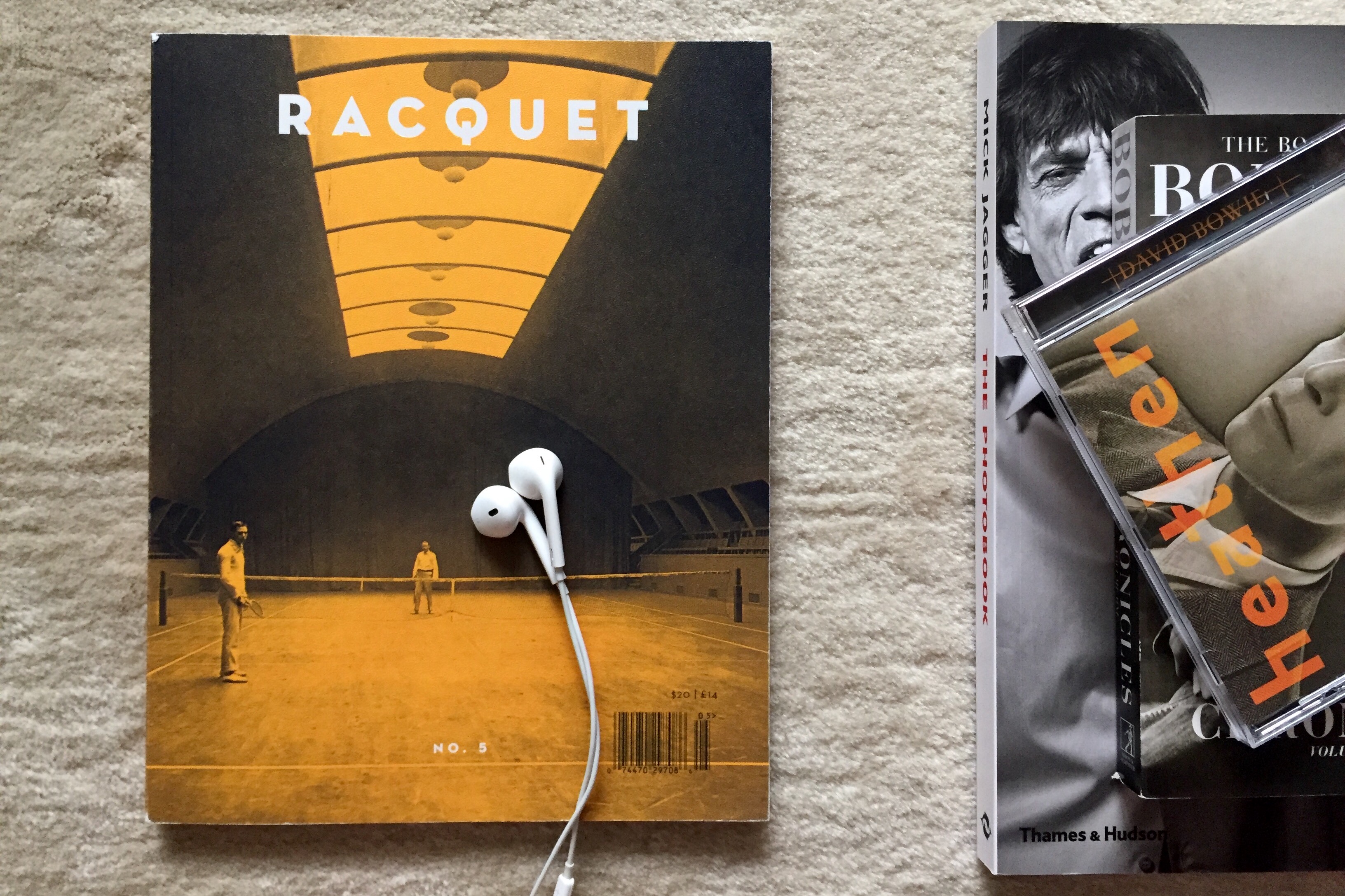
I have been a long-time fan of Racquet magazine, “a journal that celebrates the art, ideas, style and culture that surround tennis”. That’s exactly what I love about tennis, the whole picture, not just the game. And Racquet understands and celebrates that. Beautifully. And now they have their own podcast, hosted by Rennae Stubbs. She’s had some first-rate guests so far, from Kim Clijsters to Judy Murray, but my absolute favourite has been the Chris Evert episode. I love this woman. In a sea of feminism-oriented media I wholeheartedly disapprove of, 18-time Grand Slam winner and mother of three boys Chris Evert gave the soundest piece of advice I have been hearing in a very long time from a public figure: “I feel there is so much emphasis on women and little girls, but let us also add to that men and little boys and mothers who are bringing up little boys, let’s help them out a little bit.” As a mother of a little boy, I want to say: Thank you, Chris.
We seem to forget that we need to raise independent, self-confident boys, too, not only girls. Boys struggle, too. They are vulnerable, too. They are shy, too. They can be introverts, too. They need encouragement, too. They must be taught, too, that there are no two separate worlds, men and women, that we must love and respect each other. That rules are the same, for boys and girls, for men and women, and that whether you are Rafael Nadal or Serena Williams, you must follow the rules (please, do not even get me started on the Serena Williams moment at the US Open – what a crass display of lack of fair play and sportsmanship from both Williams and the American public). Chris, once again, thank you for your sportsmanship, grace, elegance, objectivity and genuineness.

I very much loved the episode with Judy Murray, too, in which she gives a very straight-forward insight into the world of tennis, advising parents to be prepared for everything the sport demands from their children. She also talks about her admirable efforts in educating a nation (Scotland) of the benefits of sports and an active life (and making tennis more accessible to more people), and also her pertinent and honest thoughts on why there are not more women tennis coaches – I am sure many hasty opinions do not take into consideration that women tennis players prefer to train with men coaches because they see it as a way to improve themselves and become stronger players. I have never played tennis professionally, but I have nonetheless been playing it since I was little and always with boys and later men for that same reason, to better my game. To this day, I have never played once with a girl or woman, and the boys and men I have played with have never complained or treated me as a weaker opponent. What I want to say is that I am sick and tired of this feminist viciousness based on nothing but social networks outrage and diatribe.

Not watching tv (I haven’t for years) has all sorts of benefits I can not praise enough. Besides affording me the time to get things done I would otherwise not be able to squeeze into a day’s schedule and helping my mind stay sane (I believe that 90% of television media is toxic), it has been partly responsible for my discovering Terry Gross’ Fresh Air. I do want to be in the know about the contemporary issues, arts and everything in between, and although I still read the written press, my go-to program remains Terry Gross’ podcast. She is a virtuoso with exceptional range. She interviews everyone from all different industries and backgrounds, from politics to cinema, and does it with such ease and diligence and candour and human touch that there really aren’t other more consistent interviews available on the medium. I have recently started to search the archive of the program and listened to the episode with Matthew Walker, neuroscientist, professor of Neuroscience and Psychology at Berkeley University, and author of the book Why We Sleep, which I am currently reading. I will soon talk about it on Classiq, but, for now, let me just say that it is a book that everyone should read, and that, until you do that, you should listen to Terry’s interview with the author mentioned above.

I have previously heard about Alec Baldwin’s Here’s The Thing, but I haven’t given it a listen until recently. And I couldn’t have started with anyone else but Patti Smith, one of my favourite artists and writers – she never wanted to be a musician, she wanted to be a poet and writer (“Books were my salvation”, she says about the magical worlds she found when reading hundreds of books in her childhood), she tells Baldwin, and what a writer she has become. Just Kids and especially M Train are two of the books I’ve become most fond of in recent years, and Devotion and Woolgathering are waiting on my bookshelf. But what I especially loved about the podcast is that I learned new things about Patti or that she shed new light on certain aspects of her life. “I wasn’t put on the planet to climb the ladder of success, I was put here to do some kind of work.” Then, at a question from the audience asking her about the women who have inspired her, Patti, who had just mentioned Allen Ginsberg, William S. Burroughs and Gregory Corso as her mentors, went on to enumerate a few women, saying that she is truly inspired by many others, but then added: “I love being a girl, but I am partial to fellas.” And that is another thought I would love to be voiced more often in the times we are living. She ended the conversation with a few words about being an artist, naming hardwork and sacrificing happily as most important to the pursuit of being a true artist. “Being a real artist has nothing to do with fame and fortune.”
Another great Here’s The Thing episode was with Viggo Mortensen. A great actor with a low-key, no-star persona, who loves books and who, in 1999, founded his own publishing house, Perceval Press, which publishes indie books (in small-run prints) just for the sheer love of books. What’s not to love about the man? I am now on the mission to listen to as many episodes as possible as soon as possible. Alec is a very direct and lighthearted host and his conversations have that unpredictable factor that makes them genuine and sincere. And that’s one of the best things about his interviews with actors, he just shows us that Hollywood people are “just like everyone else”, as photographer Laura Wilson recently said in my talk with her. His guest range is however much wider than that, from artists to policy makers and performers, and Baldwin sets out “to hear their stories, what inspires their creations, what decisions changed their careers, and what relationships influenced their work.”
in Sounds & Tracks
Comments Off on The Podcasts I Am Listening to This Fall
Ready for Autumn: Best Windbreakers in Film

Clint Eastwood in “Dirty Harry” (1971) | Warner Brothers, The Malpaso Company
As the leaves begin to go earthward and our evenings tend to become more and more homebound, we are slowly regaining our sense of style. Yesterday was the first official day of autumn and it’s time we acknowledged that we must wave summer farewell and start reaching for light layers of clothes, especially on the early crisp mornings. Ah, these crisp early autumn mornings… It just shows you that each season has its own beauty and things to be thankful for. And one of the best things about fall is the way it sharpens your sense of style. I mean, as soon as September 1st rolled in, sandals and shorts became a definite no-no even on those 30-degree C days. And you bet I can not wait to break in one of my favourite menswear-inspired piece, the windbreaker, which I literally stole from my husband, convincing him it was not fair for him to own both a leather bomber jacket and a classic windbreaker, especially that both items look just as good on women as they do on men. But let’s stick to the men for now: here’s an autumnal round-up of the men who have worn this classic jacket best.

Janes Dean in “Rebel without a Cause” (1955) | Warner Brothers
James Dean in A Rebel without a Cause (1955)
The windbreaker – also known as a blouson, golf jacket or Harrington (Ryan O’Neal wore a G9 jacket in the TV Series Peyton Place and his character name was Rodney Harrington, hence the jacket’s informal moniker) – owes its appeal in large part to its functionality: it’s lightweight but showerproof. Its style (waist length with its trademark Fraser clan tartan lining, button-fastened slash pockets, zipper that goes up the front to an extended tab on the collar) dates back to 1937, to a garment factory in Manchester, England, where the first G9 blouson under the Baracuta brand name was made. The public service utility garment as well as the official attire of the presidents of the United States to wear on Air Force One, the windbreaker became a menswear staple in the second half of the twentieth century as it was adopted as part of the 1950s teenage uniform and went on to achieve cult status among Ivy Leaguers and Mods alike – everyone from John F. Kennedy to The Clash was fan of the jacket. But nobody contributed to sealing its legendary status more than Hollywood.
“When you first see Jimmy in his red jacket against his black Merc, it’s not just a pose. It’s a warning, it’s a sign,” director Nicholas Ray said about James Dean’s red windbreaker. Ray was a director who paid great importance to colour in his films and the colour red was a conscious decision. For Rebel, he called in a colour consultant and they looked for ideas in old copies of Life magazine. He chose to use primary colours in vivid blocks, creating symbolism through colour and costume. Costume designer Moss Mabry created three copies of the jacket. “Even though it looked simple, it wasn’t,” Mabry said. “The pockets were in just the right place; the collar was just the right size.”
The entire look became iconic – Dean wore the windbreaker almost undone but not quite, allowing that other 1950s youth essential, the t-shirt, to show, and pairing them both with the most democratic piece of all, the washed Lee jeans. It may have been a look in tune with the 1950s – Moss Mabry spent several days at Los Angeles high schools, observing the clothes and styles of teenagers and Nicholas Ray also showed him a picture from Life of a group of college students for inspiration – but it hasn’t aged one bit since. However, it was not just the look, it was something universal in what James Dean transmitted on screen, through looks, attitude and expression, and I believe therein lies his ongoing image as a hero, as an ideal.

Steve McQueen in “The Hunter” (1980) | Rastar Pictures
Steve McQueen in The Hunter (1980)
The Hunter was Steve McQueen’s final film. Ralph “Papa” Thorson (McQueen) is a modern-day bounty hunter who goes after and captures criminals who have skipped on their bail to bring them back for a 20% of the reward to his bail bondsman employer. A running joke used throughout the film was that Thorson was a bad car driver. But there’s no joke about his dressing style. It’s right up there, where McQueen has always been, among the paragons of men’s style. The jacket McQueen wears in the film is not exactly a windbreaker, but a flight jacket (McQueen, however, often sported a traditional G9 Baracuta blouson off-screen).
The MA-1 nylon flight jacket, as it was officially named, was created specifically for the United States military in the 1950s and its functionality inevitably found a life in civilian service. It came in the standard air force sage green or army olive green, in light, windproof nylon, with chest tabs and sleeve pocket. Steve’s jacket has orange lining (known as Indian or rescue orange), a revision introduced in 1963 to the model (it previously had a sage-green lining), as the jacket was reversible and downed pilots wore their jackets bright side out to be more visible to search and rescue parties. This is arguably the most iconic of all versions of the MA-1, which, thanks to no small degree to Hollywood’s stars like McQueen, has become a classic.

Paul Newman, Cary Grant and Joanne Woodward on the set of “Winning” (1969) | Universal Pictures, The Newman-Foreman Company
Paul Newman in Winning (1969)
In Winning, Paul Newman plays Frank Capua, a rising race car driver who aspires to win the Indianapolis 500. Newman was a winning race driver in real life, too. He loved fast cars, but he arduously avoided the movie star image of expensive sports cars, although his various convertible Beetles were rumored to be equipped with Porsche engines. There is not much to be unforgettable about the drearily predictable Winning, but its leading man’s screen style is not one of those things. Maybe because by now Paul Newman had transcended the characters he played. You almost feel that you are expecting to watch Paul Newman, the man, on screen, especially with Joanne Woodward by his side. And we would expect to see Newman cladded in Ivy League style, as shown here, of which he was one of its most famous adherents. Suede windbreaker, striped sweater, chinos and driving shoes. It doesn’t get any more classic preppy than this.
Clint Eastwood in “Dirty Harry” (1971) | Warner Brothers, The Malpaso Company
Clint Eastwood in Dirty Harry (1971)
Mr. Clint Eastwood, I feel I have been unjust to you. I have written about your films a few times, but not about your screen style. It’s time I undid that wrong and put you right up there with all the great male role models men and women alike pour over for style inspiration. And from a style perspective, Dirty Harry was Clint’s defining film. Admitedly, if we have to compare San Francisco cop style in movies, Eastwood’s Callahan has quite some competition from Steve McQueen in Bullitt. But while Bullitt prefers a more casual style, Callahan smartens up his look by wearing his herringbone tweed jacket with a burgundy sweater vest and burgundy/navy Guards tie, slim cut charcoal flannel trousers and his Ray-Ban Baloramas – his choice of sunglasses is in fact very suggestive for his character’s style; I love it how reactionary this choice of shades is, taking the regular idea of “cop” glasses and reinventing it altogether. His aforementioned prep school outfit looks new on him, too, while remaining practical and comfortable. And that’s because Clint carries it with such confidence and all-American cool.
But I would like to pause a little on the brown windbreaker he wears in this production shot above. That’s an American look, too, and he does such a great job again at smartening up an otherwise very casual look, by pairing the brown jacket with black jeans. It just works on him. And I love the colour brown. Why don’t men wear it more often?

Daniel Craig in “Quantum of Solace” (2007) | MGM, Columbia Pictures, Eon Productions
Daniel Craig in Quantum of Solace (2008)
I have said it before and I will say it again. Daniel Craig makes a damn good modern-day James Bond. I am not debating who the best Bond is. I don’t know whether anyone will ever equal Sean Connery’s popularity, charisma and appeal as James Bond, and I’ve always been partial to Timothy Dalton’s 007. But Casino Royale is my all-time favourite Bond movie. Not only was it a very good film in its own right, but it was new, a new type of Bond film, with a story anchored in reality, stearing away from many James Bond movie rituals, starring my favourite Bond girl ever, Eva Green, and a 007 who was darker, sharper, edgier and colder, but also more human than the earlier Bonds (although Timothy Dalton was truly the first to impersonate a tougher, darker, more serious, but also more vulnerable Bond). But it was in Casino Royale where we really got to see Bond inventing himself.
James Bond’s style has gone through some changes, too, since Daniel Craig took over. That is not to say that, in the days of Sean Connery, Bond’s wardrobe was the exclusive domain of tailored suits. It was not. But the Bond of the 2000s wears jeans for the very first time in Quantum of Solace (2008). Along with them, a jacket inspired by Baracuta’s G9 Harrington nylon jacket, designed by Tom Ford, who created most of Craig’s Quantum of Solace wardrobe. On Daniel Craig, classic and modern merge perfectly.
sources: The Ivy Look: An Illustrated Pocket Guide, by Graham Marsh and J.P. Gaul / Icons of Men’s Style, by Josh Sims / Classic Hollywood Style, by Caroline Young / “James Dean Remembered” documentary
in Film, Film costume
Comments Off on Ready for Autumn: Best Windbreakers in Film

