The World in My Ears

Cindrel Mountains, Romania | photo: Classiq Journal


Spending time outdoors. No matter how many times I say this and write this, I feel I don’t do it often enough. And if not in the summer, then when? Find the time, regain mindfulness, reconnect with nature, listen to the silence, breath. And in between late summer road trips, do give a listen to these three podcasts. Because culture should always find a place in our lives, it’s one of those things that are not seasonal.
 

Brad Pitt in “Once Upon a Time in Hollywood”, 2019 | Bona Film Group, Heyday Films, Sony Pictures Entertainment


Soundtracking with Edith Bowman

I only discovered Edith Bowman’s podcast a little over a month ago (it has recently celebrated its third anniversary) and I’ve been diving into the archive every chance I’ve had since. Edith talks to directors, actors, writers, producers and composers about their relationship with music, both personally and professionally, and so much more. Edith Bowman knows and is passionate about film and music and her interviews are absolutely fantastic. Listening to them feels like you are exploring your favourite films with your best friend. And as if I needed another reason to love Martin Scorsese and Thelma Schoonmaker and their films, now I do, after listening to the episode with Thelma. Needless to say, I am currently rewatching Scorsese’s films. The latest guest on the podcast? Quentin Tarantino. And all I can say is that it’s been a struggle resisting to listen to it until I’ve watched Once Upon a Time in Hollywood (it was just launched in Europe this weekend).
 

Photography by Racquet magazine


The Racquet magazine podcast

I’ve talked about my favourite tennis magazine, Racquet, before (and photographing an issue every now and then, as well as other favourite print publications, is about as personal as I will ever get on Instagram). Why I love it so much? It’s different. You won’t find any ATP and WTA rankings in its pages. No hype, no news, no nonsense. Every issue (it’s published quarterly) is an artistic endeavor, focused on great writing and original illustration (which makes it a great read not only for tennis lovers like myself) to celebrate the style, culture, aesthetic, lifestyle and class surrounding the most beautiful sport in the world. I have talked about their podcast before, too. But season two is here and it’s all good. Billie Jean King, Sam Stosur and Jim Courier have been among the latest guests, and Rennae Stubbs is a great host as usual.
 

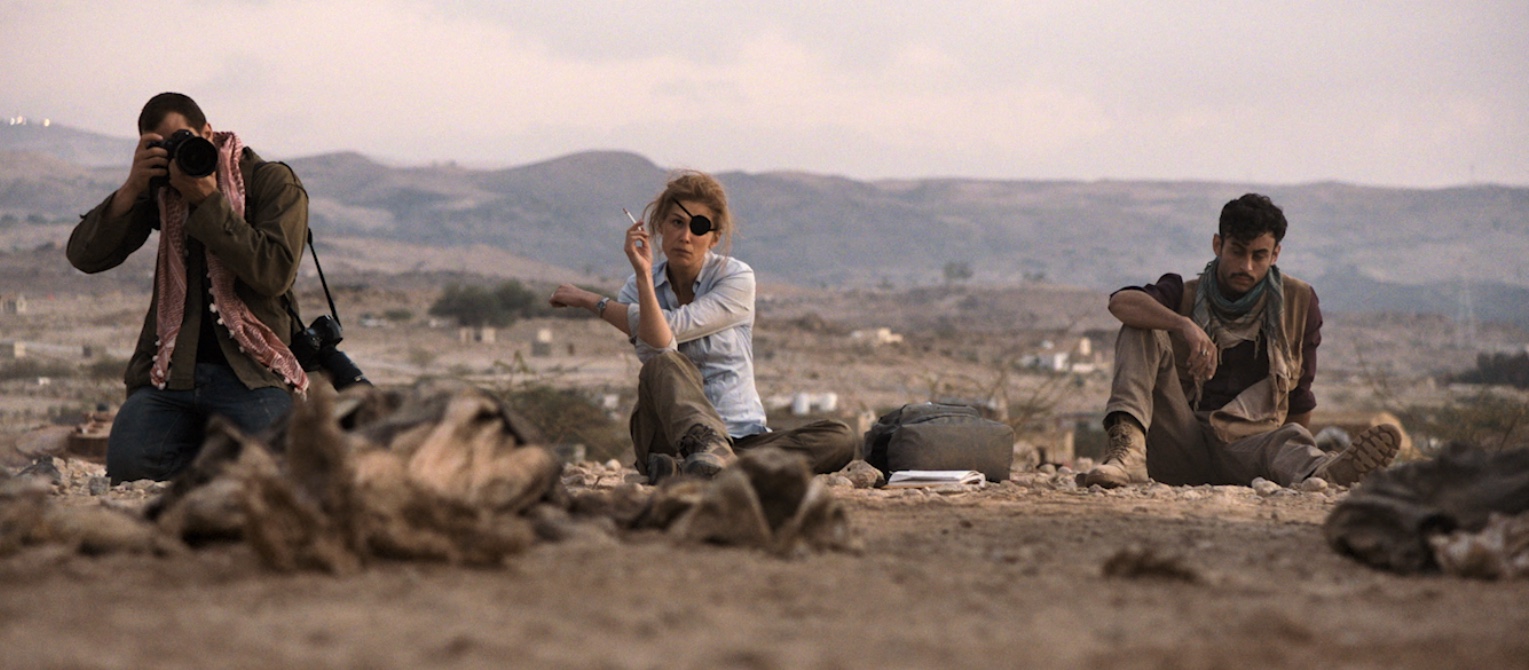
”A Private War”, 2018 | Acacia Filmed Entertainment, Thunder Road Pictures


Off Camera with Sam Jones

“The best conversations should be unconventional, surprising and sometimes just downright weird,” says Sam Jones. The kind of conversation that can only happen when you are face to face with someone. Sam Jones, the host of Off Camera, another podcast I’ve arrived late on (I had actually come across it before, but have rediscovered it now when searching for an interview with Dave Grohl) interviews actors, artists, musicians, skateboarders, photographers and writers, and his conversations flow naturally, casually, and they bring the best out of his guests – one of the latest episodes was with Rosamund Pike, and, after having just watched A Private War, it was great having an insight into the development of her character, Marie Colvin. But first and foremost, it’s Sam’s commitment to doing things his own way that I find very inspiring about this podcast. “As much as I have tried to create a multi-platform technologically relevant episodic blogpodzine, I am really just using new tools to do the same thing I have always done; which is follow my interests, and try to get in the room with some really interesting people.” In other words, he is making technology work to his and his public’s benefit. He sticks to doing long form style interviews. I salute that.

Posted by classiq in Sounds & Tracks | | Comments Off on The World in My Ears

Movies of Summer


Maybe it is the way it captures the suspended reality of summer, or how it evokes a special childhood memory, or the way it makes you succumb to chance and to the languid summer magic, or its ability to transport you to another time and world that have nothing to do with a summer escape. It can be more about a mindset than about a place, it can bottle a sense of endless possibility and far-flung adventures as well as hidden depths. A summer movie can have a different meaning for each one of us, but one thing I can say for sure. The films you will find below do not fall in the category of fleeting summer entertainment. They are the kind of films that linger with you long after you’ve watched them and which may even accompany you throughout the years. Eight of my favourite creatives from around the world talk about their favourite summer movie.


Roma (2018), directed by Alfonso Cuarón

Lisa Bergstrand, founder and creative director A New Sweden

“Roma”, 2018 | Esperanto Filmoj, Participant Media, Netflix

 
My choice is Roma, directed by Alfonso Cuarón. It’s both a tragic and beautiful story about the many faces of love. Set in Mexico City in the 70’s, this black and white film brings you into another time and life. Very touching, and also inspiring architecture and style, with a surprisingly clean touch.


Before Sunrise (1995), directed by Richard Linklater

Gabriel Solomons, founder, editor and designer Beneficial Shock! magazine

“Before Sunrise”, 1995 | Castle Rock Entertainment

 
I rarely cry in life, but films often release the waterworks. I also seem to be more of a romantic in the dark confines of a cinema. It’s the screen, the all enveloping story and my willingness to submit.

Before Sunrise is simple in concept – two young Euro-travellers meet, talk, walk, fall in love and then reluctantly resume their separate onward journeys – but profound in execution, due to the detailed focus on dialogue and heightened emotional build-up that seems so familiar to anyone that has ever experienced a summer romance. All the stages of a blossoming love are witnessed in real time as Jessie (Ethan Hawke) and Celine (Julie Delpy) glide through the city of Vienna, exploring each other’s identities, exchanging personal philosophies and establishing a foundation for what will become a lasting relationship.

As a standalone film, the ending is left perfectly poised with hope that these two soulmates will indeed meet in 6 months time at the same Viennese train platform as is their plan, but as part of a trilogy (so far?), we know that the journey will be more authentically true to life’s uncertain path – all of which makes this first instalment so bittersweet.


A River Runs Through It (1992), directed by Robert Redford

Francisca Mattéoli, author and travel writer

“A River Runs Through It”, 1992 | Allied Filmmakers, Wildwood Enterprises

 
I’ll say A River Runs Through It, directed by Robert Redford. Norman McLean wrote the book when he was 74 – quite an achievement. Most of the fly fishing scenes were filmed on the wonderful Gallatin River in Southern Montana, in June and July. The scenery is gorgeous, the story extremely touching. It made me want to visit Montana and write about it in my book, “Adventure Hotel Stories”.


Stealing Beauty (1996), directed by Bernardo Bertolucci

Heidi Wellington, writer

“Stealing Beauty”, 1996 | Fiction, France 2 Cinéma

 
The first movie that came to mind when I thought of favourite summer movies was Bernardo Bertolucci’s Stealing Beauty. For me, this movie embodies all the wonderful things about summer. True, there is no beach, but there is the beautiful scenery that is Tuscany, the colours captured in Daruis Khondji’s stunning cinematography. Afternoon siestas, lazing by the pool, the music of Mozart floating over the sound of cicadas, summer nights, art, food, great conversation, an amazing ensemble cast, a hypnotic soundtrack. Perfection.


Le temps des gitans (1988), directed by Emir Kusturica

Delphine Jouandeau, photographer

“Les temps de gitans”, 1988 | Forum Sarajevo, Ljubavny Film, Lowndes Productions Limited

 
Le temps des gitans from Emir Kusturica is my favorite summer movie. It transports you through its visual and sound power. Everything is there, the sad, the burlesque poetry, the abjection. This film exults a particular energy, magic… It’s a summer movie from the light it transmits.


Les vacances de Monsieur Hulot (1953), directed by Jacques Tati

Tony Stella, illustrator

“Les vacances de Monsieur Hulot”, 1953 | Discina Film, Cady Films, Specta Films

 
From the opening notes of Alain Romans’ score, I am immediately transported to a blissful childhood nostalgia. Summer, Sun, Sea and Tati’s timeless observation of the human character. In 1953, it was Tati’s second film and the first introduction of “Monsieur Hulot” – also my first Tati film. It is forever linked to the time it was shown to me by my Parents – laughing together recognising others and ourselves on summer vacation – rushing to the wrong platform mislead by the unintelligible station information. The world of Monsieur Hulot was still visible in my childhood; I am afraid it is now gone forever, but, because of his genius, I’ve become a Monsieur Hulot myself refusing to let go – always trying to put the fallen brick back on the crumbled wall… I am forever indebted to Jacques Tati and Pierre Étaix whose posters and illustrations shaped my work even beyond the film.


The Before trilogy, directed by Richard Linklater

Nadya Zim, photographer

“Before Midnight”, 2013 | Faliro House Productions, Venture Forth, Castle Rock Entertainment

 
My summer movie or actually movies are Before Sunrise (1995), Before Sunset (2004), Before Midnight (2013). All three movies are one big amazing story of love and relationship through time and outside of technology. Something that nobody has a luxury to experience in modern day. The movie was also shot through time with the same actors, Julie Delpy and Ethan Hawke. Richard Linklater is a genius director because he knows what real is. The story is about love, real love, complicated love. Plus, the location is romantic Europe. What else do we need during summertime?


The Knick, Seasons 1 and 2, directed by Steven Soderbergh

Mary Jo Matsumoto, painter and sculptor

“The Knick”, 2014 | Anonymous Content

 
I don’t have a go-to summer movie, but I can’t recommend Steven Soderbergh’s The Knick (Season 1 and Season 2) enough! It’s better than any film I’ve seen in years and somehow I missed it when it came out in 2014-2015. The story tackles the violent, backward corrupt world of racial segregation, bigotry, elitism, poverty and sexual mores of 1900. The religious and racial issues are sadly still very relevant and modern. Soderbergh shot and directed season 1 – 20 hours of lavish costume drama – in less time than it would take to shoot one big movie. And Season 2 is even better!

It’s a bow to Orson Welles with up-close (he’s wheeled on a small platform so he can move in and out among his actors) hand-held takes that go on forever and capture expressions in a way that’s haunting. Soderbergh had his sets pre-lit so the actors didn’t have to wait around and could power through whole scenes at full boil. Plus, film nerds like myself can appreciate the low-light capacity of the digital camera he used to pay homage to candlelight scenes in the vein of Barry Lyndon. All that aside, it’s the character development that hooked me. I’ve loved Clive Owen since Croupier, and his cocaine-shooting brilliant Dr. Thackery anti-hero is as good as it gets. Eve Hewson as nurse Lucy Elkins had a character arc that blew me away. Andre Holland as the African-American surgeon, Dr. Algernon Edwards, brought me to tears almost every episode. Even the smaller characters are great – a nun who performs abortions, a beautiful woman who lost part of her face to Syphilis, a doctor whose theories foreshadow Nazi propaganda. It will definitely take you to another world, so it’s my vote for good summer late-night entertainment.

Posted by classiq in Film | | 1 Comment

Ennio Morricone: In His Own Words


That distinctive whistle in the theme of The Good, the Bad and the Ugly (1966) is one of the most instantly recognizable elements in the history of cinema. The coyote call in the opening credits… “L’estasi dell’oro” [Ecstasy of Gold], the piece of music that accompanies Eli Wallach when racing through a cemetery in a desperate search for the grave where he believes the missing gold is buried. The haunting, melancholic ballad “La Storia de un soldato” [The Story of a Soldier] sung by a group of prisoners to cover up a violent episode when Tuco is tortured. I recently watched the film again and Ennio Morricone’s music was what made me appreciate the film in a new way.

I had just read Ennio Morricone: In His Own Words, recently released, and which presents Ennio Morricone and Alessandro de Rosa’s years-long discussion of life and music in what Morricone himself defines as “beyond a shadow of a doubt the best book ever written about me, the most authentic, the most detailed and well curated. The truest.” There’s really nothing much I can add to that. The book tells the stories behind Morricone’s many film scores (his name may forever be linked to Sergio Leone’s spaghetti westerns, but his contribution to the world of cinema reaches far beyond that, with westerns representing only about 8 percent of his diverse film productions, including Terrence Malick’s Days of Heaven, Leone’s Once Upon a Time in America, Giuseppe Tornatore’s movies, Roland Joffé’s The Mission, Quentin Tarantino’s The Hateful Eight) that have reinvented the sound of cinema and it navigates the sources of his inspiration, but the conversation also covers music theory, composing absolute music, Morricone’s approach to music as a whole and where he sees music in the world. It is a fascinating and unexpected overview on and a true insight into the uncompromising work and career of a great composer.

But what I believe it is even more extraordinary is that he is an innovator, especially for the way his film music carves out its own path while still informing the plot, for the way it bonds with images and for the way it bonds with the audiences. In other words, I believe that his film music has made it possible for many people to appreciate a kind of music, a craft, a profession that requires patience, study, hard work, comprehension, and reflection, in a day when such qualities are less and less valued and when people are after easy success more and more often.

Here are five of my favourite take aways from the book, in Ennio Morricone’s own words.


About film music

“The general appreciation of my music in Leone’s and Tornatore’s cinema goes beyond music per se: the truth is that Leone and Tornatore mixed it better than others. How? They left it alone, washed it away from other sounds; the listener can therefore focus on the music and better enjoy it. […] During the mixing phase one ought to avoid overlapping music with other noises, other musical elements, or too much dialogue.”


About inspiration and hard work

“If we want to speak about inspiration, then we must become aware that it just lasts for a moment; once that moment is gone, work remains. You write something, erase it, throw it away, and start again. There’s no such thing as falling from the sky. Sometimes the idea contains the seeds of a possible elaboration within itself, but in general, one must struggle.”


About technology

“Are you kidding? People have tried to explain to me how email works numerous times, but I’m just fine with my telephone and my fax. I’ve always relied on paper sheets to keep to my weekly schedule – I split a sheet of paper in seven parts, write the days on it and fill in all my appointments and commitments for the week. Agendas bother me and I just don’t trust computers.”


About handwriting

“Perhaps it feels too complicated to pinpoint it and define it once and for all, precisely because there’s something so intimate and private to it, which does not want to be communicated.”


About music, life

“If everything’s worthwhile, then nothing is.”


Ennio Morricone: In His Own Words, edited by Alessandro De Rosa,
and translated from the Italian by Maurizio Corbella,
has recently been published by Oxford University Press


Posted by classiq in Books, Film | | Comments Off on Ennio Morricone: In His Own Words

This Summer We Are Channelling: Paul Newman in Sweet Bird of Youth

Paul Newman and Geraldine Page in “Sweet Bird of Youth”, 1962 | Roxbury Productions Inc.

 
I have been thinking and thinking about how they would adapt a Tennessee Williams play for the big screen today. And I can not imagine it. Tennessee Williams’ plays are among the most successfully adapted for movies, covering a complexity of issues, from sexuality, Southern culture, raciality and the misfortunes of Hollywood (all very current in today’s world), and the performances in those films are among the best in cinema. But those films belong to the likes of Marlon Brando, Paul Newman, Ava Gardner, Elizabeth Taylor, Vivien Leigh. There are so many good actors today and I admire them tremendously, but that spark in the eye of the classic actor is forever lost. That undone elegance, that lack of vanity, that natural style, too.

“The quality of stardom has been absolutely debased. These days, all celebrities look the same. There’s no one like Ava Gardner, who was incredible looking and didn’t need a posse of stylists fluttering around her. And there’s never been a greater looking guy than Paul Newman. Stars then were individuals. Now it’s like they all come out of the same factory,” said Terry O’Neill, who has refused to write his autobiography explaining that he doesn’t want to sell a story and that he’d rather let his photographs tell a story. He has always considered his subjects’ privacy, he would never demean them and his discretion is what earned him their trust a long time ago. O’Neill also admitted he has never worked with stylists because he liked to photograph people as they were (I use the past tense, because O’Neill says there is nobody he wants to photograph now, not as great as the people he used to photograph) and that he would never have thought of asking Paul Newman to change his clothes for the sake of a photo. Exactly. Men today are so self aware, they place such importance on looks that stems from vanity rather than a strong sense of self.

That is exactly the distinction between the actors of those days and the contemporary ones. The ones of today are largely dressed by stylists, the deliberate image created by an entire public relations team. If the “stars” of today are mere celebrities, the STARS of yesterday were celestial beings. The photographic quality and the rarity of the images of the actors back then also contribute to their enduring appeal. Photographers had to be granted permission to take their photos, especially in the intimacy of their homes. How can you explain that to the selfie generation? That people, famous or not, fought for their privacy back then, that they were esteemed for their discretion, that they were preoccupied with living their lives and doing their jobs, and that the job was not the job of being famous. I want to scream every time I hear or read the word influencer. Influencers exist because there are so many imitators these days, people who are made to think alike and look alike by the social media culture.

There are many actors of today who look good, elegant, put together in publicity shots. But is that a reflection of themselves? You are never sure. And even if it is, it’s worth nothing when you see a photo of them in flip flops getting coffee or boarding a plane in sweatpants. Would Paul Newman’s image have endured to this day in a paparazzi-fueled world, where every possible photograph of him was available? I doubt it. But then again, he demanded too much respect from himself and from the others to ever leave the house inappropriately dressed. So let’s pay due credit to the man himself. He valued his privacy and was just as dedicated to his family as he was to his acting, car racing and philanthropy. He had plentiful talent and personal note, possessed of that innefable quality categorised as cool. Understated and humble, naturally masculine and handsome. His beauty however was never a quality his roles were based on, but rather an element that complicated his characters’ lives. He wielded his beauty with the grounded self-awareness of a man who completely lacked vanity. He was aware of his good looks, yes, but he took it as a constant challenge to prove himself beyond the superficiality of appearance.
 

Paul Newman as Chance Wayne in “Sweet Bird of Youth”, 1962 | Roxbury Productions Inc.

 
He often played the nonconformist, in the form of failures or outcasts, in Cat on a Hot Tin Roof, from 1958 (a film that left out the homosexuality theme from Tennessee Williams’ play, to Newman’s disapproval), Sweet Bird of Youth (1962), The Hustler (1961), outlaws in Butch Cassidy and the Sundance Kid (1969), The Sting (1973), he introduced us to a new type of detective in Harper (1966), marking the transition from the hard-boiled, trench-cladded, tilted-hatted private eye of Humphrey Bogart and paving the way for Steve McQueen’s Bullitt and Clint Eastwood’s Dirty Harry, and he took on diverse roles throughout his entire career.

He could have played the heartthrob in a tuxedo, but found a real pleasure in playing characters who were controversial and who lessened his looks. It didn’t matter to him, because he had the confidence of someone who was unassumingly wearing whatever made him feel good. And that quality came across whether he wore a sharp suit, Ivy League attire or double denim. He made looking stylish a matter of attitude. He always looked like himself. The look shown above is from Sweet Bird of Youth. He plays Chance Wayne, who returns to his hometown after having failed to make it as a Hollywood actor and after having repeatedly left his youth sweetheart in search of his dream. It is a look that has Paul Newman’s personality and his youth roles stamped on it. Eschewing authority and rules, his white shirt with rolled up sleeves and knit tie are unconventionally classic, imbued with individuality and very summer appropriate.

Posted by classiq in Film, Film costume, This summer we’re channelling | | Comments Off on This Summer We Are Channelling: Paul Newman in Sweet Bird of Youth

This Summer We’re Channelling: Faye Dunaway in Bonnie and Clyde

Faye Dunaway as Bonnie Parker in “Bonnie and Clyde”, 1967 | Warner Brothers/Seven Arts, Tatira-Hiller Productions

 
The honey-gold bob, the sun-kissed skin with peachy blush and lips, the silky nude top, the tailored midi skirt suffused with tomboy sexuality, the golden coin chain thrown on just so, and that insouciant attitude, all enveloped in the warm golden hour sunlight. That’s the look of summer for you. Natural, mysterious, anxious for adventures, ripe for taking risks, happy for the now, basking in the unknown.

“I knew it was a great role. I really identified with Bonnie. She was just like me, a Southern girl who was dying to get out of the South. She wanted to take risks, she wanted to live. I knew exactly how she felt – I’d felt that way for years”, said Faye Dunaway. Arthur Penn, who directed Bonnie and Clyde, concurred that idea in an interview with George Stevens Jr.: “Bonnie is a girl with a real hunger. She wants to be a movie star and have her name in the paper,” and “Bonnie’s sixth sense tells her there is romance, escape, excitement around this guy,” (Clyde, Warren Beatty’s character).

A daring, controversial crime classic, Bonnie and Clyde was at the forefront of the New Hollywood, which was highly influenced by the European cinema, and which was thematically complex, technically innovative, morally ambiguous, sexually charged and anti-establishment. Its new, tougher sensibility connected with the young audiences and changed the way Hollywood looked at movies. And at fashion.

Dunaway was among the last of Bonnie and Clyde’s principals to be cast. Beatty had considered Natalie Wood, Jane Fonda, and Julie Christie, among others. Costume designer Theadora Van Runkle recalled how Beatty was scooting a catalogue of actresses and she opened it on Faye and she said “There’s the girl you should cast.” Dunaway was perfect for the spirit of the thirties and the spirit of the sixties.

Van Runkle fashioned the character that would take Faye Dunaway to stardom and surpass the barrier of time. After Beatty (a very hands-on producer who knew that everything is in the details) vetoed her perfectly in-period sketches of Bonnie and Clyde, “with marcelled hair for” Faye “and a close-cropped center part for him”, the designer stayed away from the mini fashions of the ‘60s and instead opted for a timeless look reminiscent of 1930s glamour, but anchored in contemporary pragmatism and nodding at the French New Wave: straight hair, simply-cut silhouettes, slinky midi skirts, printed scarves, knitted sweaters and cardigans. The look easily reached the young 1960s audiences, who strongly identified with the fugitive lovers, not exactly from a realistical point of view, but dramatically speaking, as the story took on mythic proportions, escalating “into a kind of fable upon which we begin to hope for certain things”, explained the director.

Clothes and attitude worked together to attain that irresistible and individual and seductive look without resorting to exhibitiosnim, which played such a great part in the film’s enduring success. Bonnie’s costumes moved from the fashions of the day, just as the film “moved from reality into a new degree of experience,” as Arthur Penn said. It was the same reason why they didn’t shoot the film in black and white. “It was to say that this is not a document of what happened” (ed. note: the film was based on a true story, that of Bonnie Elizabeth Parker and Clyde Chestnut Barrow, an American criminal couple who traveled the Central United States with their gang during the Great Depression). “It leaps forward in time and brings it up to the present.” I wouldn’t be talking about that glowing light if they hadn’t done it in colour. They would get up every day at 4.30 so that cinematographer Burnett Guffey could shoot at first light. As noted in the book Pictures at a Revolution: Five Movies and the Birth of the New Hollywood, by Mark Harris, Penn, who had among his sources of inspiration his photographer brother Irving Penn, wanted the same level of sophistication in a colour movie that European cinematographers were bringing to black and white, and he wanted some of the outdoors scenes to have the on-the-fly feeling of the nouvelle vague. By moving the story out of that time, Arthur Penn paved the way to a new generation of filmmakers.

Writers David Newman and Robert Benton captured the world’s fascination with the film best: “If Bonnie and Clyde were here today, they would be hip… It is about style and people who have style. It is about people whose style set them apart from their time and place so that they seemed odd and aberrant to the general run of society.” Isn’t this what the individual in our society so desperately lacks today? That strong sense of self, that courage to be different, that protest of the status quo, that elegance of the gesture? “You see people who are great beauties and never get anywhere. This was style,” Van Runkle said about Faye Dunaway.

That’s why we are channelling Bonnie’s look from above this summer. Not necessarily the clothes, but the elegance and distinction and the idea that your clothes should not disguise, but reveal one’s personality. “You’ve got class,” Warren Beatty said to Faye while filming, and she took it as the greatest compliment. Because it is. Let’s aim for that.
 
editorial sources: Pictures at a Revolution: Five Movies and the Birth of the New Hollywood, by Mark Harris / Classic Hollywood Style, by Caroline Young, Film Noir. 100 All-Time Favorites, Conversations at the American Film Institute with the Great Moviemakers, by George Stevens Jr, an article from L.A.Times by Patrick Goldstein
 

Posted by classiq in Film costume, This summer we’re channelling | | Comments Off on This Summer We’re Channelling: Faye Dunaway in Bonnie and Clyde