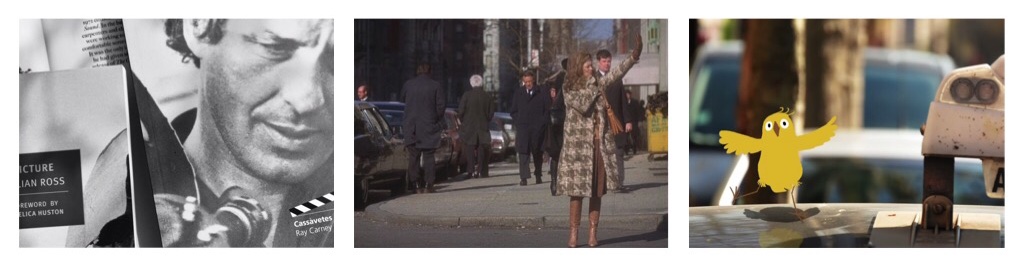
November Newsletter: I Like to Call It Noirvember


Photos: Classiq Journal


Is Humphrey Bogart the most emblematic actor for the American cinema? Yes, I believe he is. He was a man of his times. And he played both of the most celebrated detectives in American cinema: Dashiell Hammett’s Sam Spade and Raymon Chandler’s Philip Marlow. François Truffaut was once again right. “Humphrey Bogart was a modern hero. The period film – the historical romance or pirate story – didn’t suit him. He was the starter at the race, the man who had a revolver with only one bullet, the guy in 5he felt hat that he could flick with a finger to express anger or gaiety, the man at the microphone: “Hello! Hello! calling all cars…“

I have watched The Big Sleep again. It’s been the third or fourth time. I loved it more than ever before. And this has a lot to do with Bogart. It’s just extraordinary to watch Bogart in this film. His performance is perfectly judged, perfectly paced. Yes, I observed, counted his steps, too. “What Bogart did, he did better than anyone else,” Truffaut wrote in his portrait of the actor. “He could act longer without saying a word than anyone else. He was more threatening than anyone else, and he struck his blows better. When he sweated, you could have wrung out his shirts.”

Bogart was that rare kind of actor who celebrated incorruptibility and people would want to be like him. And no film shows this more than The Big Sleep. He is the ideal screen detective. “If Bogart’s appearance was modern, his morality was classic. He knew that causes are worth less than beautiful deeds, and that every act is pure so long as it goes by the rules.” In Howard Hawks: The Grey Fox of Hollywood, Todd McCarthy writes that Bogart “didn’t hunt, ride motorcycles, or indulge in Hawks’s other would-be manly pursuits”. And yet, he struck a chord with men and women alike and he hated the whole “movie star” thing. He was a very smart and well-read man, and he thought he was no better than anyone else and that’s how he lived his life. “A man with a tough shell hiding a fine core. […] By showily neglecting the outward forms of grace, he kept inferior men at a distance,” said Alistair Cooke in the book Bogie: A Celebration of the Life and Films of Humphrey Bogart, by Richard Schickel and George Perry.

How desperately do we need a new Humphrey Bogart, more high class people, more people to look up to instead of always looking down.


Left image: Christa Unzner illustration


Other viewing
 

Batman, 1989
Tim Burton

The whole family watched Batman on Halloween and everyone enjoyed the experience to the full. Dark Night might have Heath Ledger in no less than one of the absolute best roles of all time, but Tim Burton’s Batman is the film that has recreated the atmosphere of Gotham City best. Everything is just right, from the conflicted character that hides behind the placid-looking Michael Keaton’s Bruce Wayne, to the costumes that are a perfect depiction of fashion at the confluence of the 1980s and 1990s, and the Prince songs. But it is Joker that, just as in Dark Night, steals the show. Brilliantly played by Jack Nicholson in his purple suit and clown-like makeup, it’s easy to guess who my seven-yer-old’s favourite character was in the film.

 
The Dark Corner, 1946
Henry Hathaway

“I feel all dead inside. I’m backed up in a corner and I don’t know who’s hitting me.” This line of lead character Bradford Galt (Mark Stevens) sums up Henry Hathaway’s The Dark Corner. Galt is a private investigator who is himself being followed and is being framed for a crime he didn’t commit. He is being chased and cornered throughout the entire film and he has no idea who could be after him. Galt’s words mentioned above also sum up the world of film noir and how cinema had changed from the 1930s. In Death of the Cheap: The Lost B Movies of Film Noir, Arthur Lyons describes both worlds to perfection: “The well-lit, singing and tap-dancing, happy-ending world of the thirties had in ten short years become a hostile, orderless place in which alienation, obsession, and paranoia ruled. The universe seemed to conspire to defeat and entrap the inhabitants who wandered blindly through it, they were victims of fate, their own worst enemies who, looking for a score, ended by dead eating themselves. They were people unwired to anything and for whom nobody prayed.”

Bertrand Tavernier paid a beautiful homage to Henry Hathaway, one of his American friends, in his book, Amis Américains, to the characters in his films and especially his “spectacular villains”: Richard Widmark in Kiss or Death, Signe Hasso in The House on 92 Street, Hack Elam in Rawhide, R.G. Armstrong in Manhunt, and William Bendix in The Dark Corner. And the presence of a traditional cop does not provide the slightest help to Mark Stevens and the diabolical plan plotted against him. It is a villainous world, where “the hero is a private eye and the world he frequents is sordid and violent. […] The film plays in a very spectacular way on the opposition between two worlds: the wealthy, comfortable world of Clifton Webb, and the dark, nocturnal, worrying one of the private eye. A total absence of dramatic music makes the plot even more suffocating, punctuated by extremely violent moments. From time to time however, an excellent comedy scene lightens the atmosphere a little: the relationship between Lucille Ball and Mark Stevens is relatively brilliant, and we cannot forget this remarkable shot showing the milkman handing a newspaper to Lucille Ball, who has just opened the door of her room. A hand appears in the frame and seizes the newspaper from her arm. It’s Mark Stevens’, but the milkman only sees the arm. The expression of astonishment, admiration and envy that can be read on his face is irresistible. Hathaway excels at introducing brief comedy moments in his films.” Another comedic moment is that of the little girl who continues to blow the whistle to the desperation and fury of William Bendix’s villain. It’s this contrast that reveals Hathaway’s dark universe as even more striking and unnerving. Hitchcock had this talent, too.

 
Force of Evil, 1948
Abraham Polonsky

Joe Morse (John Garfield) is a smartly dressed, smart young Wall Street lawyer who thrives on both sides of the law. He wants to repay his big brother, Leo (Thomas Gomez), a small-time business owner, for putting him through school, and that means convincing Leo to work for his top client, Ben Tucker (Roy Roberts), a numbers racketeer. There are so many scenes that stand out in this film, like the wordless performance of Roy Roberts as Ben Tucker when he lets Joe do the talking so that everyone in the room knows he is his right-hand man. It’s Joe’s duality that drives the film, revealing the dark and rotten core of the entire system. A story of unscrupulousness, guilt and redemption stylised to the smallest detail in a perfect merger of form and content. “The dialogue throughout is so rhythmic and smart that it’s been described as blank verse,” remarked critic and filmmaker F.X. Feeney. “Polonsky matched this textual richness with visual work by cinematographer George Barnes, a Hitchcock veteran. He urged Barnes to emulate the work of painter Edward Hopper. (“Ah, single source lighting!” Barnes teased, after they’d visited the museum. “Why didn’t you say?”)
 

The Reckless Moment, 1949
Max Ophüls

The Reckless Moment marks the last US film directed by the German-born filmmaker. It is an unusual film noir, bringing a twist to the genre: the absent leading male character. Although Lucia Harper (Joan Bennett) is a married woman, we don’t feel in any way the presence or influence of her husband in her life. Instead, the male role is assumed by Lucia, who must resort to desperate means in order to protect her daughter who gets involved with the wrong man. James Mason is the blackmailer and his role is remarkable not only because of his talent, but also due to the changes within the character, and the whole emotional spectrum he goes through. I’ve always loved this lobby card from the set of the film that has James Mason, Joan Bennett and director Max Ophüls eating at a table, and the footnote saying: “Joan Bennet breaks bread with her blackmailer”. That’s the plot in a nutshell.
 

Collateral
Michael Mann

In the 2000s, they were still making good films. Collateral is the Tom Cruise film that cast him against type. And he is great in it. Vincent is a hit man, a guy without a past. We don’t get to learn much about him, we don’t get any preparation for it, we just meet him, what we see and hear during the course of one night is what we get. He is a well read and well dressed man (his steely exterior is in part due to his all-grey look), he has no emotions, he is not seeking vengeance, he is just a professional killer with his own moral code and he always gets his job done. He reminded me of Alain Delon’s Jeff Costello in Le samouraï. His acting is also very economical and it serves the character beautifully. Jamie Fox – another fine performance – is the cab driver Vincent picks to drive him around to make his round on that particular night, this compressed moment in time when two people, two diametrically opposed lives clash unexpectedly. But my two favourite characters are Mark Ruffalo and the city of Los Angeles by night, mostly seen from the seat of a cab. It’s one of the most distinctive depictions of LA as seen on screen – Nightcrawler, Mullholand Drive, Drive, To Live and Die in LA are a few others.


Reading
 

Tava: Eastern European Baking and Desserts from Romania and Beyond

This is one of those books that must be saluted and ends up by being loved. Irina Georgescu finally brings the amazing Romanian cuisine and cultural heritage to the world table. She opens this unique place to the world through food and this just might be the absolute best approach. A celebration of identity, a constellation of cultures, a clash of flavours.

“Featuring intimate stories that give a remarkable insight into this rich culinary heritage connecting the past with the present, as well as beautiful photography throughout, Tava is a sensitive and personal journey into one of the most fascinating and culturally-diverse places in the world.”
 

Picturebook Makers

One of the reasons why I love children’s picture books is that they treat children intelligently from the earliest age, as we all should, and they have faith in the children’s ability to understand a lot more than we adults might think. And in front of a picture book, it is adults that often feel insecure and incapable of interpreting an image, a story, art on their own. Children excel at that. I love how picture books balance things out and put children in the front seat.

“What exists in the space between the words and the pictures? How do the stories unfold? What happens from the first sketch to the finished picture book? Twelve of the world’s finest contemporary picture-book makers – Jon Klassen, Kitty Crowther, Eatrice Alemagna, Shaun Tan, Eva Lindström, Blexholex, Chris Haighton, Suzy Lee, Bernardo P. Cavalho, Isol, Manuel Marsol, Johanna Schaible – generously share their experiences, challenges, doubts, sketches, illustrations and invaluable insights into their creative process. They reveal the complex and time-consuming work that happens behind the scenes, in service of their stories and their readers.”


Listening

The album: Muddy Waters and The Rolling Stones Live at the Checkerboard Lounge


Making

Les vacances d’Irina is a very special way of making fashion. It feels like a personal journey, of the founder’s, as well as of the one who chooses to wear a piece of clothing. Seek minimal, feel free. It’s a style that speaks about your mood, your feelings and makes you feel good about the choices you make.

“Les vacances d’Irina is a brand that pays homage to the art of holidaying around the Mediterranean, as it once was… A time of simple glamour, when attitude mattered more then who you were. A time when people would still write postcards and wallow in simplicity. A time of simple ideas, honest materials and clean, timeless design. Les Vacances d’Irina slowly grew, in the rhythm and the style we wanted. Unhurried, like those lingering Summers.

We focus on sustainable items designed to last a lifetime. Both in the design and the quality of the materials. We choose to work with linen, silk, cotton and wool – all hand worked by Romanian craftsmen, as they’ve been for centuries. Les vacances d’Irina is about simplicity and authenticity. It is our own unique story that we have chosen to share with you.”


Exploring

More illustration! The extraordinary illustration universe of Christa Unzner. It simply makes your imagination fly, the way the classics, the likes of Robert Ingpen do. And for children, I believe it’s a place of infinite play and perpetual discovery. Words really are unnecessary.


The regulars: The interviews, newsletters and podcasts I turn to every week and/or every month because they are that good. Craig Mod’s newsletters: Roden and Ridgeline. Soundtracking, with Edith Bowman. Alicia Kennedy’s newsletter. The Racquet magazine newsletter. The Adventure Podcast: Terra Incognita. The print magazines Monocle and Sirene.
 

Posted by classiq in Books, Culture, Film, Newsletter | Comments Off on November Newsletter: I Like to Call It Noirvember

Dorothy Malone, the Character Actor who Almost Stole the Show in The Big Sleep

Dorothy Malone and Humphrey Bogart in “The Big Sleep”, 1956. Warner Brothers

 
Howard Hawks was a born storyteller and an “invisible director”, François Truffaut called him, because “his camera work is never apparent to the eye”. He was also a shrewd spotter of new talent. He “discovered or used effectively for the first time on the screen many actors,” says Todd McCarthy in Howard Hawks: The Grey Fox of Hollywood, from Paul Muni, Lauren Bacall and Rita Hayworth, to Montgomery Clift, James Caan and Dorothy Malone. The Big Sleep may be a Bogie and Bacall film and the film was clearly hewed to become a “suitably amorous and balanced vehicle for a Bogart and Bacall” after the success of To Have and Have Not, but being a noir film, we would be remiss if we didn’t look deeper. Especially at the supporting cast, the character actors who usually drive a film, especially a film noir. Because “hell, we didn’t know what film noir was in those days. We were just making movies. Cary Grant and all the big stars got all the lights. We lit our sets with cigarette butts,” Robert Mitchum said before he himself became one of the stars.

Noir films were films for actors, not stars. The directors and cinematographers had to be inventive and innovative (it’s where many of them cut their teeth in and created their filmmaking style) because the budgets were limited and the time-frames were short. They presented a world somewhere between pulp fiction and existentialism where life had low values and an even lower running time, a world where love is replaced by obsession and fatal desires, but found a streak of poetry in the light coming out of a street pole in a dark alley or in the smoke of the omnipresent cigar, captured the interest with an odd angle, a glowing haunted face or a sharp line of dialogue, got under the viewer’s skin with deadly femmes fatales. They were made on Poverty Row, but they revelled in their cheapness, creating their own language, honing such a distinctive and definitive cinematic style “where one did not exist before”. It’s more than a genre, it’s called making movies. Maybe that’s why, of all the genres, the classic noir films are those that still hold our interest more than any others. It’s that “making” thing, the realness, the true grit, the unique experience we are allowed of experiencing our dark side but only from a safe distance.

And the supporting actors were the gold mines of film noir. The Thelma Ritters (can you imagine Pickup on South Street and Rear Window without her?), the Elisha Cooks Jr., the Dorothy Malones.


“You begin to interest me, vaguely.”
Dorothy Malone to Bogart, The Big Sleep


The Big Sleep follows private detective Philip Marlowe (Humphrey Bogart) as he picks his way through a corrupt labyrinth of gamblers, blackmailers, pornographers, hired thugs and murderers, who have attached themselves to the rich, elderly General Sternwood, and his two daughters, Vivian (Lauren Bacall) and Carmen (Martha Vickers). It is one of the classics of film noir, heavy on great dialogue that simply doesn’t let up, it has wit and verve and style and an intricate and fast-paced plot, and where the time of day is appropriately night. It is a “deeply mysterious puzzle in which everyone is suspicious and most are guilty of something,” writes Todd McCarthy, and when the film ends you remain puzzled. I personally revel in its intricate, labyrinthine plot. And Dorothy Malone’s character falls perfectly into place.

She is the bookseller who makes a pass at Bogart. She almost steels the show of the entire film. It is her part that is truly memorable. It was Bogart and Bacall who the audience were waiting to see on screen, and on whom the producers placed their bets, but the surprise came from Dorothy Malone. The combination of mystery, lively curiosity and liberating departure from the faux feminine ideal that she projects grabs your attention, takes you by surprise. And isn’t that why we go to the movies in the first place, what we hope to experience? “For the bookseller, Hawks was delighted with a nineteen-year-old Texas newcomer Dorothy Malone. Hawks said that the scene was never intended to be taken as far as it went, but they were able to do so simply because “the girl was so damn good-looking. It taught me a great lesson, that if you make a good scene, if we could do something that was fun, the audience goes right along with it.” Like Bacall, Malone was so nervous doing her first important scene that her hands shook while she attempted to get the drink, prompting Hawks to have the bottom of the glass filled with lead so she could handle it.”

Dorothy Malone, with her character here and other films that would follow, didn’t conform to stereotypes. She doesn’t even get a name in The Big Sleep, she is just the Acme Book Shop proprietress. But she breaths life into her character, just like Gloria Graham or Lizabeth Scott did in their noir roles. She doesn’t conform. She has presence, and this has nothing to do with the costumes she wears. It’s her wit and crafty personality, not her looks, that make for a female’s best guns. And she makes a pass at Bogie while talking about books… and then closes up shop for him. But maybe that shouldn’t surprise us, especially in a Howard Hawks film. The Hawksian woman is just as much part of Hawks’ universe as his tough men are.


MORE STORIES

Lizabeth Scott: She Had What It Took for Film Noir

Dressed to fir the monochromatic look and distressed reality of a 1955 noir:
Mickey Rourke in Angel Heart

Gloria Graham in Film Noir

Posted by classiq in Film | | Comments Off on Dorothy Malone, the Character Actor who Almost Stole the Show in The Big Sleep

Denim on Film Noir: Lovers on the Run in “Tomorrow Is Another Day”

Ruth Roman and Steve Cochran in “Tomorrow Is Another Day“, 1951. Warner Brothers


Bill Clark and Cay Higgins only have each other to rely on. They are lovers on the run, even if it’s an obsessive love that they are united by. But we know something Bill doesn’t. Cay has hidden the truth from Bill and, for us, the viewers, to know that is to know that they in fact are separate from one another. Therein lies the greatest noir sensibility of Tomorrow Is Another Day.

Bill Clark (Steve Cochran) has just been released from prison, after serving 18 years for murdering his violent father. His release is observed by a newspaperman who is after an exclusive story. He befriends Clark without revealing his intentions and then betrays him and runs a discrediting story on him. From now on, Clark feels cornered and watched by everybody, tensed around everyone. He is always on the watch-out. The viewer feels this tension, too. Even when he enters a dance room and feels uneasy because he is being watched because he can’t dance. He is like an animal released from the cage who no longer knows what to do in liberty.
 

Ruth Roman and Steve Cochran in “Tomorrow Is Another Day“, 1951. Warner Brothers

 
He meets Cay Higgins (Ruth Roman), one of the dime-a-dozen girls who make a living at the dance club. Things are going good until Cay’s cop/pimp boyfriend Conover (Hugh Sanders) shows up, starts a fight with Bill, who is knocked unconscious, and then Conover is shot in self-defense by Cay. She lets Bill believe he shot the cop. The fugitives leave New York and settle down among lettuce pickers in California, but their past catches up with them. And the secret Cay harbors the entire film has caught up with her conscious, too. Throughout the entire film there is this shift of focus between Bill and Cay, the antihero who is tormented by his guilt and anxiety, the conflicted femme fatale who falls victim to her own self.
 

Ruth Roman and Steve Cochran in “Tomorrow Is Another Day“, 1951. Warner Brothers


This transformation is clearly showed in the clothes they wear – Milo Anderson was responsible for the wardrobe. When we meet Cay, she is dressed in glamorous gowns and she has platinum blonde hair, perfectly coiffed. Bill is wearing a suit, trying to fit in in an adults’ world he has long missed the start on. They change looks when they flee the police. Jeans, white shirt and denim jacket for her (and plain dresses when she’s around the house). She dies her hair black. Jeans, white t-shirt and black leather jacket for him. Not only does this change of looks have a narrative motive (they’re hiding from the police), but now they do look like a proletarian fugitive couple. Which they are.

It was the 1950s. Blue jeans were emerging as a kind of uniform for the ordinary man, for the working class man, but also as an identity staple, the symbol of a generational revolution. Marlon Brando had a lot to do with that. It was the undesigned outfit that Lucinda Ballard chose – T-shirt and blue jeans – for him to wear in A Streetcar Named Desire (1951), a look that used to be his acting costume (completed by a ragged jacket and tennis shoes) from his theater days, when he started to work with Stella Adler, prompting her to ask “Who’s the bum?,” when he entered her class. The look ultimately became part of the culture, “the new symbol of American maleness”, an urgently desired new beginning, a badge of cool, a symbol of identity, the defining fashion moment of the decade, and, most importantly, fashion that was accessible to all, regardless of the economic reality in which people lived. The economic reality in Felix E. Feist’s Tomorrow Is Another Day is poor, and it’s this economic reality – the poor people Cay and Bill find refuge at, forced to do anything for a dime – that pushes the outcome of the film.


Ruth Roman and Steve Cochran in “Tomorrow Is Another Day“, 1951. Warner Brothers


Nicholas Ray had a lot to do with the look of the 1950s, too. His poetic film noir They Live by Night (1948) was his first feature film and the first in a series of films of hard-hitting social realism that treated the theme of the confused and misunderstood American outsiders and outcasts, and paved the way for decades to come of couples-on-the-run noirs and thrillers. His film introduced its couple with a written line: “This boy and this girl were never properly introduced to the world we live in.” Bowie (Farley Granger) and Keechie (Cathy O’Donnell) are an innocent couple in their early twenties. When Bowie, a fugitive who has broken out of prison, after an unjust sentence, with some bank robbers, meets the innocent Keechie, each sees something in the other that no one else ever has, they fall in love despite the circumstances that put them on the wrong side of adulthood and start to hope for a life different than the one they were born into, trying to break loose from both a society and parents who either don’t understand them or refuse to try.

The same line – “This boy and this girl were never properly introduced to the world we live in.” – goes for just half of the couple in Tomorrow Is Another Day: Bill Clark. He was a child when he was thrown in jail. Now he is an adult unequipped for the world he has once again been thrown into. But his jeans, t-shirt and leather jacket certainly suit him better than his suit. Furthermore, they conceal and protect him from the outer world. In They Live By Night, Farley Granger’s preference for the leather jacket instead of a suit questioned the place of the individual, and of the teenager, in the American society. “One thing you’ve got to learn, kid,” one of the gang tells Bowie, “you’ve got to look and act like other people.” And he takes him to buy him a suit. The leather jacket was his safeguard against an adult world he knew he didn’t belong to.

Cay Higgins, on the other hand, is well versed in the shader kind of life, blasé and willing to fight with any means for survival. Underneath all that though, maybe they are somehow able to see in each other a way out. She certainly seems more at home in her jeans and white shirt than in her femme fatale black dresses. Free, at last. That’s the impression you get when you see them hitchhiking. Eventually they even come to love each other, but Cay’s dishonesty, not society, doesn’t allow them to function happily. And our knowledge of Cay lying to Bill and of him not having in fact anyone to rely on, suffuses the film with the noir ethos that unfortunately the ending isn’t able to sustain.


MORE STORIES


The undesigned outfit, the new symbol of American maleness:
Marlon Brando in “A Streetcar Named Desire”

Film noir style: Peggy Cummins in “Gun Crazy”

A new kind of rebel: Farley Granger in Nicolas Ray’s “They Live by Night”

Posted by classiq in Film, Film costume | | Comments Off on Denim on Film Noir: Lovers on the Run in “Tomorrow Is Another Day”

Read Instead…in Print

Read instead… in print is about a good book about cinema or filmmakers. No discursive, pretentious analyses, no verbose scrutiny. Because the idea is to invite you to read the book, not read about it here. But instead of using social media, I use my journal. Back to basics. Take it as a wish to break free of over-reliance on social media (even if it’s just for posting a photo of a good book) for presenting my work, cultural finds and interests. These are things to be enjoyed as stand-alone pieces in a more substantial and meaningful way than showing them in the black hole of Instagram thronged with an audience with a short attention span. This is also a look through my voluminous collection of books about film that I use as research in my adamant decision to rely less and less on the online and more on more on print materials.


Read instead…in print #18

Sidney Lumet’s Making Movies is the kind of book you can’t just leaf through. You read every word and you do it on one reading, just like the director says he always used to read the scripts – because “a script can have a very different feeling if reading it is interrupted”. And then you come back to read entire passages to be able to take it all in. I don’t like the word “review”. For books or films. I think you have to have a certain amount of arrogance in you to be able to do that. I don’t have it. Or you should know everything there is to know about films, more than the filmmakers making them. Nobody does, unless they are François Truffaut or Martin Scorsese. So I don’t analise movies. I talk about them. Quite passionately, quite often. Because I love films. So if you are a filmgoer, if you like movies just a little bit, if it is just one film that you’ve ever liked, then you should read this book. Roger Ebert said it best: “Invaluable… I am sometimes asked if there is one book a filmgoer could read to learn more about how movies are made and what to look for while watching them. This is the book.”
 
 
image

Directors take risks. The critics and the audiences don’t.


It’s all in the preparation. Do mountains of preparation kill spontaneity? Absolutely not. It’s just the opposite. When you know what you are doing, you feel much freer to improvise.


Dialogue is like anything else in movies. It can be a crutch or,
when used well, it can enhance, deepen, and reveal.


Good work comes from passion.


The reality of the movie insider has nothing to do with the
reality of an audience watching a movie for the first time.


Clothes are important.


Pictures are not made in the cutting room, which is the cliché
about editing, but they can be ruined there.


There is no way critics can know how well or poorly a film was edited.
Only three people know how good or bad the editing was:
the editor, the director, and the cameraman.


Sometimes an image is so meaningful
that it encompasses everything the movie is about.


The music must say something that nothing else in the picture is saying.
But when you can’t find a musical score that adds to the movie, don’t use one.
There was no score used in Dog Day Afternoon, The Hill, or Network.


Photos: (clockwise, from top right: “Twelve Angry Men”, 1957. MGM / “Network”, 1976. MGM, United Artists / Classiq Journal


MORE STORIES


Read instead…in print #14: Cassavetes on Cassavetes

Talking film costume: Faye Dunaway in “Network”

The short film is a space for infinite freedom:
Interview with filmmaker Nicolas Bianco-Levrin

Posted by classiq in Books, Film, Read instead...in print | | Comments Off on Read Instead…in Print

“The Short Film is a Space for Infinite Freedom”: Interview with Filmmaker Nicolas Bianco-Levrin

“Celui qui domptait les nuages“, 2015. Nicolas Bianco-Levrin and Julie Rembauville. Prototype Productions


The sprightliness of the reimagined story of Little Red Riding Hood.

A dark, atmospheric cautionary tale set in the slumps of Louisiana on the jazzy score of Adrien Chevalier.

A little mouse who lives among books and their extraordinary adventures and who, when the candle burns out and he runs out of matches, must take on his own adventure to find a spark to light up his imagination again.

The universe of Nicolas Bianco-Levrin and Julie Rembauville’s animated short films is infinite. I loved diving into their cinematic universe, especially that I feel that short films still dare to be creative where feature films fail. Nicolas and Julie’s films have the courage and brilliance to touch our imagination, hearts and minds, often without one single word. Insights, values and vision are expressed with humour, or dark humour, or gentleness, or more realism than many live-action films. Animation has this ability of clarifying the essence of storytelling, boiling the image making and narration to storybook-moments and gestures. There is not a wasted moment. It has our full attention. And, above all, it never runs out of that spark that lights up our imagination.

I have spoken with Nicolas Bianco-Levrin about how he creates a single world from a multitude of ideas, why he prefers short stories, and his unique collaboration with Julie Rembauville.


“Kiki la plume”, 2020. Nicolas Bianco-Levrin and Julie Rembauville. Prototypes Productions


You made Kiki la plume (Kiki the Feather) in 2020, but only recently have I had the chance to watch it, so I would like to start with it. Can you tell us how it came to be, what inspired it?

During the 2020 lockdown, we found ourselves stuck at home with plenty of time to complete projects. We took the opportunity to write a short film. We had access to the rooftops of our building. Facing our house, there are buildings typical of Paris built in the 1920s. During the confinement, pets reappeared in the city. We wrote a story about these animals on the theme of freedom. During the lockdown, it was the humans who found themselves in a cage.
 

How do you manage to condense your ideas into a short film?

First, we list all our ideas for each film or subject we want to make. Then we choose a single idea that will serve as a guideline throughout the production of the film. The other ideas put aside allow us to feed our thinking, to develop the universe, to deepen the characters.


“The short film is a space of infinite freedom.”


Why do you prefer short stories?

The short film is a space of infinite freedom. There is certainly less funding for short films. This constraint means that there is less pressure from funders who support us in the writing and production stages without constraining us. The short film allows each film to invent new universes, new ways of making.
 

There is no dialogue in Kiki la plume, which truly reinforces the theme of the film.

Many of our films are without dialogue. They travel more easily around the world. When there is no dialogue, it forces us to focus on storytelling flowing out of situations and character acting. Even in our films with dialogue, we prefer to replace certain lines with actions. This reinforces the rhythm of the film.


The Kroak book series. Nicolas Bianco-Levrin


Many of your books are also without words. I like that, from the very reason that they leave room for the reader’s imagination. And I like how you add light touches to complete the story, without words, like drawing a musical note near Kroak, for example. Can you tell us a little about your Kroak series?

The Kroak series began as a series of short stories that I drew in children’s books. I drew a scrapbook every month, telling the stories of an Inuit in his world. Every morning Kroak gets up and goes hunting. The character arrives in an all-white square and something unexpected happens. The scenarios essentially play on eccentric situations, where garden gnomes mysteriously appear on the ice shelf, or Kroak travels inside the whales, or evil spirits burn the comic book page. The illustrator must then intervene to make the character reappear. This last situation is a direct reference to the Italian series La Linea, by Osvaldo Cavandoli, from the 70s.


“Les Mots”, 2011. Nicolas Bianco-Levrin and Julie Rembauville. éditions Lirabelle


Book or film? Fixed or animated? How do you choose to tell a story in images? That’s what your book, Histoire en images, is also about.

Throughout the years, I have worked for different institutions on children’s literature: Institut Charles Perrault, Ricochet, Center Paris Lecture. I also wrote a column in a magazine specialising in children’s literature: Griffon. In this section, I analysed the work of illustrators who were interested in animated cinema. At the time, bridges between children’s literature and animated cinema were quite scarce. I had co-founded a journal specialising in graphic literature, Hors Cadre[s], hoping to be able to explore this subject further, but I was unable to do so. Promoting the work of other authors and analysing their techniques allowed me to submit my own work as an author.

Then, in 2012, I left this job to travel for 3 years with a group of artists. During these years, I had a lot of time to carry out book and film projects. During the days I progressed on my projects and in the evenings I reflected on my practice. I wrote a book that anylises the similarities and differences between children’s literature and animated cinema. This book focuses on the design and production of stories in pictures. This ranges from the stages of research and creation of the characters, to the writing of the synopsis which occur in the making of both books and films. It is the timing of the storyboard that really differs between the two mediums.


“Petite étincelle”, 2019. Nicolas Bianco-Levrin and Julie Rembauville


So what lead you to animation?

I met Julie (ed. note: Julie Rembauville, his close collaborator) in high school. Julie wanted to become a scriptwriter and I hoped to do comics. Animation was a type of cinema that particularly spoke to us and it was a type of writing that was common to our two passions (fiction and comics). We made a first animated film which we started in 2002 and finished two years later. This film was made in volume. It took us a very long time to create the sets and the characters. Afterwards, we made cut-out paper films, allowing films to be made more quickly and thus to accumulate experience. In 2012, we produced our first animated film with Filomage studios.


“In animated film, we have only two limits: time and imagination.”


Some people assume animation is only for kids and families, and it’s not. But just like children’s books, about which many children’s books writers say (and they are right) that they are not just for children, I find that, in Kiki la plume, for example, you teach through a funny, light touch about the realities of life. What do you find the most fascinating about animation?

In animation, anything is possible. We can make elephants fly, move mountains, go to the moon, eat at a the same table with the pirates, tame clouds… In animated film, we have only two limits: time and imagination. Production takes very long. At the moment, we are working on a 45-minute film and we have to do around 35,000 drawings. In this film, we have pigeons making a musical, an earthworm playing the kazou, a scooter flying in the middle of a city.


“Attention au loup!”, 2019. Nicolas Bianco-Levrin and Julie Rembauville. Prototype Productions


Your film Attention au loup! (Beware the Wolf!) is only 56 seconds long and in that short time you were able to create a very funny reinterpretation of a classic story. What made you choose that particular story?

Julie and I have been organising short film festivals for 20 years. We started by organising a festival of student and independent short films that lasted 15 years. Then, for another 5 years, we organised the 7 Petits Cailloux festival near Reims, in France. Each year, we created the title credits for the film sessions. One year, the theme for the poster was the wolf. The credits lasted 40 seconds. We had chosen a universal story, which children of all ages know so that they can easily immerse themselves into the story. Little Red Riding Hood has imposed itself on us. In order to turn the festival credits into a movie, we added an 8-second shot at the end.
 

Some of your films are in colour, some are not, like Une Histoire de Jeannot (A Story by Jeannot), or Celui qui domptait les nuages (The One Who Tamed the Clouds). How do you decide on that? Does a certain type of story call for a certain visual style?

Julie and I have made 38 films together and I drew 27 books. With each new project, I look for the graphic universe that best suits the story. In the case of Une Histoire de Jeannot, it is about the life of a young boy who will cross the world in 1871 during the Paris Commune and who will return to France in 1936 during the Popular Front. For this large historical fresco, I was inspired by 19th century press cartoons. The illustrations in these journals were drawn in pencil and printed in lithography. It was necessary to adapt the technique of lithography to animated cinema.


“Une histoire de Jeannot”, 2018. Nicolas Bianco-Levrin and Julie Rembauville. La Luna Productions


You have a very close collaboration with Julie Rembauville and I feel she is just as much part of this interview as you are. How does your partnership work?

For nearly 24 years, we’ve been making our books, movies, and everything else together. We each write stories in turn. The one who writes the screenplay directs the project, the other one assists him/her in bringing the film to fruition. I take care of all the graphic design part: characters and backgrounds. We set up the scenes together. We both do animation. Finally, Julie will manage all the sound part.
 

Speaking of sound and music, the score is such an important part of a feature film. Is it the same with short films? When does music come in in your films? Do you ever sketch or write with a particular piece of music in your head?

For each film project, we think of the whole soundtrack at the time of writing the story. In animated film, and especially in comedy, the rhythm must be finely worked out. We first seek to create a solid rhythmic structure for the story and each of the actions. Most often, the music is created after the animation of the film. But sometimes we have the music beforehand, which carries us a lot throughout the writing and production.


“We think of the whole soundtrack at the time of writing the story.”


I have to bring up the music in Vieille Peau/Old Hag. It’s absolutely brilliant and I loved the whole dark story set in Louisiana. It’s a great cautionary tale. What made you choose Adrien Chvelier for the music?

Adrien Chevalier has composed the music for 9 of our films. He has a keen sense of the synergy between image and sound. He offers different musical directions that can bring another dimension to the story. Adrien came to help us on the set of our first animated film, in 2002. At the time, he took a long-forgotten violin out of storage. In just two years, he had developed a very rich musical culture and an extraordinary sense of composition.


“Vieille Peau”, 2020. Nicolas Bianco-Levrin and Julie Rembauville. La Luna Productions


You were mentioning the film you are working on at the moment. When will it be out and where can we watch it? And how can the wide public see short films?

At the moment, we are working on the production of a 45-minute animated musical Christmas story. The film tells the story of Abdou, a young boy who lives in a somewhat sad suburb and who dreams of going to the stars. He is trying to invent a rocket engine. To pay for his engine parts, he delivers pizzas. One Christmas Eve, he meets Santa Claus. In real life, his name is Marcel and the old man is worn out, he is waiting for retirement. After a stupid scooter accident, Marcel will not be able to ensure his Christmas deliveries and Abdou will have to impersonate Santa Claus.

​Xbo Films is producing the short. The film will be released on Canal+ in December 2023. A cinema release could arrive in December 2024. In addition, the film will travel to festivals. We are also working on TV releases in other countries. For now, we have completed 4,800 drawings, there are only 30,200 left to do.
 

Thank you, Nicolas, for taking us on this cinematic journey.


Website: nicolasbianco.fr


“Empreintes” children’s book. Nicolas Bianco-Levrin. éditions Lettr’Ange


MORE STORIES

Making a fictional world feel real: Interview with film graphic designer Erica Dorn

Very, very natural and herself: Katherine Hepburn in “Bringing Up Baby”

Art directing film posters: In conversation with illustrator Akiko Stehrenberger

Posted by classiq in Film, Interviews | | Comments Off on “The Short Film is a Space for Infinite Freedom”: Interview with Filmmaker Nicolas Bianco-Levrin