Style in Film: Gena Rowlands in Gloria

Gena Rowlands Emanuel Ungaro Gloria 

Gloria loves clothes. She cares about them. They are perhaps about the only thing she cares about. She suddenly finds herself on the run, but she takes her clothes along. So she should. They are Emanuel Ungaro and they are part of who she is.

John Cassavetes was a director who liked to break away from Hollywood clichés (he was often called the “European American” director), which was probably why he always chose to produce his own movies with the money made from his acting and from constantly mortgaging the house he shared with his wife, as Gena Rowlands was smilingly remembering in an interview. And one of the clichés he deliberately worked hard to avoid in 1980’s Gloria (one of the no less than ten collaborations of one of cinema’s great husband-wife partnerships) was the sentimentality.

A Puerto Rican kid, Phil (John Adames), whose family is killed by the mob, and Gloria (Gena Rowlands in the role of her career – she is simply superb in it), the kid’s family’s neighbour, who is friends with the mob, are thrown together, but they don’t pretend to care about each other just because of that. The two have this incredible restraint in their relationship and that’s what makes it very relatable … and watchable, because, honestly, this is what brings authenticity to the story. He is not cuddly – “The kid is neither sympathetic nor non-sympathetic. He’s just a kid. He reminds me of me, constantly in shock, reacting to this unfathomable environment”, Cassavetes was commenting – and she is not affectionate – she loves her no-strings-attached life, her freedom, and just because life throws a stranger child into her arms she doesn’t instantly change into a mother figure. So, at the end, when they do care about each other (the kid gets to know her well, by the way he carefully takes her clothes out of the suitcase and hangs them in the hotel room), “it’s because of their personal trust and regard”, and it feels natural and emotional, without seeming forced and pretentious.
 
Gena Rowlands Emanuel Ungaro Gloria 

We are introduced to Gloria while wearing a classic trench coat… over pajamas… and with heels. “Ran out of coffee”, she tells her neighbours when she knocks at their door. It’s a look that reflects her way of life well. It’s noon, and it’s clear she doesn’t start her day earlier. She is not a day person. But there is something more about this look. There is something very actual, very Dries Van Noten about it. It is not costume-y at all (although it serves the plot well), a quality always present in Van Noten’s collections, regardless of the specific inspirations behind them, and regardless of the designer’s signature mix of prints, fabrics and styles. Intelligent, grown-up women dress for themselves, and just because of that their clothes appear relevant under any circumstances.
 
Gena Rowlands costumes GloriaGena Rowlands style Gloria

Gena Rowlands style Gloria 

Emanuel Ungaro is considered one of the last couturiers, who started out in the workrooms of Balenciaga, where he learned about line and colour and draping directly on the model, and then went on to work with Courrèges. Towards the end of the 1970s, he was one of the first designers who started experimenting with mixing bold textures and prints. The clothes from the designer’s boutique collection John Cassavetes chose for Gloria are tough and loud. They are very much Gloria, and very much 80s. They are shiny and bright, made of silk and satin, echoing the disco era and night life of the decade, while the oversized shoulder pads, the knee-long, flowy skirts that move so well, and the wrap dress that Gloria wears in the final part of the movie, they all suggest practicality and power dressing. Gloria means business and she doesn’t seem out of place in them running on the gritty streets of 1980s New York. The non-glamorized, non-touristy parts of the city were deliberately picked by John Cassavetes to avoid the “Woody Allen movie” feeling. And this is another thing I like about the movie. It evokes a sense of reality, that those things could indeed happen in those streets. Because Cassavetes wrote scripts and made movies the way people talked, real street talk, and the way regular people behaved.

“I love New York! I grew up there, and it seemed to me that all the pictures that are made about New York never concentrate on neighbourhoods. And New York to me is comprised of a series of neighborhoods. It was very important not to make the scenery be the center of attention, because, I don’t know, I just feel there should be some more respect given to life than to the making of a film.”
 
Gena Rowlands style Gloria

Gena Rowlands style Gloria

Gena Rowlands style Gloria

Gena Rowlands style Gloria

 
bibliography: Cassavetes on Cassavetes by Ray Carney

photos: screen stills captured by me | Columbia Pictures

Posted by classiq in Film costume | | Comments Off on Style in Film: Gena Rowlands in Gloria

Doster: 80s/90s

Doster 80s 90s 
“It’s a book filled with passion, and the man behind the camera goes deep into the essence of the object… It all comes down to passion,” is what Michael Doster said about his photography book, Doster 80s/90s, when asked by Katinka Omir, filmmaker and his interviewer in the book (this interview is one to read, by the way), what he would tell her if she had no idea what it was about. I didn’t know what to expect either, as this, strangely enough (coming from someone who loves the fashion photography of the 80s and 90s more than any kind of fashion photography), was not even on my radar when my husband surprised me with it. The most pregnant impressions that the book left me were two: the incredible joy of life everybody seemed to feel (fashion does reflect society and the times we live) and the fact that the photographer does indeed seem to love his every subject.

The shoulders of the clothes may have been too big, the hair too “done”, the make-up too much, but the energy of the 80s was infectious, the models looked like women, not like anorexic under-age girls, fashion was about attitude just as much as it was about clothes, it was more about creativity and less about money, fashion photography was done on film and not rampantly digitalised and airbrushed and you could really see the clothes and what the image was all about. And here you have this beautiful book to tell the story, no words necessary.
 
Doster 80s 90s 
“You are representing elegance, intelligence, charisma and beauty. I have a big problem when I look at today’s generation. They mostly dress alike, look alike, talk alike and behave alike. They are everything alike. Where is the individual identity?” Doster was telling Katinka Omir in their interview in 2008
 
Doster 80s 90s fashion photography
 
Doster 80s 90s fashion photography


“For me, photography is what your eye sees through the camera and the result.
With the digital photography, you shoot and then you can put anything you want into the picture or take anything out. This has nothing to do with what your eye originally saw. That’s the difference. And then, on top of that, there is post-production.”


photos by me from the book Doster: 80s/90s, published by Damiani

Posted by classiq in Books | | Comments Off on Doster: 80s/90s

Games? Must We?

Sports and ethics 
This may be a line from one of my favourite Hitchcock movies, North by Northwest, but there is nothing fictional about the subject I am approaching today. It’s very much real. And it is a sad reality sport and tennis are facing. Apart from the subjects that largely make up this blog, I like to keep my personal views out of it, although I have very strong beliefs and am very vocal in my private life when it comes to things like politics, sports or global issues. But there are some moments when I feel the need to address a controversial topic here, especially that this time it’s about tennis and ethics.

The general lines are these. You must know by now that at the beginning of this week Maria Sharapova held a press conference and admitted she was tested positive for the drug meldonium at the Australian Open. I haven’t been this shocked and disappointed since the Lance Armstrong story and Andre Agassi’s doping revealings in his autobiography. Sharapova says she has been taking the said drug, prescribed by her doctor, for about ten years to prevent health issues. The drug was only recently, at the beginning of the year, added to the list of banned substances under the World Anti-Doping Agency and she claims she unknowingly continued to take it, ignoring the email she had received back in December announcing the new regulations.

I would first like to say that I’ve never been a fan of Sharapova’s (in fact, I don’t think I have been really interested in women’s tennis since the days of Justine Henin). Although the Russian player is the only one who has managed to win all four majors (even two Roland Garros titles) in this era reigned by Serena Williams, when many other players seem to disappear into thin air after winning a grand slam title, I often spotted and resented her lack of fair play on the tennis court. Reportedly, she isn’t very friendly on tour, either. But I had never doubted her high standards as far as her career was concerned. I always thought her to be very meticulous, obsessive with details, hard working, perseverent (she had many comebacks after serious injuries), always raising the bar higher for herself, simply above board in everything.

I want to give everyone the benefit of a doubt and the fact is this drug was legal until January this year. Rules are rules and she seems to have played by them until now. But, let’s not kid ourselves, because I don’t think any of us was born yesterday. Athletes have always been quicker than authorities to pick up on the beneficial effects of various drugs before being banned. And believe me, I personally heard from reliable sources that entire sports teams (not tennis, in this case) have geneticists in their staff. You get the picture. Andy Murray was very straightforward in addressing sports ethics: “I think taking a prescription drug that you don’t necessarily need, but just because it’s legal, that’s wrong, clearly. That’s wrong. If you’re taking a prescription drug and you’re not using it for what that drug was meant for, then you don’t need it, so you’re just using it for the performance enhancing benefits that drug is giving you. And I don’t think that that’s right. I read that 55 athletes have failed tests for that substance since 1 January. You just don’t expect high level athletes at the top of many sports to have heart conditions.” You can’t have it any clearer spelled out for you.

That said, it’s not the fact that she has taken this drug almost her entire career that bothers me most, but the fact that she claims her continuing to take it after becoming illegal was an honest mistake. She simply did not open the email. How is that possible? What about the legion of (supposedly) competent agents and staff behind the Maria Sharapova brand? Her doctors follow her everywhere and this is simply something that slipped them? Something this big, with so many implications and repercussions? That’s plain bullshit, excuse my language. Or is it carelessness and negligence? At this level? The highest paid sportswoman on the planet, who has everything at stake? You are not allowed to make mistakes at this level. Period. It’s foul play, however you may look at it. And the issue that should be debated is not whether Sharapova should take full responsibility for it (why is this question even being raised?), but the greater harm that something like this does.

Former US tennis player Jennifer Capriati said: “I’m extremely angry and disappointed. I had to lose my career and never opted to cheat no matter what. I had to throw in the towel and suffer. I didn’t have the high priced team of doctors that found a way for me to cheat and get around the system and wait for science to catch up. The responses are exactly what I am talking about. Everything based on illusion and lie driven by the media for over 20 years. Beyond unfair.” True. But it is also true that it is the American athletes who probably have the best doctors in the world (Sharapova may be Russian, but she has been living and training in the US since she was seven), which makes me raise some serious questions. I am just saying that this might go much deeper, and not only in tennis.

What angries me beyond limits is that the game, a sport that I love, will suffer from this. So will the children who have Maria Sharapova as their model. And we need our children to love sport, for their wellbeing, but also for having real, worthy, healthy models to look up to. I used to think sport provided this kind of model through its champions.

photo: EPA FILE via The Telegraph

Posted by classiq in Personal | | Comments Off on Games? Must We?

Style in Film: Spotlight

Style in film Spotlight 
What do The Grand Budapest Hotel, The Great Gatsby, The Artist, Memoirs of A Geisha, Chicago and The Aviator all have in common? They are period movies which have all won the Oscar for costume design. In fact, over the last two decades, there have been just two contemporary films that have earned even a nomination, The Devil Wears Prada and I Am Love. In the entire history of the Academy Awards considerably fewer contemporary movies were recognized for their costumes. Present-day stories have always been underappreciated in comparison to the historical drama, fantasy and sci-fi genres. It is much harder, it seems, to get contemporary film costume right. In fact, it is much more difficult to convince a viewer of a costume’s plausibility in a story set within a familiar world, using familiar attire. The wider role that clothes play in film seems to be often easily overlooked in the case of contemporary characters, forgetting that accuracy is not important in period productions alone and that, on screen, the most plain piece of clothing is not just a piece of clothing and that it can take on meaning.
 
Style in Film Spotlight 
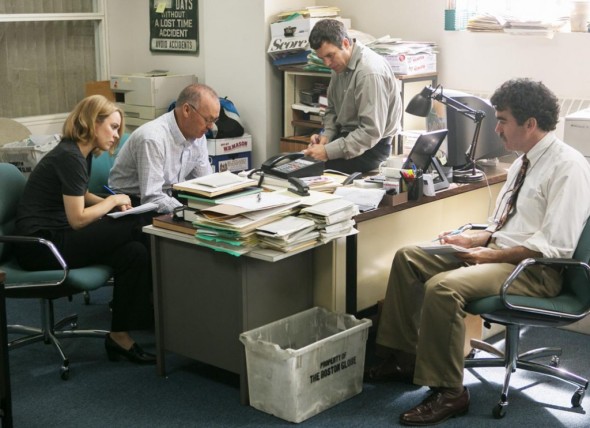
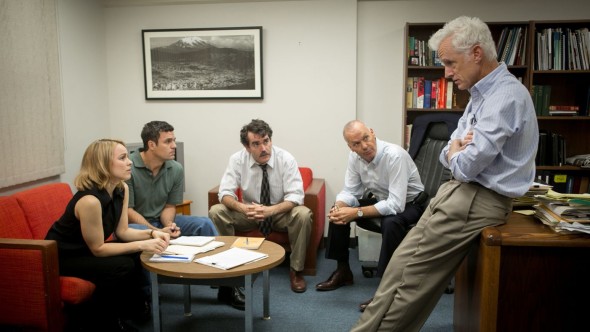
This year is no different. The Oscar for costume design will once again go to a period or fantasy film. But on the week of the Academy Awards my attention goes to one of last year’s best films, Spotlight, in which clothes go unnoticed. And so they should, because therein lies their authenticity. They were made, chosen or recreated to reflect the real life protagonists of the story, the Pulitzer Prize-winning journalists from The Boston Globe who uncovered the decades-long child abuse scandal within the local Catholic archdiocese and the subsequent cover-up. The story is set in the late ’90s, but it is a historical framework thought not “period” in the customary sense. We get to see some wonderfully realistic ’90s styles, capturing the fashions of the times and, most importantly, the dressing style of journalists – they do dress like that, don’t they? – and of the real reporters involved in the story. “We shot our first week at the Boston Globe itself, in the physical building, and people said, ‘Oh yeah, that’s just what Sacha [Pfeiffer, played by Rachel McAdams] used to wear,'” says the film’s costume designer, Wendy Chuck, who scoured thrift stores for most of Rachel’s wardrobe, largely consisting of collared shirts and a black suit.

The research for the main characters’ looks was mostly done by working with the real life reporters, gathering details of the way they used to dress from talking to them and by consulting personal photos of theirs from that time. They are ordinary clothes, but nevertheless they have their own stories to tell. Those who wear them don’t really think of how they dress, they want to go by unnoticed and without anybody reading much into them, because they have a bigger story to tell. “There’s something so generous about the spirit of these people. My drive was to pay homage to journalism and who these people were, and what they did. I felt I had a responsibility to all these people living and dead,” Chuck said.
 
Style in film SpotlightThe ’90s Gap chinos that served as a model for the pair worn by McAdams’ character (even if contemporary costume is often shopped for, it is always adjusted to fit the actor and character) were also found at a thrift store.

Costume design Spotlight 2015

Spotlight 2015 costumes
 
The men’s costumes – belted pleated trousers, slightly baggy, not exactly ill-fitting shirts, I remember this ’90s style well! – were also sourced from thrift stores, where Wendy Chuck dug out every Brooks Brothers shirt she could find (she also bought some contemporary shirts of the same label, but “never the slim cut”), as well as quirky ties for d’Arcy James’s character, Matt Carroll. “He’s kind of the everyman, he could be any reporter anywhere of that era, with the mustache and his hair and his pants, and his solid-colored shirts in maroon and green.”

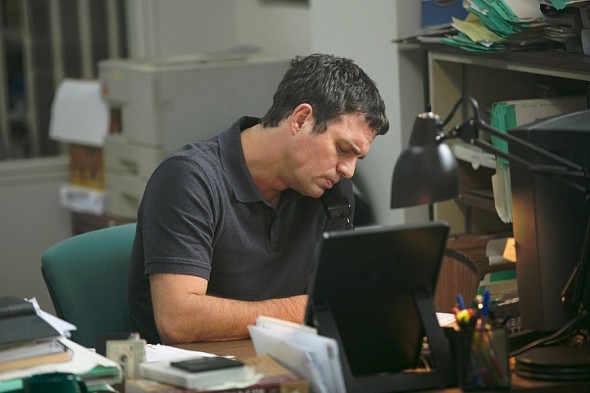
Mark Ruffalo’s Mike Rezendes had a distinctive look channeling the real-life reporter’s specific style at the time, consisting mostly of jeans, polo t-shirts, Doc Marten boots and an oversized black leather jacket.
 
Film costume Spotlight

Style in film Spotlight 
But it is “definitely preppy” that best describes the Boston reporter look, in the costume designer’s own words, defined by khakis, blue button-down and optional navy blazer. Comfortable, practical, real clothes in a real environment, classics that are mostly a non-factor in a story, but which always get the story right.
 
Style in Film - Spotlight

Style in film Spotlight 2015

photos: movie stills (except for the second one, publicity still) | Kerry Hayes, Open Road Films

sources: interviews with costume designer Wendy Chuck for The New York Times, November 2015, and fashionista.com, December 2015

Posted by classiq in Film costume | | Comments Off on Style in Film: Spotlight

A Sporting Life: Nacho Figueras

A sporting life Nacho Figueras 
Last summer I was writing about tennis and about one of the greatest, and most stylish, players of all time, Björn Borg, while making a plea for outdoor sports. Sport and style are not exactly natural bedfellows, but there are exceptions to the rule, and they are worth talking about, too, so I would like to take on the challenge of A Sporting Life more often – for the love of sport and style.

Nacho Figueras is one of the world’s best (and the most elegant) polo players, a Ralph Lauren model and ambassador for more than fifteen years (he was “discovered” by Bruce Weber), husband (to photographer and model Delfina Blaquier) and father of four. He is described as someone who takes his work, as well as his Ralph Lauren role, seriously, but who doesn’t take himself too seriously, and these are some of the words I live by.

The Argentinian has fought to raise awareness of the sport and for erasing its image as a rich man’s game (wasn’t tennis once considered an elitist sport, too?). He is passionate about his sport and his country, and took his Ralph Lauren role as an opportunity to call attention to the sport, even if that rose some eyebrows. He also breeds ponies at his farm near Buenos Aires (the place where he sees himself growing old, as I heard him say in a tv interview), where he himself learned to ride and play polo as a child.
 
A sporting life Nacho Figueras  
Now, I don’t know much about the game of polo, but on top of being an equestrian sport, which, by definition, imposes elegance, posture and respect, the impression it leaves me is that it is highly competitive and fair play, and that counts for a lot in my book. But it is, first of all, a great outdoor sport, one you can engage your entire family in. “Polo is a great thing to do with your kids and your family – it is a great day out. And to me, horses are amazing creatures that give you this cable to Earth and put you in contact with nature,” Figueras was telling Interview magazine some years back.

Given the beginnings of Ralph Lauren and his iconic logo, choosing the Argentine polo champion as spokesperson for the brand makes perfect sense – Nacho Figueras embodies the character and personality of his sport on the field, as well as in his private life. It is not, however, the polo t-shirt look that I chose for this blog post, and for your, as well as my own, inspiration (although the man knows how to wear one, and with a smart tweed jacket, no less). It’s a much more approachable equestrian look – because as much as I love the style, there are only that many ways to include it into your daily wear. But having a polo player wearing riding boots with a plain t-shirt and jeans has the benefit of making it very purposeful and practical and natural, a perfectly acceptable off-duty look. I will take on this challenge, too.

photos: 1-Gaby Messina for The Telegraph / 2-Ralph Lauren

Posted by classiq in A sporting life, Style | | 2 Comments