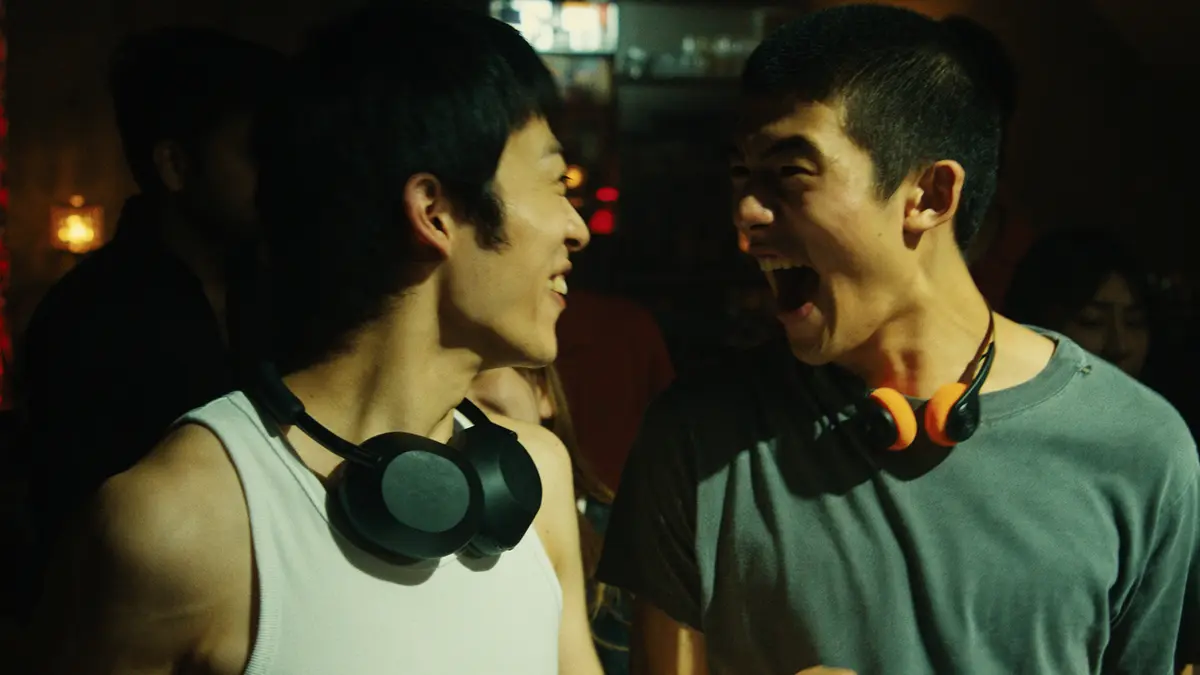
”Happyend”, 2025, directed by Neo Sora. Zakkubalan, Cineric Creative, Cinema Inutile
There is this energy that runs as an undercurrent along with a lot of on screen teenage angst in Happyend. Neo Sora, at his debut feature film, explores the transformative moments between two contrasting best friends, navigating youth and rebellion, and the unpredictable dynamics of friendship in a near-future Tokyo, in a world fraught with social and political tensions and where the threat of a devastating earthquake pervades daily life. What I believe is so defining of Happyend, in both its look, and, quite uniquely, in the individual character studies, is how the city is ever present – you are made aware not only of the world they are inhabiting, but of the way those cityscapes impact the characters’ own inner feelings. The story is set in the near future, but the characters seem alienated in the present and we are gazing at them from afar. It sounds complicated, but it feels and looks seamless, in a way that we, the audience, are not aware of. This image that the film conveys has stayed with me and it was the first thing I knew I wanted to ask cinematographer Bill Kirstein, because it is key to how the intricate characters and the powerful visual storytelling create such a compelling narrative that resonates on many levels. In an ever-growing disconnected world, this is the kind of film that hits that universal cord under which we all connect.
In our interview, Bill Kirstein and I talk about how the collaborative work on Neo Sora’s previous short films has allowed them to bring the vision for Happyend forward, about the crucial question to ask when shooting a film, how the novel as an art form has particularly nurtured him as a cinematographer, working in his mind’s eye, and the childhood movie theater that kindled his love for cinema.
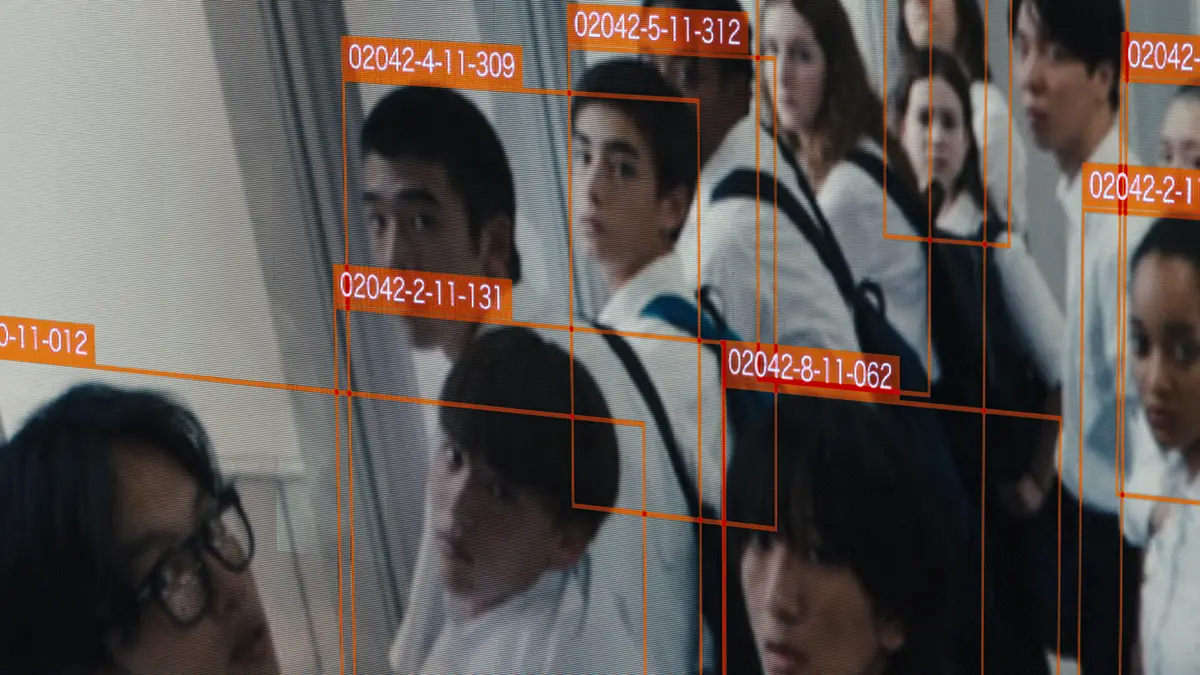
”Happyend”, 2025, directed by Neo Sora. Zakkubalan, Cineric Creative, Cinema Inutile
First of all, Bill, congratulations on Happyend! You have previously filmed Neo Sora’s much acclaimed short film Ryuichi Sakamoto: Opus. Was Happyend a natural continuation of your collaboration?
Thank you so much! Happyend was a very natural continuation of our collaboration. We were actually working on Happyend long before Opus and were able to do some scouting together while I was in Tokyo for the Opus shoot. Before that, I shot Neo’s short film The Chicken in New York on 16mm, so we already had a good creative shorthand. Opus was a very special project for so many reasons. Besides developing our visual style further, it was the first time Neo and I had a chance to shoot something together in Japan. It became a helpful testing ground for translation and to explore how our working style would fit in with a Japanese crew. One of the most important takeaways for me was the confidence that our approach was working. We had constructed the visual language primarily as a series of evolving long takes that would be cut together at specific points. These pieces would be interspersed with songs where editing was the primary cinematic tool for conveying the movement of the music. Relatively early in post production, Neo told me that the edit was falling into place almost exactly as planned. Seeing how clearly our preparation translated to the final film helped free us to follow our instincts when prepping and shooting Happyend.
“Ultimately, I think the look of the film evolved through
long conversations about the script and the story itself.”
The story is set in a near-future Japan, not much more authoritarian than our current world. Because of the looming catastrophic earthquake and the surveillance state, there is an atmosphere of anxiety that permeates the narrative, yet the film feels very nostalgic, too. How do you achieve this visually? And how did you agree with the director how the film must look like? How did Neo Sora articulate what he saw in his mind, and did you have a clear idea from the get-go how you would be able to realise it?
Neo and I have a lot of shared references that ground our approach. Early in the process, we returned to films by Tsai Ming-Liang, Edward Yang, Ernst Lubitsch, Hou Hsiao-Hsien and Shinji Somai to get the gears turning. These films were helpful for starting a dialogue, but ultimately I think the look of the film evolved through long conversations about the script and the story itself. To me, one of the crucial questions to ask when shooting a film is “What perspective is the story being told from?” One of the superpowers of both cinema and literature is that you can tell a story from any perspective and include as many different viewpoints as your budget or imagination allow.
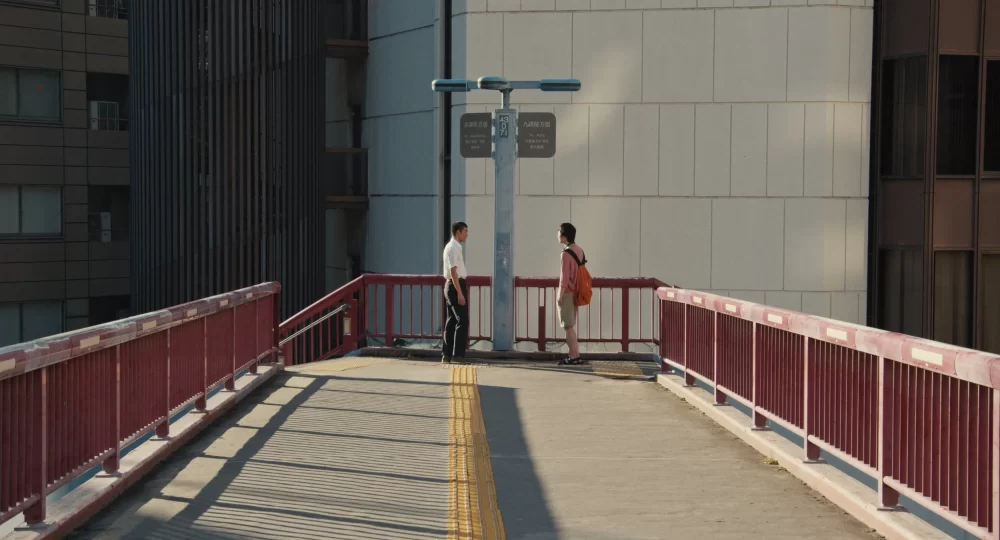
With Happyend, Neo wanted to approach the films as if it was a memory shared by Kou and Yuta many years after the events of the film take place. As we started to unpack this idea more, it provided specific answers for how we should shoot the film. Since the film takes place in the future – we realised that we must shoot the film as a memory of something that hasn’t happened yet. This implies a visual paradox: an image that looks like it’s from the future while still being mediated by the haze of time and memory. Our answer to this challenge was to use longer lenses (mostly 50mm and above) combined with a more distant camera position and deep depth of field. The subconscious effect of this strategy is an image that feels present and grounded in reality, but glimpsed from afar – remembered. The subtle version of the way looking through a pair of binoculars collapses space and allows you to see distant details, while still feeling far away from them. The last piece of the puzzle was the texture of the image itself. We used one of the newest digital sensors at the time – the Sony Venice 2 combined with rehoused vintage lenses (Minolta Rokkors) and a very subtle low contrast filter that we found through testing. This combination provided the layered feeling of a present tense and urgent story with the air of memory/nostalgia that you mentioned.
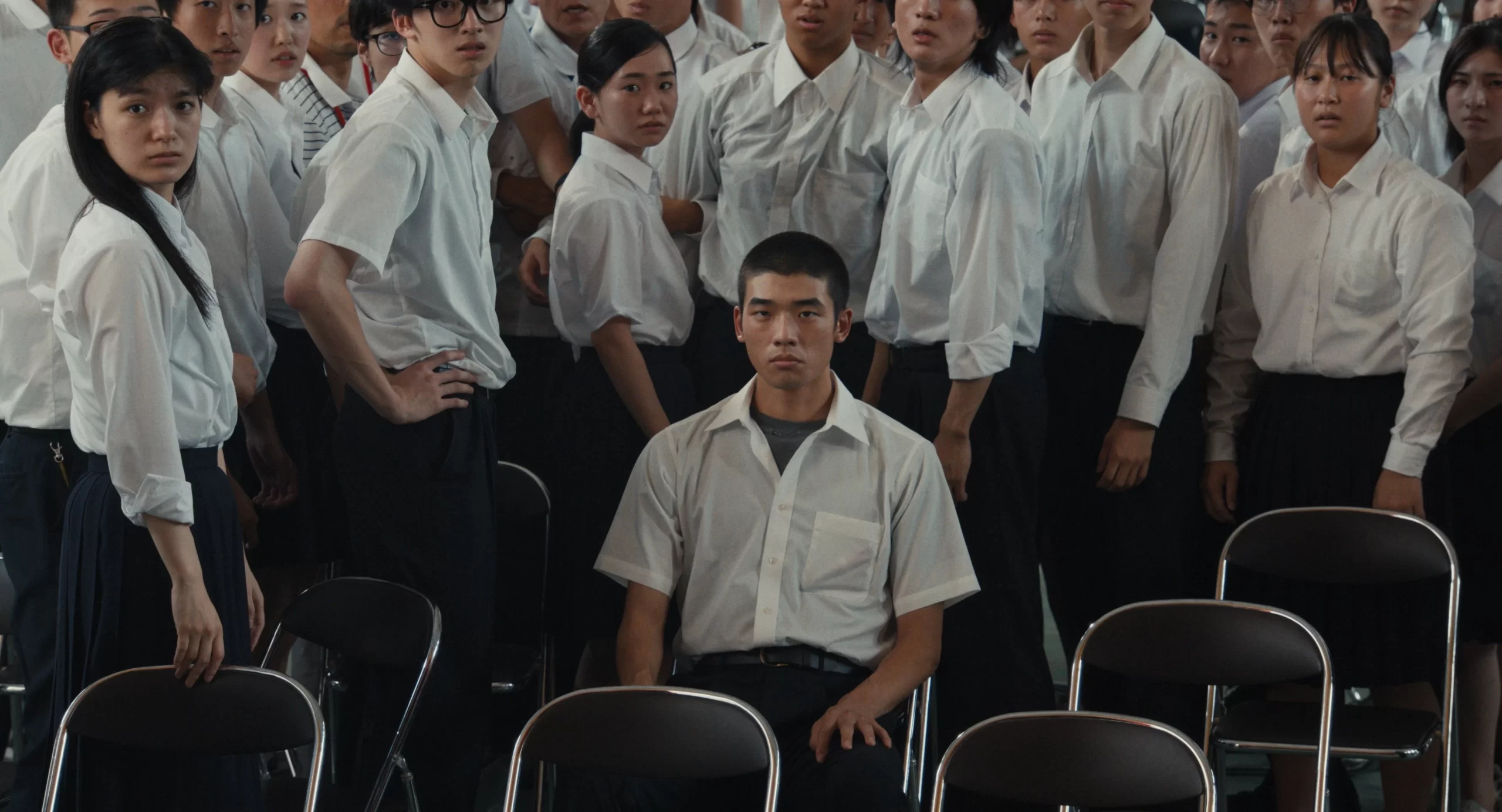
”Happyend”, 2025, directed by Neo Sora. Zakkubalan, Cineric Creative, Cinema Inutile
“One of the superpowers of both cinema and literature is that
you can tell a story from any perspective and include as many
different viewpoints as your budget or imagination allow.”
There is a clear relationship between characters and the landscape of urban life. Did you reference any films in terms of the way you compose spaces and cities?
This was another formal choice derived from the story that Neo shared with me early in the process. Because so much of the film revolves around the idea that a major earthquake could strike at any time, we wanted to find a way to visually convey this sense of impending cataclysm. Tokyo is a very vertical city. Buildings tower over the characters as they move through the world. Neo chose to elegantly explore this physical relationship by suggesting we use mostly closed frames throughout the film, meaning that we would film the characters against backgrounds that don’t show any sky. As a result, throughout the film the audience is subconsciously filling in the rest of buildings towering above the characters out of frame. This strategy creates a psychic weight akin to what the characters might be experiencing, feeling like the buildings could come crashing down on them at any time.
Friendship plays a center role in the film and the actors breathe life into the characters. Directors are usually asked how they work with actors. But I always feel that this question should be further extended and find out the DP’s perspective as well. Camera work is not just about lens, filter and light. It involves character and emotion and actors. Was it easy to create a relationship with the actors on set?
The actors on this film were all so kind, excited about the work, and focused. They became a real friend group just like the characters in the film. I don’t speak Japanese and most of the actors didn’t speak much English, so most of our verbal communication ran though Neo or other crew members who could translate. We also naturally developed a language of fist bumps, hand gestures, facial expressions and a few key words in Japanese and English; this kind of communication was all about exchanging positive energy or slightly adjusting blocking for camera. I still feel incredibly grateful for their kindness, and for their patience with my lack of Japanese language skills. Projecting this kind of energy and professionalism from behind the camera can be an important part of helping make people comfortable in front of it.
“I don’t think a filmmaker should necessarily build
with images first – it really depends what kind of
development leads to the most interesting story
and their personal working process.”
Did you work with storyboards? Do you believe a filmmaker should build a film with images first, to make sure everything is comprehensible visually, and only then add dialogue?
We did work with storyboards a bit. Neo is a talented sketch artist and I have the ability to at least convey shot scale and perspective using stick figures. For the most part though, we used a written shot list and images captured in the actual locations using a viewfinder app (an app that allows you to closely replicate the angle of view of our specific lenses and focal lengths). We incorporated these images into our shotlist, making a hybrid storyboard/shotlist document.
To answer the second part of your question, I don’t think a filmmaker should necessarily build with images first – it really depends what kind of development leads to the most interesting story and their personal working process. At some point though, I think it’s important to turn to the image and consider how it’s functioning on a moment to moment basis and how that fits into the visual language of the film as a whole. I think it’s worth noting that what’s excluded from the frame is just as important as what’s in it. In Happyend, for example, many of the more intimate moments were shot with what Neo and I called a “considerate camera.” Rather than intruding on a moment, we would often stay wide or see people only in reflection, leaving room for the viewer to imagine the intimacy between the characters. I think visual storytelling is just as much about activating the audience’s imagination and making them realise what’s going on as it is about showing things clearly.
“There’s a freedom that comes from observation –
seeing that bold choices can also be incredibly natural
as long as they support the story.”
As a cinematographer, you have to interpret a script and transform it into images. You are a visual storyteller. Is there any art form in particular that has nurtured you and built you as a cinematographer?
Visual inspiration comes from so many different places and different art forms. Photography, painting, sculpture. I especially spend a lot of time observing natural light in different settings and have used this practice to escape the particularly coercive power of “realism” or “naturalism” when it comes to lighting. Something feeling “natural” can of course be incredibly important when it affects a viewer’s suspension of disbelief or ability to get absorbed in the story. But I’ve found that, in nature, almost any lighting scenario is actually natural. There’ve been so many days that I’ve seen the sun break through a dark cloudy sky and light the land with an incredibly unnatural-feeling hard light. Or sunset light bounce off a big white building and light someone across the street with the softest, most flattering light you could ask for. To me, there’s a freedom that comes from observation – seeing that bold choices can also be incredibly natural as long as they support the story.
To bring it back to art forms – one that has particularly nurtured me as a cinematographer is the novel. When I’m absorbed in a book, my brain is just watching a movie that it’s rendering in real time. Instinctively, I’m picturing very specific images as they are conjured by the description on the page. And crucially as it relates to film, they are images in motion. I think this is a very similar experience to the job of a cinematographer – to imagine how to tell a story visually and then be able to construct that image in physical reality and render it through the camera. Being able to visualise what the script and director are trying to communicate is the first step to shooting something, so continually honing my ability to imagine is an important part of my work as a DP.
Cinema must, and will, survive. Why do movies still need cinemas? What does the cinema experience mean to you?
I started loving movies as a kid going to the Uptown Theater in D.C., which was a massive curved screen built for Around the World in 80 Days. I was always seeking out films, watching them with my family, going to the theater. The communal viewing experience went hand in hand with developing an understanding about how stories could be told visually. Before I even had the language to describe it, hearing the audience react around me and seeing them be affected emotionally at the same time I was, created a deep shared experience with strangers. When you make eye contact with people walking out of the theater after seeing a great film, there’s a new recognition. You share something with that person. The cinema connects us, it makes us feel less alone. To me, shared experience is the starting point for friendship, romance and community. The theater can plant these seeds and strengthen their bonds. Sitting quietly in the dark together as any story ever conceivable is whispered to us through flickering images, sound and music. There’s nothing like it.
“To me, shared experience is the starting point for
friendship, romance and community. The theater can plant
these seeds and strengthen their bonds. There’s nothing like it.”
”Happyend”, 2025, directed by Neo Sora. Zakkubalan, Cineric Creative, Cinema Inutile
MORE STORIES
From the period authenticity of “Meek’s Cutoff” to the contemporary realism of
“Boys Don’t Cry”: In conversation with costume designer Vicki Farrell
“Lean on Pete”: In conversation with production designer Ryan Warren Smith
“This is truly who I am”: In conversation with artist Heather Chontos