”The black suits of armour”. Reservoir Dogs, 1992. Live Entertainment, Dog Eat Dog Productions Inc.
A fashion designer who loves movies is not interested in the fleeting fashion. They are interested in making clothes that go beyond trends and the ephemerality. They are interested in people, people for whom clothes are part of their personality. Agnès Troublé is an artist, someone who has always been knowledgeable of and has always drawn inspiration from cinema, music, photography, the fine arts to make clothes. Such vast inspiration, so simple the clothes. Because sophistication is in simplicity. The more you know, the less you want to reveal through your appearance. She has never followed the norm, went against the stream, never radical but always seeing forward, relaxing the men’s rigidness and breathing androgyny into the women’s line. She went for practicality, for fluidity and lightness, for sensual over sexy, for discrete over ostentatious, for subtlety over revealing everything. She loves clothes, not fashion.
Agnès Troublé (the “b” of Agnès b. comes from Agnès’ first husband, Christian Bourgois) was named fashion editor at Elle Paris after another editor, Anne Rivemale, had noticed her mix and match style at a dinner, she designed the T-shirts for the movie Who Are You, Polly Maggoo?, William Klein’s satire about the fashion industry, and pink ski combinations for Jean-Claude Killy’s brand, worked at Cacharel, then opened her first store in 1975 and the brand agnès b. took flight in the 1980s. Snap cardigans, rider jackets, long t-shirt dresses, leather pants, stripes, polka dots, black and white, Rock ‘N’ Roll Is Not Dead! prints season after season in white ink on white agnès b. t-shirts. Timeless style. Agnès b. is one of the most revered fashion brands worldwide, but Agnès’ creativity greatly expands beyond the world of fashion, forming life-long relationships with so many creatives from so many artistic fields – life itself and people and street style are her greatest inspiration.

Quentin Tarantino as Mr. Brown in Reservoir Dogs, 1992. Live Entertainment, Dog Eat Dog Productions Inc.
But cinema remains one of her greatest passions. She grew up watching the animated series Princess Sissy, Walt Disney’s Dumbo and Si Versailles m’était conté, as revealed in the book Agnès b.: Styliste. It was Christian Bourgois, who would become her first husband, who introduced her to the black and white American films of the 1930s, 1940s and 1950s, and she “quickly brought herself up to speed by attending two showings each night of movies ranging from the great American Westerns to the movies of the French New Wave filmmakers.” In 2013, she forayed into film, directing her first feature, Je m’appelle Hmmm…. Agnès is also a keen photographer, often imprinting her clothes with her own photos, owns exhibition places in Paris, New York and Hong Kong, has helped increase the patronage of film festivals such as the Directors’ Fortnight in Cannes and The Sarajevo Film Festival after witnessing the atrocities of the war, and of film libraries in Paris and Tangier. Her pioneer spirit is relentless.
Her clothes have been worn by David Bowie, Patti Smith, Brian Molko, David Lynch, Jim Jarmusch, Harvey Keitel. Her suits were worn by the cast in Reservoir Dogs, she made John Travolta’s black jacket in Pulp Fiction, styled Jean-Pierre Léaud in many of his films, spotted Fanny Ardant wear an Agnès b. watch in François Truffaut’s last film Vivement dimanche, and printed the works of Dennis Hopper on her t-shirts. She named her first movie production company Love Streams after she met Gena Rowlands and the actress gave her permission to use the name (the title of the last film John Cassavetes and Gena Rowlands made together). From the very beginning, in the Agnès b. shops, movie posters hung alongside clothes and music was playing on the turntable. She is a rock star, a poet, a storyteller, a free spirit, a dreamer, a maker. She has created her own universe and like-minded artists and people from around the world have found their place in it as well, her work blossoming into popular culture.
When David Bowie was wearing her clothes, including her signature Breton top, but no one knew it was Agnès b., she didn’t tell anyone. She doesn’t like to advertise, she has never held a marketing meeting. She has done her own thing, always. That’s the definition of cool. She is above fashion.

Mr. White (Harvey Keitel) and Mr. Pink (Steve Buscemi) in Reservoir Dogs, 1992.
Live Entertainment, Dog Eat Dog Productions Inc.
Titled Reservoir Dogs because “it just sounded good,” and filmed in less than five weeks, in the summer of 1991, Quentin Tarantino’s first feature film is a gangster story about a robbery gone awry and “just people talking to each other.” That’s how Tarantino referred to it when attending the Sundance Film Festival for the premiere of his film, where he got to talk to Gale Anne Hurd, a big film producer and Brian de Palma’s wife. The remark was directed at Brian de Palma, as Tarantino knew that de Palma didn’t like movies where people talk to each other.
The film is firmly rooted in place, the cafés and diners of L.A.’s Highland Park, while the language belongs to the 1990s. But the costumes could belong to any decade, from the 60s to the present day. In their black suits and skinny ties, Tarantino’s gang members look like gangsters from Jean-Pierre Melville’s films. Melville has had a great influence on Tarantino (and other American filmmakers such as Michael Mann and Jim Jarmusch). “They didn’t make genre films the way Jean-Pierre Melville did. The way I do. The way Walter Hill does, the way John Woo does, the way Eli Roth does. As students of genre cinema, we make genre films because we love genre films. They made genre films because they were good at it and that’s what the studios would hire them to do,” Tarantino writes in Cinema Speculation about how Sam Peckinpah and Don Siegel approached genre filmmaking differently.
In a true homage to Melville, Tarantino refers to the iconic costumes in his film as “the black suits of armour”. Melville’s characters, too, were dressed in suits of armour. Throughout his career, Jean-Pierre Melville retained a passion for all things American and especially for the classic Hollywood gangster and noir movies. He eagerly borrowed the iconography of the genre – the snap-brim hats, the belted trench coats, the crooned music, the cars and nightclubs, but made its conventions entirely his own, tailored on his highly stylised world. He also drew inspiration from the Japanese culture and cinema. But whatever the influence, Melville’s films are his own, an individualistic genre, made by a filmmaker who, just like Tarantino, made genre movies because he loved them, infused by understatement and a sense of cool, an idealised world of mobsters and thugs, living and dying by a certain code of honour. Melville’s characters are their own. And they dress the part. In a career-defining performance, in the role of a Parisian contract killer who has realised he is being double crossed by his employees and seeks revenge, Alain Delon conjured Melville’s perfect anti-hero in Le Samouraï. Delon’s exceptional good looks and impeccable look meet Melville’s idea of the gangster as an image. Clothes make the man in Le Samouraï. The trim grey suit, the black slim tie and white button-down shirt, the black suit, the inky wool coat, the hat, the trench. Alain Delon recedes in his solitude and in the safety of his trench coat. It’s his armour.
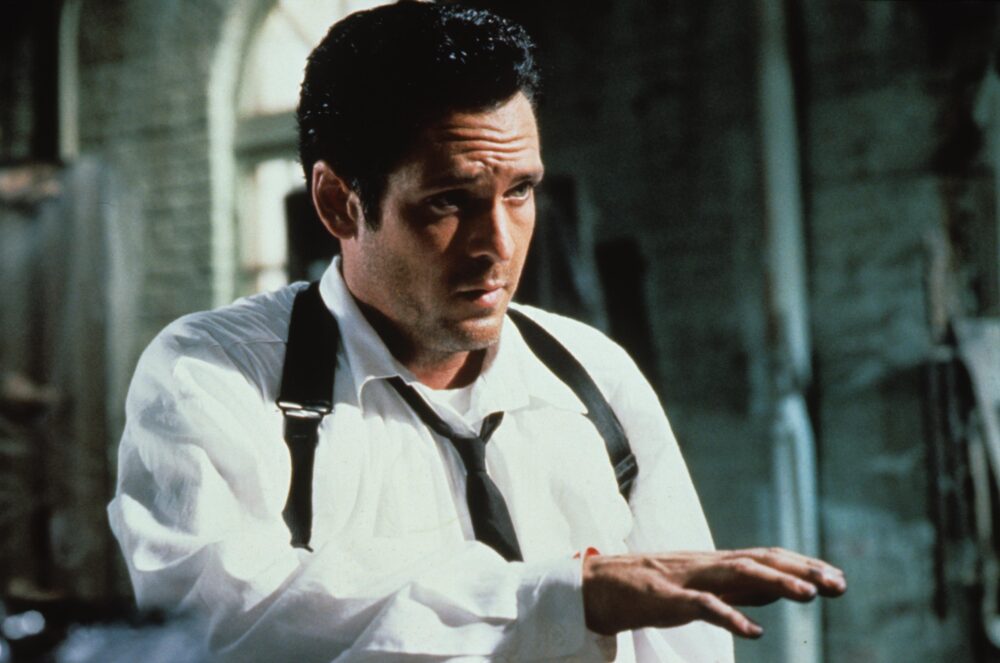
Mr. White (Michael Madsen) in Reservoir Dogs, 1992. Live Entertainment, Dog Eat Dog Productions Inc.
Quentin Tarantino’s influences may be very specific and very vast, but his universe and characters are entirely his own. He is that rare breed of filmmaker who doesn’t give up until he delivers the exact vision that is in his head. In an interview for Esquire magazine, costume designer Betsy Heimann recollected how she met with Quentin Tarantino to discuss the Reservoir Dogs script and talk about the movie visually, then went to his house and Tarantino showed her a lot of French noir films starring Alain Delon. She drew on that to further develop the characters: “Well, all these guys are in suits. And we’re talking about guys who have just got out of jail and want to be anonymous. What can they do? They could go to a thrift store, buy a black suit, a white shirt and a tie, and they could afford it.” So Tarantino went to the Agnès b. store in Los Angeles to shop for the film. Actually, only two of the actors came to actually wear suits, as Tarantino’s budget was very tight. One of the actors dressed in an Agnès b. suit was Harvey Keitel, as Mr. White, who is also the boss, so that makes perfect sense. Harvey Keitel also knew the designer personally. For the rest of the cast, Betsy Heimann had to improvise. For Tim Roth and Steve Buscemi, for example, she used black jeans and narrow, black, ‘60s-cut jackets to recreate the look. Nobody could tell it wasn’t a suit. For others, she used navy instead of black, after discussing it with cinematographer Andrzej Sekula and he confirmed that navy would photograph black. “If you went to a thrift store, you’re not going to find a complete suit, so it’s a case of here’s the jacket, here’s the pants. I wanted different silhouettes for different characters – the collar stands, the length of the collar, the width of the tie, the type of shirt fabric, the style of the jacket – and that’s what creates the unique look of Reservoir Dogs.”
MORE STORIES
Solveig Dommartin is wearing Yohji Yamamoto in “Until the End of the World”
Bring back a sample of dirt: Costuming “Once Upon a Time in the West”
The process is the same: You build the character!:
Interview with costume designer Deborah L. Scott