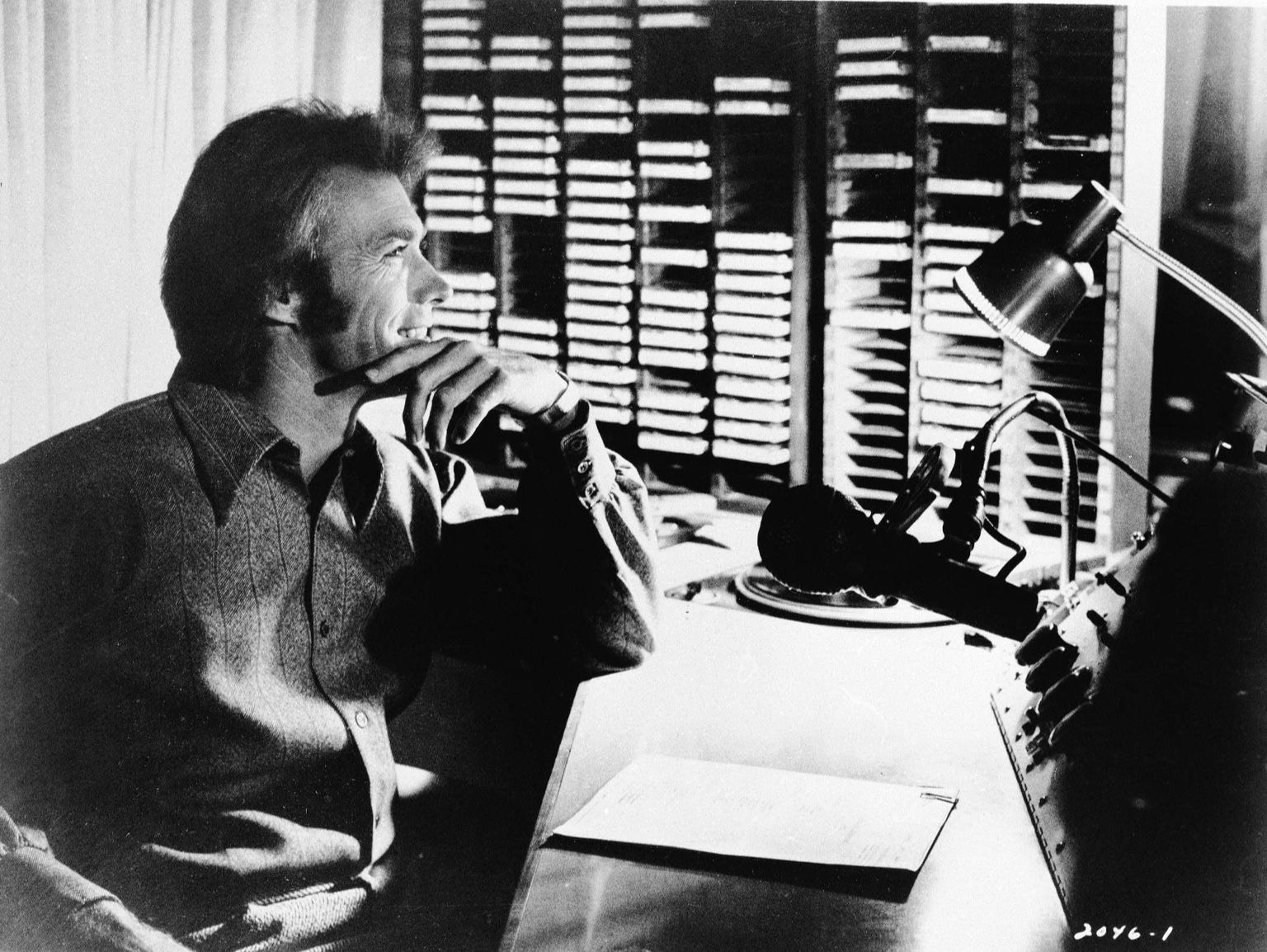
Clint Eastwood in “Play Misty for Me”, 1971. The Malpaso Company, Universal Pictures
I have always loved the atmosphere in Play Misty for Me, Clint Eastwood’s first film as a director, from 1971. It’s one of those films that has a mood. I seek that out in a film, or rather, I like the feeling of a film grabbing you, visually and emotionally, with a composition that is just right. It’s not about the style of the film. The mood is something else altogether, “a combination of pace and an eye for composition,” in Clint Eastwood’s own words, from an interview with David Thomson for Film Comment, in 1984. Play Misty for Me has that. It also has a remarkable sense of place, of the characters being part of the story, of the landscape, of their surroundings. It’s like a slice of the characters’ life. There is always this idea that movies transport you to a different world, place and time, but few truly accomplish that. “Play Misty for Me is superbly paced, unhurried, cool, and giving a strong sense of real time,” Richard Thompson and Tim Hunter perfectly captured the film’s atmosphere in Film Comment in 1976.
I have re-watched the movie this summer. I wish I had saved it for these last days of summer, because it’s exactly when I would place it. This time of year has a feeling to it, and it’s exactly that nicely paced, unhurried, cool, real time feeling that envelops Play Misty for Me. As much as I love summer and that sense of suspended reality, I am also the first one to admit that I always come to the point when I don’t mind trading it with the brisk return to reality that autumn brings along. The film’s strong sense of place and character plant the story so well that you get to live it, too.
Writing for Millimeter in 1980, Ric Gentry said: “When Eastwood reads a script, he visualises it, both in terms of shots and composition. But pre-eminent is the mood gleaned from the material, the overall sensuous texture of environments and movements that have implicit emotional resonances. […] Eastwood first seeks a confirmation of the mood, or the nearest approximation of it, in an appropriate location. It is no coincidence, then, that one of his salient features as a director is his penchant for landscape, the widest concentricity of a dramatic center.”
For Play Misty for Me, Eastwood chose the spectacular and diverse territory of Carmel and Monterey, California, the area near his home, “to suit the unstable psychology of the characters”. He also chose it to help him for characters development, because a friend of his, who had some features in common with his character, was a disc jockey for a Carmel radio station. “I scout locations in different ways,” the director explained. “You have to find locations that read into the story. Sometimes you just have to keep looking because there’s always a million other places you could do a picture, some maybe better, some maybe not. The location just has to correspond with the concept of the film, to the atmosphere created by the story.”
Eastwood chose the script because he had lived through a similar, albeit less dramatic, situation, and the idea of commitment misinterpretation, of how responsible we are for the relationships we establish, interested him. He plays a jazz-loving disc jockey in Carmel, who accidentally gets involved with a psychotic young woman. Dave (Eastwood) meets Evelyn (Jessica Walter) in a bar one night, they have a one-night stand and she tells him that she’s the one who calls every night on the radio asking him to play Misty. Dave is complacent and casual about the affair, but Evelyn becomes obsessive. And that’s the base of the story. We don’t get to know her background or anything else about her, we get to meet her and be shocked by what is happening exactly when he is and feel all the suspense because we simply want to know what happens, without revelatory explanations and blasts from the past. It’s a thriller that works tremendously well, especially on the backdrop of the rocky seascape and the apparent calmness of a small town. It’s all the more special because, as Tim Cahill wrote in Rolling Stone in 1985, “of all the roles he has played, Eastwood in person seems most like the mild-mannered California jazz DJ he portrayed in Play Misty for Me, a man happily out of step with the times and secure in his private enthusiasms.”
MORE STORIES
Art directing film posters: In conversation with illustrator Akiko Stehrenberger
This summer we’re channelling: Sigourney Weaver in “The Year of Living Dangerously”
Everything you see in a film is there for a reason: Interview with graphic designer Annie Atkins