Editorial: Hurricane


In a sea of streaming, there has been a return to analog music. And that makes me happy. The renaissance of vinyl records and turntables has brought back a tangible and human quality to music that has been lost in these digital decades. “In the age of digital, when you can manipulate anything, how do we retain a human element? How do we keep music to sound like …people? The feeling that I had when I was young?,” Dave Grohl was asking in his documentary, Sound City, his tribute to the San Fernando Valley studio that turned recording music into craftsmanship, music that had the human touch at its core, something that can not be recreated digitally.

When I was watching the documentary, one of the feelings I had was that I was watching people at work, people doing real work, people doing what they love, what they are passionate about, whether musicians, sound engineers, music producers or studio managers, people who love music, not the business of music, and who inspire other people to love and/or do music. That’s true about a vinyl, too. When you play it, there is something visceral about it, you can hear all the work that’s been put on it. What’s on it is real and there’s a palpable connection you form with the musician. But it’s not just about bringing back the sound of the youth of some of us, it’s also about discovering or rediscovering music ourselves or with our children.

It’s the ritual of it. Pull the album out of your library, examine and read the art notes and stories written on the beautiful cover. Carefully slide the record out of its sleeve, put on the album, hook up the needle and listen to the entire record. You first hear the crackle sound, which makes you even more aware of the fragility of this format, which only makes the vinyl that much more valuable, and the experience that much more special. In a world and society that have taught us that we can toss anything more and more quickly because there’s more to buy more and more often, a vinyl makes you value the things you already have and that are truly important, and that’s a lesson to teach your children, too, so that they know that hardly anything, and certainly anything with true meaning, is at the tips of their fingers.

Listening to an album on vinyl is a much more immersive, intentional, therapeutic experience than streaming it online. It is beyond comparison. It’s not just about how we listen to music, it’s also about the way we discover it. And seeing your child so carefully observing the whole operation of putting the disc on and then holding the sleeve of the record that’s playing in his hands while he’s listening to the music, that’s an incredible feeling. It makes you present. And it makes so much more sense right now to put on a record that easily sets up a mood and place and lets you just ride on the sound. Music helps us hold it together. Sound helps us find quietude in the chaos.

Bob Dylan’s Desire* is one of the few albums I can listen to endlessly, and always from start to finish. Each song takes you on a journey and yet the album as a whole seems to inhabit its own world and that’s why I love it so much. You get lost in there. Only recently have I read about the politically and personally charged stories behind some of the songs, but what grabs your attention, and I am not talking about Bob Dylan’s lyrical strengths, is the sound. Because music is not just about the lyrics or about what sounds right, but about what hits the ear. Dylan’s strong and powerful voice in One More Cup of Coffee; the guitar that starts Mozambique and Dylan singing together with Emmylou Harris; Scarlet Rivera’s beautiful violin; the way Dylan can build a story through his voice; and Sara, probably the most personal Dylan has gotten with his songs. But whatever it is, the music on this album is beyond words. And the way it makes you feel? Like a hurricane and at peace at the same time.
 
 
“Sara, Sara,
Wherever we travel we’re never apart.
Sara, oh Sara,
Beautiful lady, so dear to my heart.

How did I meet you? I don’t know.
A messenger sent me in a tropical storm.
You were there in the winter, moonlight on the snow
And on Lily Pond Lane when the weather was warm.

Sara, oh Sara,
Scorpio Sphinx in a calico dress,
Sara, Sara,
You must forgive me my unworthiness.

Now the beach is deserted except for some kelp
And a piece of an old ship that lies on the shore.
You always responded when I needed your help,
You gimme a map and a key to your door.”


Bob Dylan’s new album, Rough and Rowdy Ways, his first album in 8 years
of original material, is out now. Six decades into his career, Bob Dylan
delivers a gorgeous and meticulous record”
, Pitchfork magazine says.

 
* You can listen to the album above now, but do yourself a favour and buy it on vinyl to hold and to cherish and to experience and live it as you should. In these trying times, our intention is to support artists and small businesses of any kind, especially bookshops and record stores, therefore I will not link to global online retailers or corporations, leaving you to make the choice of helping your favourite independent record store and buying from or placing your order with them.
 
More stories: Sound to Screen / It’s Only Rock ‘n’ Roll But I Like It / Sound City

Posted by classiq in Editorial, Sounds & Tracks | | 1 Comment

This Summer We’re Channelling: Léa Seydoux and Daniel Craig in “Spectre”

Léa Seydoux and Daniel Craig. Jonathan Olley/ SPECTRE © 2015 Metro-Goldwyn-Mayer Studios Inc., Danjaq,
LLC and Columbia Pictures Industries, Inc. All rights reserved.


This Summer We’re Channelling: a recurring seasonal series
in the journal that celebrates both style in film and summertime.


There is a distinctly touristic element to the action in Spectre. The far-flung worldwide locations have always been part of the public’s fascination with the Bond films, and one of the strengths of the movie franchise, but in this one in particular that exotic undertone is even more deeply felt. The sun-drenched, warm and lively scenes from Mexico (that beautiful five minute one shot that opens the film) and especially North Africa, filled with sounds and colours, are a world apart from the grey, numb, cold and unpopulated city scapes of London. Spectre, tying together legend and narrative development, is both a return to form, but also firmly planted in our 21st century dim reality that is taking more and more hold of us.

“Skyfall was a very dark picture because of the locations – a lot of it was shot at night or underground – and because of what Bond was going through as a character. I wanted a more proactive Bond, with more locations, and a greater variety of tone,” director Sam Mendes remarks in the book The James Bond Archives.

The film clearly portrays a post-Snowden world, a world under mass surveillance due to the proliferation of digital data collection. The story is centered on Bond’s setting out to dismantle Spectre, the global criminal organisation behind the villainy of many Bond films. But Spectre also refers to a ghost from Bond’s past. The sub-plot however has to do with a very contemporary and one of the biggest present-day concerns: the unification of global surveillance and the rapid growth of drone warfare, with agent C (Andrew Scott) planning to merge all espionage agencies and shutting down the double-0 program. Both the program and James Bond are considered “old world”. So they must go… but not so fast.

This “new era” scenario also describes the direction of the Daniel Craig Bond films, in view of the latest years’ revisionist changes brought to characters and story. And, despite my repeatedly stated appreciation of both new type of Bond and multi-dimensional Bond girl, it was the less pronounced psychological realism and the nostalgic feel of Spectre, anchored in those dreamy locations, that felt like a breath of fresh air this time.


Léa Seydoux and Daniel Craig. Jonathan Olley/ SPECTRE © 2015 Metro-Goldwyn-Mayer Studios Inc., Danjaq,
LLC and Columbia Pictures Industries, Inc. All rights reserved.

 
And it all begins with the costumes and with the fact that there is much less explicit product placement, at least as far as the women’s wardrobes are concerned, in Spectre than in the previous three Daniel Craig films. Because even if Eva Green’s designer dresses in Casino Royale had an undeniable effective role in the plot, there is something more to be appreciated about proper costume design than off-the-rack shopping for a film.

Madeleine Swann (Bond’s love interest played by Léa Seydoux) wears almost exclusively custom made clothes, from the suit in Austria, to the incredibly simple and sexy sea foam gown on the train in North Africa, according to costume designer Jany Temime in a press conference after the North American film premiere in Mexico City.

We first see Madeleine at work, at her desk in the Hoffler Klinik on Gaislachkogl Mountain. She is a psychologist in an important clinic, but she is also the daughter of one of Bond’s former enemies, a Mr. White. She wears black trousers, an elegant black silk top and a charcoal grey blazer. She has a formal, rigid demeanor, very businesslike. She is smart and independent, and because of her father, her relationship with Bond is complicated from the very beginning, elements that qualify her from the start as a non-typical Bond girl. Then we see her travelling through Africa, on the way to Tangier. Naturally, her look is different. For start, a knee-length lightweight crème dress, white sandals and, one of the few recognizable brand products in the film, a brown Chloé saddle bag. And, as a matter of fact, it is a bag that makes perfect sense, not just because it is a type of bag suitable for travelling, but because of the location and of the brand itself. All the crème/white outfits Madeleine wears in Africa could very well be Chloé.

Gaby Aghion, the founder of Chloé, borrowed the name of a friend for the brand’s name and coloured it in the beige of the silk-like desert sand in her native Egypt. She had a visionary mind and took a revolutionary road, dreaming and shaping up a world of fashion for the woman of the present. The femininity Chloé clothes project is the only kind of femininity that makes sense, yesterday, today, tomorrow. It’s chic, practical, delicate, romantic, free, and beautiful on the outside, but also strong, believable, independent and confident, and even more beautiful on the inside. It’s also a femininity that isn’t afraid of being vulnerable, because that’s only human. It projects a woman that is perfectly at ease in her own skin, but who isn’t afraid of being seduced.

Bond matches Madeleine’s crème dress with a tan suede jacket, tan cotton gabardine chinos, navy polo t-shirt and suede boots. His look recalls the beige bomber jacket, navy polo shirt and pleated khakis that Timothy Dalton wears in Tangier in The Living Daylights, 1987. Dalton’s Bond was the most far-off from the gentlemanly spy and the first tougher, darker, edgier and more realistic, but more human Bond character, too. Craig’s suede jacket also brings to mind the suede jackets Roger Moore sported during his tenure as 007. Bond is a sensible man, after all, he dresses the part, but that doesn’t mean he can’t look sharp in casual clothes. Even in the heat of Morocco, he needs a jacket to conceal his gun and the choice he makes certainly serves the purpose much better than his signature fitted suits.

There is a new take on the polo t-shirt, too, which seems to be made of a lighter and more breathable fabric than 100% cotton. Timothy Dalton was the one who reintroduced the polo shirt to the Bond series in The Living Daylights after a more than 20-year hiatus – it was seen in the very first Bond film, Dr. No and had last been seen sported by Sean Connery in Thunderball. Daniel Craig wore his first polo t-shirt as Bond in Casino Royale – also short on the arms and featuring a cleaner fit, suitable for Craig’s more muscular and more action-prone Bond.

The suede jacket will be worn later on again, on the train when they talk about the gun, this time paired with a light blue shirt. Madeleine is wearing a green sleeveless shirt (presumably, or it could be a shirt dress) with pockets, thus carrying on the African adventure theme.
 

Léa Seydoux. Jonathan Olley/ SPECTRE © 2015 Metro-Goldwyn-Mayer Studios Inc., Danjaq,
LLC and Columbia Pictures Industries, Inc. All rights reserved.

 
Léa Seydoux’s Bond girl isn’t just desirable, but she loves being desirable. What woman doesn’t? “You shouldn’t stare,” Madeleine tells Bond on the train when she appears in the sea foam evening dress for dinner. “Well, you shouldn’t look like that,” Bond replies. The seduction game is a two-way street. That’s the way it is, that’t the way it’s always been. In Bond movies, too. In an interview for British Vogue, Léa Seydoux said her character was different than a typical Bond girl, but that she didn’t mind the cliché of the Bond girl. Most women in their own mind love a Bond girl, too, stereotype or not (and if we had really taken the time to properly analyse the ultimate typical Bond girl, Honey Rider, we would have noticed that there is more than what meets the eye to even the famous feminine bikini), and don’t care about gender politics. Who says differently is lying.

Madeleine is certainly depicted as a woman with her own life and her own past and with her own inner conflicts, with something to fight for and against, but she is not the first one nor the strongest Bond girl. Carole Bouquet was one. Eva Green was another one. They both saved Bond’s life after all, in two completely plausible scenes. But that is not to say that it’s either good or bad that Madeleine Swann is not as tough as them. It’s a character trait, she’s different, and that’s a good thing.

“It’s about, like, how to find your own freedom,” Jany Temime asserted. And that is something different for each one of us. For a Bond girl, too. There is something mysterious about Madeleine Swann, in a very classic way. This romantic feeling is reflected by the clothes she is wearing, especially in Africa (and especially if we observe the contrast between her feminine wardrobe and the blue lace dress that Oberhauser chooses for her, a clear sign of his controlling and powerful character, not Madeleine’s). “Her style’s a little bit nostalgic; I wanted to keep that sort of feeling about it because they are travelling in Morocco, looking for things that happened in the past,” Jany Temime told Style Caster. Madeleine reveals to Bond how every year her parents used to return to the hotel where they had spent their honeymoon, and where Bond and Swann have arrived in search of the clue “L’Americain”. It is a place, not a name.

We then see them in the middle of nowhere, on the train, and Madeleine has “this crazy, sexy dusty green evening dress, a moment beautifully built up, in a suspenseful kind of way,” the costume designer explained. “I didn’t want a red carpet dress but something that could be rolled up in a suitcase, dressed up or dressed down. Something sexy and simple.” It evokes the history and glamour of the Bond films and creates a timeless effect, too. But the dress is also practical enough to allow for movement during the fight scenes. It’s classic and modern, the standout of her wardrobe, in Temime’s words. “This is the first time that she catches Bond’s attention, so I wanted the dress to be more like second skin for her and also as simple as possible because of the situation.”

Bond is wearing a white tuxedo for the occasion. “She had that dress. He had that white tuxedo. They are in Morocco, in a train, which is an incredible look. Together they are like a dream couple.” The untraditional ivory Windsor tuxedo jacket (by Tom Ford, who also provided several other outfits for Craig’s character), rather than calling to mind Bond’s past white tuxedos (Sean Connery in Goldfinger and Diamonds Are Forever, Roger Moore in The Man with the Golden Gun, A View to a Kill and Octopussy), sets our imagination on Humphrey Bogart in Casablanca. Again classic, again romantic, again Morocco. Daniel Craig’s Bond turns out to be very classic indeed. Confident and sure of himself and with the exactly right clothes for the situation.
 

Léa Seydoux and Daniel Craig. Jonathan Olley/ SPECTRE © 2015 Metro-Goldwyn-Mayer Studios Inc., Danjaq,
LLC and Columbia Pictures Industries, Inc. All rights reserved.

 
Next we see them in a wrecked train station out in the desert, from where they will be soon taken to a desert compound where the villain, Oberhauser (Christoph Waltz), is waiting for them and where, he explains, is controlling information and manipulating the world. She is dressed in white wide legged trousers and a dainty white blouse, carrying her Chloé bag (again, the whole look could be Chloé). He is wearing a light brown jacket and the same gabardine trousers from before, both by Brunello Cucinelli, white shirt and rust brown knitted silk tie. Brunello Cucinelli is reportedly a personal favourite of Craig’s in real life and a brand he has brought to the franchise. As I was saying earlier, I am not the biggest proponent of product placement in movies. But I am an admirer of Brunello Cucinelli, the man and the designer, and of his way of making fashion. This is one of the few fashion companies with handcrafting and humanity at its soul, a brand that is rarely present on social media, because it is aimed at people who do not buy only what the internet tells them to buy, at people who appreciate the fine things in life. That’s the fashion brand that makes perfect sense today. And it makes sense on this James Bond, too, with firm, well-rooted values, but who is willing to bring a modern-day sensibility to them.

This is the first time since Pierce Brosnan’s navy blazer in GoldenEye that James Bond has worn an odd jacket that’s not part of a suit, as it was noted on bondsuits.com. The colour is appropriate, too, and a return to brown suiting, albeit a very casual take on that. The look also seems to pay homage to the “brown barleycorn hacking jacket and fawn cavalry twill trousers that Sean Connery wore in Goldfinger“, as Matt Spaiser of Bond Suits further observes. Another return to form. A classic look made modern, without the self-awareness and pretentiousness that so often characterise contemporary men’s looks, and sometimes Daniel Craig’s Bond wardrobe, too.

“Is this really what you want?,” Madeleine asks Bond. “Living in the shadows. Hunting. Being hunted. Always looking behind you. Always alone.” For the first time since and before Vesper Lynd, Bond seems to have found his match. But that doesn’t mean that the ending isn’t very un-like Bond. And that’s exactly why it sets up intriguing starting ground for No Time to Die.
 

Editorial sources: For His Eyes Only: The Women of James Bond, edited by Lisa Funnell / Revisioning 007: James Bond and Casino Royale, edited by Christoph Lindner / The James Bond Archives, edited by Paul Duncan / bondsuits.com / BAMF Style / Katie Davidson interview with Jany Temime for Style Caster, 2015 / Léa Seydoux interview for British Vogue, November 2015


More stories: Bond Girl Style: Eva Green in Casino Royale / For His Eyes Only: The Women of James Bond / Bond Girl Style: Carey Lowell in Licence to Kill

Posted by classiq in Film, Film costume, This summer we’re channelling | | Comments Off on This Summer We’re Channelling: Léa Seydoux and Daniel Craig in “Spectre”

Why Movies Still Need Cinemas

Cinema Paradiso, 1988 | Cristaldifilm, Les Films Ariane

 
Movies come to us, so why go to the movies? Never has this idea loomed larger than in the last few months. And, yet, there is no doubt in the mind of any film maker, of any film industry insider or of any film lover that, when this is all over, people will want to gather again in cinemas.

A movie is not just a movie. Watching a film is an experience. Watching a film in the darkness of the cinema, laughing together or keeping your breaths together, is an active experience. It is the theatre energy, it is the disruption of your life in the most pleasant and transformative of ways, it is the way you transpose yourself in artistic complicity and admiration with the filmmaker and every crew and cast member, it is the way you are willing to submit so easily to new ideas, new depths, new dreams, but also to laughter, enjoyment and hope. And both spectacle and spectators are essential to conjure up that new world reflected by the big screen. When the lights go down, surrounded by other people, mostly strangers, a feeling of the unexpected, of the unpredictable, of freedom, of abandon (that only as children we live to the full) is triggered in you. It is an unreplicable experience. There is something vital about the hold the big screen has on us.

And when you emerge from the confines of the cinema back into the wide world, into reality, the link is not broken, because you want the experience to live on, so you talk to your friends, to strangers, opinions are shared, ideas emerge, arguments are exchanged, new friendships are sealed, love is rekindled. Over the irresistible power of movies.

In these most unusual and uncertain times, the streaming services and on-demand platforms have offered a respite from reality. The cinema is much more than that. The cinema, the movie theatre, remains a real event, it is not just an escape from, but part of reality, and in close relation to your own self, because, as Jean Cocteau said, “I am rather surprised whenever I hear people chatter on about ‘escapism’, a fashionable term which implies that the audience is trying to get out of itself, while in fact beauty in all of its forms drives us back into ourselves and obliges us to find in our own souls the deep enrichment that frivolous people are determined to seek elsewhere.”

Everybody can be considered an outsider now. Maybe this is the moment every movie lover, every film maker, every film person has been waiting for: to re-imagine the movie theatre in order to discover that cinema, as art, is now everyone’s to re-create, and re-discover.

The discussion is wide and very complex, therefore I have reached out to film artists and film festival directors and asked for their opinions on why movies still need cinemas, why the public’s fascination with the big screen lingers and why online streaming is no substitute, and to recollect their most memorable cinema experiences.
 

The Artist, 2011 | Studio 37, La Petite Reine, La Classe Américaine


Sandra Lipski, founder and director of Evolution Mallorca
International Film Festival

Movies and cinemas go together like the earth and the sun, one cannot exist without the other. Or can they? For me, a perfect date night includes dinner and a movie (in a cinema). There is something romantic and comforting about it. The Cinema is a place for people to gather and have a mutual experience, while simultaneously also a very private and emotional one; everybody in their own personal seat, hopefully in their favorite row. The smell of fresh popcorn, the crackling sounds of candy wrappers, it’s all part of the magical experience of “The Cinema”.

I can keep romanticizing about it, but the reality is online streaming is on the rise (well, it’s already here) and audiences need to create a new habit to make the communal cinema experience part of their busy lives. My husband (a cinematographer) just told me: “Every time I see a film in the cinema I remember it as an event in my life; I remember which cinema it was, what snacks I ate, how crowded it was, who I was with and the conversations we had afterwards. When streaming a film at home the ‘experience’ of it is soon forgotten. That is what makes the cinema such a special place, it creates memories that last forever.”

I am extremely excited about the increasing growth of Film Festivals around the world. These annual events can be found in nearly every (big and small) town. They attract audiences, filmmakers and actors to come to the cinema and celebrate independent films. Film Festivals have the power to be an excellent platform to unite people, create engaging conversations and unforgettable memories – that is why we should never stop going to the cinema.


Newton Thomas Sigel, cinematographer
Bohemian Rhapsody, Drive, The Usual Suspects

The communal experience of seeing a film on a large, immersive screen, in a darkened environment, cannot be replicated at home, or streaming on an iPad. Watch Kubrick’s 2001, or Apocalypse Now on a 50’ screen with 300 people in the room and then watch it at home on your TV and hope the phone doesn’t ring, or your daughter needs something just when we get to Kurtz’ hideout. Which experience do you think will be more impactful?


Merie Weismiller Wallace, film set photographer
Mystic River, Nebraska, The Tree of Life

The lights go down, the audience falls silent, the music begins. There is no refrigerator humming nearby, no dog asking to be let out. The story begins, grand visuals on the big screen fill our eyes and captivate our minds, our peripheral vision is softly dark and frames the focus of our eager attention. Artfully we are whisked away and held well for a whole story as the movie reaches our hearts and minds; meanwhile, no one calls out from upstairs to ask us if we can put our headsets on or turn the volume down. On screen, actors full of heart and soul activate our hearts and souls and and we feel strongly. One makes a joke, someone in the audience laughs out loud, and then we all do. Laughter is contagious! There is nothing like a great audience to enrich a film. Laughing together, yet we are wrapped individually in the story the writer crafted and the director invisibly shaped for just this moment. In fact artists of so many crafts wove the threads that spun the illusion we watch so intently. A point is made, an education played out, it has our undivided attention. Finally, the credits roll, astonishing how many people it took to create that singular project! We walk out dancing, and singing the songs. We eagerly chat with strangers in the lobby, having shared a common experience. We tell our friends. Later, one of them sees it on an airplane and tells us plainly “yeah, it was ok.” Oh, a film is never the same on a small screen as it was when you lived it in a theater.

Theater going is one of the joys of free time. It is entertainment, a date, a family outing, always an event in itself. It must be affordable for people to be movie goers, and there is the catch that started the numbers dwindling… But get the cost just right and theaters will be filled again. Then word of mouth can once again ring out to fill the box office with the happy sound of music and our laughter.


Laurence Bennett, production designer
The Artist, In the Valley of Elah, Crash

I’m sure I feel like many…

Grateful that streaming gives ready access to a huge swath of more than a century of film from around the world; it’s a phenomenal resource.

But something irreplaceable is missing: the wash of anticipation, a quiet excitement – frisson – as houselights fade. Then, sensing and feeling others’ thoughts, reactions, and emotions, as we share the experience of watching and hearing a story on screen.

Cinemas must, and will, survive.


José Luis Rebordinos, director of San Sebastián Film Festival

Films are still mostly made to be shown in cinemas: On big screens, with good and high resolution image and sound quality, and to be watched in complete darkness and silence. In addition, the theatrical release is still an important part of the cinema business. This does not prevent that the development of new electronic devices have also allowed the development of the platforms and online exhibition. I believe that in medium-term, the best possible case scenario is a good combination of cinema in cinemas and online cinema, allowing viewers to choose when and how to watch the films, but with rules that allow the exhibition in cinemas to survive in good conditions.


Vasilis Marmatakis, film poster designer
The Favourite, The Lobster, Dogtooth

This is a small series of events/personal memories as a collective cinema experience:

Karate Kid screening, Athens, 1984:
Daniel LaRusso gives the final crane kick to Johnny Lawrence. Everyone in the audience stands up cheering and clapping enthusiastically.

The Last Temptation of Christ screening, Athens, 1988:
Halfway through the film, far-right Cristian extremists enter the cinema tearing the screen down and smashing the seats.

The Rocky Horror Picture Show screening, Athens, 1989:
The audience shouts A S S H O L E and W H O R E repeatedly to the bewilderment of first- time viewers.

The Usual Suspects screening, London, 1995:
Ticket holders staring at the film’s poster by the entrance. A hand-drawn arrow points at Kevin Spacey.

Before Sunrise screening, London, 1995:
After the film ends, a young girl is found curled up on the carpet floor by the exit, sobbing.

Trainspotting screening, London, 1995:
At the late-night premiere screening of the film, the animated typographic intro titles is met with wild cheering sounds from the audience.

Fargo screening, London, 1996:
During the duration of the end titles, the audience claps standing.

Mulholland Drive screening, Athens, 2001:
The doors open for the evening screening ticket holders: the lights are on, the end titles are rolling, but the afternoon audience does not move.

The Curious Case of Benjamin Button screening, Athens, 2008:
There’s a collective AWE sound coming from the stunned audience when Brad Pitt appears young riding his motorcycle.

Dogtooth screening, Maastricht, 2011:
Every single head in the audience moves abruptly in sync during the scene of the breaking tooth.

Relatos Salvages screening, Sikinos 2018:
After a free open-air summer screening event in the port of Sikinos island in Greece, the mayor apologises to the crowd of (mostly) children; because of its title, he thought the film was a family comedy.
 

Sullivan’s Travels, 1941 | Paramount Pictures


Dana Păpăruz, costume designer
La gomera (The Whistlers), După dealuri (Beyond the Hills), Lemonade

I don’t think there is anyone working in the film industry, whether director, set designer, costume designer, etc., who gets involved in a project just to prove something to himself/herself. Ego doesn’t really have its place in this art born from the work of so many people, and for the people. Cinema is first and foremost an art, and art must be shared with others, it must be discussed and commented in an open way, face to face, not just online or through a written article. A good movie can open your mind, it can make you understand new directions, new meanings, and all these come more naturally when you can go to the cinema with friends and family, when you can share with them the feelings, the ideas, when you can discuss the film. Film can sometimes get a lesson go trough better than in any other way, it can also be a way to relax or a way to get to know other people in a much deeper way when ideas about a film are debated.

For sure, when we read a book each one of us makes their own film in their mind, and depending on the imagination of each one of us, this film is more or less outlined and completed. But it is also true that when we see a film that impresses us, we realize that we have forgotten to think for an hour or two about the way we had directed that story in our minds, or maybe at least we were distracted from our everyday problems. And in front of the big screen, the experience is much more powerful, we can better and easier enter the space and the convention created by the team of artists that made the film. These feelings are stronger inside the movie theatre … they can’t be replaced by or compared to the ones in front of the TV, no matter how technologically-advanced the device may be.

I remember one of my first experiences at the cinema, it was probably still before my school years. At that time, you could hardly see a movie at the cinema, it was always a celebration, so it didn’t really matter what movie you went to as long as you were up to date with the latest release. In the 1980s, there wasn’t the question about films being categorized as not recommended for a certain age group, so I ended up watching a film about “boxing”, as it was described by the lady who was selling tickets, together with a few other adults and their children who were my playmates. It was full house, that’s how they screened the movies back then, and we children, in order to better see the screen, climbed on a fairly high radiator on the aisle. We had maximum visibility and there was no way we could miss out on any sequence. The bloody sequences during the fight between the two opponents impressed me so much that at one point I fainted and fell off the radiator. I hadn’t thought about that episode for a long time. Then, later on, after the 2000s, when I was watching Raging Bull, it all came back to me so clearly and only then did I realize what movie I had seen all those years back as a child. It had probably been one of the few good films that had escaped censorship in Romania at a time when everything was artistically censored. I wouldn’t want to say that this has been my most impressive experience at the cinema, but it is one of them.

I sincerely hope we can all return to going to the movies soon, and that us working in the field can go back to the movies sets. Movies without movie theaters … it makes no sense.


Ellen Freund, property master
Nocturnal Animals, Vanilla Sky, A River Runs Through It

That is a very tough question and I don’t know who could answer, however I was just listening to Wim Wenders try to answer the same question and he described a world of rediscovering the grand feeling of being in a large movie theatre and having that experience rediscovered by an audience. I can imagine that feeling of awe. The other options are so much less unifying. He also said “we now need to learn from actors who have to reinvent themselves for every role”.

When I was starting to learn my craft I went to a movie every day, I loved being immersed in the stories and the visuals. These group experiences curated by filmmakers and historians shaped my career and my own vision of creating characters with the smallest items – a keychain or a shopping bag.


Maialen Beloki, deputy director of San Sebastián Film Festival

This period of lockdown has been a period of reflection on the society in which we live, and one of the recurring questions has been to ask ourselves what spaces separate us and make us an individual, and what spaces bring us together and make us a collective.

The film theatre was originally invented by the Lumière brothers as a place where many people could come together and collectively enjoy one of the wonders of the world. It has therefore been a collective and popular act since the outset.

When a spectator decides to go to the cinema, it’s not only a question of what will happen on the screen. Going to the pictures is a ritual where everything matters: from the moment the spectator decides to go and see a film (the walk to get there, sitting down, waiting for the silence, for the lights to go down…) to everything that comes afterwards (talking about the film, going for something with the friends you went to see the film with, thinking about it, merging the screen action with real life…).

The spectator entering a cinema enters a parenthesis: their one and only activity, for the duration of the film, is to watch it, nothing else. And today this in itself is almost a revolutionary act: the absence of distraction, looking upwards, into the horizon, with perspective (as opposed to home screens which, in the main, tend to draw the eyes downwards) and not interrupting the story. Taking a break from life to enrich it with the experience of cinema.


Akiko Stehrenberger, film poster art director and designer
The Last Black Man in San Francisco, Her, Funny Games

Online and streaming have been a saving grace throughout the pandemic (even with my work right now). But no, it definitely doesn’t come close (and never will) to the experience of seeing a film in a theatre. For me, half the excitement is waiting for something to come to the theatre, then enjoying how it feels like an event while seeing them with my friends, watching the previews, and discussing everything afterwards together. And let’s not forget looking at the posters!

As much as I love having a gazillion titles at my spoiled fingertips with streaming, they also don’t hold my attention very long because the lack of commitment is always looming. Half the movies I absolutely adore, I can’t imagine would be as moving at home. In a theatre, a slow movie builds tension and captivates you. At home, I start eyeballing the dirty dishes.

My fondest memories of going to the theatre was when I first moved to NY at the age of 21, not having known a soul. I went to the theatre by myself and sometimes twice in a day. For me, the theatre become my living room (which was absent from my 150 sq. ft. apartment which I shared with a roommate). It would be 4 years before I’d coincidentally start in the movie poster advertising business when I moved back to Los Angeles. Maybe those NY memories planted the seed unknowingly.


Alessandro De Rosa, film music composer and author of the book
Ennio Morricone: In His Own Words

It’s hard for me to say why it is important in general, but I can try to describe why sometimes it’s important to me. During the recent lockdown I have been watching many movies and series from home (I live in Italy at the moment) and also I took the chance to think about habits and rituals as a society, about our way of being together, or at least my way to live in the society and experience movies and their functions.

I think that in the early days of cinema, going to the movies was first of all a “technical necessity”, i.e. the only way for people to access this medium, but then it soon became a social ritual, a place for people to join around the big screen, a modern version of the bonfire that lit our ancestors when telling stories in the dark of the night, dreaming and shaping their belonging to their tribe. In other words, I think that beyond providing entertainment and story-telling, movies can create a collective imagination, a bridge between people that can go beyond the movie itself: before or after going to the movies we have dinner or meet up with new or old friends, maybe with a new love that we met right there, at the cinema, and with whom we compare and comment on what we have just seen. So I definitely see a social component in movies and cinemas.

Moreover, cinemas involve not only our minds, but also our senses: the big screen can give the sensation to become a child again, immersed in a world of giants where characters, landscapes, everything is huge, while a powerful audio system makes you vibrate and convibrate, shiver and sigh. In this regard, I think that such a full body experience remains a unique and hardly replaceable characteristic of cinemas and this way of movies´ fruition (and from this point of view, who knows how much movies will change when and if the Virtual Reality will take hold…). On the contrary, I noticed that watching movies at home makes me focus more on storytelling, structure and screenplay, and makes my experience more ….intellectual(??). I don’t want to say this is negative or positive from all points of view, but it’s different.

I think of three experiences that happened in different times of my life:
Recently I was in Hungary giving a lesson about Morricone and the scene from Once Upon A Time in The West by Sergio Leone was projected. I had seen and analyzed that sequence hundreds of times while writing the book with Morricone: five demons appear from the backcountry, and Leone, with a beautiful camera movement, shows Henry Fonda’s face for the first time. I thought I knew that sequence very well, but that day, in Hungary, seeing it on a very big screen, it was a completely new experience for me, and it felt as if only then I really got to perceive those images in their full strength.

Another beautiful memory is from my childhood, and the outdoor cinema that used to take place in the summertime in the village I lived in, Solaro, in northern Italy. Similarly to how it is portrayed in Nuovo Cinema Paradiso (Cinema Paradiso), those are very happy and nostalgic moments to me: even more than the movies themselves, what I carry with me are those moments in which, for better or for worse, the whole village meets in one place for a couple of hours and shares the same magic.

In 2010, I experienced a similar sensation in San Francisco: While walking around and exploring the city, I ended up in the Union Square area. It was a relatively cold and windy night, and from far I thought I heard a music I knew, a beautiful song sung by Bing Crosby. When I finally turned the corner and got to the square, totally unexpectedly for me I saw a lot of people gathered in the middle of the square around a big screen on which they were projecting Rear Window by Alfred Hitchcock. The audience was so varied: children, elderly and young people, families, homeless, all watching this masterpiece together. I described this unique moment in the last novel I wrote with my brother: “The guitar which survived the desert” (“La chitarra sopravvissuta al deserto”, it is not translated in English yet). That unity, in spite of differences and distances… that night I seemed to see a photograph of the United States of America.

Note: I would like to credit Francesco De Rosa, Alessandro De Rosa’s brother, for the translation of Alessandro’s text from Italian.


Singing in the Rain, 1952 | Metro Goldwyn Mayer


More stories: The Films That Made Me: Lost in Translation / Interview with Photographer and Film Set Photographer Laura Wilson / La enfermedad del domingo: In Conversation with Costume Designer Clara Bilbao

Posted by classiq in Film, Interviews | | Comments Off on Why Movies Still Need Cinemas

The Culture Edit: June Newsletter


Summer, is it really you? This may be the first time in our collective memory that we have approached summer so cautiously. And yet, this will only motivate us more than ever before to live it like we mean it.

Maybe we will discover the beauty in our own back yard, or on the peaks of our own mountains, rather than on a most sought-after beach or photogenic destination. And maybe we will start keeping these special moments to ourselves. Maybe we will make every outing special and poor our heart into it, talking to each other, thirsty to hear each other’s stories and looking each other in the eye instead of taking selfies and constantly checking our phones. Maybe we will start investing in our local independent movie theatre or in our local indie bookshop instead of crashing on the sofa in front of Netflix or of our home video or instead of reading an e-book. Maybe we will support our own communities and they can regain their pride. Maybe we will travel with much more purpose, not just because we have the means to. Maybe we appreciate our educators and teachers more and don’t kid ourselves that our home-schooling comes even close to everything they teach our children every single day with a smile on their face.

Maybe we rethink our idea of home: as in not in the middle of the bustling city to broadcast our status, but tucked away in the serenity and freedom of the countryside to make us feel safe and secure and happy even in terrifying times. Maybe we start to choose the news and the people we want to listen to. Maybe we start to value ourselves and not what others put value on. And maybe we remain calm and collected even if the restrictions have started to be lifted and think for ourselves instead of following the crowd. There are a lot of maybes. Because these are still uncertain times and there is a long way to go before this is over. There are still lessons to be learned, but people, whether to smaller or radical degrees, will change. And our lives will change, too.

In the meanwhile, here on the site we will continue to navigate through a wealth of great stories through our own experiences, from books and movies, and with the contribution of amazing interviewees from all over the world, and my message is going to be even stronger as the subjects I have long been championing (celebrating culture, creativity, individuality and awareness) are becoming even more important in the current climate. I will also be bringing back the column This Summer We’re Channelling…, will dive deeper into the world of making movies alongside film industry insiders and, yes, I will daydream about going to the movies again. Because some things need to go back to the way they were.
 

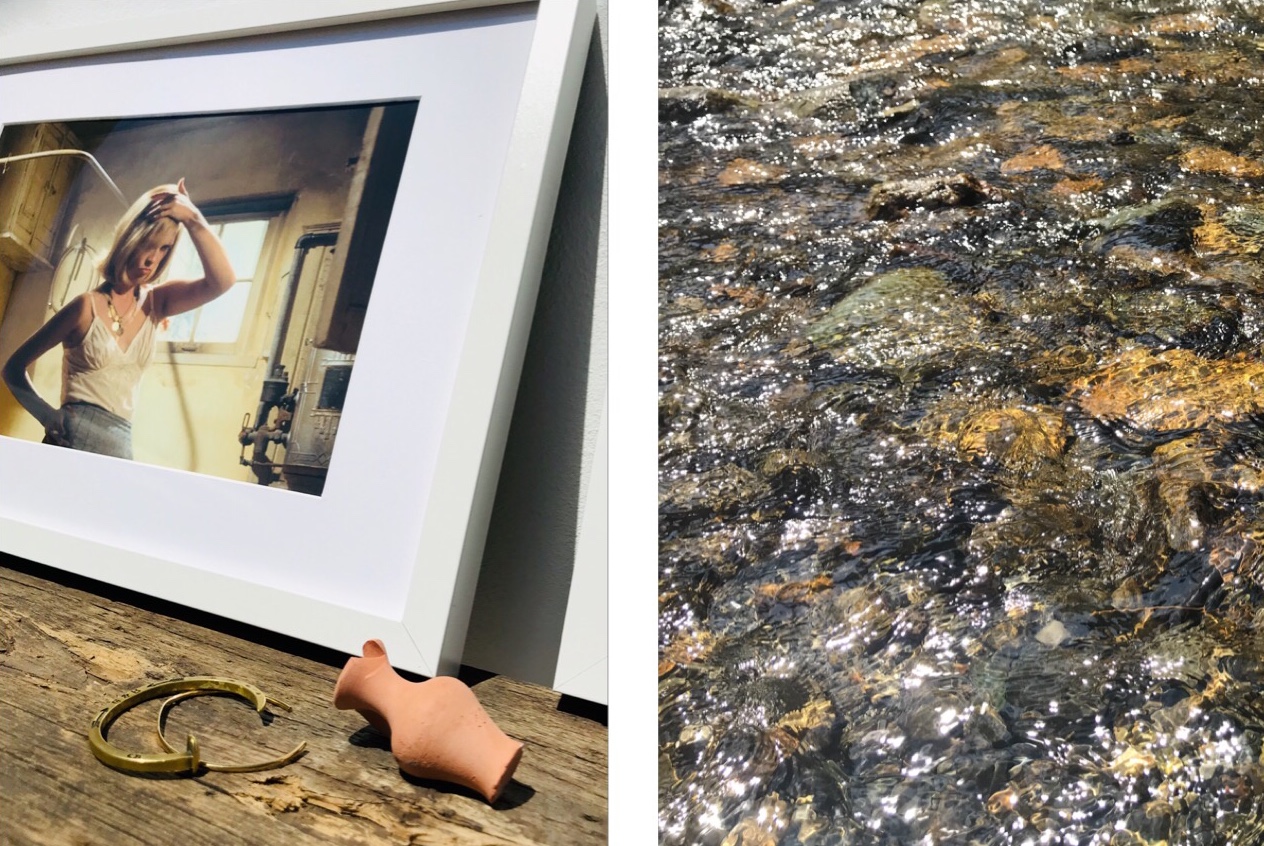
Photographs: Classiq Journal | Photographic print of image to the right available in our online shop.

 
Hilarie Burton Morgan was an actor before becoming the co-owner of the Mischief Farm in New York’s Hudson Valley and author of The Rural Diaries. When her local bookstore, Oblong Books, had to lock its doors, she asked her fans to shop locally and buy her book (she signs every copy) from the independent bookshop in her small community of Rhineback, N.Y. The people listened and Oblong became the epicenter of The Rural Diaries, shipping books all over the world. “I hope people will remember this when things start to go back to normal. The small stores provide a level of care we should reward,” says Hilarie.

Acclaimed cinematographer Roger Deakins has started a podcast, Team Deakins, with his collaborator, James Deakins. They start with a submitted questions and end … “who knows where”, and they are joined in some episodes by friends or colleagues.

How will the travel landscape look like when this is over? The way we journey will be changed forever.

Photographer Todd Ritondaro interviews photographer Oddur Thorisson on his podcast. They talk about all things photography, about how Oddur collaborates with his wife, Mimi Thorisson, on her cookbooks, and much more.

From the latest Idler issue: Michael Palin tries to take it easy … and fails.

Film music composer Alexandre Desplat talks about his scores for Wes Anderson’s The French Dispatch and Guillermo del Toro’s Pinocchio.

Abel Ferrara’s Tomasso, which follows Willem Dafoe as an American artist in Rome, inspired by the director’s own life in the eternal city, will be arriving tomorrow, June 5th, to virtual cinemas. Here are the virtual cinemas where it will play.

L’extravagant monsieur Piccoli (The Incredible Mr. Piccoli): Director Yves Jeuland looks back at the exceptional career of the French actor, who died on May 12, based in particular on his collaborations with Claude Sautet, Luis Buñuel and Marco Ferreri, three of the many more talents he worked with, from Jean-Pierre Melville to Alfred Hitchcock to Jean-Luc Godard. More than half a century of cinema seen through the career of one of the greatest actors that France has known. The documentary will be available for streaming online on Arte.tv until June 18th.
 

Photographs: Classiq Journal

 
Steve McQueen: In His Own Words*, scheduled for release this June, draws from more than five decades of media coverage, memorabilia and detailed research by author Marshall Terrill. Through a wide array of sources, interviews, published articles, personal letters and audiotapes, we get to see a portrait of Steve McQueen in his own words.

We don’t know how to breath. It’s a fact. And the current health crisis has put a new spotlight on respiratory illnesses and the breaths we so often take for granted. Terry Gross talks to James Nestor about his book, Breath: The New Science of a Lost Art (out in the US in May, available for pre-order in Europe).

Photographing the films of Ingmar Bergman: stories from Sven Nykvist. “You might say that the study of true, natural light as we actually find it in our daily lives, is a passion with me. For instance, there is a long narrow corridor outside our studio projection room, both ends of which lead out into the open. While sometimes waiting for the ‘dailies’ to be projected, I sit and study how the daylight is spread out on the floors and the walls. Such reality is always around us, affording lessons in lighting technique if we have the patience and the time to observe it.“

There are so many speaking out at the moment, about equality, diversity, change. But there are many statements that simply sound shallow, and, quite honestly, just copy paste. So I want to single out this global community of changemakers who have been facilitating real and lasting change for years, without making it self congratulating or a “thing”. The founder herself and her moving childhood experience are an example to follow. So I would like to ask what does each and every one do when nobody is watching, after the “big” social media moment?
 
 
* For an easily accessible, official synopsis of the book, I have linked to the publishing house. However, in these trying times, our intention is to support artists and small businesses of any kind, especially bookstores, therefore we will not link to global online book chains or corporations, leaving you to make the choice of helping your favourite independent bookshop and placing your order with them. If you don’t have a favourite indie bookstore, here is how to find one you can support.


Photographic and film stills prints as well as original film posters are available in our online shop.


Posted by classiq in Culture, Newsletter | Comments Off on The Culture Edit: June Newsletter

Screen to Life: Nine Style Lessons from Clint Eastwood

Clint Eastwood in “Thunderbolt and Lightfoot”, 1974 | The Malpaso Company

 
Clint Eastwood was in his mid-thirties when he had his breakthrough in A Fistful of Dollars (1964), taking the roles with Sergio Leone because no one in Hollywood would hire him, except in a television western series. In Sergio Leone’s The Dollar Trilogy, he became the ultimate antihero, with strengths, weaknesses and a lack of virtue, laconic, cool, coming from nowhere, going nowhere, without a past, without a future. It was anti-establishment. It was meant to become legendary, just as Clint’s powerful physical presence. In Dirty Harry, one of the most influential and controversial police movies ever made (on the background of a highly polarised political climate of 1971), Eastwood took on the role of a straight shooter, immoral moralist San Francisco cop: Harry Callahan. And in another Don Siegel film, the dark psychological thriller The Beguiled, Clint delivered one of his best performances, in one of his most atypical roles, as Union soldier John McBurney. It is however on his own as a director (Play Misty for Me, A Perfect World, Unforgiven, Mystic River, Million Dollar Baby, Gran Torino) that Clint Eastwood has been steering a remarkable course for five decades. Yet, he remains an outsider, steadfastly refusing to be absorbed into mere aesthetic style, steadily fighting for remaining independent. His films do not have a certain look, as they skillfully take a new direction depending on the story, structure and characters and on their maker’s approach.

Today, on Clint Eastwood’s 90th birthday, let’s have a look at nine style lessons from his films, with the biggest lesson being that every second of screen time and behind camera seems so carefully and gracefully etched on his face.
 

Clint Eastwood in “Dirty Harry”, 1971 | The Malpaso Company

 
The tweed jacket: Dirty Harry, 1971

“Harry Callahan never deliberately set out to go beyond the law; it was only under the pressure of time or when forced by the urgency of the situation,” Eastwood remarked in an interview with Michael Henry Wilson for Positif, from 1984. Dirty Harry was one of Clint’s defining films from a style perspective too. Equally parts charming and intimidating. Admitedly, if we have to compare San Francisco cop style in movies, Eastwood’s Callahan has quite some competition from Steve McQueen in Bullitt. But while Bullitt prefers a more casual style, Callahan smartens up his look by wearing his herringbone tweed jacket with a burgundy sweater vest and burgundy/navy Guards tie, slim cut charcoal flannel trousers and his Ray-Ban Baloramas. His prep school outfit looks new on him while remaining practical and comfortable. And that’s because Clint carries it with such confidence and all-American cool and his wear-and-tear clothes would seem right at home in the quintessential male wardrobe of today.
 

Clint Eastwood in “Dirty Harry”, 1971 | The Malpaso Company

 
The sunglasses: Dirty Harry, 1971

Eastwood takes the regular idea of “cop” glasses and reinvents it altogether. He is a street smart detective, and I like that his Ray-Ban Baloramas say the exact opposite, how reactionary this choice of shades is. They seem calm and collected. The attraction of the opposites surely works in this case. Steve McQueen may be a serious competitor as the best dressed lieutenant to have ever hit the streets of San Francisco, but Clint out-grades him in the shades department. Sorry, Steve.
 

Clint Eastwood in “Every Which Way but Loose”, 1978 | The Malpaso Company, Warner Brothers

 
The blue jeans: Every Which Way but Loose, 1978

Clint Eastwood wanted to make Every Which Way but Loose, a comedy featuring an orangutan named Clyde, even if everyone around him was skeptical about it. “They said it’s not you. I said it is me. Nothing on the screen yet has been me. It’s a left-handed compliment when people say “That’s him,” the filmmaker was explaining in an interview by Charles Champlain, from 1981, for the Los Angeles Times. The studio foresaw it as an instant flop, which it was, but not as far as the public was concerned. Clint Eastwood has always known his audience and his commercial success has always allowed him to direct his “small films,” as he names them. So he went ahead and made his small film. Dressed in blue jeans, the perfect medium for self expression, he is a beacon of easy and free style, making a statement with such a simple garment, just as he did when he took on the project.
 

Clint Eastwood in “The Eiger Sanction”, 1975 | The Malpaso Company, Universal Pictures

 
The windbreaker: The Eiger Sanction, 1975

“Friendship is stronger than the corruption of the system, it’s the only thing that survives in a world of Machiavellian schemes and plots,” says Michael Henry Wilson in his interview with Clint about The Eiger Sanction. About the film, Clint said that “it was a good thing that our gadgets were limited in number; we were running the risk of heading in the direction of the James Bond movies.” Once again he went against genre conventions by using black humour, which he considered “inherent in the story”. Clint had to undergo intensive training in preparation for his role and he did all his stunts. His dr. Jonathan Hemlock is an art history professor with an adventurous side (mountain climbing) and a dangerous past (former assassin employed by a secret US government agency). His beige nylon blouson jacket serves his character well (and brings to mind his brown windbreaker from Dirty Harry). The derby jacket has its origins in the MA-1 nylon flight jacket, issued to all United States Air Force and United States Navy pilots in around 1950, and subsequently developed for the civilian market in other colours than the standard Air Force green or army olive green. Its military origins, and appeal, have however never eluded it, just as Hemlock can not elude his past.
 

Clint Eastwood in “Thunderbolt and Lightfoot”, 1974 | The Malpaso Company

 
The white t-shirt: Thunderbolt and Lightfoot, 1974

It was Clint who gave Michael Cimino the chance to direct his first feature film, Thunderbolt and Lightfoot. The film, featuring a heady cast (Eastwood himself, Jeff Bridges, George Kennedy, Geoffrey Lewis), was produced by his Malpaso Company and released by United Artists. When free-spirited drifter, wanna-be criminal Lightfoot (Jeff Bridges) crosses paths with legendary thief Thunderbolt (Clint Eastwood), they decide to assemble Thunderbolt’s old gang back together to plan a repeat of their biggest heist. In it, Clint’s steely, tough guy character makes a great case for the most fundamental garment of the American style canon: the highly adaptable, much more than utilitarian, simplest yet one of the most potent garments in the male wardrobe: the white t-shirt.
 

Clint Eastwood in “Gran Torino”, 2008 | Matten Productions, Double Nickel Entertainment, Gerber Pictures

 
Any other plain t-shirt: Gran Torino, 2008

“I would like to grow up to be like Clint Eastwood. Eastwood the director, Eastwood the actor, Eastwood the invincible, Eastwood the old man. What other figure in the history of the cinema has been an actor for 53 years, a director for 37, won two Oscars for direction, two more for best picture, plus the Thalberg Award, and at 78 can direct himself in his own film and look meaner than hell? None, that’s how many,” wrote Roger Ebert in 2008 after the premiere of Gran Torino.

When they were preparing to release Gran Torino, Eastwood hoped people drawn to the film by its promise of a return to Dirty Harry-style law enforcement would realise that there was more to the movie than what met the eye (namely the image of Clint’s character, Walt Kowalski, a white male with a rifle in his hand, on the poster of the film). “I wonder if those people will be disappointed – the ones who just want the hard-ass stuff, the rifle in the face and the guns and stuff like that. You hope if that’s what attracts an audience in, it isn’t what they’re left with. You hope the undercurrent will get to them as well,” Eastwood said in an interview with Scott Foundas for LA Weekly, in 2008. The film is not a liberal fable, there is no grand transformation of the American conscience at the end of the film, it’s a story about a man’s discovery of his better nature. His clothes may picture him as conventional (like his short-sleeved shirt unfastened at the collar button and tucked in his pleated trousers), but the humbleness of a plain t-shirt is capable of revealing something deeper beneath the surface – change. Simplicity is profound.
 

Clint Eastwood in “Million Dollar Baby”, 2004 | Malpaso Productions, Warner Brothers

 
The denim jacket: Million Dollar Baby, 2004

Clint Eastwood at his most tender, vulnerable and heartbroken. That’s his Frankie Dunn in Million Dollar Baby, which is also one of his finest directorial works. His performance is what gives the film its emotional power. It’s a beautiful work of a director directing the actor, or better said, of the director giving the actor freedom to explore his character. Clint Eastwood became Frankie Dunn, a man wrecked by disappointments and emotional feelings, a veteran boxing trainer who now owns a run-down gym and occasionally manages a boxer. When Maggie Fitzgerald (Hilary Swank) comes along as an as an aspiring boxer who sees boxing as her way out of poverty, Frankie is persuaded to come out of his own misery. There is no other look than his impeccably rugged, perfectly weathered, functional, familiar, visceral and dependable denim jacket that better shows Frankie as the father figure that he becomes to Maggie.
 

Clint Eastwood in “The Mule”, 2018 | Warner Brothers, Imperative Entertainment, Bron Creative

 
The polo t-shirt: The Mule, 2018

The camera still loves Clint Eastwood’s face, finding unchanging beauty beneath the wrinkled skin. I find solace when I see Clint on the screen in a new role, as he effortlessly fits in with yet another one of his different fictional characters and stories. He belongs, whatever the times, whatever the decade, whatever his age. What I appreciated so much about The Mule, the story of a horticulturist, Earl Stone (Eastwood), who, due to financial issues, becomes a courier for a drug cartel, was that, in it, the filmmaker continues to explore modern masculinity, the good and the bad, in equal parts, of another one of his characters. It’s a different story, it’s a different character, but the style remains. Him, in a classic polo t-shirt (the formal alternative to the t-shirt, but which, in time, has crossed social boundaries, becoming universal), cap and derby jacket. Because here is a universal truth about Clint’s films: his style when in character continues to transcended the screen.
 

Clint Eastwood in “The Good, the Bad and the Ugly”, 1966 | Produzioni Europee Associate (PEA), Arturo González Producciones Cinematográficas, Constantin Film

 
The look, the attitude: The Good, the Bad and the Ugly, 1966

The hat, with a high crown and pulled down low, not the usual cowboy hat. The fringed buckskins and leather waistcoats, not anywhere in sight. The poncho, not like anything seen on an American horseman. The neckerchief, no pristine accessory, but gathering dust. The jeans, black, not the essential all-American blue jeans. The duster coat, olive green and long-waisted, rarely featured in westerns by then. The character, “The Good”, but not entirely good, nor entirely bad either, just a different type of scoundrel than the other two. Clint Eastwood in The Good, the Bad and the Ugly (1966) subverted the conservative cowboy type and reinvented him as a righteously ambiguous drifter. He didn’t want to be the hero, he wanted to wrangle the hero, and not just any hero, but the American hero, the western cowboy.

Carlo Simi was the costume designer, but Clint’s look is not attributed to anyone in particular. Eastwood reported that he had bought his costume from a Santa Monica wardrobe store, borrowed the leather gun belt, pistol and suede boots from Rawhide, the tv series he played in the 1960s, before starring in A Fistful of Dollars. Yet Sergio Leone had told Christopher Frayling that the transformation of Rowdy Yates (Eastwood’s character in Rawhide) into The Man With No Name had been mostly his idea. Wherever the truth may lie, Clint Eastwood’s character’s sense of visual style placed him in the collective memory in a way not many film costumes do and has stood the test of time to this very day. It was more about intuitive expression of character and the way it triggered a seismic shift in the public’s consciousness, capturing the zeitgeist of the time and of the spaghetti western.

Because it was about more than clothes, it was this blend of attitude and personality and laid-back approach to both character and rough devil-may-care look from the part of Clint himself that made The Man with No Name iconic, and Clint Eastwood himself summed it up well in his interview with Christopher Frayling published in the book “Clint Eastwood”, from 1992: “It was mostly the people who were in the clothes. Gian Maria Volonté had a good face, and all those Spanish, gypsy faces – that was just general… everything kind of tied together and made an interesting-looking film. You ask most people what the films were about and they can’t tell you. But they tell you “the look” [he mimes throwing the poncho over his shoulder] and the “da-da-da-da-dum’ [he hums the opening bars of The Good, the Bad and the Ugly theme], and the cigar and the gun and those little flash images that hit you.” It’s always about the people wearing the clothes. Hats off to you, Mr. Eastwood.
 
 
More stories: An American Original: Steve McQueen in Bullitt / Billy Drago’s Armani White Suit in The Untouchables / He Wore Black

Posted by classiq in Film, Film costume | Comments Off on Screen to Life: Nine Style Lessons from Clint Eastwood