The Culture Edit: February Newsletter

Left: Tracking down the classic cars of vintage ski, inspired by Meredith Erickson’s Alpine travelogue. Zürs, Austria, 1953.
Photo by Hans Truöl | Right: “The word has carried enormous resonance for me ever since. Home.” Julie Andrews, Home:
A Memoir of My Early Years


It still happens. From time to time I come across a film that stops me in my tracks. It even felt like a small victory, because it happened right after I had tried to watch Lupin, the series everybody seems to be talking about. Here I was again, falling in the trap of trusting the general opinion. For the millionth time, general opinion simply doesn’t cut it for me. But I couldn’t help trying to figure out just what is it that grabbed the interest of so many. And then it dawned on me. Quick entertainment. A rather interesting plot, a few thrilling elements and the relief of having all explained to you at the end of each episode. Because the audience of our times must be entertained in small doses, at all times, and the attention span must be kept to a minimum. No waiting, no anticipation. There must remain no room for open interpretation, every idea must be dwindled without much thought, individuality must be blurred. Was it the year that was 2020 that did it alone? Not likely, we’ve had it long coming, but it was certainly the year that did us all, and the film industry, in. Here we are at a moment in history where screens are placed in front of us, from the youngest to the oldest generations, as pacifiers, revolutionaries, entertainers, educators and everything in between.

So.

This film.

The film that saved my night (I wish I could say the film that saved the world from itself): Rainer Werner Fassbinder’s Welt am Draht (World on a Wire), 1973.

A glamorous cocktail party, circa the 1970s. The camera slowly glides past men and women jumping into the indoor swimming pool. Others stand at the bar in elegant evening attire. In the background, men with hats, with the air of secret agents, are watching. The camera stops on a good-looking man in a tuxedo. And only when we see him do we realize that something is slightly off with the rest of the party guests. People act strangely rigid, the facial expressions are minimal, their movements seem slightly mechanical, the language somewhat controlled and stiff. The man in the tuxedo is Dr. Fred Stiller (Klaus Löwitsch) and he is the most humane of the people there. He is a scientist. He helped develop the Simulacron computer system, a simulation model of the real world, on the basis of which one hopes to gain information about future economic and political developments, to learn consumer habits decades from now. Since the mysterious death of his predecessor, Vollmer (Adrian Hoven), who shortly before his death spoke of having uncovered a terrible truth, he has been the new head of the Institute for Future Research.

Stiller starts doubting that his world is the real one – does he also perceive what is in fact his imaginary world as if it were the real one? Or is he delusional? 25 years before The Matrix, Rainer Werner Fassbinder made Welt am Draht. What Fassbinder’s film brilliantly does is that it denies the viewer the show elements that are usually present in American sci-fi films. The simulated reality could very well be the present day of the 1970s and the alienation theme is more disquieting than any artificially-looking futuristic setting. And the ones populating this world, whether it’s real or virtual, seem to be mere images of themselves caught in their own contained universe. Is it real? Is it simulated? Almost half a century later, this sounds frightfully familiar. How frightening is it that we let it happen?
 

Left: Photo by Classiq Journal | Right: Meredith Erickson shares the Kaiserschmarrn chopped pancake recipe on The Taste Edit.


The Classiq Journal newsletter goes out the first Sunday of each month. It’s a culture trip.

Reading

Books
The Splendid Things We Planned: A Family Portrait*, by Blake Bailey. I only found out about this book after I had learned about Bailey’s biography of Philip Roth coming out this spring. The Splendid Things We Planned is a darkly humorous and witty account (the humour comes just at the right time, the wit helps you read between the lines) of a family in ruins that seamlessly becomes more and more harrowing as you turn the pages. It’s a moving, profound and painful examination of a dysfunctional family and of Blake’s deeply troubled brother, Scott. As it approaches the end, you feel how the story suddenly gropes you with a finality you yet knew it couldn’t be helped.

Home: A Memoir of My Early Years, by Julie Andrews
I am taking my time reading this. Some people have a gift for storytelling and it seems so natural that Julie Andrews is an established children’s books author. I would love to hear this book read by Julie, because it is so elegantly written, so finely tuned with that great sense of British humour, so unsentimentally punctuated with frankness, qualities that have always defined my image of Julie Andrews, that the only thing that seems to be missing is that unique voice.


”A lot of my life happened in great, wonderful bursts of
good fortune, and then I would race to be worthy of it.”

Julie Andrews


Online
Alicia Kennedy is a food and drink writer based in San Juan, Puerto Rico, and her newsletter, sent out every Monday, takes the form of essays that reach out to much wider issues, from food labor, to politics and climate change. Paid subscribers can participate in Wednesday discussions and receive Alicia’s interviews on Fridays.

The interview
Let me just say this: Tell me about any film featuring Bryan Cranston and I will watch it just because of him. There are very few tv series I have watched in the last years, especially in the last year (wildly surprising, I know, but I am a cinema goer and if I can’t have that (while I am waiting for and saying to myself that this is the moment for the movie theater to reinvent itself), at least I owe the movies the much more intentional deed of choosing what movie to watch from my shelves, hovering over its cover art and then putting it in the player instead of clicking on Netflix), but I will surely watch Your Honor, the miniseries where Bryan Cranston plays a judge who grapples with his own principles after his own son is involved in a hit and run. Until then, I loved reading Bryan Cranston reminiscing about his life-defining motorcycle trips through America.


Left: “Bird on a Wire”, Nadya Zim photographic print available in original landscape size in the shop
Right: Rainer Werner Fassbinder’s World on a Wire, The Criterion Collection


Viewing

A Simple Plan, 1998, directed by Sam Raimi
A great snow neo-noir, a masterfully built story of greed, guilt, decaying human behaviour and mounting tragedy presented through two of those great character arch developments, those of Bill Paxton and Billy Bob Thornton, in two formidable performances.

Incendies, 2010, directed by Dennis Villeneuve
Born a Christian, Nawal (Lubna Azabal, who makes such an incredibly visceral role) fell in love with a Muslim. What ensues is a family quest narrative that takes place between Montreal and an unnamed country that’s likely to be Lebanon. The culminating point is so devastatingly shocking that makes you question so many things, from religion, to nationality, racism, cruelty, hatred and love.

Mr. Klein, 1976, directed by Joseph Losey
There is something of Jef Costello in Robert Klein. In his sharp suits, double-breasted tailored coats, pristine fedoras, carefully slipped-on leather gloves and calculated mannerisms, there is not much the perfectly groomed and perfectly dressed Mr. Klein leaves to chance in Joseph Losey’s film. But on a closer look, Alain Delon’s Mr. Klein’s identity is an illusion.

Night Train (Pociag), 1959, directed by Jerzy Kawalerowicz
A noirish psychological story that reveals a microcosm of human experiences. In fact, the confined setting, an element of suspense and the fact that all the stories unfolding have as common denominator some aspect of love unequivocally reminded me of Hitchcock’s purely cinematic Rear Window. I wrote at length about it earlier this week.

The Ascent, 1977, directed by Larisa Shepitko
There are few world cinemas capable of transmitting such depth of human emotion on screen the way the Russian cinema does. During World War 2, two Russian partisans set out to find provisions for their starving outfit in a snowed-in Nazi-occupied Belorussia. They are captured by the enemy and forced the ordeal of deciding if they want to live or die. We don’t see bombs going off or soldiers blown to pieces or concentration camps, and yet this is one of the most powerful movies about the atrocities of war, where everything seems to happen in the close-ups of the characters’ faces. Who was that said that “the human face is the subject of the cinema?”


“My experience went through the early 60s, where boys wore short hair and this new thing called rock and roll came in, and boy, I remember everybody on the block when the Beatles came to America, and we bought albums and we would
get together and put a stack of records on and whenever someone had enough
money to buy an album, we all went over to their house to listen to it. We’d study
the art on the cover of an album and we’d study the liner notes and we knew the lyrics, because the lyric sheets were involved in it. So, you dove into it.

I think, these days there are so many more distractions going on that it’s
harder to dive in past the headlines. I think we live in a headline world now
and that’s unfortunate because you don’t get the whole story behind it.”

Bryan Cranston


Listening

Music
The Remote Part, Idlewild. Fleetwood Mac. On vinyl, if possible.

Podcasts
Whetstone is a magazine dedicated to food origins and food culture. Their podcast, Point of Origin, is about deepening the public’s understanding by going to the source, to every corner of the world, to explore where the things we eat and drink come from. More and more people are opening their eyes to labour related issues that are so clearly connected to food and the conversation is finally starting to shift and start at the root of the food chain, at the farmer, grower or migrant worker.

Alec Baldwin’s Here’s the Thing, still one of my favourite podcasts, is usually mentioned in My Regulars (see further down this newsletter), but I wanted to highlight this episode with Stanley Tucci, which ran last year, because Stanley Tucci has a book, Taste: My Life through Food, that will come out this year. In it, the actor and avid cook will “share my experiences and love of all things culinary.” On Here’s the Thing, Alec Baldwin talks to Stanley Tucci about movies, food, and life in London. Alec has also recently talked to Mick Fleetwood, the drummer and a founding member of Fleetwood Mac, a conversation I also recommend – so many words of wisdom, about friendship, a parent’s faith in his child, music. I loved the Fleetwood Mac stories from Sound City, too.

Making

Every month I highlight one lifestyle/design brand that I believe in 100%. Taylor Foster is a mother, a baker, a model and the maker of an organic beauty line, Heaven on Main Street. She makes everything by hand in Bovina, NY, where she grows or forages plants from her land and infuses them into formulas. Living the simple, slow-paced country life has never looked so good, free and happy.

Exploring

In the Alps and Meters Journal, Meredith Erickson shares her love for the Alps and food. I believe her book, Alpine Cooking, which came out last year, might be just the right escape for the time being. It’s a cookbook and travelogue showcasing the regional cuisines of the Alps, including 80 recipes for the elegant and rustic dishes served in the chalets and mountain huts situated among the alpine peaks of Italy, Austria, Switzerland, and France. And I finally have a reason not to feel guilty about the fact that the early afternoon is the time of day when it is impossible for me to be any productive whatsoever: “The fact that my mind doesn’t work from 3-4 pm, I try to just choose something to tackle”.

Libraries. Who doesn’t want to get lost in there? Especially that they have the Accidentally Wes Anderson stamp of approval.

The regulars: The interviews, newsletters and podcasts I turn to every week and/or every month because they are that good.

Craig Mod’s newsletters, Roden and Ridgeline.
Wes Del Val’s book-ish interviews.
Soundtracking, with Edith Bowman.
Here’s the Thing, with Alec Baldwin.
Monocle magazine, in print.


*Note: For an easily accessible, official synopsis of the books recommended here, I have linked to the respective publishing house or author. However, in these trying times, our intention is to support artists and small businesses of any kind, especially bookstores, therefore I will not link to global online book chains or corporations, leaving you to make the choice of helping your favourite independent bookshop and placing your order with them. If you don’t have a favourite indie bookstore, here is how to find one you can support.

Posted by classiq in Books, Culture, Film, Newsletter | Comments Off on The Culture Edit: February Newsletter

Editorial: Night Train and a Rear Window-like Microcosm of Human Experiences

Night Train, 1959. Zespól Filmowy “Kadr”


The Editorial: thoughts, short stories
or essays about the world of cinema


Atmospheric jazz music plays on the opening scene that shows us the animated entrance to a railway station. Where are they going? What are their stories? Why hadn’t it occurred to me before that jazz music goes with train journeys? It’s not an up-beat, jaunty music, it’s not romantic either, but a moody and reflective theme, Moon Ray (originally Artie Shaw’s) sung by Polish jazz singer and composer Wanda Warska, hauntingly recurring throughout the film. A train on the move, during a long trip (this one making the journey between Łódź and the Baltic resort of Hel), is the right setting that, on the background of the rhythmically speeding rail cars, affords you the unique chance of being a passenger in your own life and also a spectator at the world. What has been, what will be, how we imagine what could have been, what might be, what we want it to be.

Night Train (Pociag), 1959, directed by Jerzy Kawalerowicz, is a noirish psychological story that reveals a microcosm of human experiences. In fact, the confined setting, an element of suspense (the possibility of a murderer being among the passengers) and the fact that all the stories unfolding have as common denominator some aspect of love unequivocally reminded me of Rear Window, Hitchcock’s brilliantly, purely cinematic film, where James Stewart is confined to his chair, thus at the same time willingly and unwillingly becoming a spectator looking at the people living across the courtyard. The court yard however “conveys an image of the world”, as François Truffaut remarked. “It shows every kind of human behavior – a real index of individual behavior,” Hitchcock agreed. “The picture would have been very dull if we hadn’t done that. What you see across the way is a group of little stories that, as you say, mirror a small universe.”
 

Night Train, 1959. Zespól Filmowy “Kadr”

 
And all those little stories involve some aspect of love. In Night Train, we, the spectators, play James Stewart, peering into the lives of the passengers. And in Night Train, too, everything we see has a bearing of love. There is the coquettish wife who is bored with her ignoring husband and openly flirts with every available man, there are the man train conductor and the woman train conductor who are conservatively attentive to one another and pay each other nice compliments, there is a young navy man and a teenage girl who shyly throw glances at each other, there is the couple in love whom we only see at the beginning of the film when they board the train and then we forget about them and are only reminded of their presence when the controller rushes them out of the train after they reach the destination because they have overslept, having not left their compartment during the trip, there is the confirmed, cynical bachelor, who makes a remark about women, too, saying that he is better off without them, and even the murderer on the run is wanted for killing his wife, a crime of passion.
 

Night Train, 1959. Zespól Filmowy “Kadr”

 
And there are of course the two main characters, accidentally travelling together in the same sleeping car, she a woman with a past (one of her suitor’s is also on the train), he shielding away from something, both lonesome and unhappy, who have the courage to talk about their most hidden thoughts only because they are strangers to one another, unlikely to ever see each other again. Their elegance – Lucyna Winnika’s ice cool Hitchcockian blonde Marta in her off-the-shoulders black top and full checkered skirt, standing out from the crowd, Leon Niemczyk’s Jerzy arriving with his dark sunglasses on, very Cary Grant in North by Northwest-like, suit, white shirt and knitted tie in place – along with their loneliness and unhappiness could have played as a catalyzer for their binding. The fact that they are not, and on the evocative jazz sound, brings the film’s subtle examination of solitude to a striking effect. Each one of these characters is a display of human frailty, each one of them is in pursuit of happiness, each one of them has some notion of some semblance of happiness, but for each one of them happiness remains out of reach for the time being. The final shot is of the empty sleeping car, still messy after the passengers have left, the wind blowing through the open window, nobody in sight, on the sound of the recurring musical theme.


MORE STORIES

Identity as an Illusion: Alain Delon in Mr. Klein

Creating a new visual reality: Interview with Katherine Lam

The Nest: In Conversation with costume designer Matthew Price

Posted by classiq in Editorial, Film | | Comments Off on Editorial: Night Train and a Rear Window-like Microcosm of Human Experiences

A Sporting Life: In Search of Its Lost Elegance

Photograph by Jacques Henri Lartigue. Geneviève Dorlane, Mont d’Arbois, Megève, Winter 1930


Snow makes everything better, doesn’t it? Not just because snow somehow blocks out the rest of the world and you become aware of your own unique place in it, or because there is nothing quite like winter in nature in the snow, experiencing the inner peace and calm from being in the midst of the pine forests and pristine snow slopes combined with the equally fascinating and intimidating feeling of being up there, but because snow reveals quite like nothing else that childlike side that never fully leaves us as adults. Once again I find myself drawn to Jacques Henri Lartigue’s photography, this time his hiver collection, and the key words here are the ones used by Michael Hoppen when I talked to him last year about Lartigue’s photography: “the ultimate Peter Pan of photography”, he named him.

The world was Lartigue’s playground and he seemingly pointed his camera guilelessly around, but he absolutely knew what he was doing, because he could see things other people, and things other photographers as a matter of fact, passed unnoticed. Just like a child who still believes in magic. He never parted with this spirit of playfulness, lightness and spontaneity, with this penchant for movement and freedom, and this is what inherently defined his photographic eye. And to register the world go by in such a positive and instinctive way decade after decade is truly a very rare gift and validation of his enduring greatness as a photographer. “The world of alpine sports had a formative influence on his vision,” writes on Donation Jacques Henri Lartigue. “The skis, sleds, skates, curling, bobsleighs and even propeller-driven sleds flew past and provided a perfect pretext for his visual apology for movement. Even if snow also brought more intimate, contemplative moments.”

He didn’t just capture the moment, but reality. Because this is another quality all children have: they tell the truth. He was able to capture a whole story in a second or two, before trotting off, again daydreaming, again action in mind, in an unhurried pursuit of his art. Lartigue simply looked at the world prepared to take it all in. Just like children.
 

Robert Redford photographed by John Dominis, 1969.

 
True, there was a different kind of reality back then, before photographs, “instead of just recording reality”, as Susan Sontag wrote in her incredibly prescient 20th-century criticism that speaks a rampant, painful, disquieting truth, decades in advance, about the state of 21st-century culture, “have become the norm for the way things appear to us, thereby changing the very idea of reality, and of realism.” That spontaneity from photography is largely lost because everyone is now so aware of being photographed, looked at, perceived in a certain way. If you want to have a memory to cherish a lifetime, take a photo of the one you want to photograph without their knowing you photograph them.

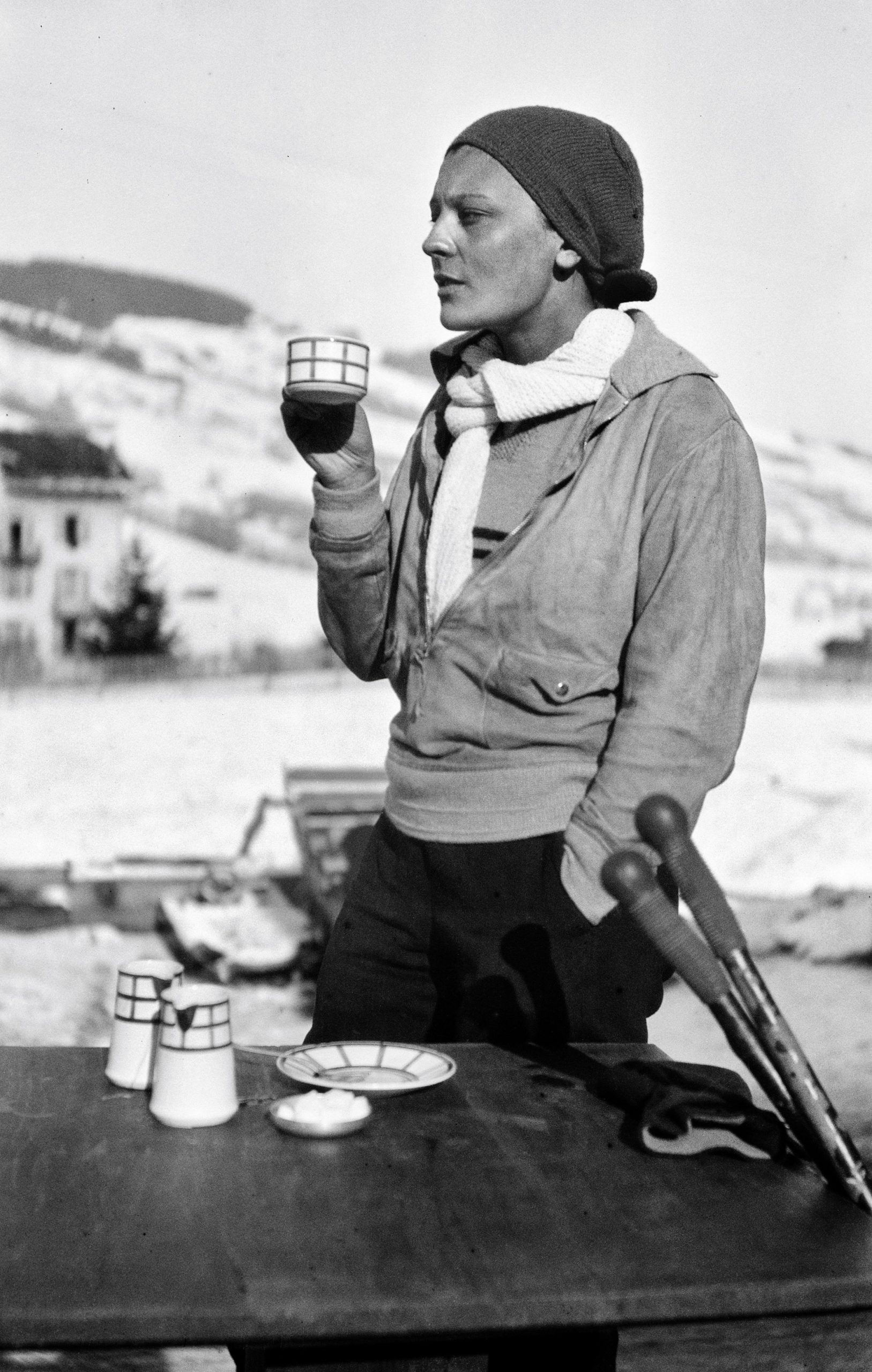
And when you are less self-conscious, elegance sits differently on you. Some people swoon over glamorous photos from the ‘20s, ‘30s, ‘40s and ‘50. I’m no stranger to that feeling either. But give me a photograph of someone in a wooly ski attire, let’s dub them winter style heroes, from a few decades ago and that would spark a ten times fold fascination in me. Skiers wore wool instead of moisture wicket techno fiber jackets and they looked great while doing it. And they looked like, well, individuals. I like celebrating individuals, whose personalities are rooted in authentic values and style, just as I like to celebrate the culture, stories and style that surround sports.

“Style can be so many things, but it’s very personal in the end,” Lisa Bergstrand, the founder of A New Sweden, a brand that makes its products locally only from Swedish wool, told me in our interview – their vision is to take ownership of their products, cradle to cradle, and to make clothes for longevity, both from an aesthetic and quality perspective. And they started with wool because it is a wonder material – naturally antibacterial, water-repellant, that helps regulate the body temperature.
 

Photograph by Jacques Henri Lartigue

 
There is something incredibly enduring whenever sports and style come in play together. And Jean Claude Killy is one who exemplifies that to perfection. The man who dominated Alpine skiing in the mid-to-late ’60s and swept the 1968 Winter Olympics in Grenoble (subsequently dubbed the Killympics) by winning the whole three alpine events, Downhill, Giant Slalom and Slalom, looked the part in form-fitting, geometrical patterned racing woollens, and he took a style rooted in function one step further and paved the terrain for après-ski and day-to-day wear, opting for rollneck cable-knit sweaters, shearling jackets and knitted beanies.
 

Jean Claude Killy. Photograph courtesy of Rolex.

 
In Downhill Racer (1969), one of the best movies about sports, about winning and the mystique of sport, Robert Redford is David Chappellet, member of the US skiing team. “What does winning really mean?” was what Robert Redford, one of the producers and the one who brought director Michael Ritchie and screenwriter James Salter together, wanted the movie to be about. Skiing and winning are all that matter to Chappellet, a character that is presented unidimensional, from the angle of a driven, self-centered professional sportsman, without insisting on any personal drama or feelings. “I’ll be famous, I’ll be a champion”, Chappellet tells his father, that’s all he is interested in, dismissing any interest even in the financial side.

But there is also Redford’s sweater trim silhouette, namely the black pullover with a chest-crossing black and white stripe, that any discerning sportsman, and any man and woman for that matter, should channel today. It’s minimalist, modern, so classically sporty. It was the time of Jean Claude Killy, when the best downhill racers wore sweaters of pure wool. If it was good back then, why wouldn’t it be good today? My grandfather, an active man his entire life who always lived (and could only have lived) in the countryside, where the winters used to be much harsher than they are now, never wore a jacket. His winter outerwear was a thick hand-made woolen pullover, worn with a proper base layer, and a sheep shearling vest on top of it. I believe in family traditions and that rich experiences involve people and nature and not much material stuff, and I also believe in simple, timeless sports traditions. Reclaiming natural fibers should go hand in hand with our newly-refound reconnection with nature, steeped in an elegant practicality.

“It was the ’70s and skiing was the scene. Everyone wanted to be outdoors with each other, bold and beautiful and kissed by the sun. It was like nature was a game. The air got you high, the sky, and there was the feeling of something wondrous and once in a lifetime.” – The God of Skiing, by Peter Kray.
 

Robert Redford in “Downhill Racer”, 1969. Wildwood Enterprises, Paramount Pictures.

Robert Redford and cast on the set of “Downhill Racer”, 1969. Wildwood Enterprises, Paramount Pictures.


MORE STORIES

Production designer François Audouy takes us behind the scenes of Ford v Ferrari

A sporting life: The Snow Chasers

Interview with illustrator Eliza Southwood

Posted by classiq in A sporting life, Photography, Style | Comments Off on A Sporting Life: In Search of Its Lost Elegance

Looking at the World from a Place of Respect, with Photographer Frederique Peckelsen

Western Mongolia, 2018. Photograph by Frederique Peckelsen.

 
The best travel photography is simple, rough and honest.

“I have travelled a good deal, though I don’t really know how to travel,” remarked Henri Cartier Bresson. “I like to take my time about it, leaving between one country and the next an interval in which to digest what I’ve seen. Once I had arrived in a new country, I feel almost like settling down there, so as to live on proper terms with the country. I could never be a globetrotter.”

If not now, then when? Truly wanting to see and live in a place, trying and being present with the people, trying and experiencing their way of life as authentically as possible, trying and understanding their symbiotic relationship with nature, trying and understanding their past, experiencing their present, imagining their future, getting out and looking at the world with curiosity, wonder and respect. You have to move softly and instead of burdening yourself with useless visual recordings, take time, feel the space, observe its people and cut to the very essence of what you see so that what your photograph radiates outward is a whole story in itself.

Frederique Peckelsen’s photography possesses that quiet beauty and vigorous readiness that come from both a sense of respect for its subject matter and from an ever-attentive eye, one that does not intrude but is intuitive and honest about what one sees and feels and lets oneself surprised. In capturing the moment, Frederique’s photography can evoke a whole story, and a whole world with barren skies, but one that will only reveal itself to those who truly want to discover it. With a slow step, an open mind and always looking with a new eye.

In our conversation, I have talked to Frederique about photography, people, nature and what travels means today.
 

Western Mongolia, 2018. Photograph by Frederique Peckelsen.

Western Mongolia, 2018. Photograph by Frederique Peckelsen.

 
Frederique, what do you make of this moment in history when tourism was put on a halt? Will people travel more with purpose?

There are two sides to this story for me. On the one hand, I am very much aware of the fact that travelling by plane to see far off places doesn’t do the environment any good. It saddens me to see how the earth is changing because people can’t have ‘no’ for an answer. We want the things we want, and we feel like we are entitled to do whatever it is we long for. Sometimes you may want something, but you know very well that you shouldn’t do it, because it is irresponsible. I’m not sure if we are able to change this as humans. The powerful we as a race become, the more entitled we feel. As if the earth owes us something. But somewhere deep down, I think we all know it is the other way around – we owe our lives to our planet. Or maybe, it is only the people who live closer to nature, and those who still feel connected to mother earth, who realise that earth will always win in the end and we might not live to see it. I wish I was more optimistic on this topic, but I’m afraid not even this crisis will teach all of us the importance of change.

On the other hand, I also know how much travel can enlighten a person. We can be more open, more tolerant, more understanding and very much inspired by seeing different ways of life. We learn to reflect on our own cultures and the way we act. How lucky or how unfortunate we or others sometimes are. Travel, and the change it evokes as a little spark, can be the beginning of a person doing better. So however contradictory it may be, travel can be both the reason for the planet’s negative climate change, and it can also be the reason for people wanting to change their own ways for the better, which may lead to a better planet in the end.


”I’m not there to judge or disturb.
I always try to build a connection with people
in my photographs, however short that may be.”


Where do you think lies the responsibility of the travel photographer nowadays, as we all know that there is the downside to travel photography of encouraging more and more people to go to the same locations?

I think we are all very much responsible for what we do, and to some extent what we might evoke in others. You can’t always control it, but you have to take your choices and their consequences into consideration. I feel that a travel photographer should take into consideration that whenever they take the time to show a place in all its glory, that others will probably want to follow. There are so many places on earth, but a lot of people seem to want to go to the same places, because those are the places with the most glamorous photos online. But there are so many places that are mind-blowing, but you have to find the path that brings you there yourself. And I think that this is what might keep people away from places less travelled – the fear of figuring it out alone. We know that certain places will be harder to get to. That those places might not have the luxurious hotels, not have the fastest internet – or none at all. I would not want to go to places that are overcrowded, or overpopulated, because it won’t give me that connection to earth I’m looking for. I think there are many overwhelming places on earth, and I do hope that editors and travel photographers all think of places less visited when they choose what to share with the world.
 

Omalo, Georgia, 2016. Photograph by Frederique Peckelsen.


I was reading something Wim Wenders wrote in his book of photographic research for his film Paris Texas. He says: “There’s a distinct kind of satisfaction that you get from looking and travelling alone, and it’s connected with this relation of solitude to photography. […] If you’re not alone you take different photos. I rarely feel the urge to take pictures if I’m not on my own.” I think this also comes from that place of travelling and figuring it out alone that you mention. It’s the difference between travelling and tourism. Travelling forces you to connect with the world. “Tourism is sin and travelling on foot virtue,” Werner Herzog said, a dictum that his friend Bruce Chatwin also liked.

This resonates so much with me. Without wanting to play down the positive effects of the tourism industry, I do agree that there is a big difference between travelling a place and flooding it with tourism. To me, mass tourism seems to turn culture into a profitable and commercialised product, in which culture loses in value. Hotels can, for example, claim land and sea where generations of indigieous fisherman had lived and fished and forbid these people to keep living there. It is a paradox in that way: we go to a place because we are moved by its nature, their people and culture, but by doing so, we destroy little parts of it so that we can comfortably stay amongst them for a short period of time. Mass tourism in this way tramples or artificalises culture. If you truly want to experience a place, a way of life, you have to take the time, and undergo that life without exhausting or claiming a land’s richness of culture. You shouldn’t leave a footprint at least, and have an equal exchange at most. 


”I think it is the place that makes the people.
People are an expression of the landscapes they grew up in.”


You have documented different cultures in your work, yet your photographs never seem to intrude, regardless of how up-close you may capture your subject matter. How difficult is it for you to keep the distance while getting close?

I wouldn’t say I’m shy, but I’m not one that would physically get too close to people, or demand people see me. It is not about me, not even just about them. It’s about the nature they move in and that they are part of. I very much like my own space, so always respect other people’s spaces.

I am just honestly blown away by some place, cultures or people. But always from a place of respect. Never from a superior standpoint, or from a purely voyeuristic standpoint. Maybe it is because it is equal. They find me different and interesting, and I feel the same about them. I always try to read a situation, and while doing that, keeping their culture in mind. Before I go to a certain place I will read up on their history, their religion, symbolism, folk stories and social rules as much as I can, because that gives much more context to a certain place. I love to have my camera with me at all times, but I’m careful with pointing it at someone. Some cultures might not like an outsider just shoving a camera in their face. Or some cultures won’t like it when I, as a woman, will come in and confidently click around. I’m not there to judge or disturb. I always try to build a connection with people in my photographs, however short that may be. Just to know whether it is ok to shortly look at them through my lens.
 

The Valley of the Moon, Wadi Rum desert, Jordan. Photograph by Frederique Peckelsen.


Do people make the place?

Ha! I honestly think it’s the other way around. I think it is the place that makes the people. I know that might not exactly be your question, but I think people are shaped by their environment. And I do not just mean the way their parents raise them, but more how nature is at the start of everything.

People are an expression of their landscape.

You can learn to understand people when you look at the nature around them. I am fascinated by the influence of landscape and environment on people, and how their culture and religion are partly formed from this. People find explanations and solutions in the form of gods, rituals, decorations and clothing that fit the obstacles that life and nature throw up for them. People are an expression of the landscapes they grew up in.

Has there been any place where you have experienced this deep connection, communion, of people with the nature surrounding them, more than anywhere else?

I would say some countries in Central Asia I visited and Iceland. Both parts of the world have weather conditions that can be so harsh, that nature is always in charge. Your plans aren’t set in stone, but nature dictates whether what you wanted to do will happen today, tomorrow, or in half a year. I’m from the Netherlands, where we have battled the sea many times, and ultimately won. We always try to predict the weather, try to dam the water or claim land that belonged to the sea and succeed in it. I thought it was interesting to see how another European country with a somewhat similar culture and history is not trying to go to battle with nature, but just accepts its hardships (and beauties). And of course places like Mongolia and the countries around the Pamir Mountains like Kyrgyzstan and Tajikistan where nomads move whenever the seasons change. Instead of overcoming nature, they live in harmony with it and have learned to read its signs. I do not want to put one way of living above the other, as it is not about good or bad, but it is because I was brought up in one that the other intrigues me.

Your photography does this, it seems to communicate that you are not only observing, but always learning from nature, you are listening to it. Visual poetry: that’s one way I would describe your photography, visual stories with many depths. Do you ever feel the need to explain your photographs?

What a beautiful compliment. As a child, I believed that trees could communicate with each other through the wind, in a language we humans forgot how to speak. So I would listen carefully, and see if I could intuitively relearn their signs. Of course I never really succeeded, but this might be how I still view nature – as a force we can’t quite understand because we don’t speak its language anymore.

So to me it is very important to not only look through my lens, but really sense a place. I am always looking for the invisible magic of the earth. Places that are overwhelming or very quiet and mystical. Only when I sense something, when a place triggers my emotions or when my mind starts to wander off and think about what folktales might have been told here, do I capture a place.

Because of this approach, it is sometimes hard to explain my photographs in a rational manner. So I never really feel the need to explain them, but rather talk about what I felt or how nature behaved whenever people ask about them.
 

Western Mongolia, 2018. Photograph by Frederique Peckelsen.


Website: frederiquepeckelsen.com | Instagram: @frederiquepeckelsen


MORE STORIES

Interview with photographer Christophe Jacrot

Interview with photographer Laura Wilson

Good Storytelling Needs Time: Interview with Photographer Susana Girón

Posted by classiq in Interviews, Photography | | Comments Off on Looking at the World from a Place of Respect, with Photographer Frederique Peckelsen

The Nest: In Conversation with Costume Designer Matthew Price

Carrie Coon and Jude Law in “The Nest”, 2020 | Element Pictures, BBC Films, Elevation Pictures


What remains if people let go of their illusions, or delusions? In one of the best films of last year, Sean Durkin’s The Nest, Jude Law is Rory, a high-risk investment specialist who moves back to his native England from New York with his American wife, Allison (Carrie Coon, in a wonderfully paced performance), and their two children. We are in the 1980s. On the two sides of the Atlantic, Ronald Reagan and Margaret Thatcher are in power and money is king. Obsessed with the idea of ​​erasing his popular origins and using his looks and charisma to conceal the despair underneath and unfulfilled dreams, Rory dreams and breaths speculation, imposing his false ascent and exasperated desire for financial, social, and as ostentatious as possible, success on the rich and his narcissistic needs and bruised ego on his family.

The family is starting to crumble in the chilly and majestic English countryside, unearthing simmering tensions inside the marriage. The dark, unsettling atmosphere creeping in makes you pay attention to things beneath the surface. Allison sees beneath the surface, too. Even before their transatlantic departure, Allison confides in her mother that “something is wrong”. This narrative shift on Allison’s side (as Rory is gradually losing control, fidgeting in all directions, she finds herself seemingly motionless, but in fact in constant process of trying to balance everything that’s happening and she is ultimately the one who could be capable of seeing past the ruin) is one of the elements that make the film stand apart. Allison’s discomfort only grows deeper, nested in the austere mansion where Rory has settled them. In their Gothic confinement (“It’s too big for us,” Allison tells Rory when she first steps foot on the property), it is not the tormented spirit of a previous occupant that looms over. The threat is something very much human, driven by much too human motives, and therefore much more disquieting.

What ensues is a seizing psychological and haunting marital drama that is as cinematically powerful and beautifully tailored as it is bitingly poignant for these times. Because what I particularly appreciated about The Nest and made me completely immerse into it was that director Sean Durkin not only created a film, but created an entire world on film, so elegantly controlled, so skillfully staged with a sense of space and symbolism. In fact, artists of so many crafts wove the threads of the story that came alive on screen, the result of a very close collaboration of co-craftsmen.

In my interview with costume designer Matthew Price, we discuss Carrie Coon’s character and the defining role her clothes have on this journey we are taken on, digging into the subtle, timeless elements of 1980s fashion, the Italian sartorial influence for Jude Law’s Rory, and going to the movies, that unique experience of being individually wrapped in a story that is meant to be shared with others in the dark confinement of the movie theater.
 

Carrie Coon and Jude Law in “The Nest”, 2020 | Element Pictures, BBC Films, Elevation Pictures


For the party scene at Rory’s boss’s house, Allison is wearing a tuxedo. In fact, both Allison and Rory are wearing tuxedos. How did you decide on her costume in this particular sequence?

Sean, Carrie and I had discussed a powerful silhouette for this scene. The other female guests are wearing more conventional 1980s evening dresses in a variety of deeper rich tones. We liked the idea of Allison standing apart somewhat in a monochrome dinner jacket trouser suit. It aligns Allison’s character with the other male figures in the room, sartorially speaking.

The story is set in the 1980s, a decade of excess and power dressing, and yet what I liked about your costume approach is that Carrie’s costumes are very subtle, they have a timeless appeal. What was the inspiration behind Allison’s wardrobe?

One of the first conversations Sean and I had was about how timeless and naturalistic the wardrobes should feel. So I took the subtler parts of the period and dug deep into those elements. Jane Birkin was an inspiration for Allison’s wardrobe. The ability to look effortlessly cool, practical, a bit tomboy yet graceful and when an occasion calls, confidently chic.

This is the perfect definition of the character, because what I thought when I saw her in a tuxedo was that, as it always is the case with women wearing le smoking, it makes her that much more appealing. She looks very attractive, not just because she is, but also because the occasion calls for a certain dress code and she chooses to do it on her own terms.

Exactly. In the same breath, she’s as comfortable mucking out the horses as she is at a more formal event.


”There’s an earthiness and warmth to her wardrobe
that acts as a disparity to other themes in the film.”


A costume designer’s job is to reinforce the story and help the actor form an identity of his/her character. But what exactly goes into the work of a costume designer today? How much ready-made shopping, how much vintage and how much making did the costumes in “The Nest” involve?

It all starts with the scripts and research period which is such an exciting time. Usually when I read a script I’ll go directly to my reference photography books, as a character might remind me of an image or photographer’s work. I’ve always based my process in photography and a certain realism that I’m attracted too. The psychology of clothing has always fascinated me. Why people wear what they do. How they wear it, who are they trying to impress, the list goes on.

As far as The Nest is concerned, the research was again based in old photography. Quite often, archive pictures of real families from the period. This is just the start process though. Then it’s into collaborating with the director, actors, producers and other heads of departments. All of the formal wear for Rory and Allison was made and the rest was a mix of vintage buys and costume house hires here in the UK and Canada. The fitting process can sometimes change the direction from where you started. For this project, we ended up very near the initial costume boards. I wanted to create a large contrast between the lived-in everyday clothing v the crisper formal tailoring.

Do you always have a strong design base and costume boards to keep referring to and to keep the costumes true?

Yes, I like to go back to the boards to make sure it feels authentic. Of course the boards are just a starting point, but I think it’s important to be open and be surprised with discoveries along the way.

Allison is a horse trainer and her casual clothes are, first of all, a reflection of her profession and way of living. But she is also the one who keeps Rory grounded and I think her practical, lived-in clothes show that as well.

Yes, I’d agree with that. There’s an earthiness and warmth to her wardrobe that acts as a disparity to other themes in the film. Ultimately, I wanted Allison to feel real and truthful for her character. Her wardrobe has a chameleon element to it.
 

Jude Law in “The Nest”, 2020 | Element Pictures, BBC Films, Elevation Pictures


For Jude Law’s Rory, on the other hand, clothes are much more important, from a material point of view, because he wants to project a certain image. How did you approach this character?

I’ve always been a fan of the Soho tailor Mark Powell. He’d cut suits for the likes of Ronnie Cray and Bryan Ferry in the 80s, and I love what he made for Paul Bettany in Gangster no 1. I collaborated with Mark in creating Rory’s suits. I wanted a more Italian cut to contrast the Britishness of the office workers. Mark brings a wealth of experience and talent and knew people like Rory from that period. I wanted Rory’s suits to feel nostalgic but have a modern feel. They’re bang on for the period, but could be worn today without batting an eyelid.

Do you believe that costumes not only relate to the characters who wear them, but also to the modern audiences who watch them?

Absolutely, but as long as we’re been honest to the character and storytelling. I think with The Nest there’s a certain timeless feel as we’ve discussed, but I’d hope the clothes feel meaningful and thought-provoking. With the popularity of vintage clothing, there’s now also a market for modern brands to be influenced from shapes within high end tv & film.


”Movies are designed to be seen on the larger screen
for many reasons, that’s their Nest.”


Are the directors usually a big part of the costume process or is it more a conversation about characters and their evolution?

Huge. The best results are always a true collaboration with the director. Sean was very trusting of my approach and nothing went on screen without us both being on the same page. There was a fluidity to working with Sean. Dialogues were always open and we kept discussing ideas, combinations and even changing small things on the day.

Was there anything in particular you felt you needed to insist on because you felt it was important for defining a certain character?

I wouldn’t say insist as such, but I’d always imagined a backless dress for the Allison club scene. Something inspired by the liberation of the 1920s but with an 80s cut. Something strong that showed off-shoulder blades and vertebrae.
 

Carrie Coon in “The Nest”, 2020 | Element Pictures, BBC Films, Elevation Pictures


I found The Nest a very harmonious film, visually speaking. It’s one of those films that have a certain style, a mood, doing a great job at creating a certain world. Photography, costume, production design came together beautifully. How does that work?

It’s felt very much an alliance from the start. When I initially fitted Jude, Matyas Erdely (DOP) had set up his camera just outside the fitting space. So we literally tested looks and colours straight off the bat in camera. James Price (production designer) and Emma Scott (hair/make up designer) were always open and inclusive. I’d say we all had a natural regard for each other’s work and to simply do Sean’s script justice. It was honestly one of the most enjoyable processes I’ve been through. Also a lot of fun with good people! Can’t ask for much more.

The remark above is also a way of saying that I wish I saw The Nest on the big screen. What does the movie theater experience mean to you? Why do movies still need cinemas?

It’s a unique sensory experience. When I first came to study in London, in the mid 90s, I used to get up and go to the morning viewings. It was my favourite part of the day. I think they started around 11am and I’d be by myself and a smattering of others. I’ve never lost that buzz of being immersed in a cinema. I don’t think you can replicate that at home, and I’m sure once things open up, people will still crave that. Movies are designed to be seen on the larger screen for many reasons, that’s their Nest.


MORE STORIES

Bonnie Lee and the leather jacket flying men in Only Angels Have Wings

Interview with photographer Laura Wilson

Jacques Demy in black and white & his quiet heroines

Posted by classiq in Film, Film costume, Interviews | | Comments Off on The Nest: In Conversation with Costume Designer Matthew Price