Born to Run

Born to Run Bruce Springsteen  

“Who were all those strangers buying my music?”

 
I like my favourite musicians’ gods old, grizzled and here, as Bruce Springsteen himself says about himself in his autobiography Born to Run. Not just because I love their music and want to hear and see them play for many years to come, but because I want to read the story of their lives (you know, the kind written after some good decades of living and making music, the kind that takes its own time to be written – Bruce wrote it in the course of seven years). I have liked every musical biography I have read so far. But then again, I haven’t read just about anybody, but about some of the best in music (like this one and this one). And I think part of my fascination with musical autobiographies comes from the fact that their authors are people who have their own voice (and, by that, I don’t mean that they can sing) and their own story to tell, people who have done it all, seen it all, learned a few lessons and lived to tell the story. And because their books, just like their music, reflect experience and the world they come from and live in.

Born to Run bears the hallmarks of having been written by Springsteen’s own hand and I like that. I like the simplicity, the honesty, the talent of describing people, the humour of describing situations. It gets to you. He lays it all out, opening up about his upbringing, his family, anguishes, isolation, hard work, rock musician life without drugs and alcohol (“Music was going to get me as high as I needed to go”), women, depression, wife and family life, fame, rock star ambition, ego, hunger, never-dying dedication, passion and desire to give it all to music and just keep going. What is it that keeps him going? “Friends, that’s the reason we don’t call it ‘working’, it’s called PLAYING! … It’s a life-giving, joyful, sweat-drenched, muscle-aching, voice-blowing, mind-clearing, exhausting, soul-invigorating, cathartic pleasure and privilege every night.”

He may call his work ‘playing’, but he and his band have always taken their fun seriously. At the end of the day and after more than four decades of music, he is still down-to-earth, in check with reality. “Greetings [from Asbury Park, his first album] only sold about twenty-three thousand copies: that was a flop by record company standards but a smash by mine. Who were all those strangers buying my music?”

Bruce Springsteen tells his story not with the aplomb of a rock star, but with the dignity of a hardworking guitar man that he still is. Thank you, Bruce.
 
Bruce Springsteen Born to Run

I loved the story behind the cover photo for the album Born to Run, designed by in-house Columbia art director John Berg, taken by Eric Meola and featuring Bruce and Clarence Clemons. “We used it to invent ourselves, our friendship, our partnership on an epic scale. […] When the cover is closed, the album front is a very charming photo of a young, white, punk rock ‘n’ roller. But when it opens, a band is born and a tall tale begins.”


“The guitar! […] the master key, the sword in the stone, the sacred talisman, the staff of righteousness, the greatest instrument of seduction the teenage world has ever known, the… the… answer to my alienation and sorrow, it was a reason to live, to try to communicate with the other poor souls stuck in the same position I was.”


“The shows were real, always… my friends were real, always… the audience was real, always.”
 

“I was all I had. I had only one talent. I was not a natural genius. I would have to use every ounce of what was in me –
my cunning, my musical skills, my showmanship, my intellect, my heart, my willingness – night after night, to push myself harder, to work with more intensity than the next guy just to survive untended in the world I lived in.”

photos: 1-by me / 2-Eric Meola

Posted by classiq in Books | | Comments Off on Born to Run

Contratiempo

Contratiempo 2016 
“Every story has two sides. The truth, just one.”

A man is accused of the murder of his mistress. He says he didn’t do it. We’ve seen it before. But the atmosphere and the way the plot unfolds in Contratiempo (The Invisible Guest), a 2016 thriller written and directed by Oriol Paulo, is gripping and keeps you tense right up to the end. The man is Adrián Doria (Mario Casas), an important businessman, who has everything to lose. His lawyer hires another attorney, Virginia Goodman (Ana Wagener), who has never lost a case, to help them prepare the defense for the prosecution. She appears at his door at night telling him they have just a few hours to go through the story again in order for her to tightly build her case. They pace, argue, and challenge each other in one room. It’s a clever cat and mouse battle, giving way to a puzzle of a story where truth and lie are interchangeable.

Lately I find myself wanting to talk about films that are everything but American. They usually ARE better. I am sure there are so many we don’t get to watch at all. And whenever I do watch one that I love, I can’t wait to recommend it. To what I have said in the previous paragraph, I want to point out two other things. First, Contratiempo is a beautiful looking film (in the same manner in which Almodóvar’s La piel que habito is beautiful), with a monochromatic, dark colour scheme, in pace with the narrative, contrasting indoor simple, close shots with flyovers of Spanish mountains and forest roadways, as the scenes move fluidly between present day and Doria’s recounting. And the music, I want to talk about the music, composed by Fernando Velázquez. It tells the story in itself. You feel the suspense, the danger, the questions, the doubts through the music. The one downside I can think of is that Bárbara Lennie (as Laura Vidal), Ana Wagener and José Coronado (as Tomás Garrido) outstage Mario Casas in every scene. But it only highlights everything else, that is really, really good about the movie.

photo: film still | Atresmedia Cine, Think Studio, Nostromo Pictures

Posted by classiq in Film | | 1 Comment

Two Actors Who Make A Difference Elsewhere

Films and the actors who bring the characters to life on screen enrich our lives. But some actors, through the work they do outside the film sets, truly change people’s lives. Many actors and actresses have lent their name to one type of humanitarian work or another, and often support a charitable cause close to them, to the point where cynics wonder if they are truly looking out for humanity or mainly looking for publicity. But the two actors I am talking about today leave no doubt in my mind that they are truly set out to pay it forward, each of them having immersed in an issue they believe in.
 
Viggo Mortensen Perceval Press 
In 1999, Viggo Mortensen started his own independent publishing house, Perceval Press – named after one of King Arthur’s Knights of the Round Table – which publishes photography, painting and other arts-related books and CDs. The press, which runs small prints (all the books are published somewhere near Madrid, a city where Mortensen has been living for years), the books being available primarily online, is aiming to cast light on work that might not otherwise be published and present artists’ work, including the actor’s own, in a way that is tailored to the expectations and the vision of the author. Let’s put it this way: it publishes indie books for the sheer love of it. And if this is not work done solely out of passion, then I don’t know what is.
 
Just keep livin foundation  
The just keep livin foundation, started by Matthew McConaughey and his wife, Camila Alves, in 2008, is committed to the health and well-being of youth in the American communities, by providing teenagers with the tools to lead active lives and make healthy choices for a better future. In other words, they provide students with the greatest needs (from public schools serving low-income districts) a safe place to come to after school where they can engage in different activities, exercise and learn about the body and mind connection, how to eat right and cook healthy. These are teenagers who would normally go home after school, where they would be unsupervised, ending up in front of the tv or of the computer, or out in the streets with high juvenile crime. There are only three words I can say to Camila and Matthew’s mission: Alright! Alright! Alright!

photos: 1-Marc Hom for Esquire / 2-just keep livin Foundation (Getty Images)

Posted by classiq in Beauty & Beautiful Living | | Comments Off on Two Actors Who Make A Difference Elsewhere

Romy in Chanel: Boccaccio ’70

Romy Schneider in Chanel Boccaccio 70 
It’s the month of the Cannes Film Festival and, 55 years ago, on May 8th, Boccaccio ’70 was opening the 15th edition of the festival. Modeled on Boccaccio’s “The Decameron”, the four short stories of love and life in 1960’s Italy were directed by four different filmmakers, Mario Monicelli, Federico Fellini, Luchino Visconti and Vittorio de Sica, respectively. Spanning comedy, melodrama and fantasy, the four tales form a sly satire and a sharp portrayal of 1960s Italian society. But the most dramatic and the true highlight is Visconti’s immaculate fable, “Il lavoro” (“The Job”), with Romy Schneider in a great role and the strongest ending overall.

Luchino Visconti arrived in Paris in 1936, at the age of 30. When he met Gabrielle Chanel, he was reportedly taken with her mixture of “feminine beauty, masculine intelligence, and outstanding energy.” Chanel was instrumental in getting him to meet Jean Renoir, who would become Visconti’s mentor, driving him to become a filmmaker. Renoir went on to hire Visconti as an assistant for Toni (1935) and Partie de campagne (1936). Coco Chanel also contributed to two major movies of Renoir’s, La bête humaine (1938) and La règle du jeu (1939).

The couturier’s collaboration with Hollywood may have been a disappointment (the most notable film of the three she did there, at the invitation of Metro Goldwyn Mayer, was Tonight or Never, dressing Gloria Swanson as a prima donna opera singer), but she had a far greater cachet in European cinema, her work involving films of some of the greatest directors on the continent: she made the costumes for Jeanne Moreau in Louis Malle’s Les amants (1958) and in Roger Vadim’s Les liaisons dangereuses (1960) (she had also designed Moreau’s clothes for the Paris opening of Cat on A Hot Tin Roof), Delphine Seyrig in Alain Resnais’ L’Année dernière à Marienbad (1961), Michèle Morgan in Marcel Carné’s Le quai des brumes (1938).
 
Romy Schneider in Chanel Boccaccio 70

Romy Schneider in Chanel Boccaccio 70

Romy Schneider in Chanel Boccaccio 70 
In 1962, after he had become an established director with films such as Ossessione (1943) (a great film noir, one of cinema’s most exceptional debuts, and another debt he owed to Renoir, who, as I was reading on Empireonline, had given him a copy of James M. Cain’s The Postman Always Rings Twice that inspired Visconti’s debut, which has since become acknowledged as the first neo-realist feature), La terra trema (1948), and Rocco e i suoi fratelli (1960), Visconti met Chanel again and asked her to design the costumes for Boccaccio’70, and dress Romy Schneider for the part. The designer did more than that. She reinvented Romy, distilling the essence of the Chanel style and helping her absorb it into her own. Chanel developed a long relationship with Romy, as she had done with other stars of the French cinema, like Jeanne Moreau, Anouk Aimé and Delphine Seyrig. “There are three people who have changed my life: Alain, Visconti, and Coco Chanel,” Romy would say.
 

“When my customers come to me, they like to cross the threshold of some magic place; they feel a satisfaction that is perhaps a trace vulgar but that delights them: they are privileged characters who are incorporated into our legend. For them this is a far greater pleasure than ordering another suit.”

Coco Chanel, 1935

 
In Boccaccio ’70, Romy, the trophy wife of a rich Milanese philanderer (Tomas Milian), decides to earn her own money and look for a job. Chanel’s clothes serve the tale’s morale brilliantly. “These clothes are all wrong! They are too chic for someone looking for work,” says a brocade-suit cladded Romy, impeccably coifed and accessorised. How does it all pan out? Her husband agrees to treat her as a call girl, leaving her cheques after sex.
 
Romy Schneider in Chanel Boccaccio 70

Romy Schneider in Chanel Boccaccio 70

Romy Schneider in Chanel Boccaccio 70 
The legions of admirers who wore Chanel at the couturier’s height of fame were buying into more than just clothes. They emulated the Chanel style. “She had invented that famous Chanel stance that looks as relaxed as a cat and has an impertinent chic; one foot forward, hips forward, shoulders down, one hand in a pocket and the other gesticulating,” wrote Vogue editor Bettina Ballard, as stated in Justine Picardie’s book, Coco Chanel: The Legend and the Life.

Romy Schneider moves around gracefully in her Chanel clothes… and jewels. First in her tweed suit and cap toe pumps, the embodiment of Chanel style. She is lying around, standing one foot and hips forward, moving elegantly and naturally in her suit – Coco Chanel clearly taught her the body language, too, to which a famous photo session of the two at 31 Rue Cambon, from 1962, during a fitting for the film, can fully testify. The suit comes off a little later on, revealing a white négligée and then just a strand of pearls around her neck as she is getting ready to take a bath. Then she gets dressed in the brocade ensemble; she ties the coin belt on her dress, playfully adjusts a characteristic Chanel assortment of jewels and her hair in the mirror. The transformation is complete: she is a femme fatale, a mixture of charm and elegance. The discrete charm of the bourgeoise.
 
Romy Schneider in Chanel Boccaccio 70 

Discover our movie stories shop – inspired by the fascinating world of cinema
and by the never-fading beauty of the tangible

 
photos: screen stills captured by me | Cineriz, Concordia Compagnia Cinematografica, Francinex

Posted by classiq in Film, Film costume | | 1 Comment

Los Angeles as Seen in Movies

Los Angeles as seen in movies Chinatown 1974 
I know what you must be thinking. On what criteria can I possibly choose just five of so many films that are shot or take place in Los Angeles? Therefore, for the films on this list, you have to dig a little deeper. First of all, L.A. has to be a “character” in each of these movies; they couldn’t have been made anywhere else but there. Secondly, I am not the type for romantic comedies or love letters to L.A. Noir is my favourite genre, so even if not all these entries fall in the category of classic noir, they must at least convey a bleak portrayal of Los Angeles, either on the surface or emdebed in the subtext. Whether social reality or crime pictures, they allow a critical depiction of Los Angeles. Thirdly, these films speak through images just as much as they do through dialogue; the cinematography is another character if you may – it’s not just the way the bright, desert light of Los Angeles is filmed in one movie in particular (see first title below), but also about the capture of the City of Angels at dark. And, finally, although it’s not a mandatory factor, it doesn’t hurt if the costumes add to the overall style of these films.
 
Chinatown 1974 
Chinatown (1974) / Director: Roman Polanski / Cinematographer: John Alonzo / Production designer: Richard Sylbert / Costume designer: Anthea Sylbert

“I wanted the style of the period conveyed by a scrupulously accurate reconstruction of decor, costumes, and idiom – not by a deliberate imitation, in 1973, of thirties film techniques.” That’s the sense you get when watching Chinatown: you feel you are in the world of 1930s Los Angeles. Polanski wanted a film that was alive in its time, not a nostalgic period piece. It is a very modern film in its look. Given Polanski’s obsession for period accuracy, there is no wonder that the costumes created by Anthea Sylbert are memorable for their thirties LA authenticity. Faye Dunaway, as Evelyn Mulwray, makes a great role, and the costumes she wears help her tremendously to commit to her character. Faye’s clothes also blend in with the narrative and the warm tones of the film and with that incredible Los Angeles light – John Alonzo’s creative, beautiful cinematography made it look like a classic black and white movie magically transposed to colour. His minimalistic approach had Dunaway shot in close-up just two and a half feet from her face, the exact opposite of traditional Hollywood movie star glamour style.

“In Chinatown, what I was trying to create was this Philip Marlowe atmosphere, which I’d never seen in the movies the way I got it in the books of Dashiell Hammett or Raymond Chandler,” said Polanski. As James Greenberg writes in Roman Polanski: A Retrospective, what Polanski brought “to this quintessentially American material was a European sensibility and an unerring feeling for the darkness of the human soul”. A realistic vision (what American director would have had his leading man wear a bandage over his nose for almost the entire duration of the film?). “If you spend any time in Los Angeles, you can catch glimpses of the paradise compromised by greed, just as Towne (Robert Towne, the screenwriter) did when he first conceived Chinatown,” says Greenberg. Robert Towne had originally conceived of Chinatown as part of a trilogy chronicling the sprawl and exploitation of the LA he remembered from growing up there. Wrapped around the four basic elements of life, Chinatown dealt with a water scam; The Two Jakes, eventually directed by Nicholoson in 1990, continued with fire and earth, in the form of oil; and the never made Gittes vs Gittes was going to be about the air and the advent of no-fault divorce in California.

One other thing Roman Polanski fought for was the tragic ending, which was essential for following the logic of the plot – an ending that takes place in Chinatown, but that also links the story to the metaphorical Chinatown, a place where things go hopelessly wrong, despite one’s best intentions.
 
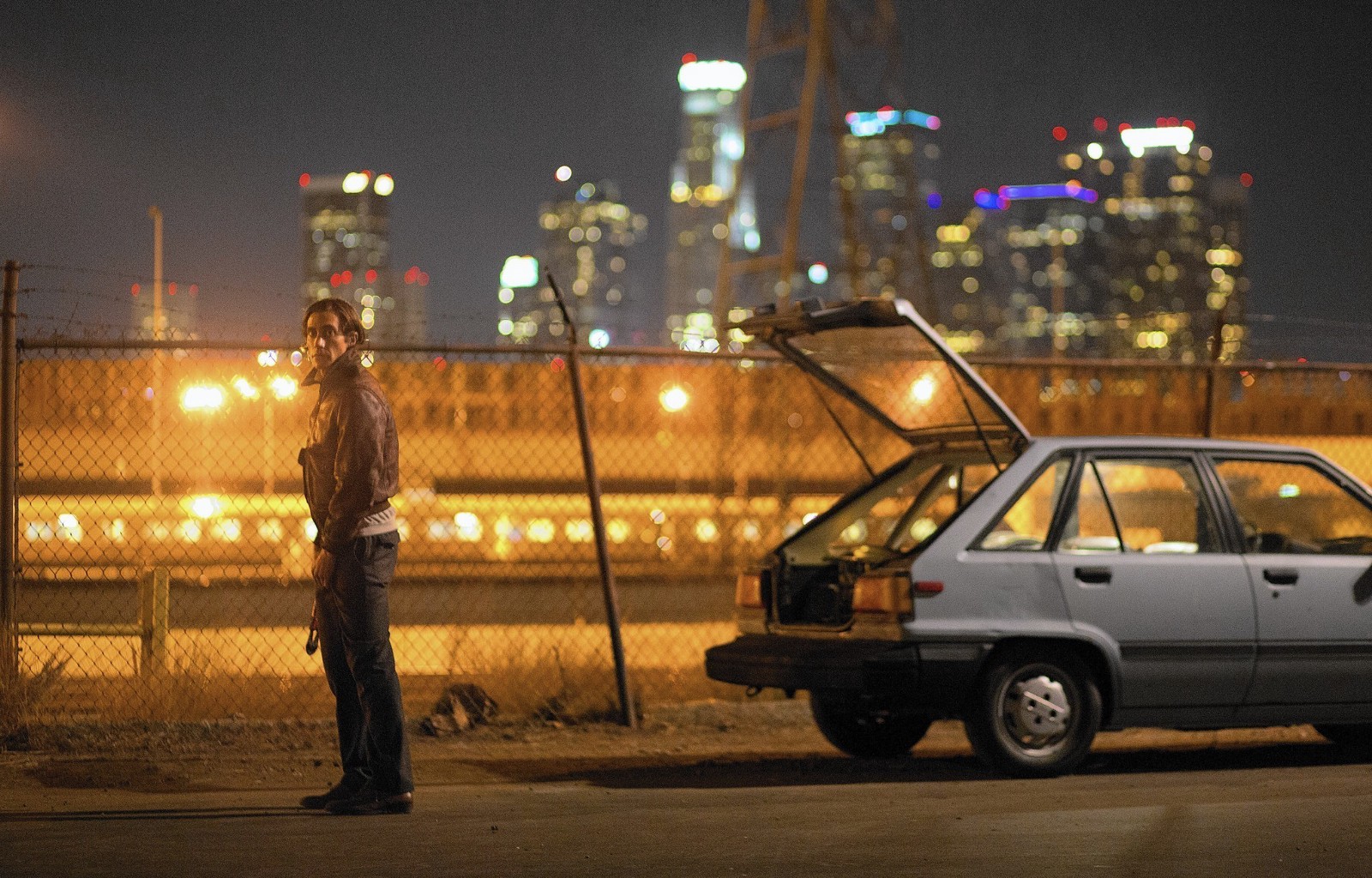
Nightcrawler 
Nightcrawler (2014) / Director: Dan Gilroy / Cinematographer: Robert Elswit / Production designer: Kevin Kavanaugh / Costume designer: Amy Westcott

Nightcrawler is a beautiful, if deeply cynical, portrait of Los Angeles as media capital of the world in constant motion. Jake Gyllenhaal, as Lou Bloom, a freelance cameramen who roams the night looking for crime scenes, the “if it bleeds, it leads” type, to sell to the morning news (the film is a morbid satire of the TV news business), delivers a tremendous depiction of the relentless fame-seeking sociopaths that Los Angeles is famous for attracting and making. Bloom is (and looks – he lost 30 pounds to get into character) hungry for what sells, cunning and corrupting, amoral and ruthless, “the perfect product of our times”, said Gyllenhaal for The Guardian. It is a sharp, creepy, stinging, comic yet cruel character study. “I did not want a character with an arc,” director Dan Gilroy, at his debut feature, told Flavorwire, and that’s something, I believe, that makes for some of the most interesting characters. “I wanted to break as many narrative rules as a could, so there’s no arc, there’s no redemption, there’s no backstory.” It is a stellar work Gilroy elicits from Gyllenhaal.

This is less about the California sunshine, and more about the dark corners and undertones of L.A. at night (although Robert Elswit, the cinematographer, commands both worlds beautifully, as he has also shown in other movies, Magnolia being one of them). It is a great example of how a film evokes a feeling without constantly reminding you that it is not reality that you are watching- Elswit’s nighttime photography communicates the danger and thrill of the protagonist’s work.
 
In A Lonely Place 
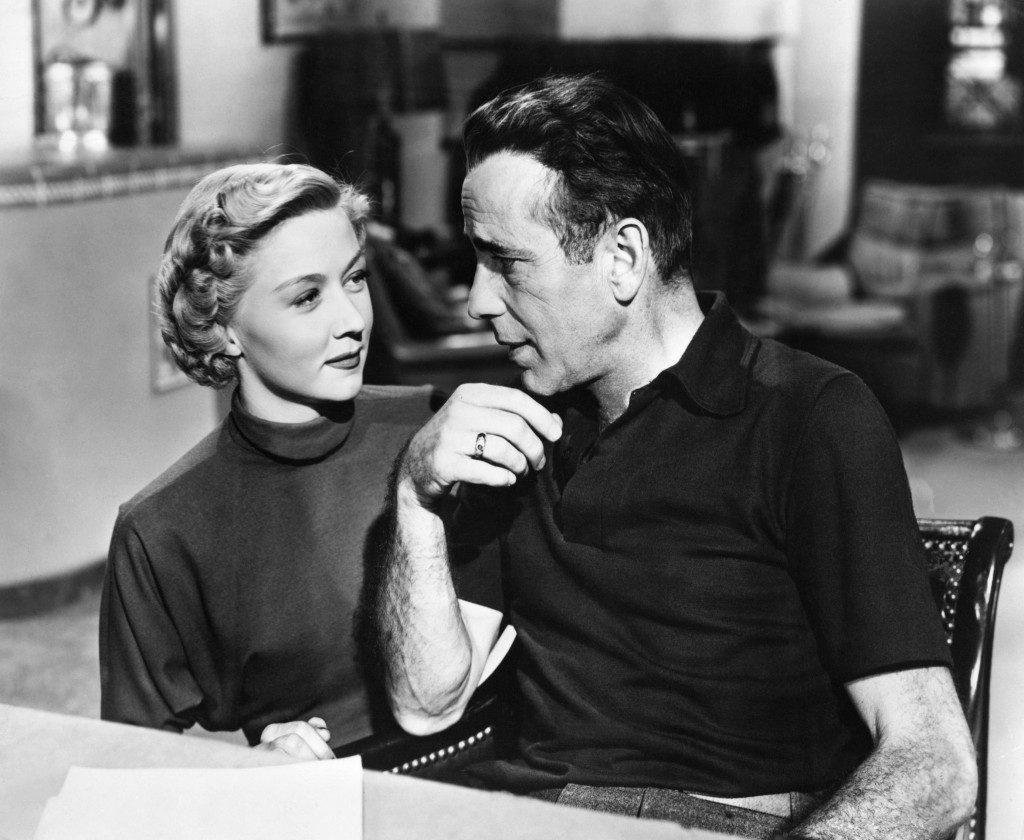
In A Lonely Place (1950) / Director: Nicholas Ray / Cinematographer: Burnett Guffey / Costume designer: Jean Louis (gowns)

In A Lonely Place is a bleak view on Hollywood and what’s happening to people in the movie business backstage. Dixon Steele, Bogart, plays a down-on-his-luck screenwriter with a hot temper. In fact, his multifaceted personality plays out as the movie’s background. You never know what might set Dix on fire. Laurel Gray (Gloria Grahame, in one of her best performances) is his beautiful new neighbour, who bears a bruised past, but who seems to have a great influence on Dixon. “She’s not coy or cute or corny. She’s a good guy, I’m glad she’s on my side,” says Bogart, as he admires Gloria Grahame. Cool and composed, she strides down the courtyard in a straight-lined skirt and turtleneck – simple, stylish, yet revealing a buttoned-up, controlled character. I have always admired the subtle, yet optimum effect of Gloria’s costumes in this film. In fact, every piece of clothing she wears (designed by Jean Louis) is buttoned up, from rollernecks, to even an evening gown and her fur-cuffed robe. But she isn’t in control after all, and whatever hopes and dreams Steele and Laurel might have had, they are crushed too soon and too radically.

An unusual film noir (my favourite), mainly because it focuses on the psychological part of Steele’s character and its impact upon the environment he lives in and on his life as well. Burnett Guffey’s cinematography adds to Nicholas Ray’s vision of what hides behind a Hollywoodian face and his success.
 
Los Angeles as seen in movies Mulholland Drive 
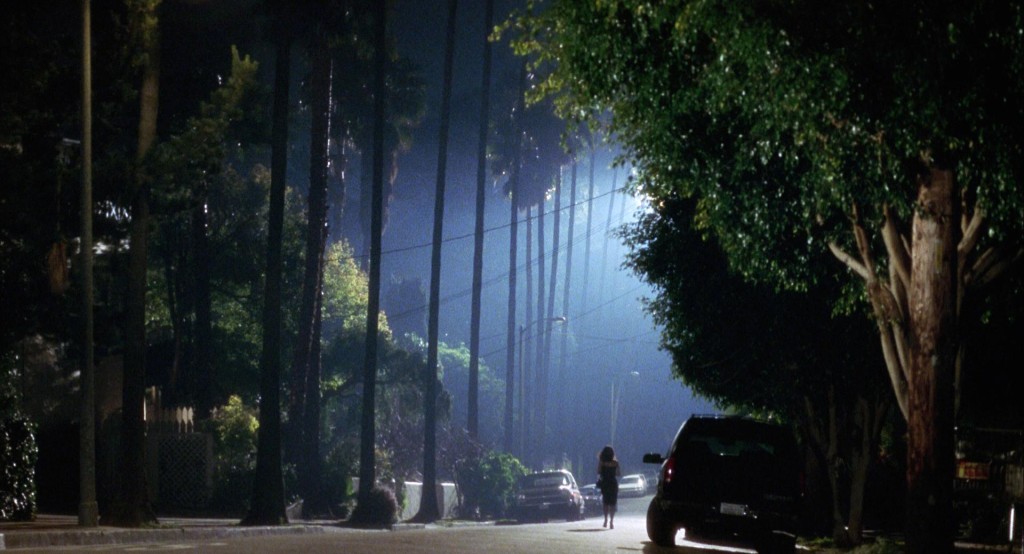
Mulholland Drive (2001) / Director: David Lynch / Cinematography: Peter Deming / Production design: Jack Fisk / Costume designer: Amy Stofsky

The first time I saw Mulholland Drive, it puzzled me. The second time, much more recently, it made me realise that it doesn’t have to be an explanation. Some of the best movies are those which defy explanation and invite introspection, prioritizing questions over answers. What better world to do that than the world of dreams? And what better place to do that than the most notorious for its dream-effects and disillusioned limelight, Hollywood? “Hollywood is where dreams are made.” Because one thing that Mulholland Drive is, under its dream-like surface, is a brilliant commentary on Hollywood’s machinations.
 
LA Confidential 
L.A. Confidential (1997) / Director: Curtis Hanson / Cinematographer: Dante Spinotti / Production design: Jeannine Oppewall / Costume design: Ruth Myers

“L.A. Confidential” is a great film noir, especially so as it is a 1990s movie. It is about the lack of scruples in the urban jungle of Los Angeles, about the equally corruptible individual cop and police department, a crime film in the style of Raymond Chandler and Dashiell Hammett (the same two Polanski took as inspiration for Chinatown). And it has more than that, too, one element being what makes the aforementioned In A Lonely Place stand apart – it deals with the psychology of the characters. It also has a Hollywood fixation, that figures not only in Jack Vincennes (Kevin Spacey as the sergeant with a knack for arresting celebrities that made him a celebrity himself – “It’s some of the best self-loathing I’ve ever seen on screen,” James Ellroy himself, the author of the novel and co-screenwriter, described Spacey’s portrayal), but also in the prostitution ring run by Pierce Patchett (David Strathairn), a pimp who moulds his hookers to look like movie stars. Kim Basinger is Veronica Lake-a-like Lynn Bracken, who lets her blond hair hang down over one side of her face in the peekaboo style of the 1940s screen siren – can anyone question her appeal?

The film has a rich atmosphere and much credit goes to cinematographer Dante Spinotti, who evokes 1950s LA, by night and by day, and further emphasises Ruth Myers’ costumes and Jeannine Oppewall’s production design. But speaking about the costumes, about Basinger’s wardrobe, to be more precise, I have to comment on the fact that, as opposed to Dunaway’s clothes in Chinatown (when we watch her, we see her living in those times), Lynn Bracken’s clothes, although beautiful and glamorous, seem almost too alive in this time, if there is any sense in that; it’s a little too stylised version of the ’50s (when we watch her, we imagine her how she would have lived in those times).

And, just wait, I have to mention Polanski’s film once again. It’s the ending. Because Ellroy isn’t interested in an ending that brings order to chaos either (and I am not talking about the many threads of the film, which are eventually skillfully put together at the end). As a wise movie cop once said, “Forget it, Jake; it’s Chinatown.”
 
photos: 1,2: Paramount Pictures, Penthouse, Long Road Productions / 3-Bold Films, Sierra/Affinity / 4- Santana Puctures, Columbia Pictures / 5-Les Films Alain Sarde, Asymmetrical Productions, Babbo Inc. / 6-Regency Enterprises, Wolper Organization, The Warner Brothers

Posted by classiq in Film | | Comments Off on Los Angeles as Seen in Movies