This film.
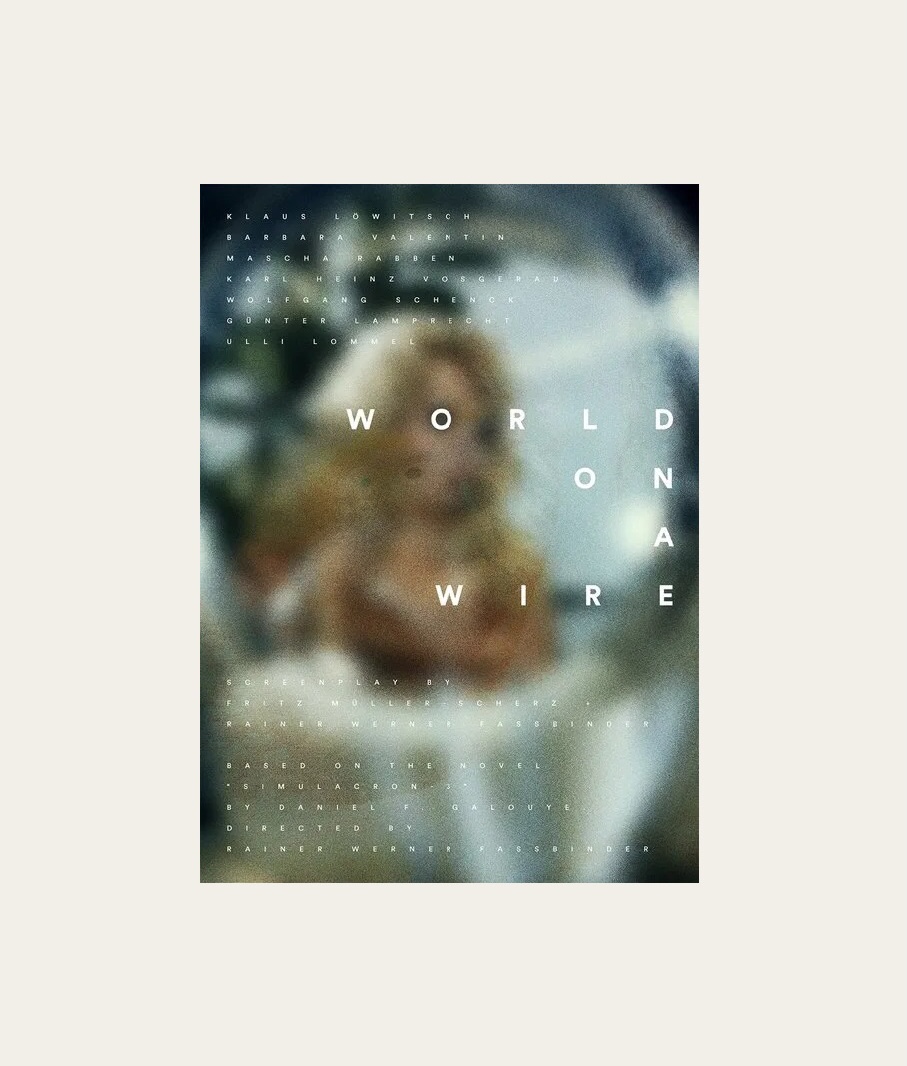
One of those films that fall into the category of “I wish I could say that this film saved the world from itself”: Rainer Werner Fassbinder’s Welt am Draht (World on a Wire), 1973.
What effect can films have on society? What can a filmmaker do for society? Fassbinder was asked these questions in a conversation with Hella Schlumberger, included in the book The Anarchy of the Imagination. Interviews, Essays, Notes: Rainer Werner Fassbinder. “He can do a lot. Entertain. Tell stories in such a way that the moviegoer is entertained and afterwards is no stupider; he can make various things clear to him or make him want to get various things straight for himself, he can express fears. For others. If no one does that, we’d withdraw into the kind of silence in which sooner or later you become a moron. Film can give the moviegoer the courage to continue expressing things, taking position on them, and making it known. I do feel that film as a medium can be effective in all sorts of ways. And it’s always a means of entertainment, and should remain that, too. Like literature, which is also supposed to be fun, or music, quite aside from the effect it can have.”
Films can make the conversation easier to have, I believe, about anything. “I don’t throw bombs, I make films,” Fassbinder once said. Exactly.
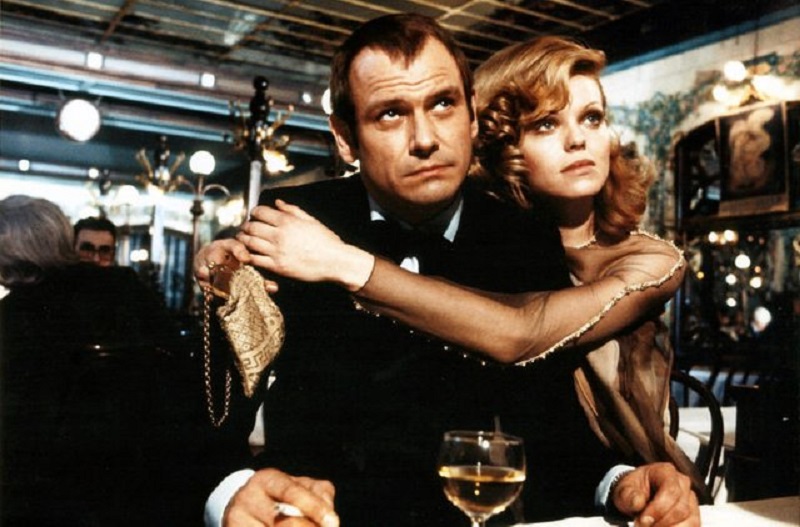
Klaus Löwitsch and Mascha Rabben in “Welt am Draht”, 1973
A glamorous cocktail party, circa the 1970s. The camera slowly glides past men and women jumping into the indoor swimming pool. Others stand at the bar in elegant evening attire. In the background, men with hats, with the air of secret agents, are watching. The camera stops on a good-looking man in a tuxedo. And only when we see him do we realise that something is slightly off with the rest of the party guests. People act strangely rigid, the facial expressions are minimal, their movements seem slightly mechanical, the language somewhat controlled and stiff. The man in the tuxedo is Dr. Fred Stiller (Klaus Löwitsch) and he is the most humane of the people there. He is a scientist. He helped develop the Simulacron computer system, a simulation model of the real world, on the basis of which one hopes to gain information about future economic and political developments, to learn consumer habits decades from now. Since the mysterious death of his predecessor, Vollmer (Adrian Hoven), who shortly before his death spoke of having uncovered a terrible truth, he has been the new head of the Institute for Future Research.
Stiller starts doubting that his world is the real one – does he also perceive what is in fact his imaginary world as if it were the real one? Or is he delusional? 25 years before The Matrix, Rainer Werner Fassbinder made Welt am Draht. What Fassbinder’s film brilliantly does is that it denies the viewer the show elements that are usually present in American sci-fi films. The simulated reality could very well be the present day of the 1970s and the alienation theme is more disquieting than any artificially-looking futuristic setting. And the ones populating this world, whether it’s real or virtual, seem to be mere images of themselves caught in their own contained universe. Is it real? Is it simulated? Half a century later, this sounds frightfully familiar. How frightening is it that we let it happen?
MORE STORIES
“We are taking culture into our own hands”: In conversation with Cinema La Clef
“You only need to assemble, or even easier: distract”
In conversation with collage artist Vesna Vrdoljak
“Feeling the sport through the images”: In conversation with photographer Alexander Aguiar